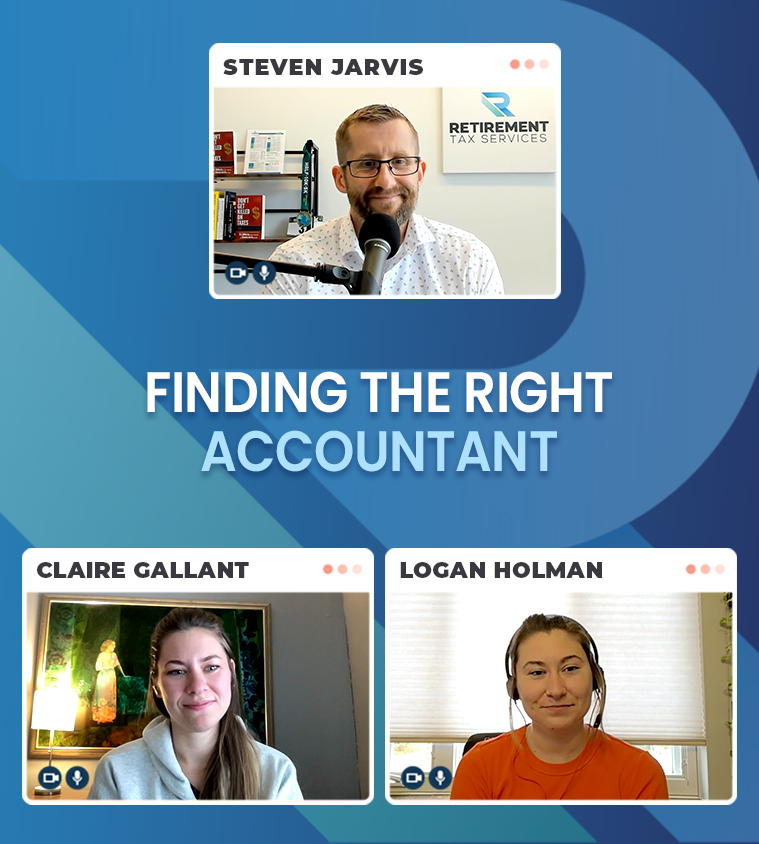
This week, Steven is joined by fellow CPAs Claire Gallant and Logan Holman to talk about the value of the “Simple” things in taxes. Claire and Logan are partners in a tax firm focused on what some may consider “simple” returns and share how they are still delivering massive value for the people they serve. The conversation also covers how to help clients identify when DIY is probably not going to cut it anymore and the value of the tax preparer/financial advisor collaboration. Listen to the end as Claire and Logan share the directory they have created of tax preparers who are actually taking on new clients and how you can take advantage of it.
Steven and his guests share more tax-planning insights in today’s Retirement Tax Services Podcast. Feedback, unusual tax-planning stories, and suggestions for future guests can be sent to advisors@rts.tax.
Are you interested in content that provides you with action steps that you can take to deliver massive tax value to your clients? Then you are going to love our powerful training sessions online. Click on the link below to get started on your journey:
Retirementtaxservices.com/webinars
Thank you for listening.
Steven Jarvis, CPA (00:51)
Hello, everyone, and welcome to the next episode of the Retirement Tax Services Podcast, Financial Services Edition. I am Steven Jarvis, your host and local CPA, joined this week by some peers, some colleagues, Claire Gallant, and Logan Holman of Vivify. Welcome to the show.
Claire Gallant (01:08)
Thank you for having us.
Steven Jarvis, CPA (01:10)
Yeah, so excited that we get to do this. I love when we get like the overlap of the virtual and the real world. We originally met through LinkedIn and had some conversations, and we got to meet in person. I was out in Ohio earlier this year, so always love being able to take those connections in person. But really one of the things we originally connected over is this wonderful world of the overlap of financial planning and tax preparation. Kind of this maybe I mean, maybe we’d all love to not have to pay taxes anymore, but that’s not going to change anytime soon. So I’m gonna give you both a second to give just a little bit of your background so the audience knows kind of where you’re coming from, where you get your credibility from on this topic. So Claire, why don’t you go first?
Claire Gallant (01:45)
Yes, I started my career actually in the wealth advice space. I formerly led a wealth advisory firm that was geared toward the everyday person and then pivoted as soon as I had my second child and asked Logan to come along and start the tax firm with me. So we largely serve clients, we call them the everyday taxpayer and we are looking for kind of like a flat transparent overall fee in our business.
Steven Jarvis, CPA (02:12)
Logan, we know Claire pulled you into this, but what were you doing before Vivify?
Logan Holman (02:17)
Yeah, so I have all I have the very traditional tax CPA background at a college. I’ve always been doing tax preparation, started for like large corporations and then at a regional firm doing privately held businesses, high net worth. And then Claire and I actually met in 2017 through a leadership program in Cincinnati and we just immediately hit it off. And since we were both in the financial industries, she would try to refer clients to me for tax prep and then unfortunately since she was kind of working with more of the mass affluent crowd I had to say you know unfortunately our minimums $3,000 so they don’t really fit so we didn’t really get a good chance to work together collaboratively when we were at separate places. And then I had like a quarter life crisis and quit the CPA firm that I was at to try to decide what I want to do? So then Claire approached me and said, you want to get back into this and you want to start a firm with me. And I totally didn’t know what was going to happen, but now I can’t imagine doing anything else. I’m so glad that Claire pushed me into the entrepreneurial path.
Steven Jarvis, CPA (03:23)
That’s so awesome. Yeah, it’s interesting how everybody’s entrepreneurial journey starts. I probably should do a podcast sometime on how mine started because there definitely was an extreme scavenger hunt involved and I was dressed like Napoleon Dynamite. But that’s a conversation for a different episode. So in the nicest way possible, Claire, you already kind of mentioned it. You said it as working with the everyday person. But I mean, with Vivify, this firm you’ve created, you’re really intentionally working on kind of all of the easiest stuff. If you’re talking to a tax person or even a financial planner, they’re gonna look at the types of returns you do and say, wait a second, every other CPA I talk to only wants to work with the highest net worth, the most complicated, multiple businesses, all these other things, looking to your point where they can charge really high minimums. So like you guys just aren’t interested in making money or like why did you pick this route where you said, you know what, let’s do the easy stuff.
Claire Gallant (04:12)
I think that the original company idea was formed as a wealth advisor when I was looking out in the industry and really couldn’t find CPA homes for the more basic clients, the clients who were W-2 employed or who were in retirement and pulling retirement distributions and investment income, that sort of thing. The genesis of the idea said, okay, I know there’s a problem in the industry where I’m looking around and I cannot find accounting homes for these more basic clients. And I think that as accounting firms try to become more and more complicated in the types of clients that they serve, there might be a way to benefit the industry by adding in whether it’s technology and no code automation, that sort of thing to make that client relationship more efficient and cost effective to serve.
Steven Jarvis, CPA (04:59)
Well, and I’m totally with you just just to be clear and people who’ve been listening to the podcast for a while know that I’m all about doing the simple things consistently over time. Like as much fun as it is to nerd out on some of these complex areas, they apply to such a small percentage of the population that most people need someone who’s just going to help them consistently do these things over time. So that was one of the things that originally got me excited about learning what you guys are doing is, oh, I’m with you. There’s a huge need for this. There’s so many people who either don’t want to do their own taxes, don’t have the really the inclination to learn enough on their own because even with AI, you can’t reasonably expect to do your own tax return without having to lean into learning some of it along the way. And so up until now, there’s been very limited resources for people who do or on that simpler into the scale, but would still like a professional to help them get across the finish line.
Claire Gallant (05:58)
Sometimes people will look at the wealth advice space. I remember what five, 10 years ago when Robo investing became important in the industry and everyone said, wealth advisors are no longer going to be a necessary form or function in the industry. Just go find a new job. And the ultimate answer was that no, people still need a human being to provide them with peace of mind about their financial plan. And I think the same thing applies to the tax industry where you could say, okay, TurboTax is going to come in and take all of our jobs or AI will come in and take all of our jobs or that there’s still space where both exist, where AI can help us do our jobs better and we still provide that humanity, the peace of mind.
Steven Jarvis, CPA (06:33)
Absolutely. Logan, would love to know, as you guys are going through this stuff, mean, I see all sorts of things that, even on the simple end of things, people still really need help with. So what are those most common areas you see where somebody might come in thinking, well, I just have a W2. This is just data entry. Where are you still adding additional value beyond just dropping it into TurboTax?
Logan Holman (06:53)
Yeah, that’s a great question. And I think it’s something that. Even myself, since I was dealing with more complex clients from the first part of my career, I forgot how I just take a health savings account for granted. Everyone understands that. Everyone knows that they need to max out their retirement account. That’s your easiest first tax savings. Definitely health savings account is a major area that we provide value, even just explaining to them, you don’t have to take distributions now, know, invest that, grow it. We see a lot of people struggling once they get to that threshold of doing backdoor Roths when they can’t directly contribute to Roth. You know, if you are using H&R Block or even TurboTax, you know, you get a 1099R that shows, hey, this is a taxable distribution. And if you just type it into the computer the way that you see it, it’s going to show up as taxable. So we’re a lot of times amending prior year returns for that or, yeah, adjusting the IRA basis going forward. Claire, are there any major ones that you think I’m missing?
Claire Gallant (07:59)
No, I think that we could also package that up and say, explaining things in plain English, but also making it easier to collaborate with those people’s wealth advisor and share their tax returns that the tax return can be used in the financial advice and planning also helps with.
Logan Holman (08:15)
So after we do the return and you know I think other firms do this, we record a short loom of delivering the return and you know maybe this person literally only had a W-2 so I’m like what am I gonna explain but I say this is the $88.79. When you sign this you’re giving me authorization to e-file it. This is the line you’re gonna sign. This is what your total tax was, what was withheld, what was paid, and they literally will say Wow I have never looked at my tax return I had no idea and that is just a constant reminder of what we take for granted every day just because we’re in this we understand it. So really just being a friendly resource to people I think is huge and they just feel better knowing that we are looking at it as opposed to trying to do it themselves.
Steven Jarvis, CPA (09:01)
Yeah, mean, taxes is one of the biggest, if not the biggest expense that most of us have during our life and certainly during retirement. And for most of us, we never really had an opportunity to actually have someone explain how this stuff all works. So there’s a lot of anxiety and concern and pain that comes along with this. If there if a taxpayer is not working with someone who will take the time and say, here’s how the tax return works. And I’m with you. It’s I enjoy it. It’s not surprising this point, but I still I love it every time it comes up that a client just expresses that sincere gratitude for something we know is relatively simple. We help them adjust their W four. The W4r has to inadvertently be one of the most complicated tax forms there is. Yeah, it’s yeah. If there’s actually one of my personal campaigns in life to finally convince one of these tax planning softwares, to like set aside all the complicated stuff and just figure out withholding adjustments. Like we could change the industry tomorrow, but that again, that’s that’s a separate tangent. Yeah, I mean, even when I work with taxpayers who have had a financial planner they’ve worked with for years, they’ll still like they get on a call with me and I help them remove an underpayment penalty or I explain how their long term capital gains are actually taxed or I show them the difference between ordinary and qualified dividends. And yeah, their their eyes light up. No one’s ever no one’s ever done this for me before. And so again, when we spend all our time talking to other tax professionals, other financial professionals, it’s really easy to lose sight of the fact that we might talk about this hundreds of times a year, thousands of times a year, but most taxpayers have never talked about it or they talk about it once a year and don’t feel comfortable asking questions. there’s a different experience we can create if we’ll just lean into it a little bit.
t’s definitely one of the things I really, really enjoy about being able to work alongside financial advisors. You’ll have to help me. I don’t remember if that’s actually a required part of what you do, but I know with your backgrounds, you’ve seen that as well, that it’s beneficial for a client to have someone in their life who’s looking out for their overall financial picture because we can talk about, the three of us can talk about taxes for hours, but it is still just one part of the puzzle. And so as much as I like being the tax specialist, I also like being able to redirect the conversation when somebody comes to me and asks what they should be investing in or how some kind of cash management things work. Say, hey, great news. I do the taxes, but let’s get you connected back to your advisor.
Commercial (11:06)
retirementtaxservices.com/OBBBA
Claire Gallant (11:36)
Mm Yeah, absolutely. And I am a CFP as well. But I don’t want it to be confused that I’m providing you with financial advice beyond just your the tax side. So we work with probably just over 100 wealth advisors who have referred in clients to us, but we don’t make it a requirement as part of working with us, partially because we have such a heart for the people that we grew up with, which was to say, kind of that everyday again, the everyday person who probably didn’t have a wealth advisor and even having a tax preparer is probably a big deal for them. But we still want to be able to serve them, and so we don’t make it a requirement to work with a wealth advisor, though I would say most of our clients are and are referred to us by wealth advisors.
Logan Holman (12:21)
I would say I really like being able to, we kind of view ourselves as people’s, like they can get their toes wet with a safe advisor, a safe professional. Like we have an Instagram account. It’s not like we’re getting a ton of business there. It’s not like we’re meeting new financial advisors there, but it’s a way to make us seem more, just like real people. And Steven, we were kind of talking about this before the podcast of how you’re like, I see people and they say, I saw what you posted on LinkedIn, but you know, they never engage. And I always am so happy when someone’s like, Logan, I transferred all my money out of my Venmo account and put it in the bank because of your Instagram video. And it’s like, OK, yeah, you are paying attention to some of the silly things I say. And even if you’re never a client, like just letting them know, like Hey, there’s people who know about money and finance and we’re willing to help you and we’re not going to be intimidating, I think. Like that’s a huge, that’s my favorite part of what we do.
Claire Gallant (13:23)
Logan has no shame. She will dance on Instagram for a like.
Logan Holman (13:28)
Yeah, luckil,y I can’t be embarrassed.
Steven Jarvis, CPA (13:31)
I don’t have shame. just don’t have dance skills. So you probably won’t see that from me. I do like how you said it helps you seem like real people. I there’s still that CPA part of you that’s like, we’re all robots. So I’m with you. get it. Yeah. So one of the things I’d love to get your opinions on, I get questions quite often of how to help clients identify when they should not DIY anymore. Personally, I’m not categorically opposed to DIYing like in life in general or even on taxes. There are people who DIY who I think it’s a great fit for them. Please keep DIYing. But I do also have kind of my list of things where it’s like, hey, if these things are present, like it’s probably time to grow up just a little bit, embrace being an adult and get a tax professional in your life. Where does that, where do you start looking out for, okay, here’s some signs.
Claire Gallant (14:13)
They have kids, speaking as someone who has kids, and it zaps every extra second of my time. I think it’s a smart idea at that point to outsource for a wealth advisor or, sorry, tax advisor.
Logan Holman (14:28)
I would say, I mentioned it before, like once you get to that you can’t directly contribute to a Roth if that’s what you’re trying to do. I think that’s a good point. Definitely also if you’re getting any form of equity compensation that’s a big, and you know, even if you want to work with an advisor for one year and learn from them of like okay what did they do? I know it’s gonna look this, it’s gonna be similar next year so I can kind of copy paste at least what they did but so much of those things you know it’s still coming out on a form and you think that the form is right but you actually have to make adjustments behind the scenes so you really have to understand what’s going on.
Steven Jarvis, CPA (15:08)
Yeah, so many great things in there. Definitely, definitely all on my list. Claire, I don’t specifically include like having kids, but I think really what you’re getting at there is that time factor. And it’s not just, it’s not just the time. A lot of people think about it as, well, I only sit down in front of my computer for 45 minutes and get on TurboTax. It’s like, well, maybe it’s probably more like three hours, but it’s all the time you spent gathering documents. It’s the time you spent stressing about it. It’s all these other things. And so whether it’s having kids or whatever other life event it might be, it’s like, hey, if you just…want some time and stress back, outsource this. Like it’s not really the badge of honor that some people make it out to be to do your own taxes. I’ll be totally honest, at this point I do my own personal return. I don’t do my business returns because business returns aren’t my area of expertise. And so it’s okay to have a tax professional in your life. Logan, you mentioned the back door Roth contributions and equity comp. Those are both very much on my list of what once we get into these other areas that we as tax professionals, know that even despite your best efforts, these are prone to errors. And so you need someone who’s not doing one backdoor Roth contribution a year. You need someone who’s doing dozens or hundreds to know what to be on the lookout for to really help ensure these get done correctly the first time. And equity comps the same way. I’m sure you both have seen this so many times where it seems like the most recent comp, um, culprits are RSUs and non-qualified stock options of it got to report on the W-2 and then the 1099 comes out.
And most of the ones I see early in the package, it’ll show, okay, here’s this gain with zero basis. And if you don’t know what you’re looking for, you’re going to double report the same income. And some custodians will bury it 37 pages deep. Some of them won’t really report it clearly at all. Sometimes it’s in a completely like supplemental tax information that nobody needs to look for. But I’ve done amendments for people who’ve come to work with me where we’re requesting 50 and $60,000 refunds just because they didn’t know look through all the pages.
Logan Holman (17:00)
Yeah, it’s so infuriating. Why does it have to be made so hard?
Steven Jarvis, CPA (17:06)
Yep, no, I’m with you. I’ve had a couple of opportunities to talk to custodians and they like it. It is more complicated on the back end than I would have originally thought, but I don’t give them a free pass. Like I still it’s like you guys need to figure this out. Like there’s so much so much lost tax dollars unnecessary overpaid tax dollars because our tax reporting is just not that great.
Claire Gallant (17:26)
Absolutely. Have you seen the betterment tax forms?So lovely.
Steven Jarvis, CPA (17:29)
One of the people on their team that is focused on the tax area, he’s actually been on the podcast, it’s been a while ago now.
Claire Gallant (17:35)
Dan Egan, maybe? OK.
Steven Jarvis, CPA (17:36)
I don’t remember. I have to go back and look. I’ll have to tag them on LinkedIn or something because I really did appreciate the conversation and they’ve done more than most. Their tax supplement form is better than just about anybody else’s because they pull out. It’s really at least the last one I saw, which would have been, I don’t know, back in March or April this year. It’s really just a handful of things, but they they summarize it so well and they just make it so much easier, especially with like state bonds interest, some foreign income things. There’s a few things that they’ve really led the charge on. Hey, let’s do this different.
Claire Gallant (18:10)
Can we complain about the worst tax form that we’ve ever seen?
Steven Jarvis, CPA (18:14)
Please complain about the worst tag. Let’s see if we all line up on the same one.
Logan Holman (18:18)
We’re gonna start a fight.
Claire Gallant (18:20)
We can start, I don’t care. RBC.
Steven Jarvis, CPA (18:22)
you want to go I thought you were going tax form you’re going custodian.
Claire Gallant (18:27)
Oh no, I’m calling people out by name. Yes, RBC Royal Bank of Canada. Yes, terrible 1099 consolidated.
Logan Holman (18:33)
It just doesn’t, it doesn’t look like any of the other ones. So us trying to like automate or teach people how to read it, it’s just not great.
Steven Jarvis, CPA (18:43)
That’s hilarious. I thought you were going to add to my list of like the W-4, and you’re like 1099R. That’s RBC. Well, there you go.
Logan Holman (18:50)
No, yeah, Claire is naming names.
Steven Jarvis (18:52)
Well, if somebody can get me connected with RBC, find me somebody on their tax reporting team. I’ll gladly have them on the podcast, tell them all the things they’re doing wrong and how they can fix it. I don’t see RBC statements too often, but I can’t contradict you on that. They’re not good. Is that the whole list or are there other people on your list too?
Claire Gallant (19:08)
RBC is bad for just 1099 consolidates and then I would say UBS for equity compensation.
Steven Jarvis, CPA (19:15)
Yeah, yeah, I want to say there’s been some, well, and it all gets conflated now, but there’s some E-Trade Morgan Stanley crossover nonsense out there where it tends to be on like a separate supplemental tax form that clients don’t really even know to be on the lookout for, which goes back to, mean, I’m all for a good gripe session, but calling specific people out of sight, like these are important reminders, whether you work with these specific companies that we’re talking about or not, that most custodians, whether you want to say it’s limitations on data they have access to or just an unwillingness on their end to do something about it. There are these areas where the tax reporting by default is not going to get you to where it needs to be. And especially for financial advisors listening to the podcast, this planning that you do with clients only counts if it’s reported to the IRS correctly. And so if you are just assuming that by default the client’s going to get a 1099 and it’s going to give them all the information they need and they’re going to relay that correctly to their tax preparer, good luck. Most tax preparers are not as proactive as Claire and Logan are that know these things are gonna ask these questions. Unfortunately, most tax preparers are still in a business model where it’s about grinding out as many tax returns as possible, which leaves very little room for asking follow-up questions and taking the time to make sure this gets done correctly. Because I think the dirty little secret that a lot of people outside the tax prep world don’t really realize is that the professional expectation of tax preparers is that we prepare a return that reflects the information that we’re given. And yes, we’re supposed to ask some questions and we’re supposed to apply some professional due diligence and those kinds of things. And some of us absolutely do. But if it comes right down to it and you provided incomplete or inaccurate information to your tax preparer and they prepared a return that reflected that information, it’s not, they’re not the ones that are going to be held liable for it. The IRS is going to come back to you and charge you all the money.
Logan Holman (20:58)
Yeah, something that I always think about is, I mean, lots of CPAs have an organizer, right? The beginning of the tax season, you have to answer these questions. And I’ve heard the complaint before that, well, I’m answering all of these questions, so I might as well just do it in TurboTax, or I might as well just do the return myself. you know, what I say is, do you know why I’m asking all these questions? Because these questions are helping me understand your forms. And Claire and I are really thinking about your whole picture holistically, not just like that one answer. So even if you do have a tax preparer, tax advisor, you’re going to still have to answer questions. But if they’re not asking you questions, that is the problem. You know, it’s definitely that we view it as a partnership. Like, we don’t want clients who are going to be rude to us when we ask questions because, hey, we’re helping you. We’re trying to do this together. And the same token is, you know, sometimes we have to ask financial advisors questions. And it’s really interesting how some financial advisors aren’t as receptive to our questions. You know, even if it’s something that, yeah, of course, we 99 % think that this is what happened, but like your confirmation gives us 100 % confidence. So of course we’re going to do that. Like that is our job. So that’s me on the soapbox. Like we ask questions because we are trying to help our clients and financial advisors should also be fine answering the questions to the CPA because if not something might happen incorrectly on your clients return or their whole financial plan and even if you’re not the CPA you’re their financial advisor like you are gonna bear some of that negative feedback.
Steven Jarvis, CPA (22:42)
Yeah. Yeah, 100%. I really look at it like, it’s kind of like driving a car. You drive a car long enough, you’re eventually going to get pulled over. And when you get pulled over, you want to know that you are taught correctly, that you were coached correctly, that you were doing everything to the best of your ability based on the information you had. And I like to use the driving analogy because there are definitely people out there who look at speed limits as recommendations, ones that they can ignore or just flaunt. But you drive long enough, you be in the tax world long enough, eventually the IRS is going to ask questions. And I’m at the point in my career where because of how we approach the tax work that we do, I’m never scared when I get an IRS letter. I’m not happy. Like, don’t get me wrong. I’m not just like, hooray, another IRS audit. I don’t get scared. I don’t get worried. Like, it’s not going to be fun, but like we’re going to get through it because we take the approach of what we like to call the straight face test, which is we’re only gonna do things on your tax return that we would feel confident sitting down across the desk from an IRS agent with a straight face and explaining what we did. And that’s especially as you move on beyond just I have a W-2, which I don’t know about you guys. I don’t remember the last time I actually met somebody who like truly only had a W-2. That’s just not how the world works very much anymore. But unless you’re really in that super simplistic world, like eventually there’s gonna be something where you’re going to be better off having somebody who does this stuff all the time.
Logan Holman (23:57)
I would say too and as people know, Claire and I are niching down to the everyday simple returns because like freaking tax code is long. We don’t have enough, you know, mental capacity to make sure we’re also really good at real estate or really good at day trading qualifications, whatever. But yeah, we’re trying to get really good at what we are good at. But we also, as Claire mentioned, we know that there’s just a need in the marketplace for other good people that are specializing in something else and we so we have Vivify but we also have Claire’s like genius like automation coding cool stuff and we’re building something called the right accountant where we are literally asking other accountants to add themselves to this because we can’t and don’t want to serve everyone but we want everyone to be able to find the right accountant, so it’s very aptly named So whether you know financial advisors are listening to this and they say okay …Well Claire and Logan you can do nothing for me because everybody I’m with has a rental property like that’s fine if you’re having trouble finding accountants for those type of clients I’m definitely just gonna plug this directory that we’re building
Steven Jarvis, CPA (25:22)
Wow. And I really appreciate bringing that up because this started as just kind of like it was like an air table link that was like a year ago, you guys sent that to me. And I sent that all the time because I’m with you guys. I focus really specifically on who I work with and I wish I could more regularly provide people with good accountants. And so I’ve been given that link to in fact that’s how I found out you guys were pivoting to the right accountant was because I said, hold on a second, my link doesn’t work anymore. Like that was my that was my go to and someone was like, hey, if it’s not you, Steven, I need somebody. And I would tell them, hey, I know a couple of CPAs who are doing a great job putting this directory together. Go ahead and check this out. what I love about it is that you’re specifically having people put, here’s the areas I’m focused on. And yes, I’m taking on clients. Because that’s an endless frustration for taxpayers is, where do I even find somebody who’s taking on new clients? So certainly applaud the work that you’re putting into that. So tell the listeners where they can go find this.
Claire Gallant (26:11)
findtherightaccountant.com. And that website, it’s a directory that is filterable by the accounting specialties or service area. So if you need to find an accountant who, for instance, works with trusts, you can filter by trust and all the accountants who serve that type of client and who are accepting clients are there. You can click into their different profiles and learn more about each of the accountants and how they charge and what their website is. So we hope more people use it. I think the wealth advice space does a really good job of niching and yeah, really defining who they serve. And the accounting industry historically hasn’t had to because there’s too many clients to go around. Everyone can accept everyone and we’re good. But it’s something that I think the industry could benefit from. So we hope more people use the directory, whether they’re wealth advisors or wealth advisors sending it to their clients who need to find an accountant.
Steven Jarvis, CPA (27:02)
So findthereightaccountant.com. And then for anyone listening who has the types of clients that Claire and Logan are talking about specializing in, usevivify.com, right, is your direct website. And you’re still taking on clients for this coming filing season. So just recap for us really quickly what your ideal client looks like.
Logan Holman (27:20)
So it’s almost easier to say who we don’t work with. So we don’t work with people who receive K1s or have rental properties. We don’t work with business owners and we do count side hustles as business owners. So no like schedule C’s. So we’re seeing a lot of W2s, retirement distributions, 1099 brokerage accounts. And we really, I mean it spans the income. Yes, some of our clients make 50 grand, but some of our clients are making millions of dollars, it’s just, you know, it’s still on a W-2. It’s just more digits.
Steven Jarvis, CPA (27:54)
It was mind blowing to me the first time I saw a W-2 with over $2 million on it. Having grown up in public accounting, that completely blew my mind that that could go. Clearly that’s the rare exception, but I think the largest W-2 I’ve ever seen was for $7 million. But again, that’s a whole different thing. So usevivify.com or findtherightaccountant.com. Claire, Logan, anything else that comes to mind before we wrap up here?
Logan Holman (28:19)
I think my thing, I would just say thank you Steven for inviting us. Remember, so we started Vivify over two years ago now and like right away you were one of the people that I followed on LinkedIn. I’m like, my God, this is so cool. And then I remember I was literally sitting at the table I’m at right now and Claire is like, guess who I have a conversation with? I’m like, how. She’s like, Steven Jarvis. We were fangirling and it’s just really cool that now like you’re at a spot where you’re us and also that you’re just open to like being collaborative and sharing opinions and what works for you because I really think that that helps everybody.
Claire Gallant (28:54)
And I think during that entire conversation, I was sweating the entire time because I was so nervous. And then as soon as I clicked off the call, Logan and I and her wife were just screaming and running around the house.
Logan Holman (29:09)
Yeah, yeah. So I said to my wife, you haven’t heard of Steven Jarvis? Like, she does not, she doesn’t know who you are. Yeah, yeah.
Steven Jarvis, CPA (29:15)
Yeah, the joke in our house is that I’m tax famous because it’s only in a very narrow strip of the world. No, you guys are crushing. I’m more than happy to have you here. Appreciate what you’re doing. And really, my philosophy is there’s so much need for this stuff. I’m never going to do it all on my own. And so I love to be able to highlight the great work that everyone else is doing. So Claire, Logan, thank you so much for being here. Appreciate everything that you’re doing. So one last time, usevivify.com to reach out to Claire and Logan directly or findtherightaccountant.com is the directory that they’re building. Highly recommend both of those. And for everyone listening, thanks for being here. And until next time, good luck out there and remember to tip your server, not the IRS.