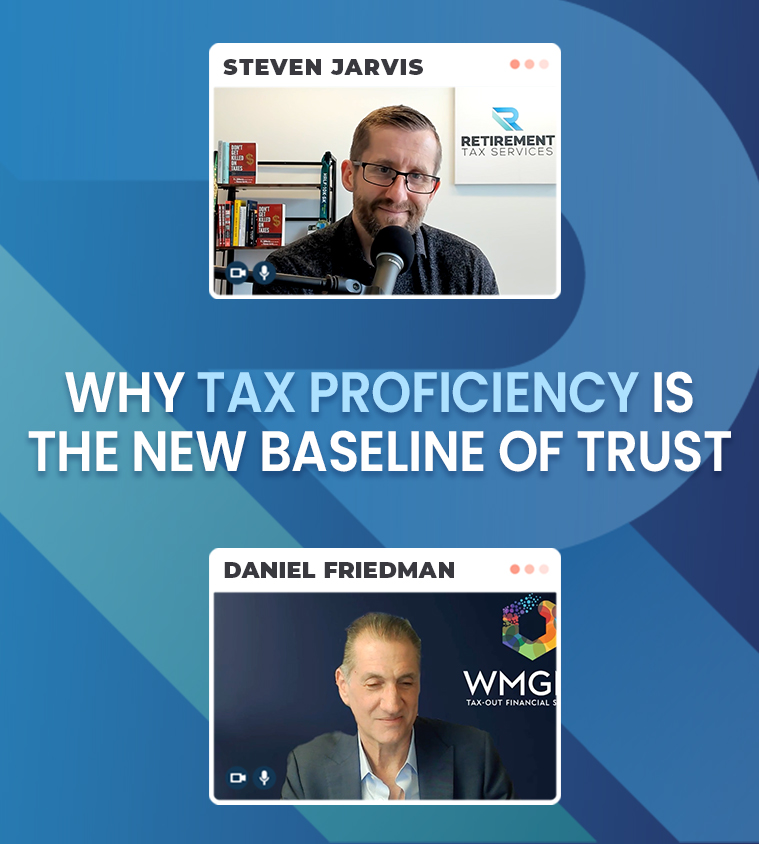
Why Tax Proficiency is the new baseline of trust with Daniel Friedman




Steven is joined this week by Daniel Friedman, a financial advisor who has been leading with taxes for 3 decades. Daniel shares the origin and growth of WMGNA and how leading with taxes has made all the difference. Steven and Daniel discuss why taxes create such a powerful opportunity and why there is still so much room for advisors to get in on the action of providing tax planning for their clients. They also discuss why more and more clients are expecting taxes to be part of the conversation, whether advisors are ready for it or not.
Steven and his guests share more tax-planning insights in today’s Retirement Tax Services Podcast. Feedback, unusual tax-planning stories, and suggestions for future guests can be sent to advisors@rts.tax.
Are you interested in content that provides you with action steps that you can take to deliver massive tax value to your clients? Then you are going to love our powerful training sessions online. Click on the link below to get started on your journey:
Retirementtaxservices.com/webinars
Thank you for listening.
Steven Jarvis, CPA (00:52)
Hello everyone, and welcome to the next episode of the Retirement Tax Services Podcast, Financial Professionals Edition. I’m your host, Steven Jarvis, CPA, and I’m very excited this week to be having a conversation around why tax proficiency is the new baseline of trust when it comes to working with our clients, particularly as financial advisors. And joining me to answer this question is Daniel Friedman, CEO and partner at WMGNA Tax Out Financial Solutions. Daniel, welcome to the show.
Daniel Friedman (01:21)
Great to be here, Steven. Thank you.
Steven Jarvis, CPA (01:25)
Yeah, I really love the framing of this question because it’s certainly a transition that we’re seeing that years ago, it used to be that the handful of financial advisors that really led with tax planning were really kind of out there on their own. It was the exception that clients weren’t really asking for, but these advisors could really set themselves apart by focusing on it. But over the last couple of years in particular, I’m hearing from more and more advisors who have clients and prospects come to them expecting them to be able to speak to some level of expertise on taxes. So before we dive in and kind of explore why this is and how you’re seeing that play out as well, give the audience a little bit of background so they know where you’re coming from and your place of expertise on this.
Daniel Friedman (02:04)
Yes. 30 years ago, Brian Beck and I met each other in a men’s basketball league. We fell in love in a desperate place. We were both working for a general agency, life insurance, financial planning firms in greater Hartford. And we said there’s gotta be a better way to go about serving people. There’s a lot of good things, a lot of bright people. We hooked up with some thought leaders some mentors who said in the financial world, the only thing people need to do is file a tax return. That’s it. You don’t need to contribute to your 401k. IRS will not come knocking, right? You don’t need to do an estate plan. You don’t need to protect your family. You should be doing all of those things. But if you do not file a tax return,you will get a phone call, a visit. So, and everyone needs to do it. We also found out that middle-class millionaires are inundated with investment opportunities and get little to no, especially W-2, our executives at ESPN, Pfizer, Hartford, here, they get no tax planning. They get tax preparation, they get some help with the sourcing in compliance and that’s important. Right, Steven, your tax return, my tax return are many, many, many dozens of pages, if not hundreds of pages. But the tax planning will often happen in the notes on your tax return or anecdotally after the year’s over. Like here’s what to look for next year. And successful CPAs are doing 1200, 1500. They don’t have a ton of time, and you’re not paying them for that. So it was also the time of AOL and getting on the internet for $14.95 a month. So we thought we’d be Netflix before Netflix, almost, not quite. And so we came up with the 10 secrets the IRS doesn’t want you to know. We marketed it on goldenrod paper with a dollar bill attached. We got people to come in. And if we can’t save you at least $5,000, $10,000 in taxes or other expenses, the financial plan is for free. Well, people were doing financial plans for free anyhow. Once we were able to show people how they were overpaying on their taxes, on their auto and homeowners insurance, we had this vast network of strategic professionals, accountants, of course, hey, here’s someone’s tax return. Give us some talking points. Then we would offer, and then on August 14th, 1995, we had the first person sign up for our subscription, which includes your taxes done by our CPA strategic professional.
Daniel Friedman (04:50)
And from that point, we’ve led with a subscription that includes the taxes. So now it’s the sourcing, getting everything together, we take care of it. It’s easy peasy. We’re doing fourth quarter tax approximations now between now and the end of year to see where you’re gonna land so you don’t get hit with the triple whammy where you have to sell iinto a market decline to raise the penalties, interest, or you don’t have the money to come clean at April 15th.
Steven Jarvis, CPA (05:22)
Yeah, that’s always the worst when clients are surprised by a tax bill and don’t have the cash readily available. And I think this is part of the reason why there’s so often toxic relationships between financial advisors and tax preparers who aren’t proactively working together. It’s because if I’m a tax preparer, and unfortunately I’ve been in this situation before, where a client comes to me in February or March and says, here’s my tax documents, I wasn’t even given an opportunity to plan proactively with them to work with them before the end of the year, and I have to let them know, actually, you owe $10,000 in taxes, you owe $30,000 in taxes. And even for people who have the cash available, that is not a pleasant conversation. And after the fact, if in February or March, you’re trying to then quickly justify to a client, well, we made you whole bunch of money, it’s fine, that is not a good experience. And it might only seem like a couple months difference, but having that conversation in December and proactively saying, hey, listen, we worked together this year. It was really positive year. There’s going to be some taxable income. Here’s how the taxes are going to get paid. Let’s high five and celebrate. Then we can high five and celebrate. But if it comes as a surprise in February or March, totally different conversation. I love how you phrased that right at the beginning of the tax returns, the only thing that you have to do when it comes to finances. It’s such a simple way to illustrate why this can be such a powerful opportunity for financial advisors.
Daniel Friedman (06:42)
Yes, yes. And some of the power, and like we talked about why the tax proficiency is the new baseline, you know, the new boss, Sam is the old boss. You instantly get credibility with people when you are able to just look at the first two pages of a 1040.
Okay, you don’t need to know a ton about Schedule Ease. I mean, it’s all good. And 99 % of the stuff you’re going to be dealing with is in a few basic areas, know, tax placement of investments. And so once you’re able to show that proficiency, the rest of the conversation, and when they’re paying you that subscription, that includes the taxes, the investments, the insurance, whatever else that you’re getting. And quite frankly, the financial plan, the tax plan dictates what the family guarantees look like. Do you need a trust? Dictates what the insurance situation looks like. Dictates the investment policy, cash flow, goals and objectives, and taxes. And then maybe some…some risk tolerance, which again, we’ve found that it’s too squishy. know, it’s snowy out here. You know, someone backed into my card, and my Bitcoin is down 40%. Ugh, weitz mere as we say in Brooklyn, enough already.
Steven Jarvis, CPA (08:01)
Daniel, let’s, let’s pull back a couple of layers here. Cause I think, I think you’re highlighting some really important things for people to understand contextually because it can, it could seem a little bit odd to an outsider looking in that we’ve ended up in a situation where financial advisors are being asked so often these tax questions and not, not CPAs, not enrolled agents. And it’s, it’s not the tax preparers aren’t being asked those questions is that, that for the most part as an industry tax preparers are not providing those answers. And so we’re seeing that shift as fewer and fewer people are getting into tax compliance, which means that the volume that the existing tax professionals are doing is going up. And you made a comment in there about how you and your firm charge for that advice. That’s part of how you, the subscription you provide. So you’re getting paid to provide that service. Tax professionals are not, most of their business models are structured around, I did a tax return, I charged you for a tax return and I moved on. And if you come and ask me for planning advice, that just takes away from time I could spend doing compliance, which is how in my brain I get paid. And so as you kind of look at the macro environment around tax compliance work, you can start to see how it’s only natural that taxpayers got sick of not getting answers, not getting resources, not getting support in this critical area. And so they just turned to the other financial professionals in their life and said, hey, I expect you now to give me advice on this. And so…It’s really up to the financial advisor. I mean, there unfortunately are still plenty of financial advisors who still just try to point the finger back at the tax professional and say, go ask your CPA. They’re going to take care of it, which means the client’s not getting any good help. But there’s also people like you, Daniel, who have embraced early and often, hey, wait, we can lead with this. We can really change the client outcome. So I am curious, how did you land on doing this as a subscription model? Where was the impetus for that?
Daniel Friedman (09:44)
We had some pretty creative mentors and the idea was Brian and I were pretty young. I was married at the time and two boys, 16 months apart in a two-bedroom apartment and the monthly subscription, the cash flow, sort of like that AOL getting on the internet. So on the 15th of every month, regardless of what other financial products were sold, we had a steady income. And when people signed up for the subscription, it was a one-stop. We always know how much money we have. We don’t know how much time. And we threw all sorts of stuff. We started this in 95, had been doing it before. So we went through, you know, all sorts of financial stuff. And the first thing we say on investments, if anyone knew where to be and when, we’d be a lot richer and a lot more famous. Though we don’t know where to be and when the plan dictates your investments. The core of the plan. Your biggest expense is usually your taxes, more than your mortgage, total up all your taxes, income taxes, state income taxes here in Connecticut, most of the Northeast, not in Florida, not in a handful of other states. And so that was the subscription. Now it’s ubiquitous. Everyone is comfortable paying a subscription.
Commercial (11:16)
Steven Jarvis, CPA (12:36)
Daniel, I love the transparency and I just appreciate like business owner to business owner like acknowledging that sometimes these things come out of necessity more than any sort of like creative genius. Like sometimes we just need to figure out how to set up our business in a way that we can provide incredible value to our clients because whether it’s subscription or AUM or you’re charging financial planning fees, however you’re charging, you absolutely need to get paid for the work you’re doing so you can keep doing that great work. So I certainly appreciate you being willing to share that background and highlighting in there that taxes are one of the biggest expenses, if not the biggest expense that most of us will have during our lifetime and certainly during retirement. And so if you’re ignoring what’s the largest expense someone’s gonna face, how well do you think their plan’s really gonna turn out? This is something that we really just need to shift our mindset from, hey, it’s a nice add-on, to it really needs to be a core part of any financial planning.
Daniel Friedman (13:28)
Yes, absolutely. I would encourage all my friends in the financial world that a tax return pay stubs something prior to putting money into investments or insurance. you know, we talk about having that. We very rarely have a conversation on and almost all of the money that we manage, which we don’t manage, we use invest net, we believe in technology and there’s a lot of great technology out there to help you with the tax planning. Just like there’s a, the information and technology has leveled the field for folks like us, institutional service for people who aren’t institutions. When you have that tax information, then it goes into the multi-generational. We want to not pay the least amount of taxes now, but over a lifetime. Making forward looking decisions based on current tax law and then maybe over multi generations, right? Step to basis on this. Should you give this? How should you do it? You know, what about the new IRA laws? There’s this giant wealth transfer. I’m the last year of the baby boom. So I don’t know. Maybe I’ll consider definitely not a millennial, but the gen X maybe more is how I identify. And so it all, and they’re like, here, can you just take care of everything? So we also have, you know, a lot of money in the AUM. None of the conversations are ever about the investments or where we think the market are going. It’s like, what does your plans, what does your plan say? You know, someone comes in, they sold their house, they got an inheritance, got $250,000. Going to buy a new car. Okay. Takes, you know, take a third of it and maybe just park it in the bank. Then what else?
Daniel Friedman (15:15)
So where’s it going to go? What do you think? Should it go into, let’s pull up E-money and see what your allocation is. Let’s see what your tax approximation is. Do we need to hold some money behind? Are you going to make that $10,000 check contribution by the end of the year without dipping into your emergency fund to get the Connecticut tax deduction? Or maybe you’re 60 and you can max out the super pre-tax that’s going to go away next year if you make over $145,000. These are all easy things to come about. they just say, okay, you know what? Yeah, I get it. We’ll have the money pulled from your account into your Schwab account, into the you know, into the right Schwab account.
Steven Jarvis, CPA (15:52)
Yeah, if we’re proactively letting clients know that something we want to be involved in, we’re getting that information, it’s doing these simple things consistently over time. It’s not about setting up intentionally defective trusts in the Cayman Islands. It’s doing what might, to other financial professionals, other tax professionals, it might seem like super basic stuff and that’s okay. I’m okay with doing the basic things as long as they’re having an impact for my client. And like you talked about, especially when we take that long-term approach, if all we want to do is get the biggest refund this year, that’s not a game I want to play. Like I want to say, how do we minimize the taxes over the lifetime of the wealth? Not even just over the taxpayer’s lifetime, not even just over the client’s lifetime, because to your point, we might be looking, we want, if we’re to make good tax planning decisions, we have to understand the situation we’re in now, and we have to make our best guess as to the situation when those funds are going to get used. And that could mean the client using them during retirement. It could mean their kids using it. It could mean that a charity that they support is gonna use those funds. We’ve got to understand those final intentions before we can really make great tax plan recommendations. I mean, the one thing that we know for certain about a plan is that it’s wrong as soon as it’s made because none of us can predict the future. And so that’s where doing this consistently over time is gonna create the best outcomes.
Daniel Friedman (17:04)
Yes, absolutely. You know, to your point on complicated, you know, tax planning, our philosophy is simplicity is the ultimate sophistication. And there are tradeoffs on all of these things. And not that there aren’t people with, you know, the intentionally defective grantor trust for Medicaid planning. And we’ve got, you know, our elder care and all that, but almost everything you do is rather straightforward. And if you can find someone to help teach you that, it’s not a giant learning curve. people are, it’s, you know, change is hard. I don’t know what to do. We brought someone over, very, you know, very successful guy at RBC, you know. The big GDC, whatever, you know, whatever that means in that world, and has just been so anxious. Can you help me? Smart guy. Everyone knows him, trusts him. The other thing that you touched upon is that multigenerational. Guess what? I’ve got three sons, 24, 30, and 32. Guess what they have to file also actual return. let’s see, right. So instead of, instead of writing a check to help them with a mortgage, maybe I’d gift shares of appreciated assets. And if they’re subscribers also, and we have a multi-generational family discount, then it goes from one Schwab account to the other. Again, time is the giant thing. And so if you can coordinate all these things, and people are willing to trade, as we say, the subscription is a relatively small amount of your money for a giant amount of our time. It resonates. Some people like, no, the do-it-yourselfers call on the people that are raising their hands. The data is middle-class millionaires are, again, all sorts of new financial products, private equity in your 401k, blah, blah, blah, all this stuff. And I’m not saying that it doesn’t have a place, but they’re not spoken to about their taxes. Everyone hates paying taxes. Everyone’s scared of the IRS. They know that when they talk to their CPA, it’s a fire drill. There’s a certain amount of time. You can’t start the taxes till the W-2s, the 1099s. God forbid that K1 is on extension. can’t do your, right? So maybe we say, you know what, is that, that, can we, how can we minimize K1s maybe? And information and technology has now allowed you to invest in those types of things without a K1. Really? You can do all that for us? And so I think that, and I know that, you know, that we got to wrap soon. When people say wow, guess what? They naturally want to tell other people. And that’s the thing. And so they say, know, geez, I’m getting zonked. I didn’t know I was gonna have these taxes paid. My accountant didn’t tell me. My financial gal didn’t tell me. you know. The coordination of all these things. And then it bleeds into, deductibles on insurance and it just bleeds over into everything. So building up a deep bench of strategic professionals, especially an accountant that embraces this kind of thing. And we’re talking to accountants who are, you know, we’re saying maybe you start to develop a subscription service for your people. The data is that for CPAs, your clients would love to get additional financial services from you because they trust you. The person who’s doing the taxes, especially a CPA, I don’t want to say they’re not above reproach, but they are the most trusted person. would you invest through your CPA if they had an investment advisory division? Yes. And you see it in some of these larger organizations. You see it in family offices and things like that where it’s tax led and they take care of everything. So I think advisors out there, that new currency is tax planning. There’s no doubt about it.
Steven Jarvis, CPA (21:06)
Yeah, totally agree, Daniel. It’s such an area of opportunity. It is an area of opportunity, but it’s becoming an area of expectation as well. Financial advisors are running out of time to ignore this topic. You’ve got to have some level. And Danny, you talked about it. You don’t have to become a CPA yourself, but you’ve got to be able to coordinate. You’ve got to be able to support those relationships. You’ve got to be able to at least give direction. You can’t be ignorant to this stuff, which is part of what we do here at Retirement Tech Services in helping advisors. Learn those things that have resources and references on those. Daniel, before we wrap up, the other question I wanted to ask you, you’ve been doing this for 30 years. What’s changed over that time? Like, what have you learned? How is this different than it was 10 years ago, 20 years ago?
Daniel Friedman (21:45)
Well, again, information technology has really made a significant difference. And that would be one of the giant changes. And now we’re looking at artificial intelligence. Again, if everyone in your business isn’t using artificial intelligence, get them to use it. Get familiar with it. It is a helpful thing. But it’s sort of the same tenants for our business, calling the people that are raising their hand, you first then me, provide actual service. Our true success formula is the same as it was in 1995, great lifestyle plus money multiplied by the time to enjoy it. Money is a means to an end, it’s not an end.
Steven Jarvis, CPA (22:26)
Dan, I really appreciate that perspective. You’re absolutely right. The core of what we do doesn’t have to change over time. The core of what we do doesn’t change with technology. How we execute, and then what I’m hearing there, maybe it’s just because it’s the words I like to use, but what really counts is the actions that we take and that we can help our clients take. As much as it’s important to be able to articulate these concepts in a way that are easier to understand, the proof and the pudding is when people take action. If you want to know whether you did a good job explaining a complex topic, did the client follow through on your recommendation? That is the ultimate way to keep score on this. You can have all the greatest, most eloquent analogies, the prettiest drawings, but if clients aren’t taking action, then you haven’t figured it out quite yet. So Daniel, love the perspective and insight. Thank you for taking the time to share what’s working for you guys. How can people learn more about what you’re doing?
Daniel Friedman (23:13)
WMGNA.com, WMGNA at YouTube. Specific questions? Daniel@WMGNA.com.
Steven Jarvis, CPA 23:23)
I appreciate that, Daniel. And one last time, thank you so much for being here. Certainly very grateful for that and grateful for everyone listening. Thanks for being here and until next time, good luck out there and remember to tip your server, not the IRS.