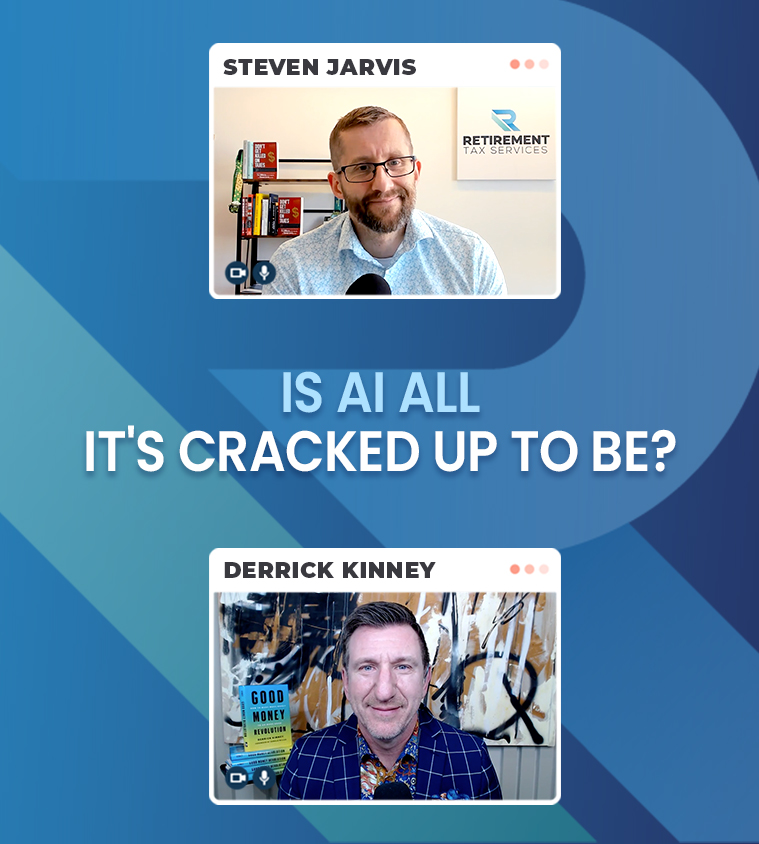
This week, Steven is joined by Derrick Kinney to talk about the opportunity AI creates for advisors, and it might not be what you think. Derrick’s emphasis is on communication, and Steven, as always, is the tax nerd in the room, but they both share their experiences with the importance of creating connections with clients to truly deliver value. Listen in as they share insight into what really delivers value in a client relationship and how AI might accelerate issues that have really been there all along.
Steven and his guests share more tax-planning insights in today’s Retirement Tax Services Podcast. Feedback, unusual tax-planning stories, and suggestions for future guests can be sent to advisors@rts.tax.
Are you interested in content that provides you with action steps that you can take to deliver massive tax value to your clients? Then you are going to love our powerful training sessions online. Click on the link below to get started on your journey:
Retirementtaxservices.com/webinars
Thank you for listening.
Steven Jarvis, CPA (00:49)
Hello everyone, and welcome to the next episode of the retirement tax services podcast, financial professionals edition. I’m your host, Steven Jarvis, CPA, and I am so excited for this week’s episode because my guest, when I asked him what he wanted to talk about, he said, let’s talk about how people who are excited about AI being the answer to everything and how sorely disappointed they might end up being. So Derek Kinney, welcome back to the show.
Derrick Kinney(01:13)
Thank you, Steven. Great to be invited back. Not a lot of people get invited back. This is real honor for me, so I don’t take this lightly.
Steven Jarvis, CPA (01:19)
Well, especially not a lot of people who aren’t related to me. We’ll skip all the nepotism for another day. For long time listeners, they’ll have heard other Jarvai on here. Yeah, Derek, it’s been a couple of years. So some of our newer listeners may not be as familiar with you, but give us just a little bit of background on who you are and what you do. And then we’ll jump a more into this topic of what AI can be good at, but why we probably should be a little cautiously optimistic about it suddenly replacing all of us.
Derrick Kinney(01:42)
Sure, sure. So I’m a former financial advisor and I had a big struggle. I had a problem and that was I kept getting overlooked by high net worth prospects and I was highly frustrated. I wonder why do other advisors have the magic that I don’t? And it occurred to me one day that it was the words I was using that was either connecting me to these prospects or driving them away. And so I decided to sell my practice a couple years ago, to help solve this problem that I struggled with for a lot of other advisors and entrepreneurs around the country. And now I’d like to say I’d to give them what to say and do so high net worth clients choose you.
Steven Jarvis, CPA (02:17)
Yeah, well, and I’ll highlight it for you, Derek, just so it doesn’t get missed in that quick introduction. This might have been a challenge you faced, but you were an advisor, you had a lot of success, you sold your practice. This wasn’t, because every now and we have people who come along who like, you know what? I can’t hack it as an advisor, so let me just go coach people instead. That was not the case for you. You served clients, you said, hey, I’m getting a lot of questions from advisors, so let me lean into this and let’s have some great conversations. that fair to say?
Derrick Kinney(02:39)
Yeah, yeah, so 25 years with Ameriprise Financial, I worked very much like an independent advisor. My mantra was no fee, no me. And I really strongly believed that when people paid you, it assigned their value to you. And therefore, what I charged them was value added to them. So it allowed me to build a top 1 % practice and I’ll talk more about it later, but there was a moment that made me decide to sell it and go on to what I call DARE 2.0, which I haven’t looked back on.
Steven Jarvis, CPA (03:08)
Yeah. Love it. Love it. OK, so let’s circle back to this idea of AI because you’re going to focus more on what you kind of introduced there of, the words we say and how we say things, how we connect with people really matters. And it absolutely does, especially as we look at how we serve people overall. But I’m going to keep weaving back in some tax elements to this. I mean, one, because I’m a CPA and that’s kind of what I do. But I think there’s this similar element with AI where It came along and for so many people it was, geez, AI is going to be the easy answer to taxes. It’s going to be the easy answer to marketing. It’s going be easy answer to communication, whatever easy answer they were looking for. But I, and I’d love your thoughts on this because we didn’t talk about it ahead of time. What I think they were really hoping for was, good, here’s this area that I didn’t want to do the hard work and now I can skip the hard work. And that’s just not the reality at all. AI can help us narrow in and focus on the extra hard part we need to do. But if you’re looking for the tool that skips over the hard part completely, like just give up now. Like that is where value comes from. That’s where differentiation comes from, is you willing to be able to do hard things that other people won’t.
Derrick Kinney(04:06)
Steven, I simply could not agree more. I’d love to disagree with you and launch this major fight on air, but I agree with you. You know, so many people feel like AI is the excuse for them not to have courage. And that is not the case. And I’ll give you an example. I was hosting a podcast at T3, the big Joel Bruckenstein event in Dallas last year. And I was interviewing 22 of the world’s top wealth tech leaders. And all of them, these are the smartest men and women in the room, besides you and I, of course, Stephen, but they’re all telling me they’re gonna save advisors five to 10 hours a week of productivity. Like they’re gonna give them time back. And I think this is so cool, but then I get back home and I get this sick feeling in my stomach. And the reason why is I realized, wait a minute, I think advisors are gonna screw this up because they don’t have a plan of what to do to grow their business those additional five to 10 hours a week. They’re going to be on the golf course, which I can’t fault them for that. They’ll be scrolling TikTok, looking at cat memes, and no ROI is going to come out of this big AI investment. And so what I realized was if you want a business that’s booming, focus on the human. You know, the whole goal here is, you know, think about Coldplay or U2, your favorite band that comes to your town. They’re not arriving on stage and they’re gonna be like sit in the back of the curtain and just play a video of themselves out there thinking that’s gonna have the same impact as if they’re doing a live performance. You know, people like the experience. And so what I would tell people is whether you are an introvert or an extrovert, if you want to make this year better than last year, you need to have a game plan for how you will prospect for high net worth clients. And there’s good news here. It doesn’t require more certification, more education, more classes at all. No, no, no to all of that. You simply need to have a better, clearer understanding of the problems high now worth clients face. And if you can verbalize those problems to them, they’ll say to themselves, oh my gosh, somebody finally gets me and they’ll wanna work with you.
Steven Jarvis, CPA (06:06)
Derrick, I love so much about what you describing there. I want to kind of pull a couple of things out because as you were talking about that, when we think about AI, I think if anything, it’s probably going to accelerate everyone recognizing exactly what you’re talking about because if we, let’s use the tax side this for a second and we’ll come back to the communication side. On the tax side of things, there’s so many advisors super excited about AI tools. And I’m there too, like there’s a lot of like data entry things related to taxes that I would gladly give up. But what we’ve got to recognize is to your point, people are looking for experiences, especially if you want to have a high value service that you are going to charge a high dollar for, you’ve got to provide an experience because we can go back probably 10 plus years, 15 plus years ago. And if someone wanted to, they could have gotten on the internet and found an Excel recreation of the entire 1040 and done their taxes on their own, accurately, effectively, in a quality way, it would have taken them a long time, but they could have done it. The DIY tools have gotten better and better, but the rate of adoption, as far as I know, someone can fact check me on this, but the rate of adoption for DIYers on taxes has gone down, not up. And so as the tools get better, it’s not that suddenly everyone’s leaving professionals behind; they’re realizing that really what they were looking for wasn’t a better tool, they were looking for a better experience, they were looking for somebody who could communicate effectively, who could come alongside them. And so I think this has always been the case, it’s just that when there was this big gap in tools available, people weren’t as aware of it. And now that AI is doing more and more, I think we’re becoming hyper aware that, here’s this piece that I, as the human in the room, that here’s the piece I really need to focus on and level up on, so that I can go and create this better experience, whether it’s on taxes or how I serve or grow my clients in general.
Derrick Kinney (07:41)
So let me ask you this, Steven. How many times do you get a call from a prospect or a client that says, hey Steven, do you have that latest CPA tech stack I just read about in Accounting Today? Do you have that available that you can use on my taxes?
Steven Jarvis, CPA (07:51)
Yeah, maybe 1 % of clients will even ask what tax software we use at all. And I think the only reason they ask is because someone told them they were supposed to.
Derrick Kinney(08:03)
Yeah, yeah. It was like this checklist to ask your CPA. What’s interesting to me is, and I firmly believe this, this might be my hot take, but in the world of AI, what’s going to produce the most ROI is the human touch. In the world of high tech, what matters most is high touch. We kind of revert back, and you think about this culturally, for example. You know, I went to a friend’s birthday party, this was for his son, and they gave him a record player, okay? Now record players in UNI’s day was like, this was yesteryear, but to this generation it was cutting edge. The kid was like, oh my gosh, a record player? It was like brand new. Or I remember like shoes I wore begging my parents to buy them as a sixth grader, and now they’re coming out now and this generation’s like, these are the best shoes ever. And I’m like. Dude, I gave those away at a garage sale for goodness sakes. So what I think the smart advisor recognizes is what is behind the curtain and what’s in front of the curtain. And most AI, I would say, stays behind the curtain. It’s going to run your processes better. It’s going to manage your time better. But ultimately, don’t think AI is going to do better work for you. AI is there to help you become a better version of you. The goal is you need to have more eyeball-to-eyeball contacts. You need to have more human connections, write more personal notes. All of the things that you thought AI would take care of, the more you go old school. Like I’m even telling advisors now, I do this myself, is if you have a summary after a visit, AI probably does the dictation, copy it and mail it to them and write a personal note on it. So when they go to the mailbox, they’ve got the car payment, the house payment, the bills. They are reminded of the value that your advisor just gave you because they were truly listening to your pain points. I just believe right now, old school tactics are going to feel like new tactics to this next generation, but it’s gonna help you stand out.
Steven Jarvis, CPA (10:00)
Yeah, in the world of AI, faster really isn’t different, shinier isn’t different, prettier pictures isn’t different. It’s what’s that piece that’s clear to the end user, to the consumer, that it was actually truly customized. Because we all know that everything’s getting spit through a computer. And I mean, as a consumer myself, I’m not even offended that someone’s going to use AI tools to serve me, but…But I am going to look for, but what’s that piece that was unique to me? Or is there a piece that was unique to me?
Derrick Kinney(10:23)
I was on stage recently at a big advisor event and I brought on stage with me some chocolate, okay? So Steven, I had in this hand a big Hershey bar, in this hand I had Godiva chocolate. And I asked the room, said, if you wanted to buy a gift for the chocolate lover in your family or someone you care about, which chocolate would convey to them that you care about them more? The Hershey’s or the Godiva? And all over the room people said, Godiva, Godiva, Godiva. Well, the Hershey bar is like $7 and the Godiva’s $20. Weight is about the same. And I asked, well, what’s the difference between Godiva and Hershey? Well, the taste is better, the packaging, the perception, it just looks better. And I asked the advisors, I said, straight up, in your local community, would your clients or your prospective clients, the people you desire to work with…Would they say you’re more like the Hershey bar advisor? You’re commoditized, the lowest cost provider? Or are you the Godiva chocolate advisor I’m willing to pay more for because you have a unique set of skills? You’re like the Liam Neeson of financial advisors. And there was a hush that came over the room, Stephen. And I could tell I wanted to hit hard. And I said, your goal if there’s one takeaway today is you want to be Godiva chocolate. And I went on to ask them, said, let’s say that you needed to have a delicate medical procedure done. Let’s say it was your heart. Would you be more inclined to go to the general practitioner who knows a little bit about a lot, or would you want to go to the heart specialist who all they did was hearts 24-7? You go to the heart specialist. And there are three things we know about specialists. First of all, let’s say that today it’s Tuesday at four o’clock. Would you expect to get in first thing Wednesday morning at the specialist office? Yes or no? No. And then depending on your insurances can vary, but would you expect to pay more or less to see the specialist? You’re gonna pay more. And then third, would you go in with the mentality of, know all this stuff myself, I’m gonna do this myself anyway, or would you go in with the expectation, I’m going to listen to every word she tells me and I’m gonna follow her exact advice.
Steven Jarvis, CPA (12:25)
Yeah, there’s an expert in their field I want to learn from them.
Derrick Kinney (12:27)
Exactly. And so the point is when you become the specialist, you see, you might have the best tech stack. You might be the most productive advisor. But if you don’t have a specialty, then you will not get paid what you’re worth and you won’t attract the higher net worth prospects that have the pain point that you have the medicine for. Even if they don’t have the problem you solve, people are naturally, it’s psychologically true, they’re attracted to people when they say, we specialize in. Because it’s almost attraction by exclusion, which is very, very powerful marketing.
Steven Jarvis, CPA (13:03)
So Derrick, then to really dive into this, to help people listening make this actionable, because in the nicest way possible, you’re not the first person who’s told me about specialization before, and I know you know that as well, and part of your ability to help so many people is because you do take this a step further and make it actionable. So make it actionable for the audience. How do we go from, hey, specialization is important, and you articulated that really well. How do you help somebody sit in the discomfort of becoming a specialist for long enough to get to that point? Because even if somebody listening says, you know what, Derrick’s got a point, like there’s not just a button to push in the tomorrow they’re a specialist. how do you help somebody sit in the discomfort long enough to get to the other side? Mm-hmm, yeah.
Derrick Kinney(13:40)
So let me tell you quick story. I’m gonna go back a step here, but let’s say that an advisor listening is at a social event in their local community. They’ve got their favorite beverage in their hand, they’re kind of mingling around the room, and a man approaches them and says, hey, what do you do for a living? And the advisor says, I’m a financial advisor. Okay, the person says, and you then ask the guy, hey, well, what do you do? He says, I’m a personal trainer. I create custom tailored workout and eating plan so people can get into shape. And you have a little bit more dialogue and you continue to mingle around the room. Well, later on in the evening, a woman approaches you and she says, hey, so what do you do for a living? And the advisor says, oh, I’m a financial advisor. She says, oh, okay. And then you ask, what do you do? And she says, you know how so many busy business owners, they always put others’ needs above their own so their health takes a back seat? We design custom tailored workout and eating plans so they can not only feel good, but they can look great and one day they can be the cool grandparent that has the energy to chase their grandkids across the floor. We specialize in personal training for busy professionals. Pause. Now let’s say that one week goes by, Stephen, and you happen to look in the mirror and you say to yourself, I think I need a personal trainer. Which personal trainer would you call? Would you call the man or the woman?
Steven Jarvis, CPA (14:55)
Well, Derek, I’ll take it a step further and say personal experience and from talking to others a week later, I’m not looking in the mirror saying, I need a personal trainer. I’m probably a week later looking in the mirror and saying, man, I wish I could chase my grandkids easier. I love how you’re illustrating this because it’s about identifying the problem in a way that resonates with the person experiencing the problem because… We’ve all we’ve all met a thousand financial advisors. We’ve all met a thousand personal trainers. And no matter how you want to give your elevator elevator pitch about that word, if you lead with the title of financial advisor or personal trainer and don’t make it relatable problems, it’s not memorable. And I’m not going to come across it in my daily life. There aren’t times in my daily life where I think, you know, boy, gee, I really want a personal trainer. But I might come across things where I say, hey, I’m a little short of breath or, you know, going up the stairs was a little bit harder than I wanted it be. I’m having trouble chasing my grandkids. Like those kinds of things. Those are going to be not only more memorable, but they’re going to drive people to want to take action.
Derrick Kinney (15:49)
So true. So I like to say if you want to make it rain, connect with pain. If you want to make it rain, connect with pain. And how do you connect with an instantly relatable problem that someone has? So one thing we’ve discovered is that if you tell someone something new, they don’t always know what to do. But if you tell someone something true, it draws them closer to you. Now let me give you an example of this. There was an advisor that called me in panic about six months ago. His 24 year old next-gen financial advisor was struggling. Not just to attract high net worth prospects, but to attract any prospects at all. Okay, he was beside himself and he said, could you talk to her? So I called her up and I said, tell me what’s happening as you’re talking to prospects. And what she said was fascinating. She said, Derrick, it feels like when I’m talking to prospects, most of them are always older than me, that they’re judging me in their mind. It’s as if they’re thinking to themselves, are you even old enough to drive? And it just crushed her confidence, understandably so. So I said, would you be open to thinking differently? And she was, and so we began to craft some dialogues and practice some scripts based on her uniqueness and how to stand out. And here’s how that played out. So she called me about two weeks later. She was attending a social for high net worth business owners and founders. And so she said, Derek, here’s what happened. About a 55 year old in her mind prospect walked up and asked her, hey, what do do for a living? And she said, you know how so many successful business owners and founders, what keeps them awake at night is the thought of passing their business to their kids and their kids are gonna screw the whole thing up and not know how to manage the money that they’ve worked hard for. We help fix that. So I specialize in working with high net worth clients, helping their kids get ready to take on what those clients have worked hard to build. And by the way, I’m also the youngest person in the firm and they pursued me really hard because I understand technology better than anybody. You would love working with our advisors. That 55-year-old prospect became a client the next week. And here’s what we discovered in that the founder of the firm WellMeaning thought he was hiring the 24 year old next gen to directly prospect higher net worth prospects directly. But instead what we discovered was the pain point many of those founders have is who will take care of my kids and train them to take on what I’ve worked hard to build. And so she began to attract clients indirectly because of helping prepare their kids to take on the money. So we took what was a liability in her mind, crushing her. She was one of the top performers in her firm because of how she changed her words to connect with pain.
Steven Jarvis, CPA (18:36)
And Derrik, just to make sure I heard you correctly, is like you worked through that with her. You had her, you said you scripted that and you had her practice that. There was role playing going on before she ever got to that event. Yeah.
Derrick Kinney (18:44)
That’s exactly right. And what we learned was, you know, people call me the client conversation guy. But what I realize is, just like Steven, I can’t say to you, okay, just say this, here’s the magic words. When I work with clients and advisors and entrepreneurs, the goal is I do what I call a five and five exercise, okay? I ask each advisor to say, give me your past five clients. Let’s go over their names and tell me about them. What was the problem they came to you to help them solve? And then second, tell me as best as you can, what was the emotion they were feeling when they came to you? Were they frustrated, angry, upset, disorganized, whatever it is? And now what is the emotion they’re feeling now that they’re working with you? Are they confident, relieved, optimistic, whatever that may be. And then we look at your five favorite clients. These are the people who you smile when you see their name on your calendar. They take your advice, they pay you well. You might even have coffee with them outside the office. Same exercise. Problem they came in to help you solve, have you solve for them, the emotion they felt pre-you, and the emotion they have now working with you. And so the goal is, I call this your focus group. There’s no fancy marketing and a research and development. You’re simply asking, what are my current clients telling me who I work with? And so what we then take is that information, and I call this my you know how statement, your you know how statement. When you start off, instead of saying I’m a financial advisor, I’m an accountant, I’m an entrepreneur, people’s eyes glaze over, they start to walk backwards, they clutch their purse or their wallet, they might murmur under their breath, I have enough insurance already, it just gets ugly fast, you you’ve seen this. And that was my problem as a young advisor, I’m like, I’m tired of being overlooked by saying financial advisor. So when I began to say, you know how so many people worry about running out of money in retirement, as I slightly nod my head? We help fix that. Through our five step custom tailored financial planning process, we craft a financial plan so they won’t run out of money, and they can finally feel confident. We specialize in retirement income planning, period. Now that’s what worked for me. See, that’s who I attracted as an advisor. But in any of those words, Steven, did I say the words financial advisor? Did I say wealth advisor? Did I say dream funder? Was there any money comment at all? So, and two examples I would give you would be if I were to say to you, Steven, you know how it feels like when you take your car to the mechanic, it often feels like you’re getting taken advantage of or overcharged?
Steven Jarvis, CPA (21:10)
My brother-in-law is a mechanic, so not the best example for me, but I’m sure everyone can relate.
Derrick Kinney (21:14)
Okay, okay, so hopefully everybody has a family member who’s more trustworthy than most mechanics. But let’s say now we’ve got two moms of teenage daughters, both talking, and one mom says to the other mom, you know how it feels like when you talk to your daughter, what you say goes in one ear and right out the other? The other mom will say, yes. And so the point of all of this is we’re thinking about how do we communicate on a third grade level? You want to say something to the person that they already know to be true. You’re telling them nothing new, but it makes them say to themselves, my gosh, just like that 55 year old founder said to the 24 year old next gen advisor, she understands my pain. She gets what keeps me awake at night.
Steven Jarvis, CPA (21:53)
Yeah. Derrick, I love the framework and how you’re laying that out there. And then, I mean, the piece that keeps coming back for me is the intentionality behind this. This isn’t something you’re just going to stumble upon. This isn’t something you just stumbled upon. This is something you worked on and crafted and figured out what worked for you and then help other people figure out what works for them. But I mean, we started this conversation talking about AI and how people who think that AI will be the solution to everything are likely to be sorely disappointed and I definitely agree with that and I don’t see that change anytime soon. As we wrap up this conversation, we give people a chance to learn about how they can learn more about what you’re doing. I know certainly one of my takeaways from this and certainly a takeaway I would recommend to everyone listening is that regardless of the topic, you being willing to put the work in, the uncomfortable work, in this case, being willing to look in a mirror and have these conversations with yourself over and over and over again. So you’re saying these words and getting comfortable with them. Working with someone like Derrick or a peer or someone else that you know and trust and aspire to be to say, okay, what are those words that I can change? Let me tell you what I currently say and tell me how that reacts or resonates. Doing that uncomfortable work is what will set you apart, whether that’s in prospecting, whether it’s in tax planning, whether it’s in your personal relationships in your life. Those are those are game changers for how you’re able to have an impact on the people who are in your life. So Derek, before we wrap up here, because I certainly appreciate your time. How can people learn more about what you’re doing or getting in contact with you?
Derrick Kinney (23:06)
Well, one of the easiest ways is to just follow the cheat code I give on LinkedIn every day. It’s funny because I got a DM from an advisor about three months ago that said, Derek, I picked up my largest client ever, a $7 million account, just by reading one of your posts and following what you said to say to his neighbor of all things who became a client. So LinkedIn is really good content that comes from one advisor to another advisor so I understand the shoes you’re in right now. And then also our website is successforadvisors.com. And I like to think I get told this, our newsletter is one of the most practical money-making newsletters for advisors and entrepreneurs. You can subscribe to that totally free. But the goal is if you don’t pick up a new client after reading it, I’ve really done you a disservice.
Steven Jarvis, CPA (23:50)
Really appreciate that, Derrickk. So for everyone listening, that’s Derek Kenney on LinkedIn or successforadvisors.com. And until next time, thanks for being here and good luck out there. Remember to tip your server, not the IRS.