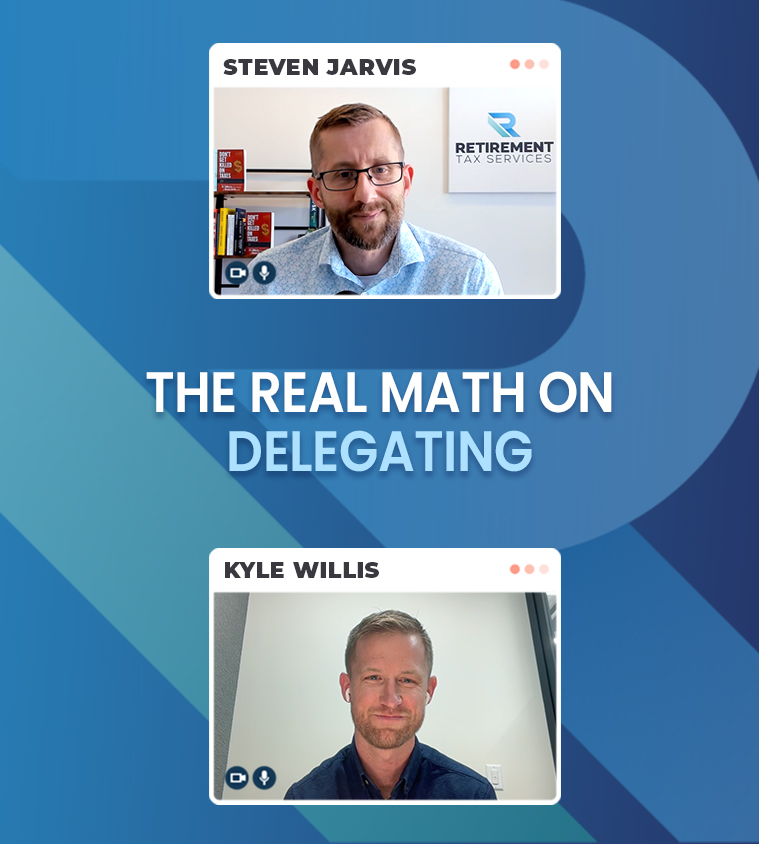
Steven is joined this week by Kyle Willis, VP of Growth at BELAY, as they discuss the power of delegating in their own lives and the value an EA can bring to a team. Steven, of course, draws plenty of parallels to tax planning and how delegation can help in that process, but Kyle joins in to give us yet another reminder of some of the things that are, in fact, more important than taxes. Listen in as they share best practices and pitfalls to avoid when it comes to delegation and leveling up in 2026
Steven and his guests share more tax-planning insights in today’s Retirement Tax Services Podcast. Feedback, unusual tax-planning stories, and suggestions for future guests can be sent to advisors@rts.tax.
Are you interested in content that provides you with action steps that you can take to deliver massive tax value to your clients? Then you are going to love our powerful training sessions online. Click on the link below to get started on your journey:
Retirementtaxservices.com/webinars
Thank you for listening.
Steven Jarvis, CPA (00:49)
Hello, everyone, and welcome to the next episode of the Retirement Tax Services Podcast, Financial Professionals Edition. I’m your host, Steven Jarvis, CPA. And as we continue to kick off 2026, I’m really excited to have another guest on the podcast from our great friends at Belay, Kyle Willis, who is the VP of Growth, is joining me this week to talk about how we can continue to use delegation to level up the things we’re doing, including things like tax planning. So, Kyle, welcome to the show.
Kyle Willis (01:16)
Thanks Steven. I am so excited to be here.
Steven Jarvis, CPA (01:19)
Well, Kyle, I always get excited for this topic because honestly, it makes me think a lot about taxes because it is a topic that always keeps coming back around for people who’ve been listening to the show for a long time. You’ll be very familiar with Belay. I’ve had several of your teammates on the podcast talking about different elements of delegation because I know in my own life and as I work with advisors across the industry, this is a topic where there’s always room for improvement and I’m always learning new ways I can use delegation. I can use
my executive assistant, my team members to level up what I’m doing in different areas of my company and how I serve my clients. So I just always, always love these conversations. So Kyle, give us just a little bit of your background and role with Belay, and then maybe one of your favorite things you’ve ever delegated personally.
Kyle Willis (02:00)
Love it. Awesome. Well, new year awesome time to be thinking about talking about delegation. You know, what can we what are some new things some new ideas that we have as we enter into the new world? Looking forward to sharing some of those my role here at Belay is the VP of growth is really to tell everyone about our executive assistant services that we have. So that is the main role that I am doing I want to be able to provide some education awareness around what does it look like to delegate for some people? And many of those that are listening today, it’s like, what is the very next step that you can take? Right. And that might be one thing that you can implement yourself. That might be a new tool that you can use, you know, all the way up to, Hey, what does life look like if you actually do take on an executive assistant? What does it look like to work together in the first week? What does it look like in the first 30, 60, 90 days? What should you expect a year down the road? And, know, how do we continue to build that up? So I know that that’s a lot of things that we can, can really start talking about today, and just like seeing it as a journey, right. Of, Hey, if I really want to commit to this and find a great partner that can really help me lean into my superpowers, which we can talk about some more of that today. I really love talking about people’s superpowers and what those are, so they can delegate the rest. Then I think that actually really sets up business leaders to really build the life and the work that they want and really build their organization. I think your second question was around something that I really like to delegate. I’ll tell you, whether it’s a report, spreadsheet, analytics,
in the role that I use, we are taking a look at that a lot. And what has been so beneficial to me as, you know, I have an executive assistant, Brianna, who’s phenomenal. And what I have loved to be able to delegate to her is anything in that space, right? And what started out was, hey, I’m gonna start building out this report or this, you know, group of data analytics in a way that I wanna see it. I would almost try to do phase one, right? And kind of like show her, here’s what I think I want it to be. At this point, which is great, and we’ve been working together a year now.
Kyle Willis (03:56)
I really am able to either just send her an audio note or send her a message and say, Hey, here’s what I’m thinking. Here’s what I would like to see. Here’s a little bit of the why behind, know, why this data is important and what I’m hoping to do with it. And then get to see her use her own creative juices and just natural skillsets and abilities that she has to be able to take off and run with that. And then I get to see this end product that comes back and I’m like, more times than not, I’m like, that’s way better than I, than I could have even instructed you step by step on the front end.
Steven Jarvis, CPA (04:22)
Well, Kyle, I appreciate you sharing that because that’s one of my favorite things about learning from other people, just hearing what what’s possible. Other people are seeing success. And you mentioned people’s superpowers, which is a great topic around delegation, because, you know, at the summit last year, we focused a lot on the three things that every financial adviser, really the only three things that every financial adviser should be doing, which is growing their practice, meeting with clients and vision casting or business planning and anything that falls out of that. So your superpowers really as a financial advisor should somehow add value in those areas and you should be looking for the other places that aren’t contributing to those where you can delegate. And I’ve found that one of the best ways to make that a reality is to hear from other people, whether it’s people like Kyle who is also a business leader or other peers come to the things like the summit, but hearing, these are things that people are handing off. And…
Some of things that I’ve really enjoyed delegating and things I’ve struggled to delegate, one that comes to mind that has certainly been a lot of fun for me is I’m a terrible artist. It’s just awful. It doesn’t surprise anyone that I went into numbers when they see how I draw, but I do a lot of presenting. I have a lot of slide decks. so when someone, again, this is I learned from someone else, but when someone showed me like, rather than Steven, you try to create and mess around in PowerPoint or do something beautifully artistic, pretend like you’re playing Pictionary. And so anytime I do a slide deck, I literally get out like blank printer sheets of paper and I draw across on it. So I have four squares and then I doodle. And it is the way if you saw pictures of these, you would be shocked that anybody could take this and do something meaningful with it. But it allows me I’m good with, hey, what should the message be? What should the stories be? What should the call to action be? And so I get to draw this out and hand it to somebody and then it turns into this incredible thing.
Steven Jarvis, CPA (06:03)
And so being willing to, you mentioned it being a journey, being willing to figure out exactly how that works, because it took some refining, has allowed me to do presentations more often and to do them more impactfully. So that’s one of the things that comes to mind for me. it is, it’s so powerful to learn from other people’s stories as we go through this.
Kyle Willis (06:22)
I love that and speaking to a bunch of financial advisors today, I’m the same way. I’m built very relationally. Presentations is something that I do often as well. I know in this world, that’s something that you’re always going to be doing. Even the example that I gave around the data and reports and how do we visualize that, I would love to be hands off of that and then just get to show up and be able to deliver the message to the person or the group of people that I’m doing. That really gives me life and allows me to show up with more energy towards that presentation, towards whatever it is that we’re showing up because that’s where I get filled up and that’s where I really feel like my superpower is, is to lean into that relationally. And so, you know, I think the other side of that is if you get so lost in the weeds of creating a presentation, you’re internally frustrated because you’re like, this just isn’t naturally my skill set or what I like to do. It doesn’t even really look the way that I want it to. Now you’re showing up in a very different place for that presentation, which is actually what you pay yourself to do or get paid to do is to show up really well in front of those people. So I think it’s, that’s a kind of a soft cost there, right? Of like, what is the cost of the work that we’re putting hours and our attention to that takes away from that superpower or what we really are leaning into that is a gifting of ours and something that we feel like we really enjoy doing and get to do and get paid for.
Steven Jarvis, CPA (07:41)
Kyle, I really like that insight that it’s not, delegation’s not just about the time it saves you, but it’s the energy and attention that if you are spending your time on a task that could be delegated, that it’s taking away from, again, not just your time, but your energy that you can put into those higher value things. Because, mean, if tie this back to tax planning for a minute, it’s. It’s very, very rare. It does happen on occasion and I usually just write these people off, but it’s very rare that someone tries to argue with me that there isn’t value in tax planning, that financial advisors should not be in some way involved in the tax planning process. And so we can usually all agree on that. What gets more challenging is to figure out what that right balance is of the time and commitment it takes to be involved in tax planning. And so this is where I like coming back to delegation because if I can agree with financial advisors, yes, there’s value in tax planning. Then we just need to sort out the mechanics of how it works… so for advisors listening, as you think about where you’re at currently and where you would like to be as far as the value you’re delivering through tax planning, I would really strongly encourage that you look at, what currently falls on me as the advisor that could be getting delegated to someone else? And it’s very possible that that means you need to spend time training someone on your team, you need to spend time… better defining the delegation process. It might mean that you need someone else to add to your team. You might need to go out and get an executive assistant, use Belay to find someone who can supplement and be a resource for you. But you’ve gotta start with, where would I like to be, and then how do I start taking steps to get there? Now, Kyle, I like to be realistic in life and I know from personal experience and I’m sure you can relate to this, not everything always goes perfectly the first time.
Steven Jarvis (09:17)
So let’s talk a little bit about what can go wrong when we start delegating particularly technical topics like tax planning. I mean, you have a huge emphasis on finding executive assistants, having great resources for executive assistants specifically for financial advisors. So that means you’re dealing with confidential information, you’re dealing with financial information. Like, how can this go wrong? And then how do we help people navigate that so we minimize that risk?
Kyle Willis (09:41)
Yeah, I love that. I like that you said minimize the risk. I think that’s what we do. We have a very extensive process of going through applications, assessments, all of that, just to even get on what we would call our contractor bench, right? These EAs that we’re saying, hey, these are the cream of the crop, the ones that we are excited to match up with our clients over here. And then the reality is like we do a lot of that heavy lifting for you. I think that’s what we are experts in is going out and finding that top talent. As with any new team member that comes and joins you,
You also have to learn how to work together. And so I think, you know, especially in that first 30, 60, 90 days, most of these EAs, they thrive on, give me very specific instructions. You can even show me, you can even go about your normal day work that you do. If there’s a task that you were wanting to offload, hit record on the computer screen or, you know, even use some sort of AI tool to be able to put together kind of step-by-step instructions based on what you typically are doing that you can hand over. And then the expectation and really what we train our EAs on is, hey, take that and run with it, right? So now you should really be hitting the ground running. And I think you should start to experience that within the first 90 days, like to have some skin in the game as the owner, as the leader on the front end to really set them up for success, but then to start to say, okay, you take off and run with this. I’m here if you need me and when you need me, if there’s a bump in the road there, right? But I do think there’s a healthy expectation of like,
Let’s do put the work in to really form a partnership here to help them understand a little bit of the why, give some specific instructions and then say go.
Steven Jarvis, CPA (11:11)
Yeah, I love that. more specific, the more clearly we can set expectations, the better. And that’s the same with team members, with clients, personal relationships. It doesn’t really matter that the more clearly we can set expectations. And then the other thought that comes to mind with that, Kyle, is I think about kind of misses I had early on in delegation that I had to learn from. Was totally on me. It was making sure that along with those clear expectations, we’re all on the same page with how we’re defining words. I…I almost hate myself a little bit for saying this because I’m not that old, but some things can be a little bit generational, we, or they can be, they can be regional, they can be cultural, there can be all sorts of places where we want to make sure that we’re on the same page. And the example that’s coming to mind is that depending on the team member I’m working with, I feel really specific in our communication policies of when, when I say call, like to me, that means like you’re to pick up the phone and you’re going to call someone. But for some people that’s really transitioned more into call is almost synonymous with communication. And so I realized that I was getting frustrated when I would ask somebody to reach out to a client, a team member, a vendor, whoever it was. And I meant call, but that wasn’t clearly specified and everyone has different default approaches. And so if you don’t really specify, like this is exactly what I mean. And so when I say reach out, I can’t say reach out that that’s vague. Like if I want to direct in outcome, I need to say, hey, pick up the phone and call or here’s the number you’re gonna call them at or whatever it is. But to your point, the more specific you can be, the better the outcome is gonna be because thankfully, got good team members behind me. wasn’t anybody was trying to avoid something. It’s that I didn’t specify and so they went with their default instead of mine. So that clarity is kindness or whatever catchphrase we wanna use for that. The more specific, the better.
Kyle Willis (12:48)
Yeah. Yeah. I would add on to that too, to don’t let the small stuff go especially early on, right? And most EAs, I think, like they also find a lot of value in wanting to work the way that their leader wants to work. And they don’t know what exactly that is if it’s not communicated, especially if there’s some small things that are being swept under the rug, right? Like the difference in, hey, when I say call, that means phone call. When I say communicate, what does that mean? Does that mean email? Does that mean within the next 24 hours? And so, you know, one specific rule that me and my EA have is… We have all kinds of modes of communication, right? We’ve got email, we’ve got Slack, but my personal cell phone, I know if she calls or texts me on that, that means, hey, I really need your attention on this right now, right? And that is like, so that to me, actually, it triggers and lets me know when I see that, like, hey, I’m gonna give that my attention as soon as I can. And there’s also a lot of trust there that we’ve built up over time too. She knows what fits within that box of needs attention right now, because it would be frustrating to me if I got pinged on my personal cell phone thinking it was an emergency or however we define that and it’s not. But we had to communicate that really clearly upfront and then over time had to realize too like what does fit within that emergency sandbox for lack of a better word. And now that we’re operating on those terms it makes for a really smooth way for, that’s just one example of how we can communicate more clearly.
Steven Jarvis, CPA (14:09)
Yeah, that’s a great example. And again, a good reminder that if we don’t set expectations, the other person receiving our communication is going to make them up on their own and not maliciously, not with ill intent. But that’s just kind of the natural human condition. If you don’t if you don’t tell me, hey, I’m to do that in 24 hours, then I’m just going to make up whatever’s convenient to me. And we see this all the time with clients. We work with advisors all the time to help them get tax returns from all of their clients every single year, which can seem like a really
simple task to request a tax return. Then you get the tax return, and then we have resources and checklists that we help people go through. But one of the things that we realized early on was that with clients, if you don’t set expectations, they’re going to assume them in a way that’s almost never going to set you up for success. So if you say, if you tell a client, send me a tax return, my team’s going to look at it. Great. They send the tax return, and then they’re mad that you haven’t given them every possible answer 24 hours later. So then we start learning how to refine this. So we say, hey, when you submit your tax return, this person on our team is going to look at it. They’ll respond in X amount of time. They’re going to look at X number of things, whatever that might look like. And then as we take the time as financial advisors, as business leaders, the person in the leadership role, if you take the time to better define what that process and those expectations are, you’re actually almost simultaneously outlining how it should be communicated to the client, as well as how you can delegate this. Because if you take the time to set really clear expectations with the client of what’s going to happen, you’re just naturally outlining, well, here’s who’s on my team that needs to look at this, here’s the training they need to make that a reality, here’s where I want them to save it, here’s how we’re gonna make sure it stays secure, like all of these quote unquote little things that make all the difference, and if we don’t specify, they will get missed and they will get done wrong.
Kyle Willis (15:52)
Yeah, yes. Setting clear expectations is going to create a very natural accountability and the clearer you can set them on the front end, the more you get to benefit from that, right? For days, months, years to come, because it’s like, now we have a understanding. We are aligned on the front end and it’s not something that either didn’t get discussed or maybe wasn’t hit head on. And then four months down the road, you’re still kind of inside like, this is so frustrating to me. Why are we not? Why have we not turned the corner yet? It might have happened, you know, three months before where it wasn’t clearly communicated how I want this to happen.
Steven Jarvis, CPA (16:25)
Yeah. Yeah. Kyle, one of my favorite things about delegation is also kind of one of the challenges with delegation, which is the fact that pretty much anything can be delegated, which sounds exciting until it comes time to pick something to delegate. It can feel like this big, beautiful blue ocean of, okay, where do I even start? Which thankfully one of the many reasons we love partnering with Belay, you make this a lot easier for us and our listeners. So anyone listening can text RTS to 55123 and get a list of 25 things that financial advisors should delegate today so that you can focus on the things that are of most value to you. So again, RTS to 55123, but Kyle, give us just a couple of things that are top of mind for you of what should every financial advisor, what should every business leader be delegating if they aren’t already?
Kyle Willis (17:08)
Yeah, love it. Yeah, take a look at that list too. That’s a great place to start. We actually built that specifically for financial advisors, so I think it will speak specific to them. But as you’re taking a look, I get asked this question all the time. What should I delegate first? I usually kind of reverse that question back to people a little bit as well to say, well, What is taking up a lot of your time right now that’s not really moving your business forward, but it’s something that you have to do. So obviously, a lot of times that goes to email and calendar, right? And that is absolutely something that your executive assistant is going to help you out with. It’s way more than email and calendar as well. And so when I think about like how a financial advisor’s business would work, I mean, there’s a lot of pre-client work and post-client work with these meetings, right? And I think as we’re talking about such a highly relational business, whether that’s data input for your client before or after a lot of the paperwork that needs to be handled, that can absolutely be offloaded. think that will really allow a financial advisor to be able to stay in the moment and think about not only their current clients, but also thinking about how do I keep serving these current clients at a really high level, have some personal touch points, whether that’s coffee or breakfast, or whether that’s a handwritten note or a gift that you want to send them, while also focusing on, what does it look like to go out and use my personal skills to go get some of these new clients as well, right?
Kyle Willis (18:25)
And if that’s an hour or two hours of pre or post paperwork or pure administrative work that gets taken off the plate, now that really does…in a really healthy way, put the pressure on the advisor there to say, okay, what can I do to go be more client facing, right? With current clients, with future clients and just, yeah, I think that’s, that to me is what really is going on, there’s the necessary parts of the business and then there’s what drives my business forward. And I would focus on delegating the things that are the necessaries and really using your own skillsets that you have to drive the business forward.
Steven Jarvis, CPA (18:55)
Kyle, you probably have better language for this, I’ll give you kind of the thought and then you can help me articulate it better. One of the things I wasn’t expecting when I got my first EA through Belay and started handing off some of these tasks that you’re describing. One of the things I wasn’t expecting is that it’s actually a little bit uncomfortable at first to let some of those things go because we don’t realize how we use some of those more routine or administrative tasks almost as an excuse to not do the hard things. It can be a little bit uncomfortable to suddenly realize, oh I didn’t realize how much time I spent avoiding the hard things by doing these little things that I still told myself. I mean, wasn’t doomscrolling the internet. Like, I was doing work that I was using as an avoidance behavior. And so that can be, ultimately, obviously, a really great thing. But it can be a little bit uncomfortable at first when you hand off all the easy things and you’re left with only the hard things. Am I the only one who’s ever had that experience, Kyle?
Kyle Willis (19:45)
you’re not, I will virtually raise my hand here as well and say, I agree wholeheartedly. And I hear this from our clients all the time as well. And you know, it’s not, it’s different than doom scrolling. It’s different than numbing out. I would actually word it in. I know that I can do this task and do it really well. Even something as small and menial as booking your gettingonsouthwest.com and booking your flight, right? Like I’m like, okay, there’s certain days where I just need a small win. I know that I can go on Southwest and I can book my flight. And at the end of that, know for those box checkers out there I can check that box off and say I’m done right I did it however that can quickly turn into 30 minutes, right? And that’s 30 minutes that actually what I am holding responsibility for and driving my business forward is something much bigger than going on and booking my flight, right? And so I do tell people, I’m like, hey, there is, you are taking a bet on yourself by saying that I’m going to go and get an executive assistant. Because when you do that, you are going to take off some of the smaller tasks that you know you can do and you know that you can do at a high level in order to have the time and the blank space to then be able to say, Okay…Now what do I do with this? And that’s where that superpower conversation really comes into play. Cause it’s like, well, what is that for you? Right. And for most of the, you know, the, the audience that we’re speaking to here today, it is that client facing work and it’s going out and it’s, you know, inviting those next 25 people to breakfast, hoping that we get one that says yes, or it’s, know, putting together that educational content that we want to put out, online to be able to show some expertise in the different services that we’re providing. And, you know, in hopes that we make a connection with someone there and really help be able to grow our client base. So yeah, it’s taking a bet on yourself for sure.
Steven Jarvis, CPA (21:24)
Kyle, I really like that framing because again, I mean, my audience is all numbers people and so anytime someone’s thinking about making a business decision and investment in themselves, people are always running the numbers and I know when I talk to a lot of people about the idea of, should I have an executive assistant, they start with trying to run the numbers on just like how many hours it’s gonna save them. And the great news for the numbers nerds out there, the math works on that side too. this, having someone to delegate to, gonna work, the numbers will work all day long on that side of it. But really, where this becomes an exponential return for you is not just that it saves you hours, it’s that it gives you the energy and the focus and takes away the excuses so that you do the hard things only that you can do. Because it’s not really about the 100 hours you get back, it’s about the one hour you weren’t ever going to spend otherwise.
Kyle Willis (22:12)
That’s right. I couldn’t agree with that more. really like how you phrased that. And I would look at it in those two buckets, right? 100%, you need to be able to get your money back just by the hour saved. The way that we would run math on that, we see that. Now, the 10 hours, 20 hours a week that you get back, what you’re doing with that, that should be in the 10X or more on your investment, right? But a lot of that is like, and I would even say it’s like, that is also up to the client, right? What you turn around and do with those additional hours. So I would have a really clear picture of that. As you’re writing down tasks that you want to offload, tasks that you need to offload, look at that as like very clear apples-to-apples ROI. Now make a list too of saying, okay, if I had 10 more hours this week, or if I had 40 more hours this month, what would I use that on? That to me should be where you really start to drive the business forward, and you should expect growth as an effect of offloading the other work.
Steven Jarvis, CPA (23:05)
Yeah. Yeah. Well, I know we have a lot of listeners who already have a belay executive assistants actually got a message on LinkedIn from an advisor here recently, talking about how much they love their Belay EA because I recently did a webinar with you guys. But whether you already have an EA, whether it’s from Belay, whether it’s just somebody on your team that you’re delegating to, everyone listening should text RTS to 55123 to get that list of 25 things that every advisor should delegate. Because if you’re new to delegating, it’s going to give you a place to start. If you’re already delegating, it gives you a comparison point, to say, okay, are there other areas I should be focused on? But I think more than that, to your point that you just made, Kyle, you also need to make that list of what are those things I’ve been avoiding that I haven’t had enough time for, whether that’s tax planning or prospecting or whatever it might be, there could be a whole list of things. But that’s where your exponential ROI from delegation is gonna come from, is that second list. So, One last time, RTS 55123 to get the list of 25 things you can absolutely delegate. And then Kyle, as advisors are coming to the summit this year, that’s definitely a question I’m going to be asking them as we get together in September, is, okay, what was that thing that you delegated that you didn’t think you could? And then what was the thing you were able to do as a result of delegating? Kyle, I really appreciate your time today and you coming on. Any other thoughts or parting words of wisdom that you like to share as it relates to delegation?
Kyle Willis (24:22)
I love it. Well, as you’re making your plans for the new year, hopefully I’ve already made some of those plans and really starting to kick off. We want to help you however we can with delegation. So I know that, you know, the download that you’ve resourced, I think that’s going to give you a lot of ways to get started on your own. I always say, hey, start on your own. Make it as much traction as you can there. We are excited to continue to partner with you all and have an opportunity to keep serving and hope as you build out your plans for 2026, that, you know, for those that are ready, like take that bet on yourself, you know, really take that better yourself, open up those hours and see what you can do with that to really grow your business in the coming year.
Steven Jarvis, CPA (24:53)
Love that, take that bet on yourself. For everyone listening, until next time, good luck out there, and remember to tip your server, not the IRS.