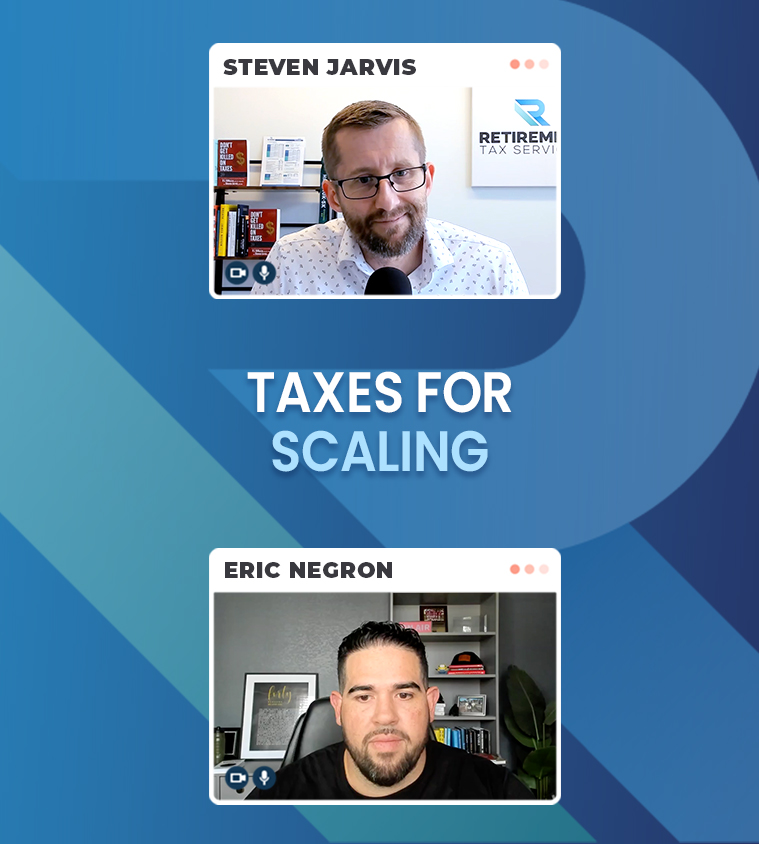
Eric Negron joins Steven on the podcast this week to talk all things growth and how tax planning can be a super power for advisors serious about scaling. Steven and Eric whole heartedly agree that the most important thing an advisor can do is rolling up their sleeves and doing the hard work. Ignore the hype, ignore the tech, ignore the designations, do the work. They both share clear examples of how this works and why it’s so important in general and how it applies to tax planning specifically. Listen through to the end as Eric shares yet another place you can catch Steven live and on stage.
Steven and his guests share more tax-planning insights in today’s Retirement Tax Services Podcast. Feedback, unusual tax-planning stories, and suggestions for future guests can be sent to advisors@rts.tax.
Are you interested in content that provides you with action steps that you can take to deliver massive tax value to your clients? Then you are going to love our powerful training sessions online. Click on the link below to get started on your journey:
Retirementtaxservices.com/webinars
Thank you for listening.
Steven Jarvis, CPA (00:50)
Hello, everyone, and welcome to the next episode of the Retirement Tax Services Podcast, Financial Professionals Edition. I’m your host, Steven Jarvis, CPA. This week, I am really excited for the conversation we’re going to have, because while advisors constantly ask me about taxes, sometimes directly and sometimes just underlying that question is really- How do I use taxes to help my practice grow? Which is why I’m excited to welcome my guest this week, Eric Negron, who is doing so much with advisors himself personally and helping other people grow that it’s just going to be a great conversation. Eric, welcome to the show.
Eric Negron (01:21)
Hey Steven, I’m super excited to be a long-term fan of your work and love everything that you’re doing to empower advisors around tax because I thinks it’s a huge opportunity.
Steven Jarvis, CPA (01:30)
Well, I really appreciate that. And I’ve been aware of you for a long time, excited about what you’re doing as well. But where we really got connected was I saw this event that you launched this last year, I became aware of it this last year, really focused on how to help advisors scale. And there’s plenty of people out there who talk about scaling. One of the things that stood out to me, or I guess two things that stood out to me about what I saw from you is one, this is stuff you’re doing yourself. So you’re speaking from a place of reality, not just theory. You’re not just a coach on the sidelines. You’ve done this firsthand. You’re still doing this firsthand. And then two, it really seemed like everything you were talking about was super actionable. It was not theory. was not like go meditate and come back and you’re going to be better. It was here are the steps to take. So just give us a little bit of background so people know where you’re coming from.
Eric Negron (02:08)
Yeah, you’re spot on. So I’ve been in the business for 20 years. I didn’t have any rich mommy and daddy. I did not have a country club membership and I had to build my practice brick by brick. And I had to learn a lot of lessons along the way. There was no Michael Kitces when I started my podcast. There was no Matthew Jarvis talking about delivering massive value. There wasn’t anybody when I started and I had to figure out a lot of stuff on my own. And as I started going through my journey myself, I scaled, right? Little by little, bit by bit, I figured stuff out. I hired coaches, I read books, I developed myself. And as I looked at our industry, and this is how you and I got connected, I realized after three years of having 15 to 25 conversations a week with different advisors that the central point of all of their issues came down to one thing, scale, right? And a lot of people would then connect that to this area of running a business called practice management. And so as I was sitting out there looking at the Lionscape, had spoken at Future Proof and I attended it. So great, I got to go and hang out with my homies at the beach from LinkedIn and it was awesome. But I didn’t grow after attending Future Proof. I didn’t learn anything about growing my business. Then on the other end of the spectrum, we have, you know, the FPA and great, I can learn more technical gobblygook about how to put people to sleep about financial planning. And maybe in one of their retreats, I can get one to two hours on practice management. And nobody was talking about scaling and what it takes to scale in 2026 and beyond.
Eric Negron (03:24)
And so I’m super passionate about it. I did it. And I think there’s a lot of false gurus in our industry, people that never really played the game at the highest level of being an advisor. And so I decided, you know what? I’m going to do something about it. So we launched Advisor ScaleCon, a conference exclusively focused on helping advisors grow and become the person they wanted to become. And we went through a multitude of disciplines, like what are the pillars it takes to scale? And I’m super passionate about it. We launched it last year. You and you connected because you saw all these comments on Michael Kitces top podcast. And we’re only going to continue to focus more and more on how we can help advisors grow and scale. Because here’s the reality. My personal business has went 8X in four years since I started applying all these frameworks that we actually teach advisors. But the reality is there’s 360 million Americans, and none of them have a shot at financial independence without a trusted relationship with advisors. And that’s why we’re so passionate about helping our peers do a better job of taking care of their clients, but also elevating the entire profession, even outside of ourselves.
Steven Jarvis, CPA (04:48)
Well, Eric, I love hearing the excitement around this. And I love that it comes from a place of personal experience for you, because you’re absolutely right. There’s so many places you can learn information from. There’s so many places you can get hype from. But at end of the day, it’s about the work you put into it. It doesn’t matter what framework you want to use, what information you want to learn. If you’re not willing to then turn around and do the work, which that’s where this stuff really gets hard. It’s not just did I sit through the session and learn good information. But what about two weeks from now? When it then I’ve gotten to my 17th know what I’m feeling a little down about this or something, the realities of life Happen like how do I keep trudging through this to get to those successes and so I’m not that’s that’s really where People kind of make it or don’t.
Eric Negron (05:25)
Yep. Yeah, I think there’s so much to be said here. think as an advisor, one of the things that’s most challenging is separating whether or not a person says yes to your services or becoming a client from your sense of personal self-worth, right? And I had to go through this journey when I was first starting and be like, just because somebody told me no doesn’t mean that I’m less of a person or less a professional. And so like, there’s all these…mental and emotional hangups that we have to kind of clear and reset ourselves. And I think advisors that are listening to you and I having this conversation that are watching all the amazing things that you’re doing and they’re looking out at the ecosystem of what’s coming out for advisors as far as resources, you really need to think about what can you be doing right now to grow yourself? How can you grow your confidence? How can you grow your competence? And how can you really position yourself to elevate the impact of advice that you have for your clients? And that’s why I’m so dang excited about what you’re doing through retirement tax services, your community, your coaching, because tax and estate planning are the two levers left to deliver a massive amount of value to clients.
Steven Jarvis, CPA (06:32)
And Eric, I’m totally with you on that. Before we dive into some of the specifics on tax and estate planning though, I want to really hammer home what you said about building your confidence and competence. Because I noticed what you didn’t say on there is, hey, you need another acronym, or hey, you need a different tax stack, or hey, you need a different marketing cover sheet. This is about how do we build those skills that translate to value for our clients, and then how do we get in front of more prospects to show them we have those skills, and I’m all for it because one of ways this comes up related to taxes, I still get a lot of advisors who will say, well, I’m not a CPA. I’m not an enrolled agent. Like, I’m not, I’m not, I’m not. And it’s like, well, yeah, but do you have a tax return? Can you pick up that tax return and learn something new about it? Can you pick up every client’s tax return and point to one or two or three or five things that you know you can help them on? And it can build from this. It absolutely needs to build from there. But there isn’t some magical certification that you have to have before you can get started on this if you’re willing to lean in and develop that confidence and competence.
Eric Negron (07:23)
Yeah, I 1000 % agree with you, Steven. I think that advisors really need to understand that the majority of people in our country, the financial literacy level is so low that being excited to share information with people is one of the greatest things that we can do, right? If you find yourself in conversations, you should share what you know, right? Be a resource and stop thinking about yourself as a damn financial advisor and start thinking of yourself as a resource and a teacher for different things. There’s so many times I find myself in conversations with people I’m out and about and somebody finds out that I’m in wealth management or whatever and they start talking about taxes or insurance or estate planning. Like, I literally will answer whatever questions that they have there, the most basic things. And I think that we think that there’s some magic formula. There isn’t. All you need to do is be a curious person who’s excited to share what you know and good things will happen.
Steven Jarvis, CPA (08:20
Yeah, no, I love that approach. There’s so many opportunities to help elevate that financial literacy. Eric, let’s go back to your claim that I happen to agree with, but let’s get into a little bit more of the taxes and estate planning, these two levers that advisors really still have an opportunity not just to deliver value, but to truly differentiate themselves from other advisors in the industry. So talk more about why you feel so strongly about that and where that comes from.
Eric Negron (08:41)
I mean, there’s all this debate in our industry about like fee compression. like, think it most, and I’m so sick of hearing about it because it’s just, it’s not true. Fee compression is a mental disease that happens when you’re in mind, when you lack confidence. And like the reality of it is, is that most advisors suffer from a crisis of confidence. And the reason why they suffer from a crisis of confidence is that their IQ is up here and most people operate with what I refer to as show and tell, crayon, low IQ strategies. And what I mean by that is tax and estate planning are the two areas that you can actually quantify the impact of helping somebody make a decision, a smart decision in their finances. It’s not this esoteric thing that’s far off in the future. Like you can literally put pen to paper and show them like if you do this, this is what will happen. And I don’t know about you, but me as a professional, that is one of the most clearest ways for me to have confidence because I know with the level of certainty exactly what’s going to occur and people are more apt to say yes to what I’m saying to them. Not only that, those are the two areas that have trigger point pains. Nobody wants to pay money and taxes. And everybody, everybody knows somebody who didn’t have their estate plan put together and knows of a horror story of something that went horribly wrong, complications, and family fighting and people don’t talk anymore or scenarios like that.
Steven Jarvis, CPA (10:08)
Well, Eric, one of the things that I love about both of these topics, and you talked about it right there, is the pain that comes with them. It’s a pain that everybody’s already aware of. When an advisor goes down the laundry list of all the different things they can do for a client, and it’s definitely a big, huge list. There’s a lot of complexities to a lifetime financial plan. But as you go down that list, most of those things are things that advisors have to come up with clever ways to explain to a client where the pain might come from. And I’ve seen every example of how to convince somebody that disability is a potential pain point. And it’s not that I disagree with that. It’s that taxes and the state-flying pay taxes even more so, we have to think about every single year, at least once a year. It’s a known pain. It’s probably the universal shared pain we all have as Americans. And so if you, as an advisor, have something of value to offer on that topic, you don’t have to convince people it’s painful. You just have to show them that you have a solution. And so we’ve shortcutted the marketing and sales process to go right to, we agree there’s pain. Let me show you how I can do something about
Eric Negron (11:00)
Yeah, like here’s the thing. A lot of folks that are listening to this right now, I’m sure number one, they want to get better as a financial advisor. Number two, they want to deliver more value to their clients. And maybe number three, they’re looking to grow in 2026. So, as I think about that as a framework, if I was an advisor right now, I would be going all in on tax. Tax opportunities are everywhere. I’m going to tell you, guys something that’s going to cost you zero dollars that you can do right now and right from the comfort of your home or using your digital weapon of distraction, your phone. Okay. You can pick up your phone, you can go on your computer and there are online Facebook communities in your local community with probably 20 to 50,000 people, depending on where you live at. Here in Austin, Texas. I’m a part of a community called the Drippin Springs Facebook group. And there’s about 50,000 people in there every single day people are asking questions about who’s somebody that could, who’s somebody can answer this tax question. Who’s a tax person? Who’s, well, I need somebody to help me with the will or state plan. 90 % of the inquiries that go on in this group have to do with tax or estate planning. And I don’t know if I was an advisor, and this is actually true because I’ve done this. I go in that group, and I started answering those questions. I started offering to be a resource. And in the last two years I brought in $40 million of new assets with zero marketing spend besides taking a couple of hours a week to answer some questions and be a resource to get folks to come in. So two topics, tax and estate planning. And anybody who’s listening to this right now, go and look at local Facebook communities, join one, start looking at what the questions that come in there and see how you can be a resource.
Commercial (12:33)
retirementtaxservices.com/obbba
Steven Jarvis, CPA (13:05)
Well, Eric, let’s make this a little bit more tactical. Like what what kinds of questions are you answering? Is this people who are who say, hey, I heard that I can move to Puerto Rico and pay only 4% income tax? Is this people who want to 1031 exchange until they die? Or is this more of a like, hey, I just don’t want to get killed in taxes next year.
Eric Negron (13:20)
Hey, okay, here’s some of the most common ones. And then here’s another idea too, for those of you that are looking for ways to grow this year. Most common one is like, hey, I sold some investments, I sold some property, I need to know what the tax implications are. I need somebody to help me understand what I need to do on my tax term. Hey, I just started a small business and does anybody know somebody who can help me with my taxes and help me understand what I need to do to get my business set up properly? Super simple stuff. Hey, my current person, tax person, CPA, tax preparer recently retired and I’m looking for a new one. Hey, does anybody have a good proactive person that can help me educate me around tax and help me file my return? None of those things are high IQ. Okay, you can raise your hand and say, hey, I can help you, right? And I think if you’re an advisor and you don’t either do tax prep as part of your business, if you’re like an art and like an art firm. We have a tax arm so we could do that, right? But let’s say you’re advising you don’t do that. This is a great way for you to build value with your strategic partners. So if you have CPAs that you work with and you’re trying to build a relationship and they can help these clients, it’s a great way for you to be like, hey, I’m gonna walk business into the door for you so that these people get helped. And then it gives you an opportunity to qualify them to see if there’s other things that you can help them with regards to their overall financial picture.
Steven Jarvis, CPA (14:31)
Yeah, absolutely. Taxes is such a great entry point into somebody’s financial life, because again, everybody has to pay taxes. Everyone’s aware they have to pay taxes. And as you’re illustrating from this Facebook group, and I see the same things I talk to advisors and consumers, everybody’s got questions. The tax code’s so complicated and ever-changing that no amount of self-conversations with ChatGPT give the average consumer confidence that they can do this on their own. They still want someone to actually talk this stuff through. And to your point, I see the same thing. Most of the questions that come in, are relatively simple for those of us who do this all the time. It’s not the complicated, nuanced, gray areas. It’s just, hey, help me understand this.
Eric Negron (15:06)
Here’s another thing. So we talked about the Facebook group as a way for folks to grow. Here’s one that’s non-traditional. Advisors befriend realtors who are doing a lot of transactions, especially with folks that they have that have investment properties or rental properties. Here’s why. I have three or four realtors that I talk to. They literally send all of their clients to me who are selling investment properties. They have questions. They’re like: How do know what my cost basis is? How do know what I’m gonna pay on my capital gains? What are the tax implications of this? What do need to know? What should I plan for, right? There’s all these questions running through their mind as they’re dealing with real estate and the realtors don’t know anything about that at all. And you can be a resource to their overall process that makes the realtor more valuable, which is then gonna lead to opportunities. So I’ve had probably…35 conversations from some realtors client who had questions about the tax implication of their investment property sale and what they should know in the last two years. And out of those conversations, I think I brought in 10 new clients. That’s not, that was a good use of my time. Just being a resource and answering some questions.
Steven Jarvis, CPA (16:06)
Well, Eric, I love hearing those examples. Let’s get really specific. mean, are these realtors you were already friends with? Like, how did you show the realtor that you had value to add? Like, what was the start of that relationship?
Eric Negron (16:15)
So these weren’t even realtor’s that I was already friends These were realtor’s that saw me answering questions in these Facebook communities that then reached out to me directly and were like, hey, can you answer questions like this for my clients? Yeah, 100%. All day long.
Steven Jarvis, CPA (16:26)
Yeah. So it goes back to being willing to provide that education, demonstrating that not just that you have answers, but again, these are relatively simple questions. Like you don’t need a PhD in taxes to be a valuable resource to these other professionals.
Eric Negron (16:36)
You got it. Because here’s the reality. The thing about the advisor industry is we think our industry is unique. We’re not. We’re a service professional. And the reality of it is that everybody is a service professional that’s looking to add value to their client’s lives, whether it’s a realtor, whether it’s an attorney, whether it’s a CPA, whether it’s an architect. We’re all looking for ways that we can deliver more value to our clients. And part of that is being strategic partners and having synergies with other smart people, right? Like advisors right now could capitalize on opportunities by just leveraging the smart people they know and figuring out how they can help answer people’s questions. And then you know what happens? Eventually, business opportunities come to you.
Steven Jarvis, CPA (17:15)
So Eric, you work with a lot of advisors on scaling, on growth. And you mentioned before, going to conferences, hearing good information, but not the kind of information you can take action on. So at most, this is going to be a 30-minute podcast. I think we’re covering some great stuff here. But how does somebody go from listening to a podcast like this to still implementing a month from now, to still seeing results six months from now? What are some of those best practices that you see that make advisors successful over the long term?
Eric Negron (17:36)
I think the most important thing is you gotta make it a habit and a discipline. You have to sit down, I think advisors need to sit down and start getting real about what things they need to do to drive success. I think there’s so much nonsense floating around about, know, I gotta join YouTube, I gotta do LinkedIn, I gotta go Facebook, I gotta do email marketing, I gotta do X, I gotta do Y, I gotta do Z, I gotta do a podcast, right? And the reality of it is that advisors need to sit down and ask themselves, what are the activities? What are the KAIs, not the KPIs, right? What are the key activities that indicate that I’m going to drive success, right? So, it’s how many conversations did I have? How many ways that I proactively put myself out there? You know, like one of your key activity indicators, those of you listening, this might be like, hey, every day, I’m going to go to some online Facebook group and answer 20 questions on whatever the subject is, taxes, estate planning, retirement planning, whatever it may be. And I’m just going to give value that way. I’m going to take time out of my week every week, and I’m going to dedicate an hour to learning more about some nuances with regarding to taxes. Maybe it’s with regards to, you know, what are the taxes from if somebody passes away, right?
Eric Negron (18:45)
What are the taxes are for retirement planning? What are the taxes if I sell an asset capital gains? Like this is a big one that comes up for me a lot in Texas is 1031 exchanges. I literally got a $10 million opportunity last year in November because somebody was like, I’ve heard Eric talk about 1031 exchanges. Why don’t I send this person there? And this person came in and we had a conversation and now we’re, helping the person go through the transaction and they were going to become a client. Like the language of tax tends to filter towards bigger money, higher net worth clients because they’re concerned about minimizing that because they want to keep more.
Steven Jarvis, CPA (19:22)
Yeah, I love that. going harness my inner Jaco for a second here and just summarize that as discipline equals freedom. If we want to narrow this down to what’s that one thing, and as I look across different advisors I know, I 100 % agree with you. It’s about that discipline. It’s about building that habit, that consistency. Because it’s probably similar for you, but you can basically pick any marketing channel. And I know an advisor who is crushing it with just that one channel. I know advisors who are still cold calling, who are doing direct mail, who are doing in-person seminars, who are doing webinars, Facebook, YouTube, like they’re individually doing these things and crushing it, but the ones who are crushing in those individual areas are the ones who are most disciplined, who are the most consistent, who have those activities they do over and over and over again, regardless of what else is going on. And I like that you added in there that it’s not just about getting the reps in front of people, it’s also what you’re doing behind the scenes to increase your expertise. And so whether you’re an advisor, that has 20 years of tax experience, and you need to focus on the activity of, how am I sharing this education? You could be an advisor who’s brand new to taxes and okay, part of your discipline needs to be every Thursday morning, you’re gonna spend three hours reviewing tax returns until you can take that five or six or seven topics most relevant to your ideal client and you can articulate them well. But whatever it is, that consistency, that discipline is what’s going to make the difference.
Eric Negron (20:30)
And I think if I was an advisor right now, right? Like I would be looking at where I could learn. Now, if I didn’t know taxes, right? Like I would join a community like what you have. I would look to like some of the vendors or wholesalers in our space have pieces that talk about taxes. Consume as much information as you can, right? And this is a little hack that a lot of people haven’t been talking about, because a lot of people are talking about AI right now. But one of the most impactful tools that I’ve come across in the last 18 months is Notebook LM. So for those of you that don’t know about Notebook LM, you can literally feed in YouTube videos, PDFs, Word documents, et cetera, and create your own knowledge base to educate yourself. You can even have it generate quizzes and overviews and guides on any subject. So if I was an advisor listening to this right now, I would be building my own curated knowledge base around taxes and estate planning so that I can spend a certain amount of time every single day bringing myself up to speed, giving myself a summary so that I can go into every situation and I come off like an expert because I’ve now been putting the information in my head and I have a clear way to articulate it and answer questions.
Steven Jarvis, CPA (21:44
I love that. I’ll have to check out that notebook LM. Well, and I certainly appreciate you mentioned the community that we have and the work that we’re doing because obviously we’re huge fans, huge proponents of this. You can go out to retirementtaxservices.com and check out our community. We’d love being able to help advisors level up on this stuff and we focus on the tax piece of it. But it’s all comes back to how do I take action? Because whether you’re serving existing clients or you’re working on growing and scaling that how do I communicate the value is really what so much of this comes back to.
Eric Negron (22:09)
I think the worst thing, if you’re an advisor listening, it’s the worst thing you can do is try to go this alone. As human beings, we were designed and built, right? It was put inside us to be in community, okay? I am, and this is gonna sound shocking to you, because I’m sure some of you will go look me up after this. I am actually an introvert. And even myself as an introvert, need community and here’s why. And I think this is coming down to what you’re doing in your community as well, Steven, is that if you’re in community with other smart, curious people, they may ask questions in a certain way that finally creates a degree tilt that unlocks things for you. And so sometimes being in a community, even if you’re not contributing, but being around other smart, curious people, will create new levels of growth for you. And I think one of the things that advisors get wrong is we’re so concerned with telling our clients about investing money and saving and like, you know, hey, the most important thing that you control is your rate of savings. Well, I think the most under invested thing that advisors are doing is investing into themselves, right? They’re not investing into their health. They’re not investing into their mindset. They’re not investing to their skills and like they get comfortable, right? Maybe they started off somewhere where they got a little bit of training and they’re they’re they’re doing good enough. Well, here’s the reality. Good enough is eventually going to get your lunch money taken away from you from somebody else that comes along. That’s excited. That’s investing in themselves. They will take your client from you because your clients want you to deliver value and it doesn’t matter that you’ve been sending them a birthday card and you call them and you’re a nice guy and gal. If you can’t demonstrate the impact in what you’re doing every single day in their financial lives, eventually somebody else is going to come along and do it. So this is a warning to your advisors that are listening to this. You have to invest into yourself. You have to invest into your skillset so that you can continue to go to the next level and take care of the people that are trusting you with their life savings.
Steven Jarvis, CPA (24:02)
Completely agreed. Such a good message to wrap up on. Before we close this thing down, how do advisors learn more about what you’re doing?
Eric Negron (24:08)
So if you’re advisor and you want to learn more about what we’re doing, would tell you to connect with me on LinkedIn, send me a DM, and I will send you information about the advisor scale con community that we have. It’s free for you to join. We have, and I’m just doing this for Steven’s podcast. Nobody really knows about this yet, but we’re launching another conference that will be in Austin, Texas, at the Dimensional Fund Advisors headquarters on June 23rd and June 24th, all around elevating the impact of advice around investments, estate planning, tax planning. You will be able to see Steven Jarvis there in real life. We might even have some Texas barbecue for you. So that’s in June. If June doesn’t work with you because your kids are out of school and you’ve got family vacations, don’t worry. We got you covered. In November, we will have our full ScaleCon event in Austin as well, where you can actually learn actual blueprint to grow your business the same way that I’ve been doing it the last five plus years, right? And you’re gonna get to learn from a curated list of experts that are actually doing this. This isn’t theory. This is the step-by-step plan and frameworks to make it happen every single day.
Steven Jarvis, CPA (25:15)
Eric, I love that. And I’m super excited to be coming to Texas this summer for the barbecue, but also to get in front of advisors, to spend time in community. I love how you talked about that. There is so much value. As much as I love doing podcasts, there is a big difference to getting in person, rubbing shoulders with people, hearing what they’re doing. It’s why I love events like what you’re putting on. It’s why we put on the summit every year. So Eric, thanks so much for coming on, sharing your time and expertise. Really appreciate you being here.
Eric Negron (25:36)
Alright, thank you Steven.
Steven Jarvis, CPA (25:38)
And to everyone listening, until next time, good luck out there. And remember to tip your server, not the IRS.