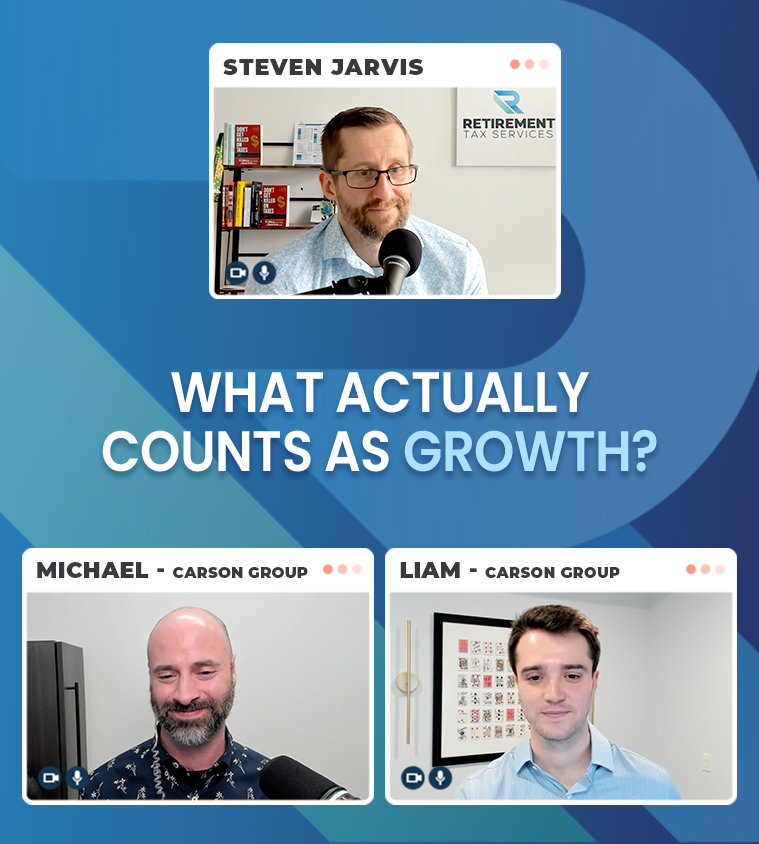
What actually counts as growth? with Michael and Liam from Carson Group




In this week’s episode, Steven is joined by two of our good friends at Carson Group: Liam and Michael. Liam and Michael are part of the M&A team and get to see behind the curtains of some of the most successful practices in the country and share what they’ve learned about the ones doing the best work. Steven discusses the role of tax planning in firms that consistently grow, and they all share insight on why tax planning continues to be such a great opportunity for advisors who lean into it. Listen to the end as Steven shares an opportunity to gain insight into your own practices, true growth, and overall health by visiting retirementtaxservices.com/carson.
Steven and his guests share more tax-planning insights in today’s Retirement Tax Services Podcast. Feedback, unusual tax-planning stories, and suggestions for future guests can be sent to advisors@rts.tax.
Are you interested in content that provides you with action steps that you can take to deliver massive tax value to your clients? Then you are going to love our powerful training sessions online. Click on the link below to get started on your journey:
Retirementtaxservices.com/webinars
Thank you for listening.
Steven Jarvis, CPA (00:50)
Hello everyone, and welcome to the next episode of the retirement tax services podcast, financial professionals edition. I’m your host, Steven Jarvis, CPA. And this week is really exciting for me because we get to talk directly with a couple of great people who are going to help explain a misconception I had and how my, my mindset has changed around this. And really what we’re going to talk about is over the years, I saw so many successful advisors running relatively small firms, which that can be a whole range of measures, but we’re talking about smaller teams, independent RIAs, those types of firms. And they were absolutely crushing it. And in my mind, those are advisors who were always going to be on their own because they’d already figured out they were already growing. They were already crushing it. And then I started meeting people who were taking that success and still joining bigger firms. And at first I didn’t understand until I got to meet specific people doing it. Like my good friend, Micah Shilanski, who recently announced joining Carson group. And today to discuss this with me are some of my good friends from Carson group, Michael and Liam. Welcome to the show. Thank you so much for being here. I’m super excited about exploring this shift in mentality for me and so many other advisors.
Michael Belluomini (02:00)
Steven, so excited to be here. It is great to speak to your listeners. And I will say that misconception, it’s not just you, that is a widespread misconception, but it wasn’t a misconception maybe five, 10 years ago. It’s just become a misconception as these businesses have grown. So I’m excited to talk about it.
Steven Jarvis, CPA (02:18)
Yeah. And Michael, like so many things, also kind of depends on the circles we run in and who we spend our time with. And it’s one of the reasons I love doing the summit and getting so many people in person together to share their own experiences. Because as we were at the summit last year, Micah shared his story of here’s all this success I saw and was excited about. And I think if you would rewind the clock a little bit, Micah might’ve even told you, yeah, of course we’re going to be on our own forever. Why wouldn’t we be? And then to hear him talk about his kind of experience learning about Carson Group and then making that decision, I looked across the room, and you could see like this eye-opening moment for everybody of, I’ve been thinking about this wrong. Micah has shared his specific story and for people listening, you can go find it or you can come to summit this year and hear him talk about that. But talk a little bit about why an advisor in that situation would look at partnering as opposed to continuing to grow on their own.
Michael Belluomini (03:11)
Yeah, so I guess before we do that, why don’t I just introduce myself briefly? So for your listeners, I’ve been in this business my entire adult life. So well over 20 years now, I love this space. I never want to do anything else. Wore a lot of different hats over the years, but I’ve only been at two different companies through my career. I came to Carson about four years ago to build our external facing M&A arm. So having conversations, just like you mentioned, where somebody that was not already in either our coaching community or on our platform, they were going through a process, they’d hired representation, and we’re looking at potential solutions like Carson. So proud to lead those efforts and I’m here with Liam. So Liam, you wanna introduce yourself and we’ll get in.
Liam Heffernan (03:51)
Yeah, of course I’ll keep it brief. Steven, thanks again for having us on. But yeah, to your listeners, my name is Liam Heffernan. So I also work with Michael on the M&A team here at Carson. I have had more than two jobs in my career. However, they’ve all been in the mergers and acquisitions world. So I did a little bit of sell-side and then buy-side. And before Carson Group, I actually worked at another RIA in the space. So, and they were also subsequently acquired by Creative Planning. I’ve seen a lot of M&A, I’ve been on the side of getting acquired as well as doing a lot of the acquisitions, and I’m excited to share some of the knowledge and explain away some of the misconceptions about the space.
Steven Jarvis, CPA (04:25)
Well, and Michael, just real quick before I turn you loose, part of the reason there’s a couple of reasons I’m excited to have this conversation on a podcast all about tax planning. Because for people listening, this is clearly a break from us talking about specific tax planning strategies or issues with the IRS or anything like that. But one of the things I’ve noticed in in this audience of people committed to tax planning, looking to do more through tax plans that they’re looking to do more across the board. For listeners, I’m sure this resonates of I want to serve my clients better, I want to do more with my team, I’m looking for other ways to expand and grow. And just like we talk about with tax planning, there’s some of that you can absolutely DIY. It usually takes way longer and is super painful. But you can absolutely DIY some of these things, but most people get to a point where there’s kind of an inflection point where they say, if I want to continue to deliver more value to my family, to myself, to my team, to my clients, I’ve got to look at doing something different. And I think that’s where Carson Group, as a great example, can come in and say, hey, here’s all these other things, which Michael, I think that’s what you’re going to talk about. Here’s all these things we can do so that you can do your highest and best thing.
Michael Belluomini (05:31)
Yeah, I think you’re exactly right. So I think if you look at why would a really successful business owner transact and partner with a larger enterprise or organization like Carson, there’s four themes that I think we consistently see. And I think the first one is exactly what you’re outlining. It’s the expansion or lift of service offerings to the broader network. So, being able to provide a better solution to your client base than you could before. And I’ll just, I’ll share a brief story. There was a firm in Kansas City that is now one of my close friends. And it was a really unique firm in that there was a founder that was in his early sixties. There was a second generation. I use that term very loosely, more around, or less so around demographics, just more around the timeframe. And the second advisor was it mid fifties. Third one was maybe just a few years older than me. He’s now in his late forties. And for him, he had been sort of tasked with continuing to build the platform at a really successful RIA. This was a six, $700 million firm. And he said, you know, I would look at and compete against large firms like Carson all the time. And I realized that for me to build the tech platform or the client offering that folks were used to seeing, I could spend the next maybe five years of my life doing that.
Michael Belluomini (06:48)
And I would be 10 years further behind at the end of it. So for me to offer trust in a state and tax planning and all the things that I just cannot do on my own, there was an inflection point where for me to continue to win clients, I needed to offer some of that. And we actually just heard one of our peers in the industry talking about this. We were having a conversation around fee compression. And his comment was, fee compression does not necessarily mean, doing the exact same thing for less money, means doing this, doing more for the same money. So being able to provide that expanded service offering to your clients.
Steven Jarvis, CPA (07: 23)
Yeah, I’m right there with you. Like anytime the phrase fee compression comes up, I always try to replace it for people with value expansion. This is an opportunity for value expansion. And so yeah, if you keep doing the same things you were doing 10 years ago, that’s just how technology works. Whether we talk about AI or just people leveling up their skills. Like the more skilled the profession gets, either you need to keep expanding your value or yes, you will experience fee compression, but it’s not automatic. It’s not something that has to exist. Fee compression only exists if you’ve slowed down in expanding your value.
Michael Belluomini (07:54)
Yeah, yeah. And like Mike is a great example of that. mean, to having being able or I should say fearlessly pursuing, providing the most value possible to your clients or recognizing that there are things that are high payoff activities for advisors that they should be investing all or most of their time in and things that they should not. interviewing AI note takers is probably not one of those things. So outsource that to somebody that is going to do that full-time or has somebody involved with that full-time.
Steven Jarvis, CPA (08:23)
Yeah, it really is interesting to see how that plays out. get, of course, I’m the CPA in the room, so of course people focus around taxes with me, but I keep getting sent more and more recent like industry reports. Anybody who like prognosticates about the industry, the frequency with which tax planning is mentioned as, this is where things are headed. Just as one example, because you talked about tax planning and estate planning, they’re evaluating our tax act, all these different things. Like as advisors look forward to what they need to keep doing, as these things are going to more and more often become table stakes. And I’m so passionate about what we do at Retirement Tax Services to help advisors do more through tax planning. And we get advisors pretty far. But there’s gonna be times where like you need institutional support behind you if you want to go even further.
Michael Belluomini (09:04)
Yeah, I agree. And you know, it’s funny you mentioned that, Steven, this is gonna be no shock to you, but we are just coming off the heels of our first survey for our top growing offices. I think we looked at north of 25 of those firms, and our CEO has been sort of unashamed at saying tax planning is like the last remaining or one of the last remaining alphas out there. There is no alpha in investment management or fund selection or anything like that. And if you look at those 25 firms, there is a consistent theme that those that weave tax planning into the core offering are growing faster than anybody else in their peer group.
Steven Jarvis, CPA (09:39)
Yeah, Michael, I’m glad you mentioned that because it’s one of the things I wanted to ask about just selfishly for my audience because everybody wants to grow. If you tell me you don’t want to grow, either you’re from retirement, or you’re just lying to yourself and everyone else. Everyone wants to grow, and we get so much misguided information about what really drives growth. And I think in this industry in particular, growth gets masked by market growth. And so sometimes it’s really hard for people to see…Okay, what is driving organic growth? And it’s easy for me on the outside, not being a financial advisor, to bang the drum of what you just said, tax planning is a differentiator. This will help you grow. I talked to hundreds of advisors a year. That seems to be a common theme, but you guys are on the other side of this where you’re not me sitting on a podcast saying, hey, this is people are telling me. You guys have to make decisions on whether you want to acquire a firm based on what you’re seeing from their growth. So you guys see the real, what’s really in the weeds of what’s causing driving organic growth. You mentioned tax planning. What else are you guys seeing as themes of what separates these firms where you see growth rates, where you guys get excited? What are those advisors doing?
Michael Belluomini (10:38)
Yeah, so I think, but maybe before we get into the habits, cause I think there’s some key ones. Liam, you want to talk a little bit about just the difference between organic growth and organic growth that includes market, and why that matters. It should be obvious to everybody, but it’s probably not. And then maybe a little bit about how that growth rate impacts just the value of a firm. Cause this really comes down to allocation of capital for us and for any really good investing firm out there. It’s not M&A is not buying whatever is presented to you. It’s about investing in the right horses and making sure you’ve got the best teams and the best talent.
Liam Heffernan (11:11)
Yeah, 100%. I think it’s interesting, especially over this, this, know, prolonged bull market that we’ve been in, everybody’s a grower and everybody will tell you that. So we look at on average, probably five. And yeah, well, they’ll let, they’ll let you know. We look at on average, probably five, six, seven, they’re called Sims, but it’s the deck that an investment bankers and to put together when they bring you to market. And when you look at those, typically one of the main, if not the main number highlighted is their growth rate over the past one to three or four years. Just about everybody, if you aren’t doing something insane and criminally mismanaging money, is most likely going to have not only a positive growth rate, but in the double digits for the most part, if you were riding the market. I think for us, our job is to really discern between the people who are riding the market and who are generating outsized growth there. But that’s definitely a hard discussion to have with some people. However, once we really break it down and we isolate the organic growth, that’s where people are going to get top dollar. I think right now that’s what firms need to be focusing on. It’s really the one way you’re going to separate yourself. It might be easy to look at your AUM growing year over year, and as a result, your revenue growing year over year, but that’s not going to differentiate you whatsoever. Cause just about every one of your competitors is probably seeing similar, if not even higher growth, assuming that they’re, you know, looking at other ways to grow and bring on new clients. So when we look at a firm and we’re looking at the key valuation drivers, that organic growth and specifically net new assets is going to be a really important number. So we’ll look at new clients and then new assets from existing clients are probably the top two drivers on that lever.
Michael Belluomini (12:41
And I think even more importantly than that, too, it’s the revenue tied to those assets. So, you we’ve had a lot of conversations internally and externally around net new revenue versus net new assets. And all assets obviously are not created equal. You know, land a big retirement plan that you’re charging 25 to 30 basis points on. That’s a lot different than getting a great advisory account that you’re charging one and a quarter, one and a half. So it’s about flows, but it’s also about where that revenue is coming from.
Steven Jarvis, CPA (13:06)
Yeah, that’s really interesting. Thanks for that context on how that works. that gives us kind of this distinction between organic and market growth and hopefully reinforces. And for people in our audience or who have come to the summit before, this isn’t a new theme for you to hear from our platform of, hey, there’s an important distinction here. And if you want to see the organic growth, you need to be putting in the work. Again, let’s go back to the people who are seeing good organic growth. What are those habits? What are those things that you’re seeing that gets you guys excited?
Liam Heffernan (13:43
Well, I would just add one more thing to what we just talking about quickly on that growth too, is the way a lot of firms are most likely going to look at it. A firm like Carson, we obviously have scale and our marketing department is our largest department at the company. So we believe that when you join, you should believe that you can grow faster with us than without us. But a lot of firms are going to say, to use an example, to create the football, suppose, you don’t draft a quarterback who didn’t win in college, even if they have what you would deem the intangibles. So a lot of people are going to say, If you couldn’t grow without us, why are you going to grow with us? So I would just, for most people, really try to get your growth rates up prior to entering the market for a sale or even exploring it. And then on top of that, just kind of making sure you have a story behind why and, you know, look at the right partners and say who can help me grow in ways that I haven’t been able to prior.
Steven Jarvis, CPA (14:17)
Liam, I’m glad you mentioned that because we see this, I know a lot of advisors over the last couple of years who have either merged with a bigger firm or sold their practice. They’ve gone through some of these events and that seems to be one of the most consistent themes that growth, obviously there’s so many numbers that go into the valuation, but growth seems to be the common factor of, you know, were they excited about what was, was the acquirer excited about what was going on and did I get a deal that fell at or above market, whatever that means, we can come back to that. But the growth is that common denominator when these conversations come up. Because on the acquirer side, this isn’t decades past or in other industries where people are out there looking for a good deal, a broken toy they can fix. Like this isn’t, let me go pay pennies on the dollar for something I can turn around. That’s what we’re seeing, what you guys are talking about. No, no, no. We want the people who are already winning and we want to help them win more.
Michael Belluomini (15:05)
Yeah, Steven, we’ve never invested in a project. and this is where I think M&A, when it comes to goodwill, because that’s what we’re talking about here. So the relationship between the advisor and the client. When there is no tangible asset, theoretically, if somebody is declining in production or they are seeing assets and revenue walk out the door, they are worth less tomorrow than they are today. So that is a poor investment. I think for any firm and there are always reasons why I think firms can get diluted and think they can turn something around. But when you asked about the behaviors, I think so much of that is it’s complacency. I mean, I think after 2008, 2009, we have seen this explosive market. COVID really doesn’t count. I mean, it was a brief blip of volatility. 2022, even with rising interest rates, was one year. I mean, we have seen a pretty consistent uptick. And I think it’s really easy for a business owner to sit back and watch the value of their firm and the revenue from that firm increase with zero action. And I love when we’re at a conference or we’re on a panel and we’re having a conversation with advisors and you get the question, well, how do you grow? How do I outperform the market or grow faster than what I’m doing today? And the follow-up question is always, what are you doing today? And usually the response is nothing. Are you prospecting? Do you have a business development mindset? Are you asking your clients for referrals in a systematic way? Are you doing any sort of brand awareness building in your local community? Do you support local charities? I mean, if the answer is no to all of that, then it’s pretty easy to see where the problem is.
Steven Jarvis, CPA (16:39)
Well, Michael, let me jump in here for a second because I mean, you guys have been around us long enough to know and our audience certainly knows we’re all about helping people take action. So let’s get super tactical with this for a minute because I could give you names of advisors who are successful across so many different channels. Advisors doing in-person seminars, advisors doing online webinars, doing YouTube, doing podcasts, doing cold calling, doing referrals. Like I can point at all these different channels. Now most of them are picking one of those that they’re going. all in on or close to all in on. So talk to me a little bit more, like are there particular prospecting channels you’re looking for? As long as you’re doing, as long as you’re disciplined and executing, we don’t care if you’re doing seminars or podcasting, just show us how you’re prospecting.
Michael Belluomini (17:19)
Yeah, I want to see the actual return on that investment. I, whether it’s podcasting or seminars, doesn’t necessarily matter. I will mention though, I just saw a study. I can’t remember. It was Barron’s that just published it. They were looking at, at 50 of the largest growers across the country. And a common theme was those folks are still doing old-fashioned seminars. And I know there’s a huge, maybe negative connotation against doing that, especially once you hit a certain level of success. Hey, I don’t need to be buying lunch for a bunch of people that maybe aren’t interested, but there is return, generally speaking, on the folks that still do that at the local Maggiano’s or whatever it might be. But I think if there is a through line to the materials and there’s a story that the advisor can tell on where the growth is coming from, and they can point to a few key examples, that’s usually enough for us. And I’ll just mention, like this growth problem, it’s an industry-wide issue. You know, if you look at Schwab or Fidelity, it doesn’t really matter, growth rates are hovering around two to two and a half percent exclusive of market. That’s pitiful. I think in most industries, if you were to look at a two-and-a-half percent growth rate, that’d be a failing business. So there’s not much you have to do to get that back up.
Liam Heffernan (18:25)
Well, we are looking at, I guess I have two quick examples. one to Michael’s point, we’re looking at a firm right now, and in the investment offering that they presented to us, they quantified, they’ve added 150 million AUM over the last three years through retirement seminars. They’re targeted towards a specific demographic. When we see that, we love that. That’s easy. That’s repeatable. That’s exactly what we want. We want you to keep doing that here. Now we’ll just give you additional resources to do it at scale. And then alternatively to tie it in, I think we’ll get there eventually, you know, in terms of driving growth, we talked about systematic processes. We talked to a firm recently who in order to become a full-time advisor from the junior advisor level, those junior advisors, they had to bring on a certain amount of assets monthly and they tracked it all. They also had to join two local memberships, Chamber of Commerce, something like that, essentially making sure they are in the community. And so they’re tying that with tangible results. And they say, where are you getting your assets from? You know, you need 12 month track record of adding X percent organically per month. And I think that just kind of that sense of accountability is going to help you grow too, because you can’t do it on your own.
Steven Jarvis, CPA (19:27)
Well, and just real quick, I’m sure most people listening have already kind of made this distinction. But if we strip out all of the M&A conversation from the discussion, this is all still very relevant and important things to everyone listening. This conversation around growth and understanding where your growth really comes from. And if you’re actually driving growth yourself, I mean, Michael, you mentioned it. Like, if you’re at these low single-digit organic growth rates, you’re probably mostly staying in business because of the market. And if that doesn’t keep up, like what are you going to do? And if you suddenly don’t have the revenue to pay your team, you haven’t grown to add these additional services, like this is a really important thing for business owners to understand, whether they are one year or 10 years from some kind of transition or they think they’re never going to. This is just being a good business owner. And it’s really being a steward for your clients because the worst thing you can do for your clients is go out of business. Like you need to be running a successful, profitable firm if you are in fact serious about providing value to your clients.
Michael Belluomini (210:24)
Couldn’t agree more.
Liam Heffernan (20:25)
Micah has said it multiple times when I hear him speak, he says, you don’t need to sell, don’t need to be planning to sell, but the optimal version of your business is one that’s ready to sell.
Steven Jarvis, CPA (20:35)
Yeah, absolutely. Guys, let’s change gears just a little bit because I know that one of the topics that comes up around this all the time is, well, what multiples are out there and what’s a business worth? Because those are like the fun things to talk about on social media, but it is a very real consideration that if someone gets to the point where they want to even begin thinking about these conversations, that’s going to be somewhere in their mind of… How does my business even begin to get valued? Michael, can you give us a little context around how this discussion really works separate from what social media nonsense is out there?
Michael Belluomini (21:04)
Yeah. Yeah. I appreciate that. Social media nonsense. think you’re putting it judiciously too. So, you know, there, let’s just cut to the chase. These businesses are more valuable than they’ve ever been. And when we talk about a well-run advisory practice that has strong client loyalty and excellent retention, and there is organic growth, we’re usually talking about generational wealth that’s being created for the owners of these businesses. And that is shifted. I mean, if you go back before this M &A boom that really started in 2019, 2020, it got real legs in 2021. But prior to this, we were usually talking about one advisor selling their book of business to another advisor. And most of the time, that business was being valued on top-line revenue. So was a revenue multiple. And there’s all sorts of saws or rules of thumb, which are, as you pointed out.
Not great or maybe less than accurate. But the reason you would use a top-line revenue multiple is because you weren’t buying a business. You’re just buying access to the clients, the staff people, the expenses, like all of that ceased to sort of exist once you acquired the business and you would then go and farm those clients to try and retain them. But you’ve seen now that business maybe 10 years ago is now a business that’s probably five to 600 million in assets.
Michael Belluomini (232:19)
There are multiple staff members. Tenured staff people, there’s their second-generation advisor talent. And that’s why we’ve made this shift to EBITDA multiples or bottom line cashflow, which is essentially, and I’m sure your listeners understand this is top line revenue minus all the operating expenses, minus all the compensation for you and your staff is what’s left is EBITDA. And that’s where we put the multiple on. So we’re buying a successful business. We’re bringing everybody over is now part of our team and we’re running the business based on that, that free cashflow. Valuations, it’s a great topic. I think Fidelity does probably the best job at encapsulating this. They’ve been tracking valuations going back to 2014. They have data on almost every transaction, whatever’s been released or what they can glean. But if you look at the median size, and I think it’s important to note, this is median, about 500 million in assets. And obviously, you’re not buying assets, you’re buying EBITDA. So we can kind of talk into maybe how margins play into that, but 500 million in assets are trading at about a 9.9X on bottom line EBITDA. That 9.9 though, goes up and down, right? So you find a firm with really strong organic growth, great G2 talent, no client concentration risks, a niche market that’s attractive, a demographic that’s attractive, all of those bring those valuations up. And that’s when you start hearing the chatter around these 12 to 15 times multiples. Now, the inverse is also true. If you have an office that does not have G2 talent or does not have organic growth, or maybe you’re a $500 million firm, but you’ve got one $250 million client, that’s gonna show up in the fee rate, that’s gonna show up in concentration, that firm is gonna trade less and be less attractive to potential buyers. So when we talk about these big multiples, they’re out there and there is reality to it, but those are for really attractive well-run firms, the inverse is true.
Steven Jarvis, CPA (24:16)
Michael, I’ve got a couple of things I want you to clarify in here for people listening who are interested in this topic. You guys do a whole series on know your value. So I want you to talk about how people can learn about that and learn more. And then specifically talk about why this should be interesting to somebody who doesn’t think they’re anywhere close to any kind of exit.
Michael Belluomini (24:30)
That’s a great question. So we launched a live stream or podcast, I don’t know, two years ago with my partner or comrade in arms, Mike Weger, here at Carson Group called Know Your Worth. And the concept around it was essentially just RIA and M&A or wealth management M&A for dummies. We found we were getting a lot of just basic conversations around when you talk about &A, what do you even mean? Like what does that entail? So we try to keep it very high-level and informative. Like, obviously, there’s a Carson bent to it. You’ll get our CEO on last month talking about the monster year we had last year, and proud to say that obviously Micah and Jamie were a part of that success. So we celebrate the Carson wins, but it’s more around just industry education and trying to maybe debunk some of these myths and then dive into when we talk about minority versus majority, what does that mean? How do valuations change?
Why do people care about organic growth? As we talked about earlier in this podcast, that’s all really important. So we do try to kind of keep to that. It’s all found either on our website. I know we’re going to talk about creating a landing page for your listeners, Steven, and then we’re on YouTube, LinkedIn, and Twitter and all of that.
Steven Jarvis, CPA (25:39)
Yep. Yeah. Yeah, I certainly appreciate all that. Yeah, for anybody listening, you’re to be able to go to retirementtaxservices.com/carson. We’re going to get you connected to all these resources that Michael’s talking about and give you an opportunity to have a conversation around valuation. And Michael, tell me if I’m framing this wrong. But the way you guys approach this is you have a relatively simple calculator. And I don’t mean any disrespect by that, but as a starting point to say, hey, because you mentioned it, sure, here’s some multiples, but we’ve got to talk about where this goes from there. So if you go out to retirementtaxservices.com/CARSON, we’ll get you connected with Michael and the team that you can have one of these conversations of, how do I stack up on these different variables that can push up or down? So again, retirementtaxservices.com slash carson. And for us, we really appreciate your guys’ partnership on this because just like advisors who get to a point where they say, hey, I need other resources, I’m going to be the first person to say…Here’s something that’s outside of my area of expertise, but it’s still important to my audience. And so a topic like this, I’m not your guy to sit down and explain to you what the value of your firm is and what’s going to push it up or down. I can give you anecdotal, but you want to talk to somebody who really knows this. So one of the many reasons we appreciate the partnership this year with Carson Group, we’re super excited you guys are going to be at the summit. Something like 100 of our listeners are already signed up for the summit. We’ve still got plenty of seats left. So go to retirementtechservices.com, get signed up for the summit then add that that backslash or forward slash, whichever direction it goes, Carson, and you can learn more about this value, about the value of your firm, and how you can influence it. Michael, Liam, any other thoughts on this topic as we get ready to wrap this up?
Michael Belluomini (27:09)
Yeah. Um, let’s, let’s, I think one more thing I think it’s important to, mention is, um, equity performance. So you would ask at the beginning of the conversation, why would somebody choose to partner with a firm like Carson if they’re crushing it? And I think the dirty secret is, uh, and really not really a secret anymore, but, um, when you look across our enterprise, so we have, um, you know, roughly 175 partner firms. Those are just 10 99s that are choosing to use our platform. We now have, um, 36 fully integrated offices. So these are Carson wealth offices or firms we’ve transacted with. When you look across that enterprise, not a single one of those firms is growing faster in aggregate than Carson. So when you talk about a really successful business owner, part of their strategy or planning should be around diversification. And I hate the phrase taking chips off the table because it’s not about that at all. It’s about diversifying your holdings and If I were to come to anybody and say, Hey, there is a faster growing enterprise. So right now all your values is tied up and into your growth. But if you could diversify that continue to grow the way you’re growing, if not faster, and then take advantage of Liam and I, you’ll put our M&A team to work for you. Put the performance of the other 36 Carson wealth offices to, your benefits, start working for your value creation. You’re going to see. The value being held in our equity accelerates faster than your own. And that is still a primary reason that people transact is gaining access to that equity.
Steven Jarvis, CPA (28:37)
Yeah, Michael, I appreciate you highlighting that. It’s such an important concept that I think once people hear it, it makes sense, but they don’t think of it on their own. I know that was first presented to me a few years ago, and it was very eye-opening the first time. like, OK, just like anything else is this scale. The acceleration goes faster. The potential gets bigger. So a lot of very exciting things in the short term and long term for people who find the right partner to partner with. Well, guys, really appreciate your time. Super excited that I get to see you at the summit again this year. And again, for the listeners, retirementtaxservices.com to get your summit ticket, and then retirementtaxservices.com/carson to learn more about what Michael shared about know your worth and having a conversation around valuation. So guys, thanks for being here. To everyone listening, until next time, good luck out there. And remember to tip your server, not the IRS.