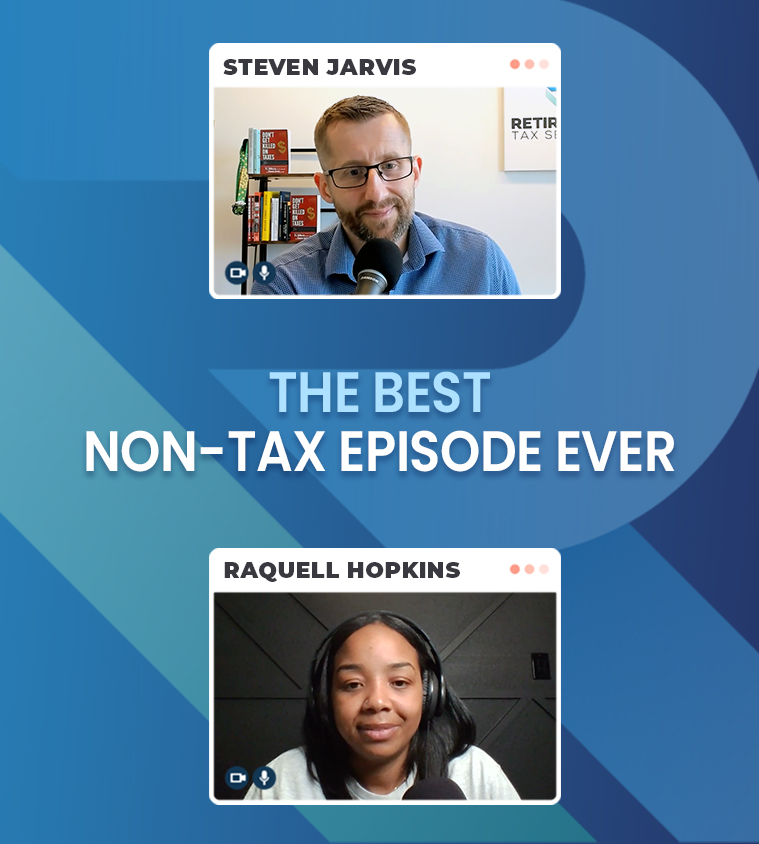
This week is special; it might be the best episode of the year, and it has nothing to do with taxes. Joining Steven this week is Capacity Expert RaQuell Hopkins. RaQuell will be joining the Summit this year as a keynote speaker to help attendees overcome mindset limitations and expand their capacity. This interview is just a sneak peek of the great things to come. RaQuell has an incredible ability to articulate complex topics related to mental health and mindfulness and help successful professionals push for even more. She has helped challenge the beliefs that hold us back and has a much nicer (and probably more helpful) way to say “nobody cares, work harder!”
Steven and his guests share more tax-planning insights in today’s Retirement Tax Services Podcast. Feedback, unusual tax-planning stories, and suggestions for future guests can be sent to advisors@rts.tax.
Are you interested in content that provides you with action steps that you can take to deliver massive tax value to your clients? Then you are going to love our powerful training sessions online. Click on the link below to get started on your journey:
Retirementtaxservices.com/webinars
Thank you for listening.
Steven Jarvis, CPA (00:50)
Hello, everyone, and welcome to the next episode of the Retirement Tax Services Podcast Financial Professionals Edition. I’m your host, Steven Jarvis, CPA, and this week is going to be a great one. We’re not really going to talk about taxes at all, and it might still be the most impactful episode of the year because I spend a lot of my time telling you to do more, to work harder, that tax planning is important, that there’s all these other things that you should do for your clients. And I believe all of that, but typically on this podcast, I don’t maybe have the expertise or take the time to share weight. On top of everything else you’re dealing with in life, here’s how you can find ways to do more to expand your capacity. So very excited for my guest this week. Raquel Hopkins is an expert in this area of capacity. She’s not a CPA. She’s not a financial advisor, which probably makes her so much better suited to talk about this. She’s also going to be a keynote speaker for us at the summit in September, because in addition to tax planning and financial planning, we really want to give everyone who comes the tools to make this stuff a reality. So with that, Raquel, welcome to the show. Thank you so much for being here.
RaQuel Hopkins (01:56)
Thank you so much for having me, Steven. I’m excited to talk to this audience today.
Steven Jarvis, CPA (02:0)
I’m so excited that you’re going to come to the summit and meet so many of these great advisors who are hardworking, high-performing people who are, think kind of naturally are aware of, times that they can, they can do more or things, other things they’d like to accomplish. But we were talking about before we hit record, there’s, there’s just something, there’s this disconnect between like, I can see a thing I want to do, but that discomfort to get there is so overwhelming at times. And so when I got introduced to your content, I was immediately blown away by the way you can articulate these concepts in a way that makes me feel like, I can go do that. So before we get into kind some of these discussion points we want to talk about, give the audience just some of your background and how you’ve ended up as someone who talks a lot about this topic.
RaQuel Hopkins (02:42)
Yeah, so my background is actually in HR. I worked my way up and eventually ended up becoming an HR executive for a global telecommunications company. And then at some point, I had that midlife crisis, Steven, and I was like, I gotta do something that’s much more meaningful and fulfilling. And I decided to transition into the mental health space. Now, when I transitioned into the mental health space, I was going through a lot of things, just questioning my life. Like, what do you do it all for? And I felt like the substance and the depth wasn’t there. So I ended up getting into like adult development, and that’s where the term capacity came from. And last year, around the same time, I actually went viral last year, February 16th, I will never forget that date. And I talked about how people are now becoming more fragile than what they’ve ever been. And there’s this, misunderstanding of what it means to support people with their mental health. And it took off like wildfire, and here we are. So I have an HR background, an executive HR background. And I’m also a licensed professional counselor and I am a certified professional coach. So my work extends within the corporate space and working with clients one-on-one where I naturally gravitate to, especially what I’ve learned over this last year, is I love being within the organization space and bringing my mental health background. I see mental health within individuals very similar to the business life cycle. You have startup, have growth, you have decline, you have maturity, and I think that we as humans operate in the same way. So I have this unique way of seeing how it’s all interconnected. So I like to support both the talent and the development of the organization and see how it comes as a whole. So that’s…my background, Steven.
Steven Jarvis, CPA (04:36)
Yeah, I love that. Thank you for sharing that. But as we dive into this, I want to highlight two things for my audience of why this was an important conversation for me to have. One is that this podcast is all about taxes. So that’s why I spend all my time talking about. But for anybody in the audience who has seen me on a webinar or seen any of my videos or even seen pictures of me,… They’ll notice the race medals that are in my background. And while it’s a fun thing to have there, that all started because years and years ago, I realized that being physically active made me a more pleasant person to be around. It really helped my mental health. And I also realized that adults in general, men in particular, don’t typically talk about mental health very much. And it’s really unfortunate. I think we’d all be a lot better off having more of these conversations. So apparently now once a year on the Tax Podcast, we’re going to talk about this kind of stuff. But Raquel, the second part of this, and again, this is why I was so excited to talk to you in particular. I’ve got a good friend who’s got this coffee mug, and I’ve seen lots of them that just says nobody cares, work harder, which I laugh at and I think is sort of good life advice because, in general, like most of us probably do need to work harder, but it’s not particularly actionable. And so before you and I hit record, we were talking about, I’ll let you phrase it because you phrase it so much better. We were kind of talking about this idea of sometimes pain is easier than unknown possibilities. And so we’ve got to help people be able to go beyond just a, hey, nobody cares, work harder to what do we actually do? So Raquel, what does that look like? How do you help people expand their capacity?
RaQuel Hopkins (06:04)
So it’s multifaceted because it really does depend on the individual. One of the things, I actually was having this conversation yesterday, one of the things in order to challenge what’s on that mug and give you something very tangible, because it’s not just work harder, oftentimes we have to become more. As we evolve as adults, like our lives start to become filled with a greater deal of complexity. And because it involves a great deal of complexity, one of the things that we have to learn is self-compassion. And there says this professor out in Austin, Texas, and she talks about self-compassion and she refers to as the three-legged stool. And the three-legged stool is you have to have self-kindness. The second part would be seeing the shared humanity amongst us all, meaning not thinking that your pain is any unique and or special than someone else’s. And then the third one is mindfulness, and not mindfulness in the sense of do you meditate? Can you slow down? Can you breathe? Like those are all helpful strategies, but mindfulness is the ability to create space for you to acknowledge what’s actually happening now so that you can actually respond from a place of clarity and not necessarily be reactive. So I think that before you can even start to talk about expanding your capacity, I think it starts with self-compassion, especially for high achieving individuals. Given my background, I’ll tell you one of the things, because I would put myself in this category as a high achieving individual. One of the things that we do, a lot of us try and motivate ourselves with self-criticism. And self-criticism is not necessarily sustainable long-term. What self-criticism does is it feeds our ego in a lot of ways. It feeds our ego in a way to where we feel worthy, or we’re constantly evaluating our worth based off of what we do. And if we’re always evaluating our worth based off of what we do, we don’t necessarily go back and assess who we’ve actually become because of working harder or doing more. So I think it has to start with self-compassion and that second piece to it about seeing your common humanity, that sort of challenges the victim in all of us. Like as a human, we’re all gonna be victims at some point. Anytime that you feel like you’re at the effect of your job or your family or whatever it may be, we’re being a victim. However, that’s also how you also become mindful because you have to be able to be honest with yourself in these moments where you don’t feel like you can actually prevail or move forward. One, the other thing I would say is it’s okay to identify with being a victim. The problem is when you start to give your agency over to those things because you’re at the effect of it.
Steven Jarvis, CPA (08:54)
Yeah, I know I’ve watched a video of you talking about that before that really resonated with me, where, and please correct me if I’m getting this wrong, but my general takeaway was, yeah, there are bad things that happen to people, and some of those things might seem worse in one person’s situation or another. But rather than wait for the world to be fair, why wouldn’t you just lean into doing, understanding your own capacity, and then doing more with it? It shouldn’t be this measuring game of who’s the biggest victim. Great, we’ve all got this shared humanity. Now let’s roll up our sleeves and do something about it. Is that a fair takeaway? Yeah. Yes.
RaQuel Hopkins (09:26)
Yeah, that’s a fair take. Language matters, though, because when people hear just roll up your sleeves, they hear bootstraps, right? And some people will say that, well, I don’t even have any boots, right? I’ve had somebody tell me that. That’s why I’m very…I am mindful of the language that I use because we don’t all hear it the same way. And because we don’t all hear it the same way, what some people will feel is that you’re embracing the pain that they’re experiencing. So when it comes to the whole victim mindset, it’s more so not over-identifying with said thing. When we start to over identify with said thing, we can’t make separation or create enough separation between our internal selves versus whatever it is that we’re struggling with. If you going back to you take CPAs every year, I would imagine that you all are busy around this time because it’s tax planning season, and it probably feels like the world is on fire. Well, it did. That feels very unique to CPAs. But if you go to as teachers right now, what does their world feel like? They would tell you that they’re probably preparing for standardized testing that’s coming up in the next couple of months. So your pain in that sense is not more special than what theirs is, but because we internalize it and our identities, they become wrapped up in what we do and the social labels that we have, we do end up creating more pain than what we even realize.
Steven Jarvis, CPA (10:54)
So Raquel, how do you help people on an individual level? What are the steps a person takes? Like how do they take this idea of this three-legged stool and do something about this? I think that’s where a lot of us really struggle of, hey, these sound like great concepts, but like me, going and doing a tax return, like that’s really easy. I know how to do that. It’s something I can go physically do. Me working on my mental health or working on expanding my capacity, that feels so nebulous. Like what is a step I can take?
RaQuel Hopkins (11:22)
I think it starts with challenging the way that you think. So everything that has been said so far, it is challenging the way that you currently approach life right now. So, and that is a step. And I think that we have made it so complicated these days, is you gotta go outside, you have to rub your feet in grass. And after you rub your feet in grass, you have to go and sit down, you have to meditate. No, you don’t. No, you don’t. If I introduce something that catches your attention, something that you have never even considered, that within itself supports with your mental health. Because if you think about your mental health, your mental health is how you think, feel and behave. And if your mental health is how you think, feel and behave, you realize that everything that you are engaged with is shaping you. And if everything that I’m engaging with is shaping me, sometimes I need to slow down enough to say, how can what Raquel is saying support me on my mental health journey? How can what Steven is presenting to us on this podcast right now support me in my mental health?
Steven Jarvis, CPA (12:21)
I like, and I love it because I like what you said in there about, about challenging those beliefs, because I think especially for people who are whatever you want to call the middle of your career, like you’re, you’re past that kind of initial stage, you’re probably more than a few years in there’s things that you’re really good at and you’re probably pretty comfortable with where you are. Even if you tell a part of your brain, I would love to grow more, I’d love to learn more. There’s part of you that’s comfortable and probably somewhat confident in those part of what you do, then it makes it really tough to, you have to be super intentional to take that time to say, hold on a second, like what about the way I think about this could be different? What part should I challenge? What should I be doing different to expand that capacity so that when I get five years from now, I can look back and see that expansion and capacity.
RaQuel Hopkins (13:09)
Mm-hmm. I think that’s a very good point because most of us, when we get to a comfortable place within our careers, it’s much easier to do that. I always go back to thinking about how we’re actually wired. We are not wired to seek growth. We are not wired to seek expansion. If anything, we’re more wired to seek preservation, to kind of stay insane this because it feels comfortable is very known. And if we are wired in that way, it means that we have to be much more intentional about our growth journey. recognizing the other thing too is it’s recognizing that change is inevitable. While you may have consistency for the next five years,because change will present itself without your permission. It’s knowing that… There’s so much about life that I don’t have control over. What do I want to do with the moments that I actually have now? And I think a lot of us miss out on the opportunity to choose the noun because we do become content, we do become comfortable. And I don’t think that there’s anything that is wrong with that, but a lot of us end up being caught off guard by change.
Steven Jarvis, CPA (14:20)
Yeah. Well, it’s interesting you phrase it that way because I can’t help myself drawing it back to taxes a little bit. But as I’ve worked with advisors for so many years now, like no one’s shocked when I bring up that tax planning would be good for their clients. Like this is a known value add. But for years and years, so few people in the industry have actually done anything about it because it requires something new. It requires growth. It requires change. And we’re all naturally resistant to that. Raquell, remind me how you how you phrase this idea of…Like experiencing pain that we already know can actually be easier for us than taking that step into growth or expansion, even if it creates new possibilities. I’m butchering the wording, but the idea.
RaQuel Hopkins (14:58)
Yeah, no, you got it, Steven. You got it. I promise you knew. Known pain is safer than unknown possibilities. Did I hear it? So known pain is safer than unknown possibilities. And that’s like, you say known pain, I would imagine in you all’s industry, it’s like, I already know, it’s brutal to do taxes, let alone start talking to somebody about tax planning. Right? So if I already know, like, it’s like the devil that you know, I know this devil, why enter into new territories? I’m not surprised that people would push you back on that because what are the possibilities that are associated with someone actually taking a step forward and saying, Hey, I’m going to start incorporating tax planning into my business. You don’t really know what’s there. You just know the risks that you have currently today. And that’s much more measurable than anything. And that supports why we’re that supports how we’re wired today. So I always tell people that when we’re looking at ourselves as humans, the best thing is understanding how we are wired. I always say that as adults, have to look at ourselves almost like children. Like, there are developmental milestones that we all hit. And as I’m writing my book, I’m starting to actually break those things down making a separation between what’s the difference between coping and capacity and what are our milestones as adults that we sort of might, I don’t like to use the word check the box, but check the box so that we know that we’re actually continuing to grow. if you recognize like some of these challenges that you’re having, like today I was writing a chapter on the capacity for connection, and the prevailing question in that chapter was. And my, it was around vulnerability and protection. Vulnerability requires risk. Most people don’t want to take risk, which means that we don’t end up connecting on a deeper level out there with other people or with ourselves because, you know, when you take risks, like you stand to lose something and it feels much better being able to say that you are in control and you can win in this moment.
Steven Jarvis, CPA (17:05)
Yeah, Raquel, as you were talking about that known pain can feel safer than unknown possibilities. This is going to feel like a ridiculous example, but for anybody who’s been following along with things I do, it probably won’t come as too much of a surprise. But as you were talking about, here’s what came to mind for me. Through kind of random set of circumstances, we don’t have time to get into this last Sunday, as we’re recording this last Sunday was the Super Bowl. I ended up doing just over a thousand burpees during the Super Bowl, which is ridiculous, no one should ever know and share. don’t recommend it. Like I got through it just fine, but it was, it was definitely painful, right? Like, no human probably needs to do that ever again, but I would gladly do that again, rather than do some of the like video content recording that my team wants me to do. Like, there’s something about that risk of having to hit record and then hear people’s feed, get those, get those one-star reviews, those kinds of like…Yes, I would sign up for four hours of burpees again, rather than do some of these things that I know I’ve seen the examples, I’ve seen other people be successful with it. But there’s something still that’s so when I have to when I have to hit record and send something out and know that it may or may not actually produce the results I want, that’s so uncomfortable for me. I’d rather go back and do burpees.
RaQuel Hopkins (18:20)
Great example because you already spoke in the beginning about how fitness supports you with your mental health. So you doing a thousand burpees, it’s impressive to me because I hate burpees. I dread burpees, but it’s not necessarily something that you would rave about because you know that it comes like second nature to you, because you enjoy fitness. And that’s why I say when we talk about capacity, it is acknowledging that people have a greater capacity for some things than what they have in others. And in these other areas, we have to figure out where the developmental gaps that may be preventing you from going to whatever your next level is. So that’s a really great example. And I love that you use something that comes natural for you, because, for example, for me, there are some things that come natural for me as well. I, inner validation, for example. Today, that comes natural for me. But when you ask me to start selling to people, that…doesn’t necessarily come natural to me and that requires me to take on more risk to put myself out there to actually be seeing very similar to what you’re saying like is one thing like I’m very comfortable recording content today but it’s another thing when you talk about recording content and then actually saying hey I want you all to invest or buy this service from me and the other thing is recognizing that when it comes to our mental health…
RaQuel Hopkins (19:56)
We don’t just struggle with our mental health because we struggle with our mental health. We struggle with our mental health because we’re humans and we’re complex. But the other thing is, we struggle with our mental health because of the transitions that we face. So when you say that your team is asking you to create more content and to get in front of the camera, that’s a transition in your business, in your career. They’re saying, hey, Steven, all right, trends are showing that we’re moving in this direction. It’s time for you to go in that direction. And what naturally happens is your body, your nervous system responds to that as if it’s a threat because it is new, it’s changed, it’s a transition.
Steven Jarvis, CPA (20:31)
Talk me through how you found success doing this. Because I know one of the things that helps me, obviously not across the board because there’s areas I struggle, but one of things that helps me is to take that step back like you talked about to try to challenge my kind of immediate responses and to kind of work backwards to say, there’s this outcome down here, whether it’s tax planning or growth in my business or something with my family or a fitness goal. There’s this outcome that I want to have. And then I try to put more context to it for myself of why do I want that outcome? Like, how does it add value to me, to my family, to the people I serve? And then what’s preventing me from getting there? And that’s where I love learning from other people and other people who’ve seen success in these areas, so I can feel more confident that the steps I’m going to take are going to have the results I want. I kind of have to just almost on repeat go through this thought exercise of kind of re-centering myself on, okay, that outcome is worth it to go through the discomfort because while it’s fun to put on a coffee mug and in general, think there people do a lot of people probably need to work harder. It’s about working harder on the right things. Generically telling somebody to go do more burpees. Yeah, that’s really hard. That’s not going to help any of us have a better life. Like that, like great. You worked hard, but at the wrong thing. So there are several different thoughts in there, but we’d love to kind of get your thoughts on how you’ve either personally or working with other people, like how do you help people have, do that mental exercise of, that thing that’s really hard for me to do is worth going and doing.
RaQuel Hopkins (21:52)
I always say it starts with the mindfulness, and the mindfulness I mean if we’re talking about starting something new for example we have to be really honest with ourselves, and by being honest I always say you have to be able to identify the emotion. For some of us, it’s fear and if you’re not honest about the fear then the fear controls you, and a lot of us don’t know how to use our emotions as internal data in the same way that you would in your business. Like you get a lot of data daily. We as humans, we get a lot of data daily, whether it’s our thoughts, our emotions, all of those things is data. And you have to learn how to use that data to make informed decisions in the same way that you were just speaking to. And the best way to do that is to start with the things that we have no control over, which is we don’t have control over the thoughts that hit us because there are a million things that have shaped who we are as people.
Which means that we don’t necessarily have control over these emotions as well. So when they’re hitting us, we have to slow down and pause for a moment and say, what’s actually happening here? And if we know what’s actually happening here, we can go and start asking ourselves the questions that you were asking that tie back into our values and our why, and what is it that we’re doing it for. And I think that it’s really important that it’s tied to our values because if it’s not tied to our values, that can lead us to burnout and exhaustion as well because if there’s always an outcome that we’re associating it with, as long as we don’t have one, we’re gonna still continue to feel like we’re on this hamster wheel of life, yes.
Steven Jarvis, CPA (23:32)
interesting. Yeah, that’s really interesting. Raquel, before we wrap up here, a couple of, I want to give you a chance to share where people can learn more about the great things that you’re doing, including how we can follow along to make sure we’re we hear when this book comes out. But one of my takeaways here, and again, I kind of want your thoughts on whether like I’m hearing this right. But one of my takeaways from this conversation is that when we look at life and what we’re naturally going to do, it’s not going to push us towards growth. If we just go with the default, we as human beings, we are naturally gonna seek comfort, which is what we’re already doing, which is what’s producing the results we’re already getting. And so unless, to your point, unless we already have the outcome that we’ve always wanted, we have to intentionally do something different. It has to go on our calendar. It has to live somewhere to say that needs to include. Challenging these mindsets that we have, spending time on mindfulness, and then figuring out what those activities are, whether your priority is tax planning or growing your business or improving your relationships with your family, whatever it is, if there isn’t an intentional effort, you’re not just gonna wake up one day and suddenly be motivated to be different. Like that’s not how this, or is that just me? Am I the only one that works that way?
RaQuel Hopkins (24:38)
No, I mean that that’s true and if you’re motivating yourself in that manner is not going to be sustainable like it’s not effective like the research it tells us that because usually what ends up happening is that’s how we feed our ego is our self-esteem and your self-esteem is simply you evaluating your work based off of what you do so if you’re always evaluating your work based off of what you do those things are always fleeting because there’s always going to be a better CPA there’s always going to be a better therapist there’s always going to be a better you know…
Steven Jarvis, CPA (25:07)
Whoa, whoa, whoa, whoa. How do you know there’s a better CPA? Hold on, hold on. Yup, no, you’re 100 % right. Yeah.
RaQuel Hopkins (25:11)
See, I told you don’t over-identify with those labels, don’t over identify. But that’s what happens though, right? That’s what happens, and when we start to recognize that we do exactly what you said, so I think it is it’s acknowledging what your strengths are, but also knowing that your strengths can also become your weaknesses because they don’t push you outside of your comfort zone.
Steven Jarvis, CPA (23:32)
Yeah, I love that. Thanks for summarizing that that way. Of course, for everyone listening who is interested in tax planning, on top of all the stuff that we’re talking about, you can come to the summit at the end of September and see Raquel live in person as part of the summit. We’re going to do a lot on financial planning and tax planning, but we’re also going to help you have these tools that you can go and actually implement the things that you’re learning. So you can go to retirementtaxservices.com if you don’t already have your ticket. We just crossed 100 registrants, so… Those seats are filling up, which is super exciting. Aside from that, Raquel, share how the audience can learn more about what you’re doing and follow along with your journey.
RaQuel Hopkins (26:08)
Yeah, absolutely. So I am on LinkedIn. am on what is TikTok and I am on Instagram. However, where I am consistent at is on Instagram, and it’s Raquel the capacity expert. And I recently just started my own podcast, called Capacity Convs. And I’m just talking to everyday people who are looking for ways of expanding their capacity. And that has been enjoyable for me. So…
Steven Jarvis, CPA (26:35)
That’s awesome. My favorite thing about podcasts is that podcast listeners listen to podcasts. On average, people listen to seven podcasts. So please go listen to Raquel’s podcast as well. Raquel, thank you again for taking the time for this. I really appreciate your insight and expertise, and I’m really looking forward to seeing you at the summit.
RaQuel Hopkins (26:50)
Yeah, I’m looking forward to it. Thank you so much for having me on the podcast and I can’t wait to deliver a powerful message to your audience. I think it’s going to be great. Yes.
Steven Jarvis, CPA (26:59)
It’s gonna be, yeah, it’s gonna be fantastic. And for everyone listening until next time, good luck out there, and remember to tip your server, not the IRS.