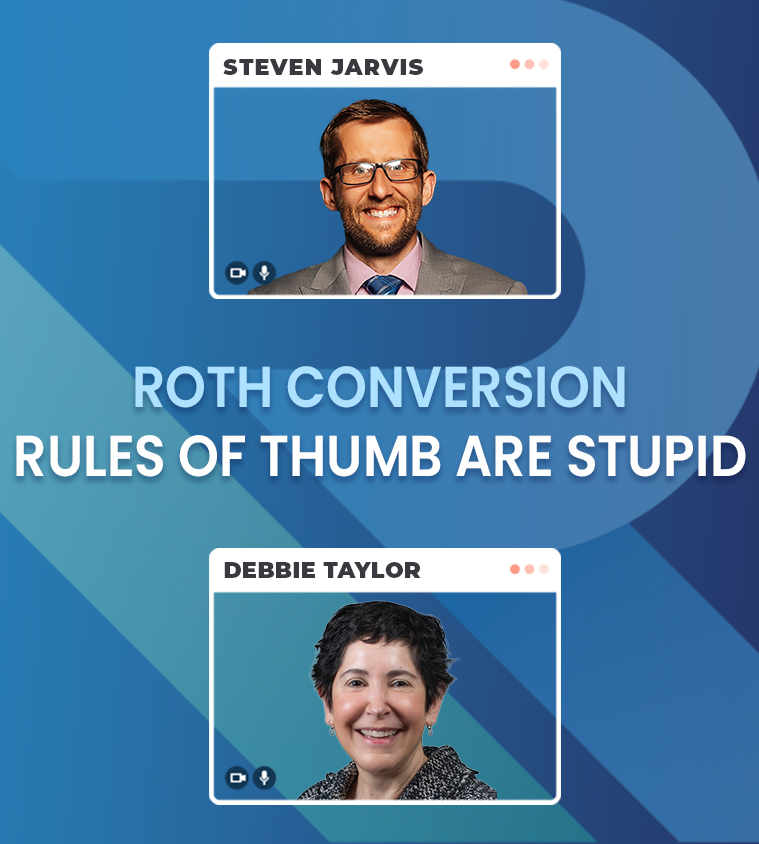
Steven is joined this week by another industry Tax Titan, Debbie Taylor. Steven and Debbie nerd out on all things Roth, taking turns sharing their “favorite” rules of thumb on Roth conversions and why they aren’t as helpful as most people make them out to be. It was a struggle for this dynamic duo to keep it to just 30 minutes, which means the time they did spend is packed with actionable insight on how you can wade through the noise and truly help clients when it comes to getting Roth conversions done.
Steven and his guests share more tax-planning insights in today’s Retirement Tax Services Podcast. Feedback, unusual tax-planning stories, and suggestions for future guests can be sent to advisors@rts.tax.
Are you interested in content that provides you with action steps that you can take to deliver massive tax value to your clients? Then you are going to love our powerful training sessions online. Click on the link below to get started on your journey:
Retirementtaxservices.com/webinars
Thank you for listening.
Steven Jarvis (00:50.19)
Hello everyone, and welcome to the next episode of the retirement tax services podcast, financial professionals edition. I’m your host, Steven Jarvis, CPA, and joining me this week is another tax planning legend in the industry Debbie Taylor, whom I’m so excited to have finally gotten to connect with virtually and Hopefully here soon. We’ll get to connect live, Debbie. Thank you for being on the podcast. Wellcome…
Debbie Taylor (01:10.68)
Yeah, good to be here.
Steven Jarvis (01:12.202)
I’m sure most of my audience knows who you are. You’re prolific in the industry for talking about taxes, but give us just a little bit of background about what you’re up to currently.
Debbie Taylor (01:19.798)
Wow, what am I up to currently? Well, I’m Chief Tech Strategist at Carson Wealth. And so we just finished the first year of that sort of inaugural program and we continue to build. So that’s actually been a lot of fun. And then, you know, I’m just continuing to write and be creative with my writing and my speaking about tax planning, which is the thing that I’m most passionate about. And I know you’re super passionate about it.
Steven Jarvis (01:43.726)
Yeah, absolutely. Which is I’m excited for this conversation. And I’m always torn between, hey, what’s the newest thing I can talk about? And then having to remind myself that some of these topics that you and I have been talking about forever still need to be addressed. And sometimes it’s the basics that need to be addressed and sometimes we kind of have to pivot on this stuff. so shocking no one, I want to talk about Roth conversions. And more specifically, I want to talk about, and I appreciate that you brought this up before we jumped in. Debbie, let’s talk about some of these, we use very sarcastic air quotes here, rules of thumb that people want to just try to oversimplify their life and move on with things. But I’ll let you go first. What’s a rule of thumb that comes to mind with Roth conversion? Let’s dig into whether or not it really makes sense.
Debbie Taylor (02:22.446)
So you shouldn’t do a Roth conversion if you’re in a high tax bracket.
Steven Jarvis (02:26.06)
I love that one. I’m sure you’ve seen this too, but when I tell advisors that I’ve I have clients who have and continue to convert in the 37 % bracket, sometimes it looks like their heads gonna explode like this is like malpractice or something. So Debbie, why should a person convert to Roth in a high tax bracket?
Debbie Taylor (02:39.308)
Yes, yes. Well, I mean, there’s a multitude of reasons. So first of all, it could be a good estate planning tool, which a lot of people forget with Roth conversions. And so what you find is a lot of people in a high tax bracket have children who are successful, who are also in high tax brackets. People have a potential estate tax problems, whether it’s federal or state, right? You can think about Roth conversions as a way of gifting or doing estate planning because you’re getting that money out of the estate and you’re prepaying the taxes for your children. So that’s just one reason why you would do them in the 37 % tax bracket. I’ll give you two others. So if you’re worried about taxes going up, it’s just a way to hedge against tax policy risk, which is very important. And then the third one to think about is when the market goes down. And so we do rough conversions when the market goes down. We did them in April of 2025 during the Trump tariff. tantrum. Okay. had like three or four weeks where the market was down 20% or close to 20%. We did them then. We also did them in October of 2022 when the market at its bare was down 20%. And so if you’re doing Roth conversions for clients who in the 37% tax bracket, when the market is down 20 % when you do them, then not really doing them in the 37% tax bracket, when you factor in the market rebound that inevitably happens. So those are just a few reasons why that rule of thumb does not make sense.
Steven Jarvis (04:11.47)
I’m 100 % with you there. And as we kick off this conversation, that’s a perfect illustration of I get where like rules of thumb might have originated from, but like there’s the reason that the tax folks like us answer so many questions with it depends. It’s not a cop out. Like we’ll have the rest of the conversation. But if you’re not applying this stuff to specific client situations, you’re doing your clients a disservice because blanket saying you should never convert in a high tax bracket. Like you’ve done a of clients in specific situations of disservice. That’s just not universally true.
Debbie Taylor (04:42.83)
Yeah. And so I think of it in a few ways. First of all, years ago, before we had the technology or the tools to really do this analysis, do this sort of case-specific work, know, rules of thumb then can be helpful, right? You just think about, you know, just historically, like if we didn’t have the tools to measure something, you would walk it out, and you’d say, oh, I walked it out and this room is nine feet. Well, now we have a tape measure where now we have a laser beam and we know that it’s not literally nine feet, it’s nine feet and eight inches, right? But for a long time, nine feet was as good an estimate or approximation that you could have. And I think these rules of thumb made sense at a time where we did not have the tools, didn’t have the technology to model this out. So thank you very much for decades that we had these rules of thumb, but they don’t make sense today anymore.
Steven Jarvis (05:33.846)
Yeah, no, completely agree. Debbie, another rule of thumb that comes to mind is, I hear this from people all the time, well, I shouldn’t convert to Roth if it’s gonna increase IRMAA. Yeah.
Debbie Taylor (05:44.088)
That is like the absolute work. Okay. First of all, when we’re making Roth conversion recommendations, we are modeling this out, the lifetime tax savings over the client’s life, right? So we’re modeling this out and we are adjusting for an additional IRMA charge over this next year or two or three years when we’re doing serial Roth conversions, for example, right? But here’s the other thing that I say to that client, right? Is I say, would you rather pay one or two years in higher IRMA surcharges now, or would you rather have a decade or two of higher IRMAA surcharges at the back end that you’ve basically lost all control over, particularly when one of you has passed and now that widow is paying that IRMAA Sur charge at a much higher rate. And I just shut that one down.
Steven Jarvis (06:28.494)
My mindset has changed a while ago as I’d listened to so many of these rules of thumbs that I didn’t universally agree with from advisors. And I think what advisors are saying when they so tightly hold on to these rules of thumb, what they’re really saying is, I don’t know how to articulate the value proposition to the client, so I’m gonna stay away from it. And because you just gave a great example of, hey, there is an additional cost. I’m not saying, hey, there’s a way to avoid that. And sometimes it’ll make sense, and sometimes it won’t. Either way, you need to be able to articulate to your client…Here’s the value proposition and why this makes sense. And if you can’t do that, that’s what you need to practice. That’s what you need to work on as an advisor, is your communication.
Debbie Taylor (07:05.038)
You know, I think that’s a great point, Steven, because what you find is that some advisors want to dip their toes into these areas, but they don’t want to do the work and the modeling, which is painstaking. It’s custom. changes every year. It even changes during the year. And what I say when I talk about this to advisors and train them is I’m like, you need to be prepared to defend your recommendations. And I think being, you know, an attorney, I’m a retired attorney, having trained as an attorney, you know, I think that that idea of how to frame an argument, how to advocate, you know, how to position things comes very naturally. And you need to expect some resistance because people are trained naturally to try to defer taxes. And it’s even as you know, a principle when you’re studying for the CPA exam, right? Is why to postpone taxes, try to postpone income. Well, there are times where it doesn’t make sense to postpone taxes. are times where it doesn’t make sense to postpone income, but we need to be prepared to defend that somewhat unorthodox recommendation.
Steven Jarvis, CPA (08:12.162)
Yeah, I’m totally with you, Debbie. And I got a little bit stuck on what you mentioned that people want to dip a toe in and that that doesn’t really work. And so I think maybe maybe you and I can change the language on this and we’ll just stop telling people that you can dip your toe into tax planning. Like you can absolutely jump in and swim one lap instead of trying to swim the English Channel. But tax planning takes work. And that’s something I try to talk about all the time. Like, yes, we can do this incrementally. You don’t have to take it on all at the same time. But if you think you can do it effective tax planning with just your toe in the water, you’re wrong. Like someone else is going to drown because you didn’t get in.
Debbie Taylor (08:46.946)
Yeah, I mean, I think that’s a really good point is particularly even now with OBBA pass. One of favorite slides, one of my favorite expressions is no drive by tax planning. Right. And so like there was a time not too long ago where we could make that Roth conversion recommendation. And yeah, like would you possibly phase out of one or two minor credits that you probably weren’t going to qualify for anyway, where you got a few bucks on and nobody even knew what those were. Right. So it wasn’t that big of a deal. Now with OBBA. I would tell you more than ever, there are no more drive by recommendations. And so I agree with you. think, you know, what we need to do as advisors is roll up our sleeves and, really be serious about this.
Steven Jarvis (09:29.774)
This might feel like it’s coming out of left field for people listening, but what comes to mind as you say that is to me in part it reinforces the value of narrowly focusing on who you work with so that you can better narrow in what you need to learn because there might be a thousand different things that might impact a Roth conversion, but if we get to a specific client situation, I’m probably looking for three or four or five key attributes to say, okay, what’s relevant to this client? I don’t need to learn all thousand things. If I work with clients that are in similar situations,
Okay, I know what characteristics I need to look for if the premium tax credits can be relevant. You mentioned 03BA. Okay, are they at an age where the new senior deduction is relevant? Like there’s some of these different things that can be very impactful that at a minimum, we at least need to know when to ask the questions. I’m all for whether you have an advanced planning team you work with, you have a CPA you work with, it’s just somebody on your team directly. Like I’m all for working with other people, but as the advisor having…any kind of tax conversation, you at least need to able to identify when do I need to ask more questions.
Debbie Taylor (10:30.466)
Yeah. And so I think that brings up a great point because what it reminds us of is having that target market or the niche or that specialty, because you can get really good at it. Right. Like we are doing Roth conversion analysis every day, right? Like every day we’re doing this. So we have templates, we have procedures, we have checklists, and we have like literally two people in this, in our office. And that’s a big part of what they do. And so when you do roll up your sleeves and decide to focus in, you can give the best service most efficiently with high quality. So I think that’s very fair. Yeah.
Steven Jarvis (11:02.414)
Okay, Debbie, what other rules of thumb? We’ve got never convert in a high tax bracket, which neither of us agree with. We’ve got never convert if it’s going to impact IRMAA, which neither of us agree with. What else you got?
Debbie Taylor (11:11.554)
Don’t make rough contributions when you’re in a very low tax bracket.
Steven Jarvis (11:15.298)
Make Roth contributions when you’re a low tax rate. Talk to me more about that.
Debbie Taylor (11:19.278)
Well, the idea here is that you’re supposed to be in a very low tax bracket in retirement. So why bother doing those Roth conversions if you’re in a very low tax bracket or why bother making Roth contributions when you’re in low tax bracket?
Steven Jarvis (11:33.922)
Yeah, and so what’s your argument against that?
Debbie Taylor (11:36.256)
My argument is we should be making Roth contributions or Roth conversions in low tax brackets because that money will have decades to grow in most instances. And there is a very good chance that you are going to be in a higher tax bracket in retirement. so, you know, the only reason I mentioned that is because my point here is that there’s so many rules of thumb connected with when you should not do Roth conversions. And sometimes they say, don’t do them when you’re in a high tax bracket. Don’t do them when you’re a low tax bracket. Like don’t do them when you’re still working right, is another one. But if we think our income is going to go up, if we think we’re going to move to a high tax state, if we’re worried about taxes going up in the future, tax laws changing, then even when you’re working, it could still make sense to do that Roth conversion.
Steven Jarvis (12:20.014)
Yeah, Debbie, I’m totally with you there. To me, one of the starting points of any Roth conversion conversation, it has to be specific to that client of, what is your income now? And what are, what are specific events in the future that are going to change your income? Like if we can’t understand that client, then what, are we even doing? Because Roth conversions, to me there’s, there’s two really valuable pieces to a Roth conversion. Potential tax savings, which as you and I both know, that’s, well, that’s only going to happen if tax rates go up in the future, whether because Congress changes them or our income goes up. Tax flexibility is another big piece of that. So even if I’m working with a client who they’re in a relatively low tax bracket now and we map out their income, like, you know what? You might be in a similar tax bracket in the future, but if I look at your assets and everything is pre-tax, what happens when you need a lump sum of money? That almost inevitably happens to everyone at some point in their life. Why wouldn’t we create flexibility now while we have the option?
Debbie Taylor (13:14.67)
100 % and we’ve seen people come to us with like 2 million or 2 and a half million dollars in a traditional retirement account and every dollar they need has to come out of a traditional retirement account which means they need to pull out a dollar 50 and it becomes a negative feedback loop essentially and so you want that tax diversification or that tax flexibility. Alright I’ll give you another one. This is a biggie. Don’t do a Roth conversion if the money to pay the tax dollars has to come out or is that ideally true most of the time? Sure, I would ideally prefer that the money not come out of a traditional IRA to pay for that Roth conversion. I think we all agree that that’s not the ideal place. But when you model the numbers, okay, if you’ve got somebody who’s got $2 million plus in a traditional retirement account, and they are before RMDs, they don’t have any other income yet, the social security has not kicked in, we have modeled that out and it has made sense to do Roth conversions to do exactly what you’re talking about is create that tax diversification, the tax flexibility and drive down that traditional retirement account balance for down the road. Now, are the Roth conversions as aggressive as they would be if we had a bucket of cash sitting on the side? No, if we had a bucket of cash, we probably would have been converting much more, right? When you model it out. But at the end of the day, it’s not a hard no, right? It’s a yes, but a qualified yes of let’s approach this thoughtfully and carefully, but it’s not enough, right? So that’s another big one.
Steven Jarvis (14:46.7)
Yeah, I’m totally with you. I’m really glad you brought that one because a couple of other things that come to mind with that one. I want to make sure I really hammer this because it’s something I talk about fairly often of we can’t let the mathematically optimal outcome get in the way of getting something done. And we’re all numbers people. I like I’m with you. I get where that inclination comes from of let me massage the numbers until it’s perfect. But you spend so much time doing that you never get anything done. We also have to remember that there’s there’s a very big behavioral piece to rock conversions. And we can casually do the math and say, okay, it makes sense. But for a lot of clients, there’s this kind of angst and pain with wait, you want me to pay the IRS how much on purpose before I have to? We like to do the math and think, our options are either this amount or this amount. And this amount is optimal. So let’s do that amount over there. But we also have that conversation with the client. And I’ve run into clients like this where if they have to write the checkout of their savings, they’re not writing it. They have the money, but they will not be caught dead writing that check to the IRS, but they’re okay with it being withheld from the distribution. And so if my options are do a zero-dollar Roth conversion or do a smaller than optimal one, but get it done. Yeah, I’m doing it.
Debbie Taylor (15:57.038)
100 % so let’s not let great be the enemy of good right okay. Here’s another objection Okay, so here’s another objection is what if the rules change that they start taxing the Roth conversions down the road.
Steven Jarvis (16:10.496)
What if they break the Roth promise? Yeah. Does Congress return your phone calls? They don’t return mine.
Commercial (16:17)
It’s a new year, which means new goals and an important time to remember that if willpower was enough, we’d all already be billionaires with six packs. What’s more important is systems and better yet, having the right team in place. As a financial advisor, you should be focused on three things, meeting with clients, growing your company and setting the vision for your company. And if you’re anything like I was a couple of years ago, what gets in the way of those things being the focus is all the other little to-dos that have to happen. And I always told myself I had to do. That all changed when I hired an executive assistant through Belay. Belay has a huge team of US-based executive assistants that they are ready to pair with financial advisors just like you to help you take as much off your to-do list as possible so you can focus on just those three things. Having an executive assistant means you have someone who’s gonna track your to-do list and take most of those things off your list for you so they get done, but you don’t have to be the one to do them. I had hesitations before I hired my first executive assistant, and Belay blew my mind with how well their system works, with how well they train people, with their process for pairing someone who works for me. So if you’re ready to learn more about how Belay can get an executive assistant on your team to help you crush this year and accomplish your goals, text RTS to 55123 and really commit to elevating what you’re gonna do this year.
Debbie Taylor (17:41.686)
So look, I mean, you know, look, it is legitimate because Congress has shown that they don’t know how to keep their word. OK. And they are completely mismanaging our country’s finances. You the Journal was reporting this morning, actually, our deficit, our national debt, all of its sky high outside of World War Two. We’re the highest that we’re ever going to be. You all of that. So we get the fiscal mismanagement. We also see, though, that Congress has been doubling down on Roth’s insecure act in 2.0. So they need that revenue. The Roths help to provide that revenue. And here’s my answer to that. And I’m curious, Stephen, what your answer is, because this one is a tough one. know, none of us have crystal balls, right? But here’s my thinking on this. First of all, they are essentially institutionalizing Roth IRAs at this point with all the recent legislation. So if they win and try to start outright taxing Roth distributions on the back end, I feel like there would be a total mutiny with all of these taxpayers that bought in and essentially have been forced now to be doing Roth contributions, particularly as part of Secure Act 2.0, Is catch up contributions now have to be raw. So they’re literally forcing people into Roth. So I just think that that would be, you know, sort of very problematic from a legal slash constitutional perspective. And, I do not practice law anymore, but I do feel as if that literally could even be violative of the constitution because we already paid taxes on it one time to come back to us to try to tax us a second time, I do think could even possibly violate due process. That is just my armchair thought on it. But here’s what I think could possibly happen trying to play out worst case scenario is possibly worst case scenario. For example, a Roth distribution is not counted towards Maggi for let’s say an Irma surcharge. Okay. I could maybe, maybe see them trying to do some back doorway of saying, oh, no, we’re going to revise the magic definition here or there. And maybe now all of a sudden we’re going to start including Roth distributions that way. So it’s not maybe a direct tax on the Roth, but it’s like this backdoor way. And here’s how I address that. And again, I’m just trying to play out worst case scenarios here is I’m like, if they try to do that backdoor type of approach, right. I still would argue that clients are better off 10, 20, 30 years from now going into retirement, being in retirement.
Debbie Taylor (20:06.06)
with those large Roth accounts that are primarily coming out tax free, even if there’s one or two little back doorways that they try to catch up with us, creating that tax flexibility. And by the way, leaving an inherited Roth IRA to your children versus a traditional IRA. And I will come back to the inherited IRA that’s traditional versus Roth because we’ve run some of those numbers and I’m sure you have as well. But I’m curious what your thoughts are on what if Congress changes its mind how you handle that. And then let’s talk about Securac and leaving an inherited Tritional versus inherited Roth and that whole part of it.
Steven Jarvis (20:42.84)
Debbie, think we’re gonna need to just change this podcast about three hours long. I’m loving this. when questions come up, whether it’s Roth specific or just in general of, but what if Congress changes the rules? My response is always a very quick, you mean when Congress changes the rules? Because the tax code is written in pencil, whichever party you dislike more, it’s everybody’s favorite tool come election season. So absolutely, tax laws are gonna change again. One of the things I say to clients all the time is that we need to make the best plan we can with the information we have today and the laws as they’re currently written. And yes, when Congress is in a cycle of talking about specific tax rules, I might hesitate just to, not even hesitate, I might be like a little bit patient to see how some of these things pan out, but if you want to wait for the tax code to be clear and stable, you’re never going to do anything. Those things will never exist. And so, yeah, I’ve gone down rabbit holes before trying to speculate. Okay, what may or may not happen? I can’t disagree with your theory on some of those backdoor things. At the end of the day, my strongest argument for I think they’ll keep the Roth promise is every year we keep getting more and more voters who have Roth accounts. And so I think I originally stole that from my good friend Ben Brandt. Hey, if you’re worried Congress might change the rules on Roth, you see, go get more of your friends to contribute to Roth. It’s the same reason that Congress has such a hard time making changes to Social Security, because lots of people who get Social Security also vote. I’m going to keep doing Roth conversions as if the Roth promise will be there forever. And we’ll deal with that. The other thing, Debbie, that that always reminds me of is I’m a huge advocate of doing the same things you’re prescribing to your clients as they make sense in your situation. If you’re all in on clients being in Roth, you better at least have some Roth dollars. I would like to hope you’ve done a Roth conversion yourself, because then if 20 years from now Congress says nope we’re gonna tax Roth at the very least at least we were all in this together.
Debbie Taylor (22:35.726)
100%. So I agree with you and you and I are basically saying the same thing. I’m saying they institutionalize Roths and that’s my way of saying, hey, we’re all doing this. So it’s going to make it really hard for them to change their mind. And I agree with you. mean, we have pretty sizable retirement accounts and over 60 % are in Roths. And so that’s a decent number for us. I agree with you. Okay. So here’s what I’m going tell you. The other thing then is from an estate planning standpoint, right?
Steven Jarvis (22:56.558)
A decent number for anybody. Yeah, nice and dumb.
Debbie Taylot (23:05.33)
Inheriting a traditional IRA is literally probably the worst asset you could inherit, right? Guns, crypto, traditional IRA, right? To me, it’s right up there, right? And so we ran some numbers inheriting a traditional IRA versus inheriting a Roth IRA. And if you just leave that money in there for the 10 years, we’re not even assuming an RMD on the inherited traditional IRA, okay? You leave it in there for the 10 years. And then at the end of the 10th year, you pull out that traditional IRA, pay the taxes versus that Roth IRA at the end of the 10th year and pay the taxes. And I know that there’s all different permutations. I get that. But at the end of the day, you’d have more than $2 million in additional tax-free wealth for those heirs if it’s a Roth IRA, inherited Roth IRA at the end of the 10 year period. I think we were starting with like 2 million. mean, the difference is absolutely staggering.
Steven Jarvis (23:59)
So now I’m totally with you. had run the numbers just quite like that before, but one of ways I have looked at it Debbie, which I think reinforces what you’re saying is that especially when that 10 year rule first came out, I got really concerned because there are all these advisors. I’m sure you remember this too. You’re probably in tons of questions. The rule came out and then the IRS basically kept saying, hey, but we’re not going to enforce it yet. We’re not going to enforce the RMDs yet. And so all these advisors are like, hooray, we can wait. And I was like, wait, time out. You only have 10 years. It’s the required minimum. think what I originally did, it’s been a little while now since I did the math, I took like a million dollar inherited IRA, and I went as simply as, what’s the tax difference if we take it all in year 10 versus evenly throughout 10 years? And it was like a six figure difference. And that’s overly simplistic and not the way you should approach it, but you’ve got 10 years, and so even if we ignore Roth for a second, like you have to be proactive when you have options in front of you or you’re gonna get killed on taxes.
Debbie Taylor (24:53.55)
Yeah. So, I mean, there’s a lot there to unpack. So first of all, we call that post-mortem planning, right? Is, the client comes to you, they inherited that IRA. By the way, that’s happening more and more, right? So in 2020, you had like five clients that did that, right? That somewhat died like that month, right? Or in 2020. But now, you know, you have a book that is growing of traditional inherited IRAs that your clients are inheriting with that 10-year period. So you need an entire process around that. And you’re right, you the example I gave to you was overly simplistic to make the point because, you know, we’re not going to wait until the 10th year to pull out, know, $2 million, right? We know that. The point is that you need to be proactive. You need to be thoughtful during that 10 year period, working closely with the client post-mortem planning. So that’s one part of it. But then the other part that we’re talking about is the profound benefit that goes to your beneficiaries. If you leave them a Roth IRA versus a traditional IRA.
And I think when you’re trying to have that conversation with clients, know, until they can actually see those numbers in front of them, you know, all they see is a big price tag upfront, right? a pay taxes, right? But when you sit there and model out, here is potentially the difference and it is millions of dollars because let’s face it, a Roth IRA, you leave it there for 10 years, you don’t touch it. It’s going to double over those 10 years, tax free. Okay. There’s no amount of post-mortem tax planning that you’re gonna be able to do on that traditional IRA to make that match essentially the doubling of an inherited Roth IRA. One of the best assets that you can leave to your children is that inherited Roth IRA, even if they do have that 10 year period. And so that’s another sort of angle here.
Steven Jarvis (26:35.182)
Totally agreed. I’ve talked to, I don’t know, thousands of taxpayers at this point about Roth. And I’ve had two, literally two, who have said, screw the kids, they can pay the taxes. And we didn’t do Roth conversions, but it was two out of thousands. And so sure, like great, we can spend all of our time on these exceptions, or we can learn how to help the majority of our clients.
Debbie Taylor (26:56.184)
Well, I mean, that raises a great point because I’ll tell you, even within my clients and prospects, and I’m in front of prospects now all the time, large prospects, I will tell you, I’ve only seen one client in 30 years that had a hundred percent of his assets in a Roth IRA. Okay. One client. And by the way, he was a CPA. Okay. So he died. It’s like three or $4 million. All in Roth account. Other than him, I have never seen somebody that you could argue has over-converted, right? Like, this guy came to me, he’s got four million, he’s got three and a half in Roth. He didn’t really need to do three and a half Roth. He could have been fine at two and a half or three in Roth, right? I have never seen that with the exception of this one client, right? And my point is that people are erring. Advisors, investors, do-it-yourselfers. And if everybody’s erring, they’re erring on the side, of under allocating to the raw.
Steven Jarvis (27:56.744)
That’s what you’re implying behind this as well. It’s not that they’re consciously looking at Roth and pre-tax and saying, nope, I’ll do pre-tax. It’s that that’s just the default. That’s what they were steered into. It’s hard to make changes. so it’s not that for advisors listening, it’s not that your clients did this in-depth analysis and they’ve morally landed on, need to do pre-tax. It’s that no one’s ever explained to them the difference and given them a path to do something about this. And so they’re just going with the default and that’s how we get killed on taxes.
Debbie Taylor (28:26.008)
Yeah. And so what I say when I meet with prospects is I say, you know, the government, the IRS wishes that you never met me. Okay. Because I’m the first person to tell you, and by the way, you’re in your sixties, you have three financial advisors, whatever, right? You’re supposed to be really smart. You’re an engineer and nobody has had this conversation with you. And you’re sitting here with the three and a half million dollar traditional IRA, right? And so I agree, I think there’s been a ton of momentum in favor of traditional retirement. Look, the Roths weren’t around for many years. And then they came around, people didn’t really understand them and advisors weren’t talking to them. And then the Secure Act changed everything, right? The Secure Act changed everything. So if you were on the fence before and now the Secure Act is basically an inheritance tax on large IRAs, right? It’s not the Secure Act, it’s an inheritance tax on your children. And so people don’t even realize that they don’t understand it. And I think, you know, a lot of advisors have not done a great job, you know, having this conversation. So I just think it’s sort of everywhere. This momentum for the most part in favor of these traditional retirement accounts and part of your job, Steven, you do a great job of it. Part of our job is to educate our clients so that they don’t tip the government as, you would say, right.
Steven Jarvis (29:41.838)
Debbie, I’m not sure how this would work anyways. I feel like I need to acknowledge that neither of us are somehow affiliated with the Roth concept. We don’t get paid for doing Roth conversions. In fact, a lot of the advisors I work with follow an AUM model and you could argue that they lose money by having clients convert to Roth. But it is so valuable for the client that in more seriousness, I feel like I should say Roth is not the magic answer to every situation. don’t pressure my clients into always converting to Roth. But…It’s so universally available that I genuinely believe that at least needs to be considered for every taxpayer you meet. And there are going to be times where the answer is no, or it’s no this year, or not yet. But if you haven’t even considered, like, please, please call me if you think that there’s just a whole swath of people that shouldn’t even think about Roth ever. Like, I’m going to argue pretty hard.
Debbie Taylor (30:32.174)
Yeah, and I think that’s a great point is, we’re digging deep and nerding out on like Roth IRAs, which is fun, but taking a step back, you know, I consider it part of distribution planning is what I’d call it. And there are a number of tools that you can use in connection with distribution planning. So that could be just, just drawing down a traditional IRA in low income years, right? That is, that is effective. And there are times that we are doing that in conjunction with the Roth or by the way, in place of the Roth where the client just doesn’t have the appetite to pay the tax upfront and not get anything in return, right? And so we’re like, okay, then let’s start drawing down this traditional IRA before RMDs kick in before social security, right? So there are other tools, there’s the QLAC, right? So that’s a tool, there’s QCDs to help out. So I mean, there are a number of tools in the toolkit that we’re looking at. I know you’re looking at them, but I think we’d be remiss if we didn’t lean heavily on the Swiss Army knife is what I call the Roth IRA.
Steven Jarvis (31:29.388)
Debbie, could nerd out on this for hours with you. Appreciate all your insight and expertise. How can people follow along with the great stuff that you’re doing?
Debbie Taylor (31:36.046)
Yeah, I mean, there’s social media with Carson tax. So, you know, we’re out there, we’re doing speeches and I’m writing a ton of articles for horses mouth every Monday. I have the lead article for the week on tax planning. So just a lot of different places like you.
Steven Jarvis (31:50.36)
Exciting. Well, Debbie, so very much appreciate your time and expertise this week and for everyone listening until next time, good luck out there and remember to tip your server, not the IRS.