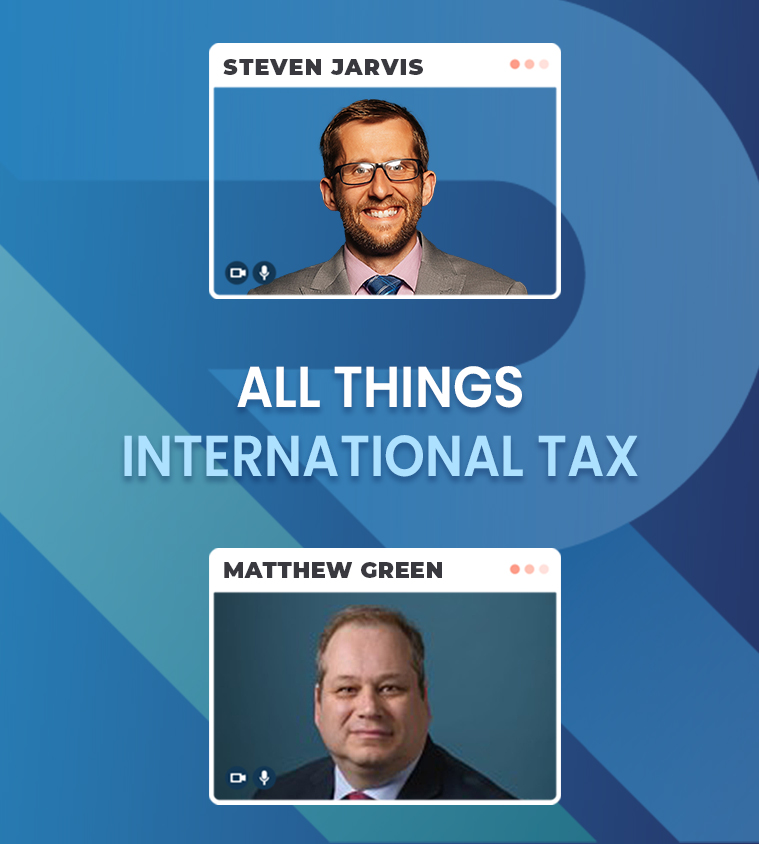
Steven is joined this week by someone with personal and professional experience with international taxes: Matthew Green. Matthew shares his personal experience learning about the US’s approach to taxing it’s citizens living abroad and through that started sharing his newfound expertise with others. He now works specifically with taxpayers navigating international waters to make sure they don’t get killed on taxes. While a lot of the discussion is around avoiding common mistakes and staying in the IRS’s good graces, Matthew and Steven also talk about the potential for tax planning, even when there are international considerations.
Steven and his guests share more tax-planning insights in today’s Retirement Tax Services Podcast. Feedback, unusual tax-planning stories, and suggestions for future guests can be sent to advisors@rts.tax.
Are you interested in content that provides you with action steps that you can take to deliver massive tax value to your clients? Then you are going to love our powerful training sessions online. Click on the link below to get started on your journey:
Retirementtaxservices.com/webinars
Thank you for listening.
Steven Jarvis, CPA (00:50)
Hello everyone, and welcome to the next episode of the retirement tax services podcast, financial professionals edition. I’m your host, Steven Jarvis, CPA, and I’m excited for this week’s conversation because we get to address a question that I get fairly regularly, but I am not an expert in myself, and that is related to international taxes. So joining me as an expert in this area, I have Matthew Green, Matthew, welcome to the show.
Matthew Newbery Green (01:12)
Thank you for having me on. I’m glad to be here.
Steven Jarvis, CPA (01:16)
Yeah, Matthew, I’ve got a whole range of questions because like I said, I’m not an expert in this area. It’s an area that I quickly refer out because I think it’s an area where people should be working with someone who does spend their time on international tax. But before we dive in, just give us a little bit of background as to what it is you do and how you arrived at this place where you’re helping people on taxes broadly, but also on the international piece.
Matthew Newbery Green (01:39)
Yeah, I’m a dual citizen, American and British. I was born here to British parents, and then they left when I was very young. So the family kind of forgot that I was an American. Then we need to fast forward 40 years. was working as in internal audit in Qatar, working for the national oil company. And some of my friends there said, by the way, you do realize you’re still an American. And I was like, no, I didn’t know that. So I took my baby passport and went over to the embassy gave them a good laugh looking at my passport. They actually wanted a copy of it because they’d never seen anything that old. And got my passport updated, and then it dawned on me, I can’t remember how, but I needed to do tax. And so I went through a programme of, that’s called the Streamliner programme, where people who have been delinquent in their returns, if they’re abroad and have foreign assets, then you can do a catch-up program with very little penalties, hopefully in most cases zero. So there’s a good opportunity for people to get themselves up to date through the Zamnesty program, and I went through it. Because I went through it, I wanted to help people that do that. At the same time I was doing this, I came over to the US to do my masters because I had discovered a big tax issue in Qatar that I’ve been working with where somebody handed me a K1 and I was like, do they need to pay tax? And they said, yeah, they probably do. It was a K1 from a partnership, and there was millions of dollars involved. So I took this back to my bosses and they were absolutely horrified and we appointed somebody in the US to take it over. And I discussed doing tax because I found that I really, really liked it. And so I discussed doing tax with the people that we had appointed to help and they said come and do a master’s. So without cutting a long story slightly short, I chose Denver because it had all sorts of different good reasons for going there. So I came to the University of Denver to do my master’s in 2015 and stayed here ever since obviously being an American and have now branched out on you know into doing international tax. I started ever since I graduated I started working in the international tax Sphere and that’s always been the bit that speaks to me because of my background. So that’s how I came in there to come and do it and I find it fascinating.
Steven Jarvis, CPA (03:58)
Yeah, there’s definitely a lot of interesting things in the area. then, mean, because of course, then you’re not only dealing with the US tax code that changes constantly, you’re also dealing with other countries tax codes and the trees between those countries. for people listening who aren’t as familiar with international tax, let’s start just from a really high level because you hit on it there. But I want to make sure it’s clear to everybody listening. The US definitely has this approach where they are going to hold on to as long as they possibly can wherever you are. Matthew you tell me if you explain it differently to to people but the general idea is that if you’re a US citizen the US basically considers all of your income wherever you earn it as US income and… Yes, they’ll probably give you a credit for taxes you pay other places But you can’t assume that just because you’re halfway around the world the US doesn’t still want a piece of what you’re
Matthew Newbery Green (04:44)
That’s absolutely correct. The shortest way to put it is that America is one of two countries in the world that will tax you on the basis of your nationality rather than residence. So wherever you are, you’re an American, if you’re going to live in Newfoundland, Iceland, the Antarctic or anywhere, you still have to file a US tax return. Now that doesn’t necessarily mean that you end up paying tax, but you have to report everything on a worldwide basis. Most other countries will, if you become a resident by their standards, then they will tax you on a worldwide income where you’re a resident. But America doesn’t. America says, as long as you’re a green card holder, a permanent resident or you are a citizen then you have to file your taxes and report all your worldwide income.
Steven Jarvis, CPA (05:28)
Yeah, this is really important. Over the last few years, I’ve seen more of a trend of people who are getting towards or into retirement, which is a lot of the clients I work with, a lot of the advisors I talk to are working with clients in that space. And we’re getting more and more people who are asking these questions about, what is it? What if I go and live, live abroad? What if I move completely? And so the more and more of these questions come up and I’m always looking for, I get lots of questions about when should people stop DIY in their return. And if we’re talking about international tax, we’re way beyond just should you not DIY, because you should absolutely not DIY your taxes if you have international considerations. But I would even take it a step further that if you’re to the point where you have international considerations, it’s not just that you should be working with a professional, you should almost certainly be working with a professional with expertise in that particular area. This isn’t, let’s hope my local CPA can figure out how the tax treaties work with Spain. It’s let’s find somebody who’s done this before.
Matthew Newbery Green (06:21)
Absolutely. I mean that’s why I do this is because I like the experience of doing this. It is more challenging but yes absolutely you should, people should always go to somebody who knows their stuff no matter what. I mean it’s a simple principle that even for people with non-international tax issues it’s better if you go to somebody, if you’re an engineer you go to somebody who has a particular experience in your field. Because businesses are allowed to deduct anything that’s ordinary and necessary, ordinary just means that what is usually in that industry. And if you don’t know what that industry is, then that can cause a problem. And it’s the same thing with international tax, or the international size of American tax, I should say. Once you get into assets abroad or having any kind of foreign entanglements, the tax code gets a lot more complicated, and the penalties for making a mistake in it are significantly more frightening.
Steven Jarvis, CPA (07:16)
Yeah, that’s a really good point Matthew because you’re absolutely right. Whether we’re talking about just foreign disclosure reporting or actual income earned in other countries, there’s no logic in the tax code to begin with. But you’re absolutely right. It’s not uniform across the board of how the IRS is going to come after you or how they’re going to penalize you if you do this wrong. And it gets more complicated as well as more severe if you do it wrong.
Matthew Newbery Green (07:39)
Absolutely. If you have any kind of foreign business entanglement, then in most cases you have to file what they call an information return. So you have to file effectively a set of financial statements and you may or may not pay tax on that income in the US. And if you don’t file these forms correctly or on time, all of these information returns have a $10,000 penalty attached to it.
Steven Jarvis, CPA (08:06)
Yeah. That’s wild. That adds up real fast. So Matthew, I know at this point you primarily work with businesses with international components, but obviously you yourself have these international considerations and all business activity eventually is going to end up on an individual return of some kind. Where does a person even start? If I’m a US citizen who’s considered working abroad, living abroad, you know even taking what an extended vacation that turns into what looks like residency somewhere like..How do I even start learning what I need to be aware of if I’m going to go live in another country?
Matthew Newbery Green (08:38)
Well, the best thing to do is to not necessarily try and do it all yourself. You look for somebody for international tax accountants and find somebody that actually specifies that they deal with the specific aspects of having assets abroad and having income abroad. What they will see, look for expat taxation, things like that. It depends upon the level. But you should always do a good Google search and try and look for people or get recommendations for people that exclusively deal with foreign tax issues.
Steven Jarvis, CPA (09:12)
Matthew, in your experience, how important is it that that person have experience in that specific country? Because I think as humans, we wish everything just had a rule of thumb that we could follow. And sure, there are some concepts that span multiple countries, but there are also unique aspects to this depending on the country you end up in. So, how important is it that I find somebody with experience in that particular country I’m interested in?
Matthew Newbery Green (09:35)
Well, one of the main problems you’re going to have, particularly with people in my position, is that nobody can cover every country. Right? So the chances of finding somebody who actually deals with both sides of the equation, unless you’re looking at seriously big firms, is small. So what most people end up doing is having a tax advisor on both sides of the Atlantic or both sides of the world. And then the two advisors get talking to each other and work out what potential issues there are. So it isn’t actually that important to find. It’s important to find somebody who can navigate their way around the tax treaty with the country that you’ve got, but everybody’s tax situation is different. So you need to find somebody in the US who knows their stuff and find somebody locally that knows their stuff as well. So it does get quite complicated if you want to move across.
Steven Jarvis, CPA (10:30)
Yeah, that makes a lot of sense to me. again, I’m very quick to turn away international tax work because it’s not an area of expertise for me. We have a couple of clients who have international tax elements. But in each of those cases, the only reason we agreed to work with them is because they had a dedicated person in that country. And so they’re not coming to us saying, OK, Steven, now you’re responsible for navigating my tax obligations in whatever country they’re in, our role becomes more just facilitating, having that conversation with that person who is handling everything there. Because at the end of the day, it depends on the country and the situation, it doesn’t have to be overly complicated, but if you’re new to it, it’s going to be confusing. It’s going to be challenging.
Matthew Newbery Green (11:10)
Yeah, absolutely. mean, I’ll give you an example.If you take Spain, most people would sit there and go, OK, fine, I need to go and be a Spanish resident. But there are special programs. It’s called the Beckham Rule, where David Beckham, the soccer player, lived in Spain and they gave him huge tax breaks. So you can actually get a much lower tax rate if you are temporarily resident in that foreign country. So it’s always good to check with somebody who knows the subject who knows the subject from each angle. yes, somebody who can navigate you through this is important, but it can also save you lot of money on tax in the foreign country as well.
Steven Jarvis, CPA (11:45)
Yeah, because regardless of the country we’re in, money and the concept still holds if we want to pay the taxes we owe and not leave a tip. Maybe it’s not the IRS, maybe it’s a different taxing authority, but let’s only ever pay what we absolutely have to. And usually the best way to make sure we’re doing that is by being proactive and finding people who can help us understand where we have options and what our choices are.
Matthew Newbery Green (12:08)
Absolutely, absolutely. You need to find somebody who really knows their stuff. And unfortunately, some people may actually tell you that they do that. But I’ve seen the odd example where the person who said they could do it couldn’t.
Steven Jarvis, CPA (12:21)
Matthew, that’s certainly a challenge, regardless of the topic at times within tax. OK, how do I vet someone new? And as you and I sit here and say, hey, you absolutely need somebody who specializes in this area, what do you recommend to people as far as a screening process when they’re picking a new tax preparer to work with?
Matthew Newbery Green (12:38)
Well, I would suggest that you do a bit of googling and do a bit of research into what you have to do. Pick out some form numbers and then talk to the person and say, do you do Form 5471? And how many of those have you filed? Because if they say, well, I’ve done one or two, then you may want to move on to somebody who’s done 40 or 50.
Steven Jarvis, CPA (12:57)
Yeah, that’s interesting to get specific with it. I like that. It’s something that resonates with me of, what are those? Because I think you’re right. If we ask generic questions, it’s easy for people to say, ” Yeah, well, of course I do that.” But when we get more specific, that’s when we’re going to uncover more of, OK, but do you do this a lot? Have you really worked with people like me? So that we make sure that we’ve at least done our due diligence. Obviously there’s gonna be those bad actors out there. It’s thankfully still I think the exception that someone’s just going to flat out mislead you if you ask them detailed questions, but let’s at least take the time to have asked those questions.
Matthew Newbery Green (13:30)
Yeah, I mean, it’s kind of similar to employ, you know, appointing a lawyer. You know, if you, you know, if you get mown down by a bus, want an you want a you want an injury lawyer. And if you want a patent done, you have to get a patent lawyer. You know, you don’t just go and get any old lawyer, you get one who actually specializes in the field. And it’s the same with accounting.
Steven Jarvis, CPA (13:47)
That is an interesting analogy because it does seem like for the general consumer, people intuitively understand, I need a specific type of attorney. But consumers still just generically, I need a CPA. It’s like, no, no, CPAs, tax professionals, whatever their designation is, they’re not all created equal. We need to find people who are going to be able to provide the service that we actually need.
Matthew Newbery Green (14:10)
Indeed. mean you’ve got to, people obviously don’t know much about the tax system but the tax code is so broad, it’s so big and all encompassing that you cannot be an expert in all of it.
Steven Jarvis, CPA (14:20)
Yeah, yeah, that’s that’s one of those things to look out for that I actually I’m really encouraged by professionals who will just tell me here are the things that I don’t do well, or here are the things that I’m not going to take on because if you try to tell me you’re good at everything, I know you’re lying like that’s not it’s just not possible.
Matthew Newbery Green (14:36)
Yeah, absolutely. You know, I don’t do much in the world of crypto and stuff like that. And I’m more than willing to admit that that’s not my field. You know, I’d much rather be upfront and honest with people than actually try and take on something that I then have to try and muddle my way around.
Steven Jarvis, CPA (14:51)
Matthew, as you’re working with people who are new to the international tax base, what are the things that surprise them the most or the things that you have to do the most kind hand holding to help people get through?
Matthew Newbery Green (15:00)
Well, the biggest issue that I find is there’s an issue of PFIX, which is Passive Foreign Investment Corporation. The basic idea of it is if you take a rental property, you have a rental property abroad and you put it into a corporation. You then have to do information returns on the corporation and you may or may not pay tax on that income. The IRS’s focus is not these days, it’s not necessarily so much about avoidance as deferral. What they don’t like people doing is hiding assets away. So there’s a whole new regime which came out in 18 about how these companies can be taxed, but there’s also a passive they also have a bit of a downer on passive investments. So if you are parking passive investments in a foreign company then that is an issue but where that really becomes an issue is certain is mutual funds and ETFs because they if they’re structured as a corporation and you buy units in it it is automatically one of these PFIC things. Now depending upon, there are various routes and it’s a very complicated topic, but essentially there’s a very punitive regime for taxing of those particular funds. So if you get income from a fund, then that gets taxed in the US, but it can be at like 40 % because it’s taxed at the maximum rate and they attack on penalties and all this kind of stuff. So you end up paying loads of money, so that for your accountant to prepare your tax return and also for the the extra tax involved so you can’t ever make any money on these. Where that really becomes important is that these days every most investments are based upon ETFs and funds. You can’t go and open up, if you go and open up a savings account or anything in a foreign country, particularly if you have a pension plan or a tax advantage savings account in a foreign country, then most of these will have these funds in them. And people are like, wow, I shouldn’t be investing this. And the answer is no, you really shouldn’t. Not if you want to make any money because the tax and compliance costs are outrageous. So that’s one of the biggest areas that I find. And this is one of the biggest reasons why I strongly advise people to speak to somebody who knows what they’re doing before you go. I’ve dealt with people like Australians who’ve come over here, they’ve been given a job by their parent company or whatever in America, and all of their investments in Australia that they thought were perfectly fine are going to fall into this and they’re going to end up with ruinous tax consequences. I’ve known of a couple of people who left the US because of this.
Steven Jarvis, CPA (17:36)
It’s so important to take down the time to understand what we’re really getting into before we make those decisions. it’s not the kind of, all too often people think about taxes as, that’s something I’ll deal with at end of the year when I file my tax return. But especially when we talk about where our residency is going to be, where we’re earning income, if we’re only thinking about this after the fact, we can do a lot of damage on our tax bill..
Matthew Newbery Green (17:57)
Absolutely, absolutely. Because some of these things you can’t really do anything about once you’re here. Once you’ve got that American residency, there’s nothing much you can do about it apart from ditch these stocks, which people don’t want to do because they’re not necessarily going to make much money on them.
Steven Jarvis, CPA (18:11)
Matthew, at what point in the process should a person be doing their own research versus reaching out to a professional? Like, hey, I’m considering this, or hey, this is three months away. When do you engage a professional to help you in this process?
Matthew Newbery Green (18:23)
Well, you can engage somebody when you start thinking of it, but it’s probably better to do it once you have a concrete plan in mind. I mean, there’s no point paying for somebody to give you all sorts of advice until you have something reasonably decent in mind.
Steven Jarvis, CPA (18:39)
Are there any resources or content sources that people can go to if they’re just looking to like high level learn about these things or is it kind of more specific and nuanced?
Matthew Newbery Green (18:49)
As an overview, there are plenty of articles out there that are written by tax attorneys and stuff that will give you guidance on these particular topics. to get any, it’ll never be specific to the person’s situation. And that’s why actually, having an idea of is this going to be a problem, then you can go to somebody and say, is this going to be a problem?
Steven Jarvis, CPA (19:13)
That makes a lot of sense. Matthew, how can people specifically learn about what you’re doing? As people listen to this and say, hey, I need help on this, and Matthew’s the guy I want to reach out to, how would a person get in contact or learn more?
Matthew Newbery Green (19:24)
You can always just go through my website, is, or do a Google search for Newbury International. It’s newberyinternational.com, which is all one word. But yeah, they can go on there and that, can make, you can make an appointment to speak with me. You can, you know, you can ask questions through that portal. But usually the best thing to do is set up a time where you can have a chat with me about your situation.
Steven Jarvis, CPA (19:42)
Well, I certainly appreciate that because like I said, as we kick this off, this is definitely an area where I even though I’m not the expert in the area, I feel very strongly is something as you’re getting into this, you want to work with someone who does this all the time. And so for advisors listening, whether that’s you personally, or you’re working with clients who are starting to have international tax questions or considerations, or looking at making decisions on these things, like this isn’t something we want to make up as we go, we want someone who can help us navigate this in a way that we’re compliant, and that we’re saving taxes where we can.
Matthew Newbery Green (20:11)
Indeed, and once you get into things like tax treaties it gets a lot more complicated because people have the mistaken idea that because there’s a tax treaty between the countries you don’t have to pay any tax on your income in Finland or whatever. It doesn’t work out that way. Tax treaties are just there to define who gets to tax what income, but there’s a sneaky part that’s hidden in most tax agreements that actually says that each country can tax the individual. It’s usually a citizen or sometimes a resident, regardless of what the treaty says. So it does get more complicated than it’s a treaty. I don’t have to pay income on this, my interest income. I get loads of people who say, but the treaty says I don’t have to pay any tax on my interest. And the answer is it does, but that section doesn’t apply to you because you’re American citizen.
Steven Jarvis, CPA (21:01)
Yeah. Yeah. It pays to get specific. pays to have somebody on your side helping navigate this. Well, Matthew, I certainly appreciate you taking time to share your expertise and experience. Any other thoughts for people who are new to this international tax space?
Matthew Newbery Green (21:13)
With the exception of the Pfic thing that I said, the thing that I always advise all of my clients is tax is usually only 20 % of the problem or 20 % of the issue, right? If somebody offers you a million bucks to go and work somewhere and you’re going, my goodness, man, I have to pay 40 % tax. I’d rather think about the 600,000 that you’re making after tax than the 400 grand of tax that you’re paying. People have an aversion to paying tax and that’s fine. That’s just human, don’t have to sit there and go, oh my goodness me, I can’t afford the taxes in the next country. Because it isn’t always that much of the equation, particularly from the American side. Europeans pay up to 50 % tax. So if you go and live in Europe, you’re going to get taxed more. So theoretically, depending upon what you have, you probably won’t pay any tax in the US because of the tax credits or the treaty.
Steven Jarvis, CPA (22:14)
Matthew, that’s a great reminder to end this on because I’m a huge fan of let’s make good life decisions and then figure out the tax efficient way to go about them. I’m with you. Like sometimes we got to take a step back. Remember what the positives here are. Obviously navigate the compliance piece correctly, but just because there are taxes involved doesn’t mean we should avoid something like the plague.
Matthew Newbery Green (22:32)
No and people do get overwhelmed by tax and it’s easy for us professionals to say but it’s like don’t get overwhelmed because there’s always a way around it. Don’t run away from things, run towards them and find out what you have to do.
Steven Jarvis, CPA (22:46)
Absolutely. Well, Matthew, thank you again so much for taking the time to come on and talk about this and for everyone listening until next time. Good luck out there and remember to tip your server, not the IRS.