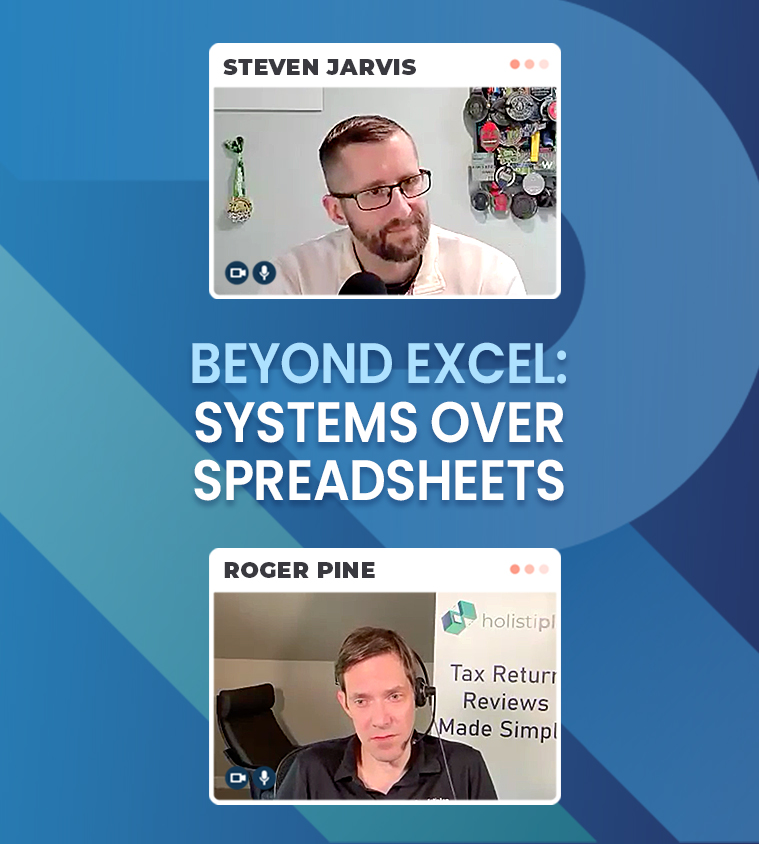
In this episode, Steven Jarvis sits down with Roger Pine, Co-founder of Holistiplan to explore how advisors can systematize tax planning in their practices. They discuss why Excel alone isn’t enough, the importance of creating a repeatable process, and how Holistiplan helps advisors deliver richer financial planning to more clients. From the software’s origin story to innovative features that streamline tax return reviews, this conversation highlights the real work behind every client, every year.
Steven and his guests share more tax-planning insights in today’s Retirement Tax Services Podcast. Feedback, unusual tax-planning stories, and suggestions for future guests can be sent to advisors@rts.tax.
Are you interested in content that provides you with action steps that you can take to deliver massive tax value to your clients? Then you are going to love our powerful training sessions online. Click on the link below to get started on your journey:
Retirementtaxservices.com/webinars
Thank you for listening.
Steven Jarvis, CPA (00:51)
Hello everyone, and welcome to the next episode of the Retirement Tax Services Podcast, financial professionals edition. I’m your host, Steven Jarvis, CPA, and this episode might be one of the most requested as far as questions I get from advisors, which is some of some version of Steven tax planning sounds great, but what tool should I be using to get it done? Joining me this week on the podcast is Roger. Roger, welcome back to the podcast.
Roger Pine (01:15)
Yeah, happy to be here. Is the answer Excel? What’s the answer for the best place to do tax planning?
Steven Jarvis, CPA (01:20)
That nerdy part of me, there is that nerdy part of me that wants to answer to everything to be Excel. I used to proudly call myself an Excel wizard. And then I grew up a little bit and realized that I really should focus on the thing I am best at, helping clients take action, communicating, all those kinds of things. And Roger actually quotes you all the time and hopefully I quote it correctly because at least I attribute this to you years ago, you described it as, Holistiplan is an incredible tool and every tool needs an operator and that really resonated with me because I’m focused on creating great operators and Holistiplan has really done a great job of creating great tool.
Roger Pine (01:51)
Yeah, no, it’s a great, yeah, the star of the show is not the software. I wanna be in the background and let the advisors who work with us to be the heroes of these conversations. And that’s how we always think about it. And yeah, it’s a good operator and there’s advisors who do great work every day. They’re the ones who inspire me to keep making stuff for them so they can be the best versions of themselves they can be. And you do the same. So I appreciate the work you do with advisors as well.
Steven Jarvis, CPA (02:15)
Yeah, absolutely. It’s definitely a natural, natural collaboration for us to jump on this together. Roger, as I talk to my audience, I would imagine that most of them know who you are and know who Holistiplan is. I think the most recent T3 report I saw showed something like 40 or 50 % market adoption for Holistiplan. I might be getting that wrong, but I mean, you’re getting to the point where maybe a household name for a lot of people, but still give it. Give us kind of like the quick origin story of why this is such a passion project for you in particular, and then we can kind of talk about where Holistiplan at and where it’s headed.
Roger Pine (02:44)
Sure, well, the origin story is a midlife crisis.I was working as a financial advisor myself. In fact, I worked as an advisor for about 10 years in a very planning-centric firm. And one, I fell in love with computer programming. That was part of it. Also, I just really was fascinated within our own firm wedid a lot to try to get as efficient as we could with planning and planning doesn’t scale well. It’s hard to do a very personalized service that is also scalable. And we did a lot of cool things in the business and I wanted to do more. And so I turned 40 and I had a midlife crisis and I left and went into the wilderness. And a couple of years later, with a partner started Holistiplan and our goal, our mission statement, as we stated is we’re here to help financial advisors deliver richer financial planning to more clients, richer financial planning, like how do you go deeper? How you do a better job? More clients, how do more of your clients get the services and how do you get more clients to deliver the services too? And so that’s been it. I took everything I learned as an advisor, all my network, all my friends in the planning world and we together have built something that we have now over 10,000 firms using Holistiplan today. It’s exceeded my wildest dreams when I thought of the old, we’ll help a couple of people figure this out. But it’s made a real impact. And I think tax planning is having a great moment as well. And kudos to you and others who are out there carrying the torch for tax planning in general, because we’re just a tool, like you said earlier. It’s tax planning is the actual thing that is really making a wave in the profession right now.
Steven Jarvis, CPA (04:23)
I love it. Thanks for sharing that. Yeah, you’re absolutely right. The star of the show is what actually gets done for clients.. I’ve always just had a personal aversion to some pie in the sky… Promise that that may or may not actually come to fruition what what I’ve always appreciated is this combination of yes… We have absolutely want to help clients with real tax savings, but we want to help clients and advisors both understand what’s going on in a tax return understand where the opportunities are where there’s potential issues, like just how do we navigate this and to me most important? How do we then take action? So? Definitely appreciate the emphasis there
Roger Pine (04:56)
Yeah, thank you. You one of the things that’s always hard about building software, especially when your audience is, you know, people who are new to financial planning, people who’ve been doing it for 20 years is how do you meet all of those people where they are such that, you just talked about going into detail and depth and, some people want that, but some people also just want the surface level and meeting all of those people where they are and giving them something valuable. That’s the challenge and the art behind those of us who make software what we’re trying to do. And it’s not easy. I’ve learned a lot over the course of this time, and I’ve learned a lot about financial advisors over that time period.
Steven Jarvis, CPA (05:31)
I probably not a midlife crisis, more just a little bit of a curiosity. I had gone down the route a little bit of programming software development kind of things, enough to be probably just more annoying than your average CPA. But I think it gave me just a little bit of insight into how it’s not as simple as, I have this idea, let’s magically make it appear on the software. And so definitely appreciate the hard work that goes in there. What I’d love to know from you, like, because you’re six or seven years into this now, like when you look at Holistiplan today, how does it compare to what you thought it would be seven years ago? And then kind of what comes next? Because this isn’t, hey, we’ve solved tax planning and we’re done and we can just sit here. Nothing’s ever going to change.
Roger Pine (06:11)
Oh man, so it’s so funny you would ask that because the very first iteration of what we built in the spring of 2019, was just me, by the way, I was it. I was the only programmer in the company. That was me. Okay. And I’m like a self-taught dude. Like, so it was a little rough around the edges in the early days, but the division was always very much tied to something that I did in my old firm as an advisor where I call it assembly line. There’s maybe different, some people surge or whatever you want to call it, or planning calendar. In my view, one of the ways to help scale financial planning is try to group a set of tasks across all of your clients into given times of year, right? So we’re recording this in late March, but someone might be hearing this in May, April or May. That is a time when it makes sense to be looking at tax return reviews for a lot of your clients. Some of them file in October, can’t do it for them. like, and there are real benefits to taking a block of clients and hitting them all at once. Because you know, you get into a groove, you kind of work out like the best way to explain a thing, you know, after you’ve explained this particular strategy to three clients, you really nail it for the fourth and fifth, you know what I mean? And so like, and your business, if you’re working with colleagues, you start to figure out the division of labor. So the point is like there are real efficiencies gained from grouping planning work into distinct parts of the year. Okay, I’ve always believed that. And so a very early, I’m getting to the story of what we’re building now. The first version of Holistiplan that no one has ever seen besides like two people. The idea was we actually had a very integrated experience around doing that. So it was like, okay, it’s tax return review season. I’m gonna send out a blast email to all my clients out of the system. At the time I built a MailChimp integration, now we’re gonna, spoiler alert, that’s all coming in house. You’re gonna be able to blast all your clients from Holistiplan. But let’s send an email to all my clients and be like, hey, it’s tax return season. Here’s why it’s a great idea for me to read your tax return. These are the potential benefits. If you want me to do it, just click here to upload a return. It’s good to go. And then your advisor does that. You send that out to a hundred clients and you just wait for them to come in. Your client at three in the morning could upload their return. You don’t have to like move the document here and there and there. And, and when you think about it, you can do that for a lot of types of planning, you know, like, you know, in my firm, I’m in a university town. lot of my clients were at Texas A University and they’re benefits open enrollment is in June. So every year in June, we would blast all the A employees that were our clients and say, if you want us to review your stuff, click here. If not, no problem. We would let them opt in. But even if they didn’t opt in, we were reminding them of the value that was there if they wanted it. It was available to them whether they took advantage of it or not. So anyway, long story short… That was always part of Holistiplan, this idea of in bulk, can I communicate with my clients to value what I’m doing, give them an easy way to give me the information. We already have a way to digest that information, read in the documents, and then how do you take it through to the analysis? And so yes, within the next couple of months, hopefully within the May timeframe, we’ll have this way of like, just email all your clients, boom. You want me to do tax return review for you? Great, upload it here. And so that’s a big thing that’s in service of our goal. We’ve talked about this many times. It’s every client, every year goal. Like how do you make it super easy for the advisor to provide these services to all their clients? And the way you do that is you have to remove friction along every step of the way, including just asking for returns. No one wants to send a hundred individual emails asking for tax returns. And then you get the pay, you know, they bring in a piece of paper and you scan it or they email here and they, know, how do we have a very repeatable assembly line type process? So that’s what we’re doing. We’re doing a lot of cool stuff on the backend with actually some cool like AI tools for allowing those who opt in for those tools to allow the system to help the user, the advisor through the process of running the analysis. Right now we ask a lot of our customers to like build a model to model this thing. And nerds like you, Steven, you love building that. You love digging in on that, but not everyone does. So how do we give people like a little Steven right there on the screen to help them through? Maybe we’ll license your head and have like a little Steven there on the screen to help them through. But like, that’s what we’re working on. remove friction every step along the way. Cause that’s how you really drive scalability. That’s what we’re, that’s what I’m excited about this year. And that’s all this year stuff we’re working on.
Steven Jarvis, CPA (1055)
That’s super exciting, Roger. And I love our conversations because it’s so much fun to meet people who are kind of working in parallel in different realms. And when we come together to see those common ideas we have and how they’re getting executed on different sides of it, because not a software guy. So I’m going to focus on training the operator that you’re clearly really deep in creating that tool. But I love that you talked about removing the friction, having a system, because… You mentioned before we hit record there’s definitely been this is this episode Over the last couple of months There’s been a lot of noise in this space around different tools around tax planning and so not surprisingly I get a lot of questions from advisors What tool should I be using? What should I be looking for in a tool? Like how does this fit in my practice and the questions tend to start more around? I would say that the marketing end of it of well, which one hat which one has the nicest, this or that or display or whatever it might be. And the question I’m always asking advisors is how do you build a system around this? Because if we rewind a few years, we’re running several years, it’s not that the problem wasn’t that there wasn’t a good enough calculator, it’s that there wasn’t a good enough system for how to consistently execute this with clients. And to me, that’s always been one of the things that impressed me about Holistiplan. And why, when advisors come to me, wanna work with us and say, hey, is it okay if I send you a list of plan reports? I say, yes, please send them to me. Because where we get the most value to clients, the most consistent action is if we have a system to implement.
Roger Pine (12:20)
Yeah, and we started this call talking about Excel, and we were kind of tongue in cheek, like, is Excel the best system? We’ve always had an infinitely customizable software product called Excel. It’s always been there. But the reality is, software needs to be opinionated. And I didn’t really realize that until getting a few years in here. But we have an opinion, these other guys down the road have an opinion, these other guys down the road have an opinion. So, and a software company can have a soul, I believe, like it has a meaning and a mission. And for me, it all goes back to that, how do we drive, how do we help advisors deliver richer financial planning for more clients? Notice I didn’t say in there, make it the easiest thing under the sun. I want it to be scalable. Scalable is different from the easiest thing under the sun. Like, you know, it’s a subtle difference. But I trust advisors to use their brains and their clients to trust them to use their brains. so I want to build, again, I want to meet people where they are, but I, you know, we stand for something and I stand for richer financial planning, not just easier financial planning or prettier, you know what mean? Those things need to be true too. But at the core, like that’s the thing in the board. And by the way, you said a thing about, consistency. That’s another thing I didn’t realize when I first started out. When I first started out, I was building software for my nerdy friends. We had all been doing this stuff already. We were already doing tax planning. We already had systems. We had a lot of Excel stuff and checklists. And originally I was like, the whole point of our product is to help them be more efficient. How do we help them do the thing they were doing faster? And when I talk to my nerdy friends, they’re like, thank you for helping me be more efficient. What I learned is, as we’ve gone into this, there are as many advisors or even more who value consistency. And true scalability has to be both efficient and consistent. And what I’ve learned is like, especially with advisors who are new to planning, or especially with advisors who have multiple people in their office or even multiple offices, they want the assurance that if I were to give the same fact pattern to two, three, five, 10 of my advisors, are the outputs gonna be the same every time. And that’s a compliance thing, it’s a quality thing. You know, it’s like, you know, if I open a thing of Ben and Jerry’s ice cream, I expect a certain thing. And there are food scientists who work very hard for a consistent product to be in that freezer, whether I buy it in Maine or Hawaii, right? And advisors have the same obligations as their clients. What’s amazed me is that it’s been a selling point for our software even more than the efficiency thing. They’re both, of course, sides of the same coin. They both add up to scalability, but consistency is the thing that everyone’s going to, anyone who wants to play in this market of building tax software, they’re going to have to nail that consistency story. And that’s something I didn’t, I wasn’t ready for. I didn’t know that was a thing, but I’ve learned to embrace that. And that’s, you know, that’s why we’ve done so well is like, we’ve been able to deliver that for people.
Steven Jarvis, CPA (15:13)
The other thing that’s interesting to me that I think fits in with what you’re talking about is when it’s consistent, when it’s systematized, it’s also so much easier to delegate because we all only have 24 hours in the day. And you and I could spend most of those 24 hours nerding out on taxes, but I think we would both agree that taxes is one piece of a client’s picture, not the whole thing. And so for an advisor to do right by their client, they have to have a system for addressing taxes that also allows them to address all the other things which at some point in that scale is going to mean I’ve got to be able to delegate this, so that they can they can consistently produce something back to me that then I take across the finish line, whether that that’s the client communication, the final recommendation, whatever that is. And so, yeah, the system… Us being able to do that means that instead of doing this for a handful of clients every year, we can do it for a hundred or 200 clients. And that gets back to being able to realistically accomplish this goal of every client every year.
Roger Pine 16:08)
Yeah, it’s the only way. I mean, like, it’s, you know, all the years that financial planning has existed as a discipline, we still, I think, struggled across that, clients per advisor barrier, you know what I mean? In a meaningful way. Mean, some firms get it up to 150, but if we’re really going to deliver financial planning to the number of people who deserve it, which is everybody. We have to figure that out. We, you, me, everybody in this business, have to figure out how to do that. And of course, it’s gonna be delegation, it’s gonna be automation, it’s gonna be a common, it’s gonna be business process, a combination of a lot of things. And so I’m happy to be a part of it, but you know, we’re only just scratching the surface, I think. I think there’s a long way all of us have to go. If we believe in the value of planning the way I do, right? All of us have to step up.
Steven Jarvis, CPA (16:55)
Yeah, Roger, I want to give you an example. Somebody just brought up of how they’re using Holistiplan. You tell me if this was intentional or by design or just kind of a natural outcome, but we were talking specifically about year and time letters, which Holistiplan has a good tool built in for that. And then the advisor was telling me that not only are they using Holistiplan to help them build out, Hey, Mr. Mrs. Client, here’s what you should expect, but the documents you for your year, but then they’re going after the fact and using Holistiplan to then check to make sure all of those things actually ended up on the tax return to say, great. As the advisor, I know I’m having an impact on the tax return. So once it’s filed, I’m gonna back into Holista plan and say, oh, did the QCD, did the Roth conversion, did the qualified dividends get reported correctly? intentional or accidental or by design?
Roger Pine (17:33)
100 % intentional. You know, we I think we’ve talked about this before in previous conversations, like, if it’s not on the tax return, it didn’t happen. It didn’t happen. And then it’s just like, you can have the best intentions and you have the best process and like, know, like everything is docu signed, we don’t do any wet signatures anymore. And then if it’s not on the tax return, it didn’t happen. Didn’t happen. And so yes, it is totally by design. We have these tax letters where in Q1 advisors can communicate to the tax preparers or their client if they’re the tax preparer. Here’s all the reportable stuff that we were involved in last year. And then you’re right. Actually, when you run the tax report, when you analyze the return, we look at that tax letter, and we say, okay, this person did a QCD, and we actually on the report surface, you need to look at line, I don’t know, is it line three these days? I don’t remember what it is, line four.
Yeah, line four. We say, look at line, be sure to look at line four because I have on good authority, you three months ago that you did a QCD. Look at that. So yes, we do try to close that loop. So when you do the review, that’s your last chance to make sure it actually got done. And so what we always say, like tax planning is a year round sport. There’s all these handovers like May, if people are listening to this in April, May, it’s tax review season right now. Let’s review those returns. Let’s come up with our plan for the remainder of the year. Q4, you gotta get it done by December 31st with a few exceptions. You gotta get it done. So that’s like action time. That’s tax planning season. But then Q1, we don’t get to rest because we gotta make sure that we’re informing all the tax repairs of what we did. So that’s tax letter season in our system. And now we’re back to April, May of the next year. And now we gotta review to make everything that we got in there was captured correctly and then and on and on. So you just like pass it through. That’s the beauty of tax planning because we as advisors get this evergreen source of stuff to talk about our clients with and prove our value to them and actually deliver value to them every single year. So it’s great. That’s why we try to make sure those. So yes, that handoff was absolutely by design and that’s part of the fun.
Steven Jarvis, CPA (19:35
Well, I love that and it speaks to it speaks to how you’re developing a system that advisors can use throughout the year to create that consistency to create that value because you and I talk about this idea of every client every year and and I love to focus on it from the standpoint of how do we deliver value but I do also try to remind advisors. This isn’t just like hey I want I want to get the highest marks and get that a plus rating so I’m gonna go out and look at tax returns like you really should see this as of responsibility, that if you are helping somebody make financial decisions, you should see it as your responsibility to make sure these get reported on the tax return correctly, to make sure it’s reported to the IRS correctly, because otherwise it doesn’t count. And thankfully, there are also things that we can do to be proactive, to look down the road and make recommendations on what comes next. You know, the tax return is expected to be filed every year. So, you as the advisor, should build a system to make sure you are involved somehow in that tax return every year.
Roger Pine (20:27)
Right, and if you have a system, it can be super easy. I mean, I think that the pushback you get and the pushback I get is like, man, it’s worry, it’s extra work to do it every year for every client. I mean, I’ll do it for this set of clients. Obviously, for this set of clients I do tax planning for, but not these other ones. And we have to make it super easy. That’s, I see it as my to make it super easy. And then like, we also have to convince people it is valuable for every single one of your clients. There is,… I have it right here on my desk. It’s always on my desk. So people listening aren’t gonna see this, but those who are seeing it on video, I have it on my desk at all times. This is a 40-point inspection from our like car dealer, right? And it’s got green, yellow, red. I looked at the engine oil, looked at the brake fluid. I looked at powers and everything’s green. Like this is awesome. And so they didn’t find, they didn’t actually find some amazing thing to change. But I feel good that they looked, right? They demonstrated value to me by showing me that they looked at all these things, right? And so we as advisors, even if you don’t, and by the way, I would argue you usually will find something for most types of clients. But even if you don’t, there’s still value in going to your clients, say, look. And by the way, let me just explain a couple of things to you. Break fluid, you know I’m Break fluid, you gotta make sure it’s, and then I don’t know what I’m talking about. It’s washed out or what? It’s extra fluidy. I don’t know. Yeah, extra fluidy. But that’s part of our job is to demystify these things, even if we don’t find anything. So yeah, I appreciate the work you do to try to get people, to think in terms of yes, every client deserves this. And not only does every client deserve it, but every client will find value from it and every client will, you never know which clients can be like, hey man, my advisor, can you believe it? They look at my tax return every single year. They didn’t find anything, but you got a weird tax thing? Talk to my advisor. So you never know. You gotta remind clients what you can do. So anyway, we’ll keep battling, but I think everyone really needs to think about what are the reasons why they’re not doing tax playing for every year? And are they the right reasons? Like if it’s too hard, let me try to fix that. If you think the client doesn’t need that, let’s try to convince them that they do, because they really can benefit from it.
Steven Jarvis, CPA (22:31)
Yeah, I’ve yet to meet the advisor who can convince me that there isn’t value in looking at tax returns every year. Like the joke I always make is, well, you only need to do it for your clients that pay taxes. If you don’t have clients who are going to pay taxes ever in their life, I’m questioning why they need a financial advisor, but that’s a whole different thing. Yeah, there’s, and so, I mean, we kind of kicked this, I kicked this off with, I’m excited to have you on the podcast because I get this question all the time of what software should I be using? And for people who, listening, who are like ready with their pen and paper for me to give like, okay, here’s the exact answer. Like this conversation wasn’t a bait and switch. Like this conversation is the important part of how you decide how you’re going to address this because more than having the having the right calculator, you need to have the right system. And so Roger, you describing how you’ve built this, not just like here we can do the math because the math is table stakes. If you guys weren’t doing the math right, like we would throw this out the window, we would have the conversation. But the math is table stakes. This the system is what is actually going to make a difference. So as you look at, should I implement a holistic plan in my practice? It’s okay. Well, what system are you going to use instead? Because if you think that tax planning is negotiable, like please find me the next conference and I’ll explain to you why you’re wrong. You need to have a system in place. And if you want to do it in Excel, you can, I know advisors who do, but they spent five, 10, 15 years trying to figure that system out. So you could do that on your own. Good luck with that. Let me know how it works. Or you could use a system that’s already in place.
Roger Pine (23:53)
I’m biased as to how you pick a software, but yeah, you’re right. I want a software that matches, that’s gonna take you to a, you know, again, my job is to be in the background, but I wanna be, I wanna take advisors to a better place. I wanna help them to a better destination, which is richer planning for more clients. I believe that, this sounds kind of airy-fairy, but I believe that, even software companies, even maybe airlines, but even software companies can have a soul and can stand for something and can have values. So that’s hard for me to tell people exist or not, but I would say try us. But I’m doing this because I believe in what we’re doing and I love it, it’s the best job I’ve ever had. so, I don’t know if you want to work with people who believe that way, then you might enjoy working with Holistaplan because that’s how we see the world and that’s the type of products and service we try to deliver for people.
Steven Jarvis, CPA (24:$5)
Roger that’s awesome and for people listening who aren’t currently using Holistiplan you can go to Holistiplan.com. Though the link will be in the show notes Roger, your team was nice enough to invite me to come to a virtual tax planning summit that you guys are doing on April 22nd. So you can again go out to Holistaplan.com, I believe that’s a free webinar for people to attend get some CE credits more importantly get some really great tax-focused information on how you can take action to better serve your clients. So that’s on April 22nd. I’ll be there, super excited for the session that I’m doing. And I just love any chance to learn from other people on what they’re doing well to serve clients on tax planning.
Roger Pine (25:22)
Yeah, I appreciate you being there, Steven and and shouting that out. This is I think our fifth year, sixth year, and it’s always free. It’s you know, it’s been free every single year. We do it like right after the tax filing date as a way to like kind of kick off the tax return review season. And so yeah, we get thousands of people that thing does other nerds like you man nerds like me who want to kick off tax planning season with a bang and so we’ll probably tried to show a couple new little features in the software too for those who show up. But in general, it’s just a thank you to the community and a way to get everyone in the right mindset for kicking off tax return review season.
Steven Jarvis, CPA (37:24.258)
People who listen to this podcast clearly believe in the value of tax playing. Like what should people be thinking about as far as like how do they self reflect and say, what do I need to add to my system, my process this year to make sure that I’m delivering more value to my clients on taxes?
Roger Pine (26:13)
Well, I think I would love to see advisors challenge themselves or challenge their thinking of, you know, this is something I do for the top 10 % of my clients or the top 30 % of my clients. I don’t know, like, I remember when I got into the business as a financial planner, I wanted to help people and I wanted to help people like me. And when I started in the business, I didn’t have a lot going on, you know, and you start to work with high net worth people and low net worth people and this type of person. But like the reality is you’re right, like everyone who files taxes could benefit from a tax return review. And so I guess if we’re talking about self reflection, I would say like, challenge your assumptions as to what you could do this year. Try another 10. You know, I’m gonna try to meet you halfway listener and make it easier for you to reach out to those extra 10. But just see like push yourself, could you do another 10? I mean, you’ve got on your video, you’ve got a bunch of metals behind you. That’s because you challenge yourself, right? And like the way we grow is when we apply some stress to our body or to our mind or to our process. And that’s how you learn and get stronger from it. And so one way that I challenge listeners to do that is like challenge your expectations or challenge your assumptions as to what you could do and try to push it a little harder. Add another 10 clients to get tax planning for the first time this year, right?
Steven Jarvis, CPA (27:27)
I love that. Well, Roger, thank you so much for being here. I appreciate all the background, all the insight. For everyone listening, that’s an incredible recommendation right there. The challenge the way you’re thinking about this, as I talk to advisors, there’s almost constantly a gap between how many clients they could be serving on tax planning and how many they are. And whatever mental barrier you’ve given yourself of why you can’t do it for those additional clients, challenge that. That’s an incredible recommendation for having. For delivery more value to your clients this year. So Roger, thank you so much for being here. Looking forward to seeing you on the 22nd for the the virtual summit. So again Holistiplan.com if you want to get signed up for that, and then for everyone listening until next time. Good luck out there and remember to tip your server, not the IRS.