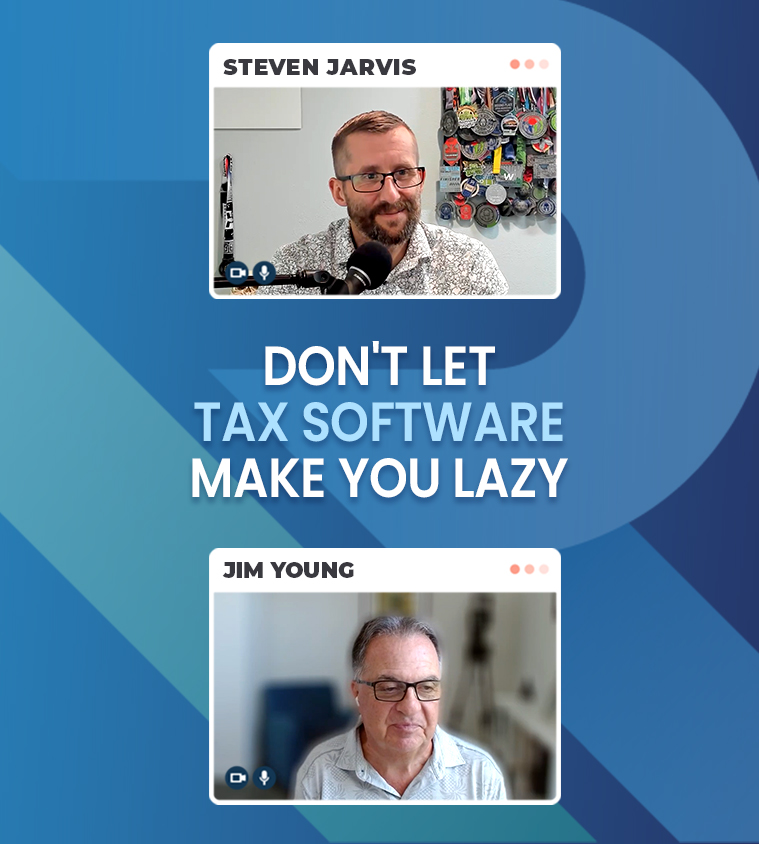
Steven Jarvis welcomes back financial advisor Jim Young to discuss how tax planning has evolved over the past five years and why reviewing actual tax returns still matters. Jim shares how today’s tax planning software has made advisors more efficient, but explains why it shouldn’t replace understanding a client’s return line by line. The discussion highlights the difference between reviewing a tax return and actually providing tax planning that helps clients make better decisions. Steven and Jim also explore how recent tax law changes created new planning opportunities, making it even more important for advisors to understand what’s happening on the return.
Steven and his guests share more tax-planning insights in today’s Retirement Tax Services Podcast. Feedback, unusual tax-planning stories, and suggestions for future guests can be sent to advisors@rts.tax.
Are you interested in content that provides you with action steps that you can take to deliver massive tax value to your clients? Then you are going to love our powerful training sessions online. Click on the link below to get started on your journey:
Retirementtaxservices.com/webinars
Thank you for listening.
Steven Jarvis, CPA (00:49.774)
Hello everyone and welcome to the next episode of the Retirement Tax Services Podcast Financial Professionals Edition. I’m your host, Steven Jarvis, CPA. And on this week’s episode, we’re actually revisiting a conversation from from years ago, which is crazy for me to be able to say that we’ve been doing this whole RTS podcast for years now, but rejoining me on the podcast, Jim Young, a financial advisor at Trilogy Financial, is here to talk about ind of the evolution of using tax planning tools, but the importance of remembering where this all came from and actually getting real tax returns out sometimes. So, Jim, welcome back to the show. How have you been?
Jim Young (01:27.658)
I’ve been great. Thanks. Thanks for having me back. I think this is gonna be a good topic to discuss. And I actually had to go back into my notes and find out when we did meet. And it was, it was five years ago, almost five years ago. That’s the last we spoke. Yeah. Yeah. Time flies. It seems like just yesterday.
Steven Jarvis, CPA (01:44.822)
Yeah. And when those of you who weren’t listening back then, I mean the original conversation was more around the evolution of redoing tax returns into using other tools. I won’t speak too much for you, but I think we’re both fans of using tools to facilitate what the freight or the financial professional is doing. But when you reached out to me to come back on the podcast, it was really about this kind of idea of making sure we’re staying balanced with keeping the hands on experience. And I think pretty intentionally for the 2025 tax year… You went back and started pulling out the actual tax returns going line by line and some things stood out.
Jim Young (02:18.4)
You to kind of go back to what we originally talked about, this was a career change for me 25 years ago. I started with Trilogy Financial, which is which is a relatively new firm at the time. They’ve been around a couple of years. And they weren’t unique in the comprehensive planning, but they were one of the companies that started really doing holistic planning, you know, and trying Trilogy Financial tax and estate planning. So I was taught 25 years ago that you need to pick up the tax return. You need to pick up the tax return. And what we did was originally for that initial meeting with the client and we looked at a couple of small things. What was their AGI? Mainly we were looking, did they qualify for a Roth IRA? Because we were doing tons of Roth IRAs back then. Then we also looked at did they owe or did they get a refund and talked about that, see how they felt about that. They got a big refund, the conversation of, well, you know, you were giving the the government a loan and blah, blah, blah, yeah. And then we’d also look at the interest payments and dividend income to talk about maybe potentially doing some deferral of that. But more importantly, you know, seeing where that came from, because it may be accounts that we didn’t even know they had. Yeah. They had that conversation. I see you got some 1099 from Fidelity. I didn’t even know you had a Fidelity account. And, and and you know, uncovering those types of things. But that was essentially it. You know, it was really kind of basic, but at least we were doing that. We were bringing some value to a client that a lot of advisors were not doing at the time of looking at the tax return.
Steven Jarvis, CPA (03:51.914)
And Jim, the reality is that a lot of advisors still aren’t. Depending on whose data you want to look at, like self-reported data always has a few questions that go along with it. But within the last year, I know I think it was the Kitces’s team that put out a report that talked about something like 80% of advisors think they’re giving tax planning advice, and only like 20 or 30% of clients think they’re getting it. So even as tools proliferate and advisors think it’s simpler to do this stuff, there’s still a huge gap on clients actually feeling like they’re receiving help on taxes.
Jim Young (04:22.55)
Thanks for bringing that up because you know, maybe six or so years ago, I started using tax review software. I used Holistiplan, yeah, which completely changed how I was looking at tax returns. Cause believe it or not, yeah, we would pick up an initial tax return, but on subsequent meetings, reviews, it didn’t always pick up the tax return. It was a conversation. How did your taxes come out? Did you blah, blah, blah. But now with the software, you know, I can scan it in and it’ll print out a really good report that I can do a a much deeper dive, you know, finding out what their marginal rate is, finding out what their effective rate is, where in the marginal rate do they land? So we, you know, how much wiggle room do we have for certain things? you know, what’s their safe harbor? Is that an issue? Irma surcharges. Are they, you know, are they going to be getting some Medicare premium surcharges two years down the road that they aren’t even aware of? Taxation, Social Security, capital gains rate, where do they lie with that with capital gains rate? Are they at a zero? And if they were at a zero, are they going to be at a zero cap gains rate this year? So we can talk about doing, you know, some some tax planning that way. Are they in the knit tax? I call it the knit wit tax. You are they paying that or are they close to that? So really, you know, allows us to look at that from the where they are today. But is that real tax planning? That’s really just kind of rear-view mirror type of stuff as opposed to let’s look in the future, which the software really allows you to do that, you know, to to run some scenarios.
Steven Jarvis, CPA (05:58.604)
Let’s pause there for just a second because it it’s really easy in any industry, but when we’re when we’re industry and insiders talking to each other, it’s it’s easy to use words really broadly without stopping to define them. And the way you describe that, that that probably is a lot of that gap we’re seeing in financial advisors reporting, well, of course I do tax planning, and clients saying, Hey, I’m not really getting tax planning. Because when you’re sitting on the financial professional side of the desk. You’re you’re trying to be really generous with yourself. You’re like, well, I talked about taxes. So of course I’m doing tax planning. But I think you’re right. A lot of times there’s professionals that are stomping at, I took the time to review where they’re currently at. And I’m with you. Like that’s important information, but that’s that’s not tax planning. And if all you do with a client is say, Hey, I know where you’re currently at, you can’t blame them for saying, Hey, my advisor doesn’t do tax planning. Cause If you want a client to really leave feeling like you provided value, you did planning for them, they need to be able to clearly say, here’s the thing I did different because of what Jim identified for me or what Jim recommended for me. Figuring out where they’re at today is important to building a plan, but that’s not the planning.
Jim Young (07:05.31)
Correct. Yeah. And and that’s where the software comes into play, you know, combining Holista plan we use for our financial planning software, eMoney, and combining the two together, you can really do some planning. But, you know, looking forward and saying, well, let’s run some scenarios. If we were to do a series of Roth conversions, how is that going to affect your taxes? Is it going to put you in an IRMAA scenario? Is it going to put you in a higher tax bracket? And we can say, well,…. You’re going to have to pay taxes on these conversions today. And it’ll likely be this kind of dollar amount. But over the long run, I can run it into e-money and say, yes, it’s you’re you’re gonna pay some taxes up front today, but the tax savings over a 10, 20, 30-plus year plan, I can save you this much. Or conversely, if we were to do conversions, it’s not really gonna save you that much, right? Because we don’t know what the tax brackets are gonna be down the road. So it’s the things like that you know, looking at are we gonna put as we talked about the net investment income tax three point eight percent is it gonna be gonna put you in there? Are we gonna increase the taxation on your Social Security by doing these tax planning things? How could potential future charitable giving through, you know, QCDs, qualified charitable distributions if the other age to do that, donor advised funds, you know, to to say, okay, if we to were to do some tax planning today, this is how we can save you money and show them hard numbers of how we can save them money. And the software that we use these days, and I don’t just mean us, I mean as an industry, allows us to really see that and show that to the client to help them make these decisions. How are these decisions going to affect them positively or negatively on things such as taxes?
Steven Jarvis, CPA (08:52.61)
The tools are definitely getting more and more powerful. one of the things I’ve been really excited to see, I’ve I mean these tools are really proliferating. I’ve started working with the great team over at Nitrogen on their tax tool. And one of the things that stood out to me and the way they’re approaching this is they said, Hey, this is all about how we help facilitate conversations between the advisor and the client. I think that’s the way you’re describing your approach as well, because the industry was not missing good math. It it wasn’t that we were missing a tool that could do the numbers for us. Yes, we can always find ways to do this more efficiently. We can find ways to integrate these different things. But the gap that’s typically missing is how do we effectively communicate this value proposition to clients? Which that’s why I was so interested when you reached out and said, Hey, as I maybe took a little bit of a step away from the software and got back to getting my hands on the tax returns, different things stood out to me. So I’d love to hear like some of those examples of what are some of those things that stood out? Why was it so important to you to take a step back and say, let me get my hands on these returns?
Jim Young (09:49.25)
Yeah, before we get that, I’ll tell you, full and fair disclosure, I am semi-retired. Yeah. I stepped away from a lot of the responsibility I had running a branch office with Trilogy about four and a half years ago and really pared down my book of business. So I had the time to do this. Now I’ve become a big student of the game and I love financial planning. It’s really almost become as much of a hobby as it is a career for me. But the issue is you’ve got to find the time to do this. Yeah. You know, and I see all my clients. I I do a surge. I see them all in May and I see them all in October. I’ve got a small enough book where I can do that. But if it if you’ve got a larger book of business, you can see them all at once and but give yourself time to review the tax returns. So so I said, you know what, I’ve got the time to do this. I just kind of did it. So why not? Let me go through these these tax returns. One of the things that I found out, found out a couple of mistakes. And I gotta be very careful about you know throwing a CPA under the bus because I’m talking to one right now. But I I did have clients that they’ve been clients for a number of years, and we were doing backdoor Roth. And because they were making too much money, they didn’t qualify to contribute to a Roth IRA. And so we were doing this backdoor Roth. Well, fast forward to a couple of years ago, a few years ago, that that most companies these days have Roth 401ks. So now we have the ability for people who are making too much money to contribute after tax dollars into a Roth type of investment. So the backdoor Roth IRA, it’s kind of a pain, you know, to do that and to keep track of it. And so I don’t do them really that much anymore. I I’ve switched over that. So I’m going through their tax return, line down by line, and I and schedule by schedule, and I see that their CPA had filed at an 8606. And correct me if I’m wrong, 8606 is really just a schedule t for tracking of after tax money into traditional IRAs. Pretty much for the IRS to track that stuff. Is that really what that that form does?
Steven Jarvis, CPA (11:52.248)
There’s a couple of pieces to it. The second page eighty six six just reports the what we think of as like conventional Roth conversions, but it is all targeted towards traditional IRA and Roth IRA accounts. It is not related to 401ks, traditional or pre-tax or after tax.
Jim Young (12:09.048)
So I saw that they had tax preparer had had filed an 8606 for seven thousand dollars when we didn’t do the backdoor Roth IRA. And then I said, you know, you need to go back to your tax preparer and say he needs to file an amended tax return. Change that. No big deal. You know, it it wasn’t like it changed their taxes or anything; it was just, you know, file the amended tax return. That was one thing. Another thing I had a client, she said, Jim, I I owe a lot more in taxes this year than I did in the past. Why why is that? So I went through lineup by line and she most of her income is through alimony and through pay one. Okay. So nothing has taxes withheld from it. And her alimony was higher than it typically was because the it I guess she gets a certain percentage of her husband’s bonus. He got a big bonus in 2025. So her alimony was much higher. And because of that, the estimated taxes that she was doing for 2025, which were based on 2024 wasnt enough. So she got herself into a underpayment penalty, first off having to pay more because she wasn’t paying enough in estimated taxes. And underpayment penalty, which wasn’t much, it was a couple hundred bucks, but it was still, she didn’t even know she paid that. I said, You do realize you paid a penalty. And she goes, No, I didn’t. So we kind of looked at, you know, going forward, making sure that this year, what her alimony is, making sure their estimated’s, you know, we’re satisfying the safe harbor, which… Correct me if I’m wrong here. See if I know my rules here. You gotta pay at least ninety percent of this year’s tax liability, or is it a hundred percent or a hundred and ten depending on your income? Is that how it works?
Steven Jarvis, CPA (13:46.22)
Yep. Yep. 90% of the current year. Yeah, depending on your income from every file and jointly, it’s after $150,000 of income. You have to pay 110% of the prior year. So typically when our income is going up, it’s a little bit more, it’s a little bit more likely that by default we’re gonna hit the the prior year safe harbor number. But there’s exceptions to that. And you’re describing a a a really common exception where our main sources of income don’t by default have withholdings. And so this is why it’s so helpful to make sure that we’re applying this specifically to clients as opposed to generically just saying, well, their income’s about this level, so they’re probably fine. Yeah.
Jim Young (14:18.318)
Yeah, because the new W four was, you know, designed to eliminate some of this stuff, you know, which yeah, you laugh at it.
Steven Jarvis, CPA (14:26.062)
It’s like W four was was I’ll use very sarcastic air quotes, was designed to simplify everybody’s life and just made everyone’s life so much harder. I I’ve yet to meet the person who’s like, No, no, no, the W four is great. Not just you, nope.
Jim Young (14:38.182)
Thank you. I thought it just me. Okay, yeah. It it’s so, but anyway, so I was able to to go through that and explain to her why that bec and show it on her actual tax return where the lines were and why that was. And so by going to the line item by line anymore, you know, you you find certain things like this, but it allowed me to educate my clients on what’s really going on behind the scenes. Now, I’ve been working with most of my clients for many, many years. You know, some for as many as 20 years. So I know how far I can go before I lose them. You’re really not quite sure you’ve got that’s where the the zoom really helped because you can really pay attention to when they’re starting to glaze over. I actually have one client, she kind of raises the flag and says, Jim, you’re losing me. And you’re saying, that’s right. Okay, okay, back up, back up. But you want to be aware of of how deep you want to go into this stuff because you don’t want to bore them, but you also want to make sure that they understand what’s going on as we talked about the twenty twenty five, there were some changes. The one big beautiful bill act that Trump signed in July fourth of twenty twenty five changed some things and changed some things in a in a in a big way. And a lot of them being retroactive back to January first of that year. Yeah. So one of the things that I noticed by going line item by line item, which you wouldn’t normally if you if if if you didn’t pick up the taxpayer, but if you didn’t, is that a greater
number of my clients, their tax prepare itemized as opposed to the standard deduction. When I think it was Tax Cuts and Jobs Act, which doubled the standard deduction. Yep. What is it? 90% of the filers did standard deduction. Became easy. And that was the whole point of that to make it easier. Well, certain changes in the tax code, with one big beautiful bill, changed that. What I was seeing is it was mainly was the increase the cap on salt. State and local taxes. You know, we went from 10,000 to 40,000. So I was able to show my clients where that fell in the tax return to say, this is why your tax repair itemized as opposed to standard deduction. And this is why you got a bigger tax refund or or your tax liability was less this year than was last year. Because most of my clients are in California. And we’ve got, you know, high we’re a high-tax state.
Jim Young (17:02.466)
Whether it’s your property taxes or income taxes or whatever that may be, it allowed my clients to itemize and which really helped some of my clients that do charitable giving to really take advantage of these being able to go back and itemize again. But I’ve also noticed that I think every tax preparer runs it both ways. They’re going to run it itemizing and then they’re going to run it standard to see which comes out. Is that- yeah, are you seeing that? Mostly, most tax preparers do run it both ways.
Steven Jarvis, CPA (17:34.166)
That’s an interesting one because you mentioned the Tax Cuts and Jobs Act. I think people have gotten really conditioned to the fact that 90% of taxpayers are going to take the standard deduction. And I haven’t seen stats from 2025 yet on how many people itemized. I know I had probably dozens of clients that were itemizing this year that hadn’t in the past because of the state and local tax deduction. And so while well, most tax prep software will absolutely do that comparison if you put all the inputs in… I think a lot of people have been conditioned to kind of stop tracking their charitable giving, to stop tracking their medical expenses, because for years now it just hadn’t mattered. And so from the financial advisor side, I mean absolutely reviewing for that to see if clients still are not only like, hey, are they itemizing, but how close would they have been to itemizing? Because it’s possible, probably not so much that the tax preparer just didn’t ask at all. But if it got asked as part of a 50-page organizer. If it got asked as part of a 17-page list of questions that and you know, questions that are probably written in industry jargon that the taxpayer doesn’t understand, like that could be worth revisiting from for the financial advisor. Because I mean, Jim, if you think about most of your clients who are coming to you because you are an expert and they don’t want to have to be experts themselves, if I just went to that client without any other context and said, Hey, for 2026, do you expect to itemize your deductions or take the standard deduction? They’re they’re probably gonna have a vague idea at best of what I’m talking about. And they’re like, I don’t know, probably whatever I did last year. It’s not something they spend a lot of time on. So they need somebody in their corner looking out for them.
Jim Young (19:02.434)
Yeah. And one of the things when I met with all my clients in October, I let them know that one of the changes that in One Big Beautiful Bill was the ability to deduct a thousand dollars of charitable giving, even if you’re doing the standard deduction starting this year.
Steven Jarvis, CPA (19:18.668)
Yep, starting in twenty twenty six. Yeah. Yeah.
Jim Young (19:20.546)
Yeah, and I told them that, okay, you’re you’re likely gonna do the standard deduction, but starting this year, you keep those receipts. ‘Cause you’re gonna be able to deduct a thousand dollars per person. So I guess it’s two thousand per per married couple. So I I I gave them that heads up for for all of them and I’ll remind them again when I meet them about being able to do that. One of the other things I was looking for because of one big beautiful bill was the senior deduction. Yeah. And making sure that, you know, anybody sixty five or older took that deduction that up to $6,000 per filer, $12,000 for a married couple, and explained, because that would have a couple of them could have said, I didn’t get the full $6,000. We didn’t get the full $12,000., It’s a sliding scale. It’s based on your income and your income was too high. So, you know, that’s why you got, you know, eight, eighty five hundred dollars instead of the twelve thousand dollars. And again, the opportunity to educate them on how this works and show them on the tax return where that is. So… That was very helpful as well. And my background with Trilogy was as a branch manager and I love to educate new advisors. And so now I don’t do that. I get the opportunity to educate my clients.
Steven Jarvis, CPA (20:32.13)
Well, Jim, you were certainly very fortunate that early in your career, this this was an expectation and that you got those opportunities. I mean, you had to put the hard work in of actually reviewing the returns, but that you were essentially told early on, hey Jim, go do this. Like if I could wave a magic wand, I would make the entire industry like take the time to review tax returns, especially early in their career. But periodically throughout their career, because as you mentioned, tax laws change, the forms change. But for advisors who who want to level up what they do on taxes. Getting the actual reps and picking up real tax returns, maybe a silly analogy for some people, but if you’re not getting the reps in, like how can you expect to get better at something? So, like, if you want to be able to pick up heavier weights, you’re going to practice by picking up progressively heavier weights. It works the same way with any skill set or or even mental muscle that we want to exercise. If you want to get better at talking to your clients about taxes, do more reps, pick up more tax returns, go line by line, practice explaining those lines to someone. And then make sure that you’re ready when you get to that meeting with a client to be able to, like you talked about, Jim, to be able to go through these things and talk about the things that are relevant to them.
Jim Young (21:37.228)
I wouldn’t be surprised if when I started 25 years ago, if I came in with a with a case in the folder and gave it to my branch manager, said here’s the case, can review it. Where’s the tax return, Jim? I didn’t pick it up. You didn’t why? I don’t think this ever happened, but I probably felt like, you know, Jim, go back and get their tax return. Go back and knock on their doors. I took it upon myself to really learn the tax returns because I I’m just a very inquisitive person that wanted to know where the numbers is because you got the 1040, which is essentially two pages, but you’ve got all these schedules that that all that data is drawn from. And I wanted to know where that was. And you know, still I still have my old HP calculator that I use at my desk to run the numbers and see, you know, okay, now I get it. That’s where that percentage came from. That’s where that number came from. And, you know, one of the things we mentioned pre-show is that I I wanted to make sure I brought up is that if any of your listeners are new in this in this business and if you’re using tax software to review a tax return. Hey, that’s great. But don’t let it make you lazy. AI is great, but it’s it’s tending to make us lazy. But you know, take a tax return or two or three or whatever that is and go through them and go through a couple of them. You know, a client who’s a small business owner who’s got some Schedule C income, utilize that and see where all that Schedule C income, you know, what’s being deducted from it and why they’re deducting it and can they deduct it? Because… That will make you more valuable to your existing clients, bringing them value, which will absolutely make you more referable to the people that they know.
Steven Jarvis, CPA (23:14.476)
Yeah, absolutely. Since you’ve hammered this topic so much, I’m just gonna go ahead and make a shameless plug here. Cause what you’re describing is exactly why we created our 37 point checklist for reviewing tax returns. We put this together and we framed it as a list of questions that you should be asking about the tax return. And it’s going line by line to say as you hit these lines, here are questions as the advisor you should be asking yourself to make sure you understand the return and you can tie it back in to what you’ve done with this client. And it was it was created as a guide for helping advisors review tax returns, but helping them learn better how these tax returns work. It’s been downloaded thousands of times now, which is exciting to see. You can go to retirement taxservices.com, download a copy for yourself. But advisors are now using this to compare against what they’re getting out of software. Because yes, my two or three page PDF is not nearly as dynamic as a piece of software, and it’s not meant to replace software. But we’ve talked about it throughout this conversation, Jim. Like you still there still has to be an operator for any great tool. And if it if you’re serious about providing value to clients, you have to make sure you understand this at a level, even if you’re using a tool, you have to understand it at a level where you can correctly identify and then effectively communicate where there are opportunities.
Jim Young (24:23.584)
Your clients will know how much you know absolutely based on how you present the review of the tax return. If you’re just reading it off a piece of paper that was spit out by a they’re gonna know that. They’re gonna, especially if you’re meeting them face to face and you’re looking at the piece of paper, as opposed to, you know, really talking them, you know, one on one or one on two to say, this is what I saw. This is what we’re going to do, or my recommendations going forward, and this is how it’s going to save you hundreds of thousands of dollars in taxes over a thirty year plan by doing proper tax plan.
Steven Jarvis, CPA (24:57.346)
Yeah, absolutely. And money’s emotional. Tax is even more so. This is this is the thing that will stand out to your clients as the value you’ve delivered, as the things they can easily tell their friends when they want to refer someone to you. I’ve yet to meet the advisor who is disappointed they started talking about taxes with their clients.
Jim Young (25:12.92)
Be careful because you you know, you and I are a couple tax nerds. Okay. There’s no doubt about it. And I’ve got to be careful because sometimes I dive in too deep because I get excited about this stuff. Really think about how much they really need to know because you’ll have clients that that want to dive deep with you. And there’s nothing wrong with that. And that’s those are the ones you want to have fun with. So you gotta you got you got to know your clients and and understand how much is enough and how much is too much.
Steven Jarvis, CPA (25:37.92)
Absolutely. Absolutely. Well, Jim, I I appreciate you taking the time to come on and share. To me, there’s always so much value from learning what other people are doing in practice, which is one of the biggest reasons we host the RTS summit each year. So for anyone listening who hasn’t signed up yet, we are on track to sell out. So sign up sooner than later to make sure that you get a seat. That’s the end of September in Scottsdale, Arizona. You can go to retirement tax services dot com to get signed up. We have some great presenters coming, but perhaps as important, if not more important. Are the other advisors in the room that you can ask questions of, you can learn from, you can say, Hey, where are you doing well? Where are you struggling? How can I learn from these things? So would love to see you all in person in September. Go to retirementtaxservices.com to get signed up. Jim, once again, thank you so much for your time. It’s great having you on the show. Thank you for absolutely. And to everyone listening until next time, good luck out there. And remember to tip your server, not the IRS.
Jim Young (26:21.573)
I enjoyed it.