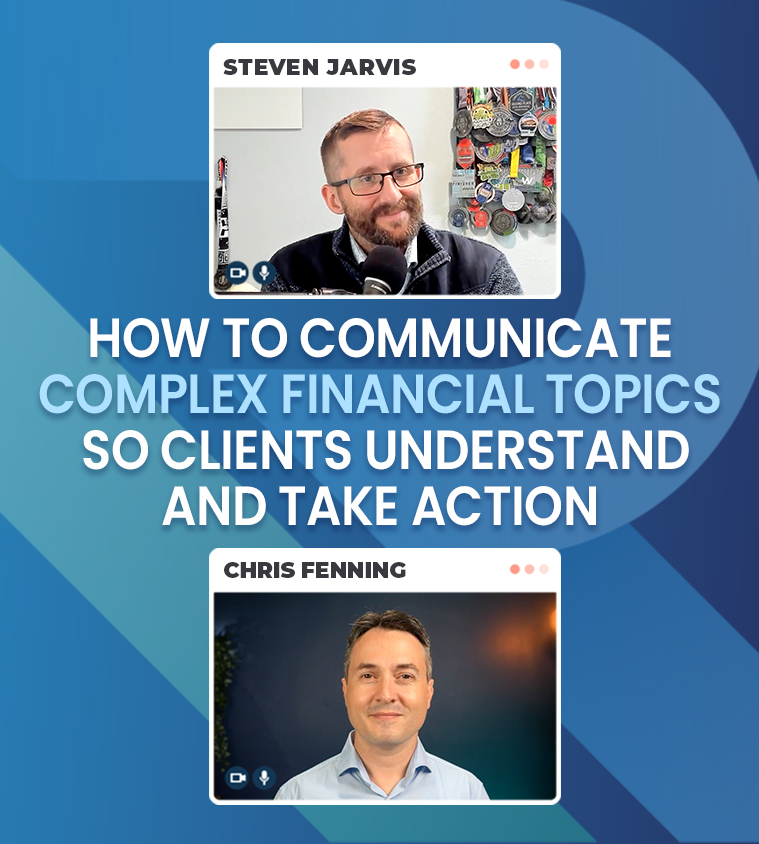
How to Communicate Complex Financial Topics So Clients Understand and Take Action with Chris Fenning




In this episode, Steven Jarvis, CPA, is joined by communication expert Chris Fenning to discuss how financial professionals can communicate complex topics in a way that clients can understand, trust, and act on. They explore why expert language and industry jargon can create confusion, even when advisors have the best intentions, and how small changes in communication can make a significant impact. Steven and Chris discuss how to recognize when a client may not fully understand a conversation, the importance of using relatable explanations and analogies, and how to simplify information without losing its value. They also share practical strategies advisors can use to prepare for client conversations, practice their explanations, and build stronger communication skills that improve the client experience.
Steven and his guests share more tax-planning insights in today’s Retirement Tax Services Podcast. Feedback, unusual tax-planning stories, and suggestions for future guests can be sent to advisors@rts.tax.
Are you interested in content that provides you with action steps that you can take to deliver massive tax value to your clients? Then you are going to love our powerful training sessions online. Click on the link below to get started on your journey:
Retirementtaxservices.com/webinars
Thank you for listening.
Steven Jarvis, CPA (00:52.27)
Hello everyone and welcome to the next episode of the retirement tax services podcast financial professionals edition I’m your host Steven Jarvis, CPA and this week we’re gonna take a little bit of a departure from the norm of diving in with financial advisors or other tax experts to have a conversation that I think you will really be interested in falling along with because it’s something that I’m super excited about and something that’s really important to all of us. We spend all our time talking about topics that our clients are coming to us because they are inherently complicated and we have to find this balance between being the professional and helping them but also communicating effectively on these complicated topics. So joining me this week to kind of help explore this idea of how do we find the right balance of communicating on complex topics, is Chris Fenning. Chris, welcome to the show.
Chris Fenning (01:36.782)
Hi thank you very much for having me and gosh you’re right, tax and finance is wickedly complicated and you are all so good at it and we know very little about it. So bridging that gap, this is a conversation I love to have because everybody wins.
Steven Jarvis, CPA (01:51.726)
Yeah, well, geez, isn’t that the truth? Especially on taxes, I mean, we all have to pay taxes each year. Especially in the US, I feel like we’re kind of just like almost trained as if everyone should understand taxes. Like it’s really, it can really feel easy to want to DIY your taxes. There’s tools out there. And so we’re expected to do this thing that we were never trained on. So I think it’s a great topic for this discussion. Chris, before we get too far into it, why don’t you the audience just kind of some of your background? Like why are you the one here having this conversation with?
Chris Fenning (02:18.614)
Yeah, so I’m not an obvious guest for this show because my background is satellite design engineering through a career that ended up through in mergers and acquisitions. So not a deep financial background, but the single thread that joins all of my work together when I was employed and what I do now is bridging the divide between experts and non-experts. Yeah. Helping software engineers talk to managers, helping finance teams talk to non-finance teams. And recently, working with people in the wealth industry and the finance industry, helping financial advisors talk to their clients so that they understand, trust and act.
Steven Jarvis, CPA (02:55.672)
Yeah, and such a valuable conversation to have because there is a real difference. I I spend a lot of my time talking to financial advisors. And even for me, like I spend all of my time on tax. And so when I’m talking to financial advisors, like I’m trying to be really intentional about, okay, how do I take all the things I know and narrow it down for the financial advisor who’s also an expert in finances in general? In a way that’s digestible, they’re gonna be able to take something and go do. And I would say I’m pretty comparable with these other financial professionals, we’re all in the financial services industry, but then when we take that and we look at the step down, that gap that we need to bridge to a client who may or may not have any real background in finances, if we wanna do this well, there’s some really intentional effort that needs to go into how we practice and deliver communications around these topics.
Chris Fenning (03:41.55)
Yeah, absolutely. And you’ve just given the example of when you’re talking to people in the finance industry, you’re already being intentional about how you describe things and you’re all in a similar space. Yeah. But there could be words that are specific to tax that people who are estate planning still within the financial industry don’t have that same terminology. And one of the root things here is jargon, which has got a really bad rep. If you say jargon and people are like, in the business world, it’s always low hanging fruit or synergistic or other blah terms. But jargon, I’m huge fan of it, but I think it needs a different name. Instead of jargon, it’s expert language. And Steven, your expert language is slightly different from the expert language of an estate planner or a financial planner. You’ve got deep expertise, but it’s slightly different. And your expert language is shorthand. That means when you’re talking to another tax services professional, great, you can have quick, accurate understanding by using a few words. But as soon as you step outside of that realm, people don’t understand the words in the same way you do. And you need two or three sentences to get the clarity that you can pass with a single word. And so when we go from financial advisor to financial advisor, that’s a difficult step. Add in the client, my goodness, that’s 10 steps further removed, if not more.
Steven Jarvis, CPA (05:06.616)
So Chris, this might be jumping to the end here. So you just tell me if you want to take this in a different order. as I was getting ready for this conversation, even as we got started, one of the things I’m always looking for personally is how do I evaluate whether something’s effective? And so I think in this dynamic with a client and a tax professional, financial professional, sometimes it can be hard to judge how effective our communication is while it’s happening because a lot of clients are gonna defer to the person with the license or the degree or the certification or whatever it is. Like there can be this real unintentional at times authority play where I’m gonna talk to you, maybe I’m over relying on some of this expert languages you’re talking about and the client out of discomfort or uncertainty or whatever it might be might nod along and tell me that they understand. And so like when we think about like how we can improve our communication, like… How are we going to evaluate whether we are doing an effective job to even know what we should be improving on?
Chris Fenning (06:04.174)
It’s so important to be able to recognize these things. And there are a couple of phrases and clues and keys that are really prominent between clients and financial advisors. The biggest one is you’ve got to the end of laying out a plan, describing the options, giving your proposals. And what seems like an obvious path forward, they say, yeah, you know, I just need some time to think about that. Yeah, just give me a moment or I’ll come back to you. When the plan should be obvious or when there should be a decision in that moment, if they defer it, there may be some outside influence, but usually it’s a sign they don’t understand. And they don’t understand well enough to be able to decide in that moment or even ask the correct follow-up questions.
Steven Jarvis, CPA (06:47.214)
Yeah, you kind of hinted at it there, so maybe this is where you’re headed anyways. But I did want to clarify, like when you talk about a client deferring the decision, is that any deferral the decision? And maybe you’re just giving an example to keep this short, but I didn’t just hear a deferral from you. I heard a deferral with uncertainty. You kind of mentioned it there at the end that they’re not sure what follow-up question to ask. Because if we’re dealing with life-changing events, to me at least, the piece of like, hey, can we set a deadline for when we’re going to decide? That might not inherently be the worst thing ever, as long as the clarifying questions are happening, like we’re clear on why the decision needs to made by a date. So it seems like it’s probably the combination of those things.
Chris Fenning (07:24.878)
Yeah, you’ve hit on what to do about it. It’s to ask for, to set a timeframe to ask what they need to help. Is there anything else that can be provided? Because when somebody says, I need time to think of it. Quite often, what they’re saying is I don’t understand, but no one is going to admit that. No one’s going to admit it. And so they’re looking for, okay, let’s say you’ve laid out a plan for a person. It’s a very easy plan. There’s nothing particularly complicated about it. And you’re looking for a go, no go. If you get to the end of that conversation and they’ve not been asking questions throughout, but they don’t immediately say, yeah, okay, that makes sense. I’m going ahead. Something is stopping them from moving forward. And if they haven’t been asking questions, then it’s likely, don’t like you you’re about to lose the relationship in general, which is unlikely to have happened. But quite often it’ll be, they don’t get it. So they’re going to go on internet to the answer or ask financial advisor, TikTok for what should I do? Which is also a terrible thing to do because it’s generic, not specific advice. But so during that conversation, here are some things you can look out for. So you’re not just waiting for that bit at the end. It’s when they’ve got that glassy eyed look and they’re really not focused on you anymore. They’ve got that glassy eyed, they’ve zoned out. Another tell is they ask a similar question in three or four different ways. That’s a dead giveaway that they haven’t understood the message that you’re giving or the description, or they don’t know what the terminology is. Which is the third giveaway is they ask a question that seems utterly unrelated to the thing that you’ve said. It’s a very strong indicator that somebody’s misinterpreted a word that you’ve mentioned and they think it means something else. And then that again shows that they’re not understanding.
Steven Jarvis, CPA (09:08.076)
Let’s make sure we hit on both of these things, but let’s take them one at a time. Let’s start with what are the things that we do when that situation has gone wrong? Because as you described, I know I’ve been in those situations where, the questions they’re asking are not asking. Like, clearly there’s some things we need to clarify. So I think it’s really two skills we need to work on. It’s how do we course correct mid conversation or towards the end of a conversation? but we’ve already, we’ve already made an attempt. It didn’t go well. How do we course correct? And then after we talk about that, I want to spend a little bit more time on How do I prepare for the next time so I avoid that altogether?
Chris Fenning (09:38.392)
So that first one for how do I, how do I course correct? One of the most effective ways is a little bit of self-deprecation. If you think the client’s just not getting it, you’re getting no feedback at all. And the more you push, the less you get back. It’s not because you’re giving advice they strongly disagree with, because if they strongly disagree, they will tell you people will react to that. So what’s happening is they’re overloaded with information. They don’t understand the words, the phrases, the plan. And so here’s the self-deprecating bit. I’d say. Hey, Steven, I’m just going to pause for a moment. I realize I’ve gone quite deep into this. I love the detail. I’ve gone into it. I just want to take a step back and can I summarize this for what we’ve done? Cause I may have gone too far. Can I run over these headlines? And then I will get some kind of feedback from you. And at that point I start again, not at the last few sentences, but I start again from… So our goal is this, your goal is this, you’re resetting the expectations and you’re looking for the nod or the verbal confirmation that yes, that’s actually a priority. Because, tangent here, because if you’ve started out a session with a pre-agreed plan, didn’t validate it right at the start and you go straight into the plan. Perhaps they have a different priority for the conversation, but didn’t have the opportunity or weren’t willing to speak up. So you might’ve been going down the wrong path. So validate that goal and then break down your, whatever you’ve been proposing, whatever you’ve been discussing into high level, small steps. Give the three bullet point summary. Here’s what we’re trying to achieve. Here are the couple of problems we’re looking to overcome. And we’ve got two possible solutions. A and B. Option A has this benefit. Option B has this benefit. And today we’re looking for a decision on that. And here’s a really important thing. Don’t ever say, does that make sense? Or do you understand? It’s people are going to say what Steven? They’re going to say.
Steven Jarvis, CPA (11:35.982)
Yes. Nobody wants to say no to that. You look terrible if you say no to that.
Chris Fenning (11:41.688)
So here are some phrases to use instead. You can say, what questions do you have? yeah. And then pause for eight to 10 seconds. They will fill the silence. And here’s a different phrase, which is slightly easier for people to respond to is, so what do you think about that? And pause. Let them say the next words and let them talk through where their questions are, their concerns are, what their feedback is and then you’ll get to the heart of why they don’t understand, don’t agree, and so on.
Steven Jarvis, CPA (12:15.104)
I love how specific you’re making that I want to highlight just a couple of things in there It might have seemed subtle to some people listening But I really like as you were reframing that conversation you you were asking the client for permission to start over and summarize it and and that might seem subtle But it’s so important for how the rest of that conversation is gonna go now Nobody’s gonna say no to that but by asking the question having them essentially give you permission now We’re all on the same page. Okay, here’s this thing we’re gonna do together so I think that’s an important one that gets overlooked by a lot of people like asking for that permission to do what you’re going to do anyways. then I love the alternatives you’re giving to does that make sense? Because I had a coworker years ago when I still had a big accounting firm, it was almost a joke in our office because she would say it so often. And it was to the point like it just grated on all of us. And so I catch myself every now and then saying it, but not often. But now you’ve given me tools to replace the last couple of things. really like I think the one I’m going to use is, hey, what questions do you have? Because I also like that response because it sets the expectation that, it’s okay to have questions. It’s okay for this conversation to keep going. I’m not trying to tell you that I’m so perfect and great that you have to have gotten it all the first time. There can be no possible room for discussion. So it’s, hey, what questions do you have? I love that.
Chris Fenning (13:30.37)
Yeah. It’s opening it up and having that little bit of self-awareness. Yeah. We’re not all great communicators. And I teach this stuff. It’s hard and it takes practice and it’s so easy to get wrong, particularly on the terminology. And we’ll come to that in the, in the second part of what can we do to prepare, but just a single word can throw off a whole conversation at recognizing that we’re so deep in our own expertise that bridging that gap to the client takes lots of of small moments like the one that we’ve just discussed.
Steven Jarvis, CPA (14:03.032)
Love that. Okay, Chris, let’s let’s take the second piece of this then of now we’re getting ready for the next client meeting or the next opportunity to explain one these complex topics or to go through a plan with someone. What are things that we’re doing ahead of time to prepare ourselves to have a better outcome from the onset so we don’t have to use the skills we just talked about?
Chris Fenning (14:19.374)
Yeah, there’s a few things that we all need to do. doesn’t matter what your specialty, doesn’t matter what your industry, there are a few things that we should do whenever we talk to somebody else. And the first is consider what is their perspective. So I’m thinking about a topic from the goals that I want to achieve, all the things I want to achieve on behalf of my client. But what is my client’s perspective? Are they thinking about their immediate self or are they thinking about their family or are they thinking about something broader? Am I going to tailor my message so that it matches their perspective and I’m not just talking from my own? The second thing is about making it relevant. It’s perspective, relevant, relatable, simple and jargon free. Now there’s five things there, but I’m going to give you an example that will make this a bit clearer, particularly on relevance. We’ll take it outside of finance. Imagine you got a letter from your water company. And the letter started with, we’re investing 500 million in the water infrastructure in your area. We’ve got 10 teams out working on replacing the pipes, upgrading the infrastructure, pumping stations are being done. We’re fixing stuff in the roads. How far down that letter are you going to read?
Steven Jarvis, CPA (15:25.563)
I would have stopped reading before even what you got through. That would have been straight in the garbage.
Chris Fenning (15:28.758)
Okay, now imagine the letter started with, hi, Steven, your water will be off on Monday from one till three and we’re digging up the road outside of your house for three days. How much of that letter are you going to read now?
Steven Jarvis, CPA (15:39.342)
Yeah, now I’m the whole thing.
Chris Fenning (15:41.378)
You’re paying attention to the detail, right? Yeah. Why?
Steven Jarvis, CPA (15:43.234)
Yeah. Because it’s about me. We’re all our own favorite topic. And so the first example you gave, that sounded like a newsletter that went to a thousand people. There was all the exact same. And so I’m reading the first two sentences, I’m throwing it away. But when you make it about me, man, that’s my favorite topic.
Chris Fenning (16:02.028)
Yeah. So the equivalent in finance is, okay, we’re to be managing your tax exposure and we’ll accelerate some of your deductions. I’m going to do some deferred income or some strategic withdrawals. So the client, that’s letter number one. Instead, we’ve got to make it about impact to them. And that’s the key to relevance. So from their perspective, what impacts them, how do you make it relevant? And then you have to talk about it in a way that’s relatable. If you’re explaining a mechanism, a financial vehicle or a product or a service. Explaining the service is not going to be as effective as describing it in a way that relates it to things they already know about. Again, coming out of finance, a firewall for a computer, like antivirus stuff, it’s like a castle wall. It’s harder for things to get in, but you still have a gate where you allow traffic that you want in and out. That’s a good analogy for a firewall. In finance, you’ve got to look for the analogies. I heard a great one from somebody who was talking about the difference between a 401k and a Roth IRA. They were talking to a 19 year old who was a hunter. I’m not going to get into this hunting good or bad, but what they tried to do is describe to this person from their perspective, the difference. And they said, well, imagine your money is a deer and the deer goes into the meadow. The IRS is a hunter. And in one of these financial vehicles, the IRS is going to take that deer. It’s looking for its cut. And in the other vehicle, there’s no, the deer is free and clear to run around that meadow and then you can take it at the end. Yeah. Interesting. Which way, which one of those is the 401k? Yeah.
Steven Jarvis, CPA (17:39.118)
That’s it’s really I like how you’re making a specific to the person that’s being talked to because Roth has a conversation I talk about all the time and so I have kind of my Rolodex of analogies that I like But as I’m thinking about this as we go like I’m not always taking the time to say okay Which of these analogies is going to resonate the most with this specific client?
Chris Fenning (17:58.254)
Yes. Yeah. Another example, had this a couple of days ago, he was interviewing an advisor for a book I’m writing. And he said, well, I was talking to a farmer about diversification and the farmer wasn’t clear on diversification for his portfolio. And so the advisor said, well, you’ve got crop growing land, dairy cows and beef cows and one other source of income, like honeybees or something. And he said, okay, so what we’re going to do is we’re going to sell your crop growing land. We’re going to sell the dairy cows. We’re going to get rid of the bees and just stick with beef. Is that a good idea? And the farmer went, no way. might have a bad year. That’s terrible. I need, I need this variety. One goes up. He said, that’s diversification. That’s what we do with stocks. Immediately the farmer got it. Yeah. And it was relevant to that person. Not a complicated analogy, but made it really relevant and relatable to them and their situation. So when the original question you asked was how do you prepare for a client’s conversation? If you know the client, think about what are the analogies I could make that connect to them? And if you don’t know the client, think, what are a couple of questions I can ask that identify what’s important to them? And usually that’s work and family, work, family and hobbies.
Steven Jarvis, CPA (19:09.326)
Yeah, yeah, that makes a ton of sense. really like that because I think one of the challenges when we’re dealing with complex topics is knowing when to stop. As the expert, like there’s some level of clarity we need to provide so that the client we’re working with can feel taken care of and that we’re a trusted advisor and all those things. But at some point, and I think it’s easy to take this way too far, we’re almost trying to prove our expertise or we’re trying to prove our worth that we want to explain the whole tax code instead of simplifying this to, do we want the IRS to take their piece now or later? And so I like the framing there. And like, I can see this in some of the ways I already approach other topics with clients. I wasn’t thinking about it in that framework, but that’s the way it plays out. I like, hey, here’s a really simple way for me to start. And if the client gets it, great, I’m done and we move on. If they don’t get it, then I’m gonna slowly add layers until we get to, okay, the recognition is there, the value proposition is there, now great, we can move on. At no point, is a client actually coming to me and saying, Steven, make me an expert on the tax code.
Chris Fenning (20:10.154)
Yes. I want to make one very small change to that. It’s not adding layers. It’s trying different versions at the same high level. Or even making it simpler. The simplest explanation of why you buy when the stock market is down is when you’ve got a fridge full of steak and you find there’s a sale on at the store, you don’t get annoyed that you paid full price. You go buy some more steak. And that’s an example that if you’ve got the funds, why you go and buy stuff when it’s on discount.
Steven Jarvis, CPA (20:17.884)
Yeah, okay, I like that.
Chris Fenning (20:39.436)
And that comes from going at a higher level. The risk and the concern I’ve heard from a lot of people is, I don’t want to dumb it down. I would change that framing. It’s not dumbing it down. It’s simplifying up, simplifying up to the level that they need to know. And there’s a way to think about this that I talk about when, working with software engineers, which, and they really, they really get this because they want to go into the detail because the detail of how something works is important just like in finance. The thing is, to the end user, no one cares about how. So the method is this, all of the magic and the wizardry of the mechanism of the product of the service of the plan lives inside a magic box. And when the client says, I want to do this thing, you say, I have a magic box for that. And when they say, well, how does that work? Your response is, do you want to know how it works or do you want to know what it does for you? And to make that really clear, here’s the example. If I turned up to your office and said, Steven, we’ve got a new coffee machine. And you said, how does that work? You don’t care about copper coils, steam pressure, the motherboard that’s running it. You care about when I put the coffee, the mug and which button do I press? Don’t open the magic box unless they are really geeking out and really care about how the thing works. What most people want to know is there’s a magic box. The magic box is well proven. It does the thing. Tell me what, tell me what it does, not how it does it.
Steven Jarvis, CPA (22:06.83)
Yeah, tell me what it does for me. Yeah, and now you’re back to, again, asking for permission to have these conversations that you want to anyway. And so you’re getting everyone to lean in and say, yeah, let’s have this level of conversation. I love that.
Chris Fenning (22:17.71)
Do I have time to add one more thing on jargon? I mentioned it earlier. So jargon, expert language is the thing that trips all of us up the most. asked, I asked about 24 people in financial planning, financial advice and wealth management to give me a list of words that they were confident their clients understood. And they each gave me, why are you laughing, Steven? Why are you laughing?
Steven Jarvis, CPA (22:42.062)
Keep going, Chris. No reason. My guess would be that they gave you lists feeling very confident and whatever you did with them next, I would bet that the clients felt way less confident with them because I’ve seen that play out over and over again. Bingo. And every now and then I’m guilty of that too. I keep a list like that, but for myself, these are words I shouldn’t be using with clients or at least I shouldn’t be using without some kind of clear explanation as to what I mean.
Chris Fenning (23:07.756)
Yes, yes. And the, it’s wonderful that you do that. Every advisor should do that. Here’s the gap that you probably struggle with as well. And I have this in my own work. Of those 24, there were six words, everybody, almost everybody wrote down. I went to a group of 30 business owners who’ve got successful businesses. They’re all seven figures and above. These are smart people. And independently, I gave them a bit of paper and said, just put a tick next to each one of these that you would be confident explaining to your spouse. Of those six terms and those 30 people, one person knew all of them. 25% of the group knew none of them. None. These words included mutual fund, IRA. They didn’t know with any confidence. They all said, I’ve heard of these words, but none of them could confidently say, I understand them to explain to somebody else. The Gulf was huge, absolutely huge. Only one word had 50 % of people saying they knew it, which was IRA. And even then when I, when I probed a little bit, some of them clearly didn’t have a good description of it. So the gap is so, so big.
Steven Jarvis, CPA (24:17.366)
I love that example. appreciate you sharing it. But before we wrap up, I love making things actionable and practical to implement it. So you mentioned at least once, maybe a couple of times that like practice is an important part of getting better at this. So I want to talk for just a second about what effective practice looks like. Because I think once we’re done with high school sports or college sports, if you’re lucky enough to play, I certainly was not. Once we’re removed from the playing field, like I think we just kind of like shrug off practice and don’t really do it. We don’t actually get down and do the push-ups. We just kind of tell ourselves we practice. And so I’m constantly telling people that they should be practicing saying these things out loud in a mirror so they can see themselves talking, that they should be recording these things and listening to it back and watching it back, that they should be practicing with team members. That if you want to get better at communicating, practicing communicating is not just listening to a podcast. It’s not just reading a book. It’s getting the reps in. What would you recommend on how people actually practice this?
Chris Fenning (25:12.558)
You’re absolutely right. You have to apply it. Practicing, it’s like practicing a speech. You can’t practice it by reading. You have to say it out loud at the volume you’re going to deliver it. So let’s make this really specific. Somebody’s about to go into a session with a client. They’re about to describe something that is complex or convoluted or has multiple parts. Talk to somebody not an expert in the industry. Talk to a friend or a partner and say, can I, can I chat to you for three minutes? I want to see if I can summarize something I’m going to say to a client. And I want to see if it makes sense to somebody who’s not in this industry and then say it. So there’s pre-work before that. You’ve got to write down, write down, what is the summary? What is my three point summary? What is an analogy that I can use? What is an analogy that’s relevant to that client? And then how do I deliver that very succinctly and then stop talking? So I’m not adding loads of extra detail and then run it by somebody who doesn’t know, because that’s the best equivalent of the client.
Steven Jarvis, CPA (26:10.134)
Yeah, and just one more thing that comes to mind as you’re describing that. I think people who haven’t done a lot of public speaking or haven’t done a lot of public speaking in front of large groups are on a stage because I think we do ourselves a disservice by not acknowledging client meetings as public speaking. Like these are skills that need to be learned and developed. It’s really easy for us to go watch someone present or even listen to a podcast, listen to somebody who does this all the time and discount the work it took to get there of they’re in natural. That’s just a skill they were born with. This isn’t hard for them. In my experience, when I was only working with coworkers or in small group settings with clients, it was easier for me to tell myself, this isn’t a skill I need to practice. This is just conversations. And then when I started getting on bigger stages, having more conversations, I started realizing, the people who do the best at this are the ones that work the hardest. They’re not the ones with the most natural talent. And my skill at all those things has gotten significantly better as I’ve practiced. And it’s not that you practice and you get to a point where you stop practicing. NFL players don’t take the off season off. Like they’re practicing every chance they get. You have to accept that practice is part of anything you want to be really good at. You are going to practice forever.
Chris Fenning (27:16.462)
Really, huh?
Chris Fenning (27:21.9)
Yes. And here’s a slight shift in the mental approach that people might have for this and the mindset is that public speaking is not standing up in front of a room and delivering a speech and doing something in front of a big crowd. The ability to be a great communicator comes from knowing frameworks, knowing the tools and knowing the pieces. It’s like cooking. You pull the different ingredients in different quantities to create the outcome that you want. So you might need a little bit of storytelling. You might need a lot of simplified language, frameworks, structures to summarize things. used a couple in our conversation today. used goal problem solution as the summary method. There’s dream nightmare, nightmare action. There’s what, so what, now what. There are lots of simple frameworks that you can use. All of these are things that you can deliberately identify and practice that when you’ve got them, public speaking on the grand stage becomes a lot easier and is more just about getting over the nerves of being in front of a large group. But when you’ve got confidence that you are clear, that you are concise, that you are making things relevant and relatable and jargon free for the audience, and that audience can be one person, that, that is when you are really communicating well.
Steven Jarvis, CPA (28:38.304)
Thank you so much for taking the time to come on and share this expertise, share these frameworks. I think this is super helpful conversation to be having. For people listening who want to learn more about what you’re all about, where do they find you?
Chris Fenning (28:48.77)
Come find me on my website, which is my name, chrisfenning.com, and LinkedIn is my semi-social hangout. Anyone who gets in touch with me gets a voicemail welcome. I’m happy to answer any questions at all.
Steven Jarvis, CPA (28:59.03)
Chris again, thank you so much for being here really appreciate the time to everyone listening until next time good luck out there and remember to tip your server not the IRS