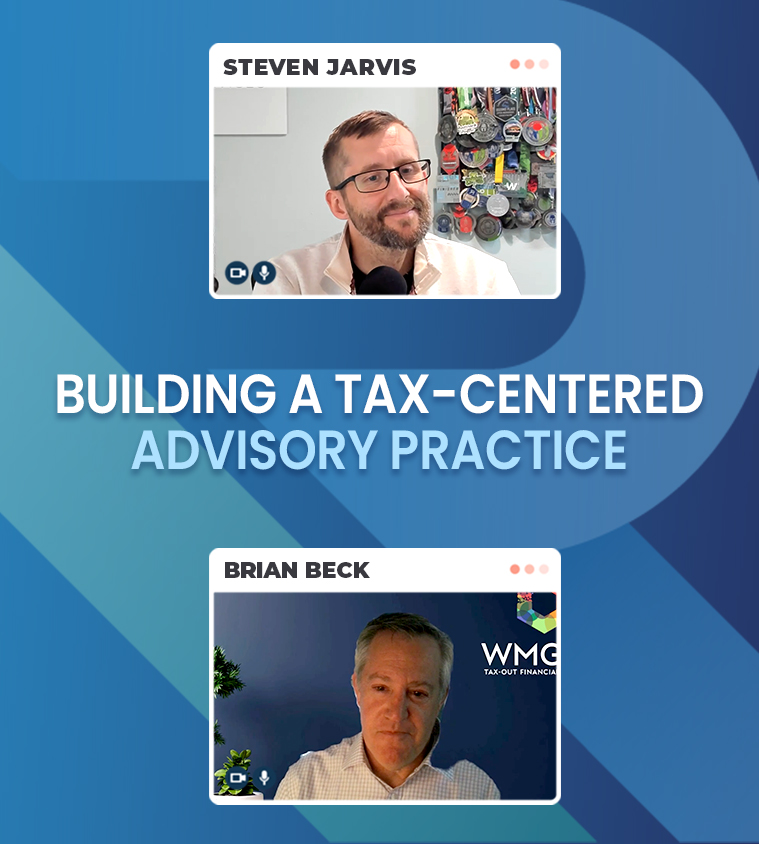
In this episode, Steven Jarvis, CPA, is joined by Brian Beck to discuss how financial professionals can build a practice around proactive tax planning. Brian shares how his firm has incorporated taxes into every client conversation for more than 30 years and why tax planning should begin immediately after tax season ends rather than waiting until year-end. They discuss the benefits of a subscription-based model, how it encourages clients to stay engaged with their financial planning, and how advisors can create stronger relationships with CPAs through collaboration instead of competition. Brian also explains how his firm structures CPA partnerships, handles tax preparation through outside providers, and the importance of understanding compliance requirements when adding tax services. The conversation highlights practical steps advisors can take to become more comfortable with tax conversations, including reviewing tax returns and learning the language of tax professionals.
Steven and his guests share more tax-planning insights in today’s Retirement Tax Services Podcast. Feedback, unusual tax-planning stories, and suggestions for future guests can be sent to advisors@rts.tax.
Are you interested in content that provides you with action steps that you can take to deliver massive tax value to your clients? Then you are going to love our powerful training sessions online. Click on the link below to get started on your journey:
Retirementtaxservices.com/webinars
Thank you for listening.
Steven Jarvis, CPA (00:52.398)
Hello, everyone, and welcome to the next episode of the Retirement Tax Services Podcast Financial Professionals Edition. I’m your host, Steven Jarvis, CPA. And this week we get to have one of my favorite kinds of conversations, which is when I invite other professionals to come on and share how they incorporate taxes in their day-to-day life within their practice. So, joining me this week to talk about what the some of the great things that he’s doing. Brian Beck. Brian, welcome to the show.
Brian Beck (01:16.622)
Thank you very much, Steve. Great to be here.
Steven Jarvis, CPA (01:18.422)
I’ve had your business partner on before this back in December, so definitely a good episode for everyone to go back and listen to. you guys are with WMGNA. Just a little bit of background about kind of just to remind people of y you guys have been embracing taxes for a long time, but but highlight four is kind of your role and then some of the things that really stand out to you as far as why taxes are so important.
Brian Beck (01:38.658)
Yeah, I mean we started off thirty-plus years ago, I know sixty years old. We had a saying that your taxes affect everything you do and everything you do affects your taxes. So we built our entire practice based upon that. So anybody that came into our office really, really wanted to make sure that taxes let off any type of planning or any type of investment advice or any type of advice period, whether you know the taxes always started the conversation little backwards with the traditional financial advisor who they gather all the clients information and figure out okay what can I sell first and then, you know, the after effect is my God, if I made so much money you paid taxes, or you sold some stuff and you pay taxes. So the last thirty-plus years, our focus really in my specialty, has been really on the tax planning side of any client that comes
Steven Jarvis, CPA (02:32.546)
Yeah, I love that. And I mean the fact that you guys have been doing it for 30 years, I mean, you’re you’re some of like literally the original people to lean into this. I mean, with podcasts like this, with social media, it’s easy for people to talk about taxes as if they’ve really leaned into it, but it’s still more the exception than the norm. And there are very few I I mean, I can probably think of a handful of advisors that I know of that have actually been seriously incorporating taxes for literally decades.
Brian Beck (02:58.196)
I think a lot of times in in our industry, most people are like, Okay, I’ll do tax loss harvesting at the end of the year. That’s not tax planning. You know, and we’ve always said tax planning really begins April 17. The tax season ends is really when the planning really starts. Because I always tell my clients that listen, after December thirty first, you know, ninety percent of your tax savings goes out the window. I mean, there are some things you can do after January first to tmanipulate and save some money in taxes. But the real tax savings I think, you know, work summer months. And I just had a couple of conversations with clients and well what was it about? How could I save some money this year in taxes? All right, let’s start planning now. Get the ball rolling.
Steven Jarvis, CPA (03:41.208)
Well, Brian, on behalf of the entire tax profession, I do appreciate that you said April 17th and not April 16th, like that you at least gave everybody an extra day. So thank you for that. But I can completely agree that the tax planning is most effective when it’s a conversation throughout the year. It’s a conversation we’re not focused on getting the tax return filed. And I had to laugh when you you when you mentioned tax loss harvesting is almost it most people use it as almost like kind of their cover for I don’t really do tax planning. One of my favorite things to do anytime somebody there’s like guilty pleasures. When somebody posts on LinkedIn about how great the tax savings from tax loss harvesting are, I always just like to comment and say, Hey, you mean you mean tax deferral, right? Like you explained to the client that you just reset the basis lower and the gain’s gonna be bigger later and they just they never respond to that for some reason.
Brian Beck (04:25.87)
It is funny and you know, I work on both sides district. So I’m on the advisor side and then you do the CPA, but you probably see it a lot of the accountant side where accountants will Well, I I do tax planning. I tell people to put money into an IRA or a CEP IRA on April fifteenth. So, you know, I think it’s like anything in this society today, it’s it’s two extremes and really what you want to get is somebody in the middle that’s gonna kind of do both. You know, you you look what successful financial advisors have done, you look what some successful CPAs have done. You take the best from both worlds and you know, I I always take the Bill Gates approach that stealing somebody else’s idea is better than creating a new one. So
Steven Jarvis, CPA (05:03.146)
A good friend Michael Henley, his quote on is I would rather copy greatness as opposed to embed mediocrity. It’s a good one. So it’s just a good reminder of like, like, hey, like I get that there are some people who are just trailblazers and are going to take us to Mars, but I’m not that guy and I’m okay with it. Like I would rather learn from all the other people around me and and keep improving on what I’m doing through that. I think I’m sure in part because you’ve been doing this for so long, but you take this to a level the even if we look at this small subset of advisors in the industry who do take tax plan seriously, because thankfully it’s it’s a growing percentage, but it’s still small. But like you take this a step further, not only are you incorporating the tax filing in the work that you’re doing, but you’ve actually just built this as a a year round subscription for your clients. So talk a little bit about like how you ended up with this model.
Brian Beck (05:48.68)
It wasn’t our idea. I mean, we had a consultant, and they were like, imagine if you were like, and this is in the nineties, so if you’re in business in the nine, you understand this. If you’re like AOL and you charge, you know, twelve dollars a month, you know, all these people. And and that’s really where the subscription came from was really from AOL. Is that we’re gonna start charging a monthly subscription fee for taxes and financial planning, just like AOL charges you nine ninety-nine, then it was twelve ninety-nine for your internet service. So, you know, that’s the impetus came up with. And then, you know, a lot of our clients seem to like it. You know, you’re paying a monthly fee. And I’ve always told clients, it it really is like a streaming service. You know, if you’re using it, you use it often, you’re probably happy. But if you’re not using it and you’re paying for it, you’re not happy. And I I think that has forced the hand of a lot of clients to say, okay, I either have to get involved in my financial impact life, or I’m just going to get involved. I don’t want to get involved with it. And you know, and and our services really aren’t right for the the client. And I always believe that. If you’re paying for a service, use it.
Steven Jarvis, CPA (06:54.56)
Is obviously a focus of what you’re doing, but you you are doing financial planning. Do most new clients come to you because of the tax side and then just migrate into the financial planning or is it a combination from the onset?
Brian Beck (07:06.408)
I think is combination. And I think, you know, it it’s like any business. How somebody comes to you is probably, you know, it doesn’t differ ways. I think it’s a pain threshold, or you know, the client will eventually say, you know, I’ve had enough and or I want a second opinion, or I I’m doing something, and you know, it’s like a gut feeling that says basically something’s not right here. Can you take a look at it? And I would say probably 90% of people that come to me, whether they’re managing it themselves or they have another advisor, they have another CPA, you know, they usually come to me and and say, you know, I say, why’d you make this phone call? And they’ll be like, you know, this something wasn’t right. And I want a a second opinion. You know, they’re usually referred by a CPA or another client. And they and since they know we’re charging a fee, they know that they’re going to get independent advice. And I always tell people, you know, whether you take my advice or not… That’s not what you’re paying me for. You’re paying me for to do the plan, uncover, you know, what your issues are and and try to solve them. And I tell people it’s it’s not rocket scientists we do. I am not Elon Musk. I’m not going to take you to Mars. That’s not my job. My job is to give you information. And and and to be honest, it’s not really that complicated. And you know, Dan probably said what our whole monarch of true success is, we’re just having a great lifestyle plus money, the times the time to enjoy it. And really that’s what our our our service really comes down to is the time saving. So if you want to research all the information, go use Claude, use ChatGPT, go right ahead. But if you want somebody to handle it for you, you know, that’s primarily what we’ve leaned into those type of people.
Steven Jarvis, CPA (08:51.33)
Yeah, I love that. Brian, I know you’re a huge fan of huge advocate for like RIA CPA partnerships. So talk to me a little bit more about how that works because you guys are doing kind of end-to-end financial planning, tax planning, tax filing. So what do those partnerships look like for you? And then let’s get into because you’re you’re much more formal with these than the typical like, hey, send me some referrals.
Brian Beck (09:12.842)
I try to tell CPAs, listen, either you’re in or you’re out. Okay. And I think that’s the toughest thing for most of CPAs. And you have the old school, the new school, and the and and I you would say probably like the hybrid, where you have CPAs that have one foot in, one foot out. Because a lot of CPAs don’t let’s be honest, you know, they don’t trust people in the financial services industry. They’ve always had a bad experience. Name 10 different episodes of, you know, where advisors screwed up relationship up, gotten away, and that they just don’t want to deal with it. But that doesn’t mean that you shouldn’t keep trying and looking out there because your idea as a CPA is really the the client’s best interest. You know, like our firm’s a fiduciary and really most CPAs are fiduciary. Your job is to really take care of the client in the best possible way. And what better way than to try to find somebody who can complete the missing link of something that you don’t know. So, you know, everybody doesn’t know everything. And I and I think I think that’s what we try to tell the CPA community is that you gotta keep going. You can’t just put your head in the sand and say, well, you know, my clients have advisors and they’re they’re happy and and that’s it. No, no, no. You have to ask questions. You have to start uncovering things because you know, taxes are a commodity. You know, with AI, you see it on the legal side where paralegal associates are being by the wayside. Claude, I you know, I have a lawyer friend who said they got rid of two associates in a paralegal because they have Claude now. And I think, you know, taxes are in that AI realm of something that Claude and ChatGPT very shortly are gonna be able to produce, handle sixty percent of anybody’s, you know, out there tax return. Yeah.
Steven Jarvis, CPA (11:04.886)
I’m looking forward to that. I Claude go faster on that. Brian, one of the things I want to ask you about, I talk to financial advisors all the time about getting more involved in tax planning, about helping facilitate conversations with their clients, CPAs, all these kinds of things. One of the kind of pieces of pushback I get, which I’ve never put a lot of a lot of validity to this, but it’s a it’s a genuine fear from the advisor of like, hey, if if I start asking for tax returns, if I start asking tax questions or giving tax input, then the CPA is gonna see it as a threat. They’re gonna think I’m taking their job all those kinds of things. But Brian, you you guys are partnering with CPAs even though you offer tax prep in-house. And so if this was really any kind of legitimate concern, like CPAs would just run the other way and they’d never talk to you. So talk about why that isn’t an issue.
Brian Beck (11:47.822)
We don’t physically do the C I could do it. We outsource that to other CPAs.
Steven Jarvis, CPA (11:51.936)
Got it. okay. So you include it as part of your subscription, but it’s through an outsourced partner.
Brian Beck (11:57.246)
Exactly. So if I’m charging a client four hundred dollars a month and the accountant’s going twelve hundred dollars a year, a hundred dollars that four hundred dollars is going to some other CPA.
Steven Jarvis, CPA (12:06.758)
Okay, well so talk talk more about that. So then so then the subscription is is through your firm, but you’re for them to get access to the tax filing, you’re actually outsourcing that to these different CPA partners. Absolutely.
Brian Beck (12:16.834)
Yeah. Yeah it works in a two-way street. So yeah, the CPA, and we just had a recent one, he loves the monthly billing because as you know, you know, come tax season is what seventy, eighty, maybe ninety percent of most tax firms revenues and you’re doing billables and years where let’s be honest, where there’s a large capital gains in December and all of a sudden the client owes money. They’re not too happy with the CPA, even though the CPA had nothing to do with it. They’re pissed off. They may send in your thousand dollar, twelve hundred, or six hundred dollar bill a couple weeks late. You can still have mortgage payments and rent to pay. So the monthly fee is worth collecting. So when the work is done, the CPA guaranteed gets paid within, I think we pay every two weeks. The CPA will send us, you know, a list of here’s the tax returns I did. The bill is covered by us and there’s no there’s zero collectibles that they have to worry about.
Steven Jarvis, CPA (13:16.91)
So Brian, get questions all the time from advisors who are looking to s try to find more formal relationships with CPA. So let’s get like super tactical on this for a second. So if I’m hearing that right, like if I’m a client coming to sign up with you, you tell me, Hey, it’s gonna be four hundred dollars a month, we’re gonna provide financial planning, this is gonna cover your tax rent at end of the year. And then you have a CPA in mind that’s gonna go go prepare my tax return. So have you set up an agreement with the CPA already of you already know what my tax filing fee is going to be? And so you set that aside or there’s a range. Like what if the CPA gets in and it’s like, hey, this one took me twice as long, Brian; I need to charge you more? Like, how does that dynamic work?
Brian Beck (13:50.04)
It’s actually very helpful because that’s a great question. But I’ll get a tax return from a client because that’s what we do. We’re gonna get the information gathered. The first thing I asked for is a tax return, pay stub, everything else. Yeah. So I’ll send the ta copy the tax return to the CPA and say, Hey, listen, this is the tax return. But if you don’t ask the right questions, like a lot of times clients would say, Well, this year my schedule C is gonna be double. Or I have a schedule E, I bought two rental properties.
Steven Jarvis, CPA (14:07.022)
Interesting.
Brian Beck (14:19.746)
You have to know those things. And then I’ll talk to the CPA and say, listen, and the CPA will give me a ballpark and they’ll say, Hey, listen, this return’s gonna be six hundred, eight hundred dollars a year. But you have to re realize with our bigger CPA firms that we’re generating sixty, seventy, eighty thousand dollars a year in revenue. Do you think that CPA firm’s gonna come back and say, Hey, you remember that tax return that I said was six hundred dollars? Really gonna charge you six fifty. Yeah. I’m like, Really? Fifty dollars. Now if they said, listen, we had to do a lot more work, that six hundred is twelve hundred, a lot of times I’ll look at it and most likely it’s because the client’s net worth, you know, or they sold something, they have more money. So I’ll I may say, hey, listen, we’re not looking for short term relationships. So the CK may say, hey listen, you know, going forward the you know the return is gonna be twelve hundred, not six hundred. And I’m like, okay, so the first year and be to six hundred dollar cost, but year two, I can go back to the client and say, Hey, listen, instead of paying me an extra six hundred bucks, you know, it’s fifty bucks, your your subscription went up by fifty bucks a month. And it’s a lot easier for that client to say, you know, my subscription went from four hundred to four fifty. Okay, instead of saying, Well, you gotta write the CPA a check for six hundred dollars ’cause I didn’t charge you more money, enough money on your on your monthly subscription.
Steven Jarvis, CPA (15:42.04)
So what’s that initial conversation like with the CPA? ‘Cause I would imagine they when you approach a CPA with this, this is a this is a completely new concept to them. Not not a lot of CPAs are out there doing that. So how how do you broach this this topic originally to say, Hey, come to the table and have this conversation? Well
Brian Beck (15:57.55)
That’s that’s a good question. There’s a lot of traditional CPAs that were like, I just don’t want anything to do with it. So really a lot of the CPAs that are interested, you know, they’ll scratch their head and say this is a great concept. And and we had one CPA that said, That’s so good. Can you pay me monthly? So if I’m charging six hundred dollars for a tax return, would you be able to write me a check to fifty dollars every month? And we said, Absolutely. Sure, sure. We collect the money on the 15th of the month, unless it’s a weekend, so it’ll be a seventeenth. And then we could just turn around two weeks later and you know, if your billables are twenty-four thousand dollars a year, you know, I’ll cut you a check for two thousand dollars a month that will cover the returns. And then if the client leaves or you don’t do the tax return, you know, we’ll get that money back. And then obviously that situation works into our favor because this would you said, well, what if a CPA says it’s attack time? Well, this return was supposed to twelve hundred. I gonna charge two thousand for it. Well they already got their money monthly. The CPA is gonna think, well, wait a minute, how am I gonna get more money for the tax return? I already said $1,200. Now it’s $2,000. So the CPA will say, you know what, maybe I’ll eat the first year cough, the second year off the tone, listen, you have to increase the fee. And then I can go back to the client, increase the monthly fee. So that works very, very well for both all partners.
Steven Jarvis, CPA (17:21.811)
How many of these CPA relationships do you have?
Brian Beck (17:24.086)
Right now we probably have about a half a dozen and we’re always constantly looking for more relationships to try to expand relationships and also refer business because you know comes down to the situation. We’ll have clients in in an area. I live here in Florida, and as you know, Florida’s a pretty big state. Yeah. And you know, it’s tough because I’ll use an out of state CPA sometimes because the CPA that I have here or a couple in in Florida aren’t taking any individual clients anymore. Or they’re not taking returns less than fifteen hundred dollars. That’s the toughest impetus to what we’re running into because the good CPAs are not taking the small tax return. You know, I talked to them and they’re like, you know, it doesn’t make sense for us to take a five or six hundred dollar tax return. It’s too much headache, too much work. Rather have the business owner that we’re charging ten, fifteen thousand dollars a year to do the return, we’re doing all the work. You know, you’re handling all the financials, we’re handling the financials on the business side, and we’re working together and the client really appreciates it. Because that’s one thing going back 30 plus years that our CPAs like about our clients is we always started off the business before we started subscriptions. We said, listen, if somebody’s nice and wants help, we’ll help them. And the other flip side, if somebody has a ton of money and is an asshole, we don’t want them as a client.
Steven Jarvis, CPA (18:44.896)
Life is too short for that. You definitely want to work with people you want to work with. Absolutely. Brian, talk talk about like compliance, regulatory, that that kind of stuff. Like, when we get in the weeds of this, like, what was it like the first time setting up one of these relationships? I mean, was was the attorney the one who actually won setting up all the agreements? Or was it relatively straightforward to kind of get this partnership going?
Brian Beck (19:03.52)
It’s relatively straightforward, but the issue, and that and this is the big issue, and I talk about this a lot. We were registered with the state of Connecticut almost thirty years. The law changed in twenty twenty one, because the way we do business, we don’t manage any money, we outsource it to the party asset manager. Okay. For twenty twenty one, you know, that was not considered R registered AUM. That was just considered assets under advisory. So but they changed the law in twenty twenty one. So Connecticut has always audited up. And then now we’re registered with the SEC. So I got some insight into the regulatory of what’s going on. And there’s 13 states that are copying what the SEC is doing. So if you’re charging a subscription or you’re trying to do what we’re doing, you just can’t add on subscription fee without doing additional services for the client. But because we’ve doing it for 30 years, we talked to the state, the head of the banking department. I talked to two high-level SEC attorneys. They looked at our case review and they both said the same thing. One, you have 20 years of tax returns of a client. So there’s the risk tolerance. Two, you’ve been doing this for 30 years, and you don’t have any customer complaints. So 90% of the clients for us is covered. But if you’re trying to jump into this bandwagon, you better be prepared to back up what you’re actually doing. What you should do and the SEC and the states tell you, tax planning. Because that’s outside the financial services box. So if you’re just saying, well, in the past they used to give financial planning for free, but now I’m charging a subscription for it. Well, what additional financial plan are you doing? If you’re doing tax planning, even though you’re partnering with the CPA who’s helping you come up with the ideas, they’re gonna let that fly. If not, you’re in trouble.
Steven Jarvis, CPA (20:56.27)
We always want to make sure that we’re doing this stuff compliantly because that’s what allows us to continue to serve clients. Brian, if we if we make this just a little bit simpler for a second, because even before we get to the full partnership level, just constantly hear from advisors who are looking to meet new CPAs and tax professionals who are looking to build those relationships. So, what are some things you found effective as you try to kind of add tax professionals to your Rolodex and then just strengthen that relationship before we ever get to a partnership? Just how do we build that relationship?
Brian Beck (21:20.318)
It’s a lot easier because I mean, I could do a tax return. So I know a lot of times that CPAs are thinking. And that’s difficult for most financial advisors because they go in, they can’t even read a tax return. I mean if you put a tax return in front of them, you know, they’ll gloss over it. So I I think just be honest and open and say, listen, you know, let’s work together. This is what we’re trying to create. Let’s each fill in the holes for each other. What are your issues and concerns, Mr. or Mrs. CPA, that you’re having with your client? What you see a lot of time? The last three years, you have clients that have salaries, you know, six-figure salaries coming in with twenty, thirty, forty, fifty thousand dollars of capital gains. Did you ask why? Did you ask if there’s something else that they could be doing for that? Even the W-2 employees, we can help you save money in taxes. And let’s sit together and talk.
Steven Jarvis, CPA (22:12.056)
Brian, that makes a lot of sense. Brian, I really appreciate your time and coming and sharing your expertise. Where can people learn more about you and what you’re doing to your firm?
Brian Beck (22:19.082)
Pretty simple, wmgna.com. We have our, you know, our own YouTube channel and everything, and find out more about it.
Steven Jarvis, CPA (22:26.904)
Love that Brian, thanks so much for sharing. For everyone listening, I mean, like I we always talk about, I mean, taking action is what counts. I love that that recommendation there at the end, Brian, that reminder that, like, hey, if you want to build relationships with someone, you’ve got to have some level of fluency in the language they want to speak. Probably the most frequent recommendation I give on this podcast is get tax returns, review tax returns, get those reps in. But it’s it’s not just to talk to your clients better, it’s to build those better relationships because you you don’t have to pretend to be an expert. You don’t have to become an expert. You’ve got to be comfortable talking about these things. So the tax professionals are gonna wanna have those conversations with you. So I love all of that!
Brian Beck (22:59.694)
Appreciate the time today, Steve. Hopefully the next tax season will be easier than the last one.
Steven Jarvis, CPA (23:04.014)
That is always the goal. To everyone listening, thanks for being here. And until next time, good luck out there, and remember to tip your server, not the IRS.