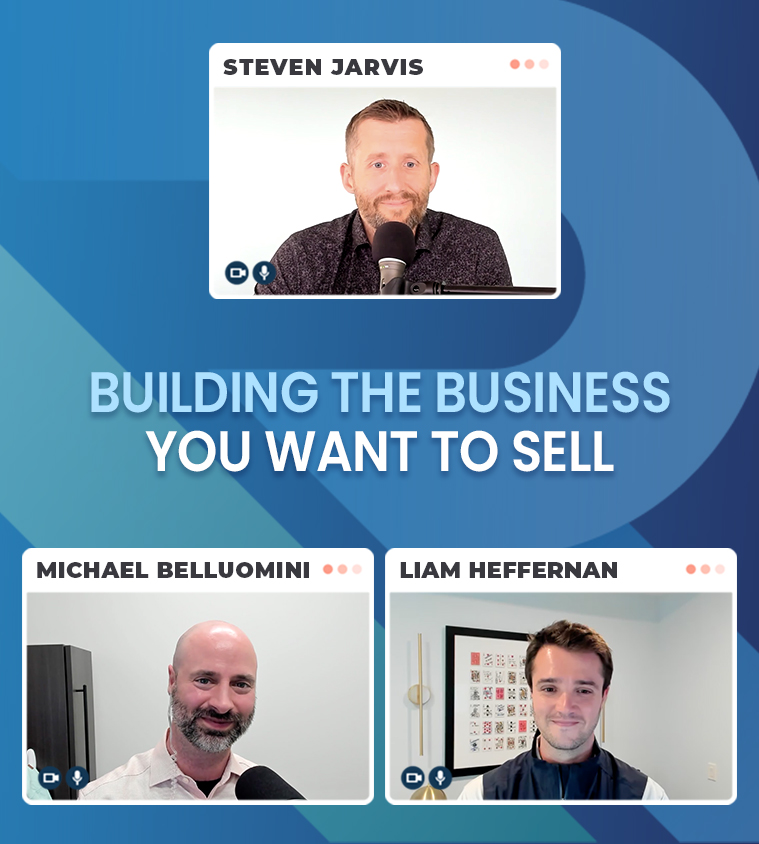
Building the Business You Want to Sell with Michael Belluomini and Liam Heffernan




Steven Jarvis, CPA, is joined by Michael Belluomini and Liam Heffernan of Carson Group to discuss what makes an advisory firm attractive to potential partners and how advisors can build a stronger, more valuable business. They explore organic growth, documented processes, delegation, client service, and the importance of talking with advisors who have already gone through a transaction. They also discuss the resources a larger firm can provide and why advisors should build a business that is ready to sell even if they never plan to sell it.
Steven and his guests share more tax-planning insights in today’s Retirement Tax Services Podcast. Feedback, unusual tax-planning stories, and suggestions for future guests can be sent to advisors@rts.tax.
Are you interested in content that provides you with action steps that you can take to deliver massive tax value to your clients? Then you are going to love our powerful training sessions online. Click on the link below to get started on your journey:
Retirementtaxservices.com/webinars
Thank you for listening.
Steven Jarvis, CPA (00:23.4)
Hello everyone and welcome to the next episode of the Retirement Tax Services Podcast Financial Professionals Edition. I’m your host, Steven Jarvis, CPA. And rejoining me this week on the podcast are some good friends from the Carson Group, Michael and Liam. Guys, welcome back. So excited to have another great discussion with you.
Michael Belluomini (01:07.712)
Hey, likewise. We could not wait for this. It’s hard to believe, but we did our first podcast in your sort of multiverse with you. And then I’ve been obviously on The Perfect RIA, now several times with your brother. So it’s been a ride. It’s been terrific fun.
Steven Jarvis, CPA (01:22.476)
Yeah, it is a lot of fun to just be able to have these conversations that help so many people. I mean, thousands of people listen to the podcast. We’ll have something like 350 advisors at the summit just this next month, which there’s a few seats left. So go to retirementtaxservices.com, get your ticket to the summit. But it is really cool getting to help so many people learn how they can better serve clients, learn about opportunities available to them as business owners, as leaders, all those kinds of things. And that’s really why I was excited to have you guys back on right now. I I’ve just finished speaking at a few different In-person events, interaction with advisors, one of my favorite things to do. And there seems to be this theme recently of you guys can speak to this better than I can. You you talk to hundreds of advisors, you look at hundreds of practices. But for your typical advisor, I mean, they’ve been maybe in one or two firms their entire career. They they hear they hear all these talking heads like us, or they see things online. They kind of feel like that a glimpse of what other firms might… Do in practice for them to learn from, but they they don’t really know. And like for for me, this is most relevant on the topic of tax planning. They’ll either think, well, I could be doing more on tax planning. I already do way more on tax planning. I can’t do anything on tax planning because compliance won’t let me. And so, I mean, when I think of people in the industry who have seen more firms than anyone else, you guys are the first ones that come to mind. So it’s a really kind of open-ended way to start this conversation. But how do you help advisors who have only seen one or two firms in their whole career? Kind of understand what’s even possible out there.
Michael Belluomini (02:46.496)
It’s a great question. I’ll answer with a little bit of a story and then Liam chime in here. But so often when we talk with an advisor that is going through the process of considering whether to partner with a larger firm or sell their business or even exit, maybe part of the conversation always comes down to the the what’s in it for me. And for the best advisors that we talk to, it it comes down to buckets. It’s… Any sort of partnership or transaction has to do well by me. Like I need to come out of this okay. My team and my staff need to come out of this okay. And I need to be able to show an increase in whatever it might be to my clients. And for most of those advisors, I would say what the client lift looks like is probably one of the most ill-defined because to your point, Steven, they don’t know what’s out there. And if they did sort of know what other firms were offering, they would work to either compete with that or develop some capabilities of their own.
Liam Heffernan (03:45.934)
I think that makes sense. I would just chime in. I think what’s been interesting even over the last two years in this space, I’d say, is as the major aggregators have perhaps separated themselves a bit in terms of deal velocity and what they can offer. I think what you’re seeing is the client is less of a concern in terms of everyone, everyone has it down pat now. If you’ve been a successful aggregator and acquire the last few years, then you’re doing something right on the client side. So then if if you’re an advisor selling your firm. The biggest questions are, you know, what’s in it for me? But I find especially at least the firms that we’re pursuing where there’s that cultural fit, it goes in order of client staff and then the advisor. So if the advisor is not worried about that, then the next biggest concern I think is for their staff. I think for us, I know that’s a big focus in terms of how we can differentiate ourselves. And so a lot of advisors, I would say that’s also, you know, that’s the guidance I would give them as you’re evaluating options, I think, or if you’re not even evaluating options, but if you’re thinking of, what would maybe make me sell. That’s what a lot of advisors who have sold, at least to us, are saying. They’re saying, how can I make sure that my staff has not only continued success, but even more career advancement opportunity in this new structure post.
Steven Jarvis, CPA (04:50.542)
Yeah, that’s really interesting. For my audience, I kind of have a question that’s gonna ask you to pull back the curtain a little bit. Maybe it’s not gonna seem like the most fun question for you, but I’m I’m gonna trust that you’ll lean into it here. Because whether someone is actively looking for an opportunity to partner to exit, or somebody’s early in their career or just happy with what they’re doing, I think there’s tremendous value in evaluating what other people are doing, what works, what we can learn from, how we can adapt and improve. I think one of the challenges with that is that when you get into this conversation of we might partner together. It’s just like an interview. Of course, everyone is putting their best foot forward, right? Of course, everyone is bringing their best bullet pointed list of here are all the amazing things that we do. So if you take off your Carson hat for just a second, you’re just giving advice to someone, whether they’re looking for how do I improve my firm or how do I evaluate a partner, like how does the advisor sitting on the other side of that table really think about or evaluate the claims being made to them of here’s how we’re gonna help with tax planning or here’s how we’re gonna let you help you do more run estate planning. Like what’s that look like from the advisor side?
Michael Belluomini (05:52.44)
For advisors that are looking at Carson or considering a partnership with Carson, I usually would advocate two things. One, ask any firm that they’re interviewing or having a conversation with, why do people choose you? And hear how Liam or I would describe our ideal candidate and why they would partner with us. But two, talk to people that have sold and not just one, talk to multiple people that have gone through a transaction. We had one very prescient seller that that asked the question. He said, Hey, I want somebody that looks just like me that has transacted within the last year, and then somebody that sold maybe three or four years ago to see how life has sort of unfolded for them through that timeframe. And I thought that was a a smart way to approach it. You don’t want everybody to look like you and you don’t want recency bias. So he was able to have a multiple conversations with folks that had partnered with us. And luckily we won that business. he’s here and happy. But I would I would advocate that anybody that’s looking at at doing something like this, like get a roster of names and and make sure, by the way, that the potential buyer is not on the phone. Have a a private conversation with that advisor. Even if if they’re gonna give the good, bad, and the ugly, it will be a more free-flowing and honest conversation if I’m not there chaperoning the call.
Steven Jarvis, CPA (07:06.114)
Yeah, I love that recommendation. That’s the like when advisors ask me if they should start their own tax practice. I get that question a lot. It’s that same theme of find someone who’s gone through this. Don’t don’t just look at the bullet pointy list of frozen cons. Find someone who has gone through this with this particular partner. Like get as specific as you can, someone who looks as similar to your situation as possible. And I love that. Like without the potential partner or buyer on the phone, just have have a heart-to-heart with them. Jeez, I’ll do shameless plugs throughout this podcast. That’s one of the reasons I love how we’ve set up the summit. So I appreciate partners like you coming to the summit. and I mean, specific to Carson, for those of you who don’t listen to the Perfect RIA podcast, my good friend Micah Shailanski partnered with Carson. Geez, that’s been a year ago now. If you haven’t listened to the TPR podcast, it’ll take you about two episodes to realize that Micah is the poster child for radical candor. And so if if you have if you have questions about the partnering process in general or about Carson specifically, come to the summit and ask him. You will get you will get zero fluff for Micah, which which is great. It’s one of the things we love doing.
Michael Belluomini (08:07.736)
I appreciate it. I I I’ve always defined it as he will praise us when we deserve to be praised and he will hold us accountable when we need to be held accountable. And we have quite a few partners that are like that, but it makes for a better partnership. absolutely. It doesn’t feel like a statutory employee situation.
Steven Jarvis, CPA (08:23.854)
I love how you phrase that of praise the positive and then hold accountable. Cause if if you if you want to get into a partnership where you don’t think there needs to be accountability, like whoa, like we need start from some this something much more rudimentary. Like every partnership, every team member, every client, like every relationship needs accountability. So I love that framing there. Like I said earlier, I mean you probably look at more firms than just about anybody else in the industry. Do you guys have been busy this last year too? There’s there’s I I constantly see announcements about about partners that you’ve added. What are trends that you’re seeing in kind of the elements or services that financial advisors that you’re excited to partner with are are doing different? Because you know, it’s easy for someone on LinkedIn or on a podcast to talk about how investment management is table stakes or that we we use all these kind of buzzwords about things we take for granted in the industry anymore. So what really sets apart a firm for you guys?
Liam Heffernan (09:15.544)
I think, for us right now in terms of what they have or what they’re looking for.
Steven Jarvis, CPA (09:18.614)
No, in terms of what the advisor is doing, because again, I’m I’m thinking about my audience who’s listening to this podcast. Some of them think that any kind of liquidity event is decades away, some of them might think it’s next year, but I think all of them can learn from what are other people doing really well. And so, I mean, Carson is putting their money where their mouth is. If if you guys find a a firm that you’re excited about, you’re willing to put money on the line. So to me, your evaluation holds weight. So I want to know as you look at other firms. What differentiates the ones where you say, yes, we want to pursue partnering with them versus, hey, maybe here’s some things to work on, come back later?
Liam Heffernan (09:51.702)
Yeah, I think the biggest ones for us, I know when we’re gonna throw an extra turn to evaluation, organic growth’s key. I think we talked about this on the first episode that we joined you on. And organic growth remains king in in that space. When when we look at a firm, we don’t want a melting ice cube. We want a firm that that knows how to grow. I think the industry average right now of actual net of market pickup, organic growth is around two percent. And so if you’re at two percent, it’s still impressive. But when we start seeing five, six, seven, eight percent, that’s when we get really excited about something. Where that growth comes from, there’s a large variety. A lot of firms have their own little mousetrap. I think a lot it’s COIs and it’s client referrals, which is fine by us. I think the most important thing is that you have some sort of documented process around it. It’s a lot easier for us to get comfortable with the valuations that are required to win these deals when we know that you have a repeatable process to kind of emulate that growth, you know, not just up until the sale, but post close. And then I would say the second one, and we’ve said it before on here and and on TPR is… Is just getting those G2 and G3s involved in the business. We would love to have the founders forever, but we know that’s not the case. There’s a reason a lot of them are selling and partnering with us. We don’t do you know, we don’t partner with a firm where the owner and the lead advisor is going to leave after a year or two. But 10 years is more than we could ask for typically. And we’d love to have them for that long. But what happens after 10 years? And so for us, it’s important that we know that you’ve got someone in the business, ideally with a little bit of equity ownership in the business, so we can have alignment there as well. And just making sure there’s a smooth transition down the line when the G one does decide to hang it up.
Michael Belluomini (11:23.01)
And Steven, I think the way you asked that question, I’ll go a little more to the intangibles or what’s the profile of a perfect fit. So as Liam just mentioned, the investments that we’re making in an ideal partner that would be joining Carson, it’s it’s not a succession play. It’s not somebody that is going to be exiting soon. Rather, it’s the folks that want to grow faster or more sustainably with a partner that can provide additional services or take things off the plate of the advisor that are not high-payoff activities. So anything that does not allow them to be meeting with existing clients and serving them or going out and winning new business, if I can offload everything else, I will be in a better spot. My clients will be in a better spot because I’m devoting more time to them. So that’s why we invest. But the ideal fit for us, there’s also an aspect of looking for that entrepreneurial mindset. We don’t want people that just want to sort of salute a flag and say, give me the playbook. I’m now an employee and behaving like an employee. These are folks that are going to be substantial shareholders of the larger Carson enterprise. And we want them motivated and excited about being that. Therefore, they’re going to go out and help grow this thing with us and drive shareholder value for all of us. So somebody that’s got a little bit of that anti establishment streak, maybe a little bit of a chip on their shoulder, but wants to join a larger team that is going to provide that lift and get them into a position where they can win more often.
Steven Jarvis, CPA (12:45.602)
Yeah, I love that. And I’m just thinking back to even a lot of the things that we really hammered home at the summit last year. You phrase it just a little bit differently, but I think this is why we get along so well. I mean, we we we talk to advisors constantly about there’s really only three things that an advisor should be doing, like especially as a business owner, as a team lead, if you’re managing a team, meeting with clients, prospecting, and then business strategy, like the the vision casting, those kinds of things and time spent on anything else. There’s other things that still have to get done, which means you either have to do them yourself as the advisor and you’re taking away time from those actual valuable activities, or you’re finding somebody to help you do them. Liam, I want to go back to something that you said you talked about not only like does organic growth really drive the valuations and drive the excitement for the car anyone else to acquire a firm, but you talked about like, hey, make sure it’s a documented process so it’s clear how this happens. And the reason I want to really kind of reinforce that is because I I think that.I think that’s valuable whether you’re planning to be acquired or not, whether you’re planning to partner or not. And it applies in so many areas. because for for one, if we don’t have a documented process, we’re probably not being completely accurate with our assessment of how consistently we do something. If you can’t pull up the scoreboard, you don’t know really what the score is. And so being able to have a documented process so we know, not just this idea of sure I get tax returns for all my clients. No, no, no. What’s the process and what do you do with those tax returns?The other thing that really helps again, way before we ever get to a partnership, is being able to delegate to team members, being able to incorporate other people onto the team. Like if you don’t have documented processes, back to your point, Michael, you’re you’re gonna be stuck not prospecting and not being with clients with a lot of your time because you’re having to recreate the wheel every time one of these things comes up. And so I love that so much of what you guys were talking about reinforcing for the partners that you are excited to partner with. Like… You’re still helping these advisors be better advisors. Like somebody could go through a lot of this process with you. Somebody ultimately decides, hey, this isn’t the right fit right now. The advisor’s still better off for having gone through these conversations and done these self-assessments. Is that fair?
Michael Belluomini (14:49.082)
Absolutely. And it’s appropriate due diligence. I mean, I think every advisor should be getting a market rate valuation at least every few years, even if they’re not contemplating a transaction right now. you should know what the business is worth and be building enterprise value and doing the things that would make you more attractive to another firm, because the things that would make you more attractive to another firm are the very things that will lend itself to additional success in your current life. Liam, you were gonna say something. I apologize.
Liam Heffernan (15:18.39)
No, you’re good. I was just it reminded me because I remember the first time I ever heard it was at the summit last year. You guys were on stage, and Micah mentioned something about even if you don’t want to sell, the most valuable version of your business is the one that is ready to sell, right? And you’re gonna you could never sell, but your bottom line is probably gonna be at its best if you’re ready to sell because you’ve cleaned up the business, you’re ready to grow. Going further on what you said, and I think it’s really interesting because we just had a manager meeting recently where we were very excited for this reason. You’re saying the documented processes, I mentioned it about growth. But generally speaking, a process-oriented firm is what also excites us. It’s not just around growth though. If you’re going to integrate and partner with a firm, there’s going to be a lot of new things that you have to, of course, we are adhere to. Of course, we have a lot of firms who, you know, everyone’s very unique. We don’t we don’t have a a one size fits all. Everyone still operates a little differently, but they’re on our platform. And so knowing that a firm has all already has processes in place, they’re very good at adhering to them. And maybe learning new ones tells us that that’s gonna be a much smoother integration and transition, generally speaking.
Steven Jarvis, CPA (16:17.516)
Yeah, absolutely. and just real quick to reinforce or to give people this resources behind a comment you made, Michael, about valuation. It it can feel like, hey, I saw somebody on LinkedIn say they got six X, so I’m just gonna multiply my firm by six X and I know my valuation. But that’s nonsense for so many reasons, not the least of which social media is people only putting their best things forward. Six X of what? And do you have clean numbers? And there’s so many other things that go into that. And I was met
Michael Belluomini (16:42.718)
Measured by whom?
Steven Jarvis, CPA (16:43.926)
Yeah. As measured by whom the last time you guys are on, this link is still live on my end. So hopefully you guys are still good with it. But if you go to retirementtaxservices.com/Carson, we’ve got some links there to some resources around valuation that Michael’s put together in the past that Hahas put together. And if you drop your contact information in there, the team from Carson will actually kind of help you start some of that as well, at least get your ideas thinking in the right direction. So absolutely. Doing your personal evaluation of your firm in an Excel spreadsheet is not as helpful as you think or as you telling yourself it is.
Michael Belluomini (17:16.012)
We’re actually gonna, we’re talking about this very thing at the summit here next month. We’re we’ll be on stage with Matt going through the example of two different firms with very similar top line revenue and assets and two totally different valuations and why that is.
Steven Jarvis, CPA (17:31.178)
Liam, you’re like you absolutely hit it on the head there of like the these conversations matter whether you think you’re selling next year or 20 years or like it’s somehow in your head do you think you’re never gonna exit, which we all exit business life, all these things someday. But like the this exercise, be able to go through and say, Okay, these valuations are based on best practices. They’re based on quality of of client service, they’re based on growth, they’re based on these things that are important to me as a business owner, whether I sell it or not. So, you’re not gonna be worse off for having gone through these exercises. In fact, y it’s they’re the kind of things that start setting you apart from from the rest of the industry. I
Liam Heffernan (18:07.182)
I agree. Yeah. And I and I I go back to we’ve done some, you know, we’ve been focusing on some larger deals recently. And there’s a lot of firms where the owners financially, it’ll be great for them. They’re gonna come into more money, but they might already have more money than they ever needed. And so a lot of them will say, you know, that’s the least important reason for this transaction for me. A lot of them they did the evaluation that we’re talking about and they said what in what world and how can I give even more to my clients? And I think that for them they arrived at the place where I need to go to market and and potentially work with a larger firm who has broader resources where I can offer those to my clients. So it’s not always about money either. It might actually be best for your clients as well.
Michael Belluomini (18:44.948)
I I actually think that’s true most of the time too, Liam. I mean, I there’s a a firm that’s a partner of ours. I won’t name the city. They’re in a major metropolitan area that has the headquarters of multiple other large national acquirers and integrators, big RIAs. And his comment was, I have been competing against these firms my entire adult life. At some point, I recognized that I needed help. And I looked to a firm like Carson to back me. So that I could win the clients that had historically gone to one of these two larger firms that offered more in the way of a value stack and technology and all the things that I couldn’t do as the owner of a highly successful but very local RIA.
Steven Jarvis, CPA (19:26.284)
Michael, let’s stroll into that just a little bit. Like I have a tendency to get really tactical to things. It’s almost like there’s a reason I became a CPA. And I mentioned earlier in the podcast, like, hey, you can’t just take the bullet point list that’s put in front of you and just like take it at face value. You got to evaluate some of these things. So I’ve talked to people who’ve gone through the process with Carson who are excited now that they’re a year or two years into being with Carson about the resources they get access to. But but this is a process. So like for a firm that the partners, like what kind of things do they immediately start seeing benefits from as far as that that resource stack behind them? And what’s kind of that timeline to get somebody fully integrated so they really feel like they’re wielding the full might of Carson? I
Michael Belluomini (20:01.646)
I think it falls into a few camps. Efficiency or capacity is a huge one. And that tends to be the advisor that is attracted to the tech stack as an example and recognizes that by using our technology, they’re going to free up another eight to 16 hours per week and they can use that time to go out and win new business or serve their existing clients. So focusing less on trying to make systems talk to each other and trying to figure out whether AI is going to be right for them in their practice and more time out in the field. The capacity also can come by the way of of operation support and and paraplanning support and just basic functionalities that maybe we can do better in Omaha for our field offices versus them trying to staff up and and do at a local level. The second one is is actually a an expanded breadth of of services. And that’s where you I think what we typically see is advisors that maybe run into a case or two. So maybe they have… One or two retirement plans. They have one or two ultra high net worth clients. They maybe have that one endowment. They’ve never really thought about tax planning and they shy away from them because they view their their existing book as maybe the millionaire next door or Mass Affluent. And they’re afraid to sort of go out and compete. It’s almost like an accommodation to try and win these larger accounts. And they’re looking for a firm that can surround the advisor with additional resources like planning support and advanced case design.
And support for ultra high net worth clients that are looking for concierge travel and generational planning and advanced trust and estate planning, all those things that maybe they weren’t doing at the local level that a firm like Carson can provide. So that it’s capacity, I think, to start the conversation. And then they start imagining what life is gonna be like on the other side, and they see these shiny new objects that they don’t have access to right now and realize my addressable market’s gonna expand. And when I come across one of these clients, I can actually win them and then keep them around by servicing them.
Steven Jarvis, CPA (22:03.852)
Yeah, that makes a ton of sense. I was just maybe within the last month or two, I was talking to a friend of mine who fairly recently joined Carson, definitely within the probably about a year ago or so, and was just making this kind of it’s it was so funny because I used to work at really big accounting firms. And as an entrepreneur now, there are definitely days where I miss having like departments I can call to deal with things that aren’t really my skill set. And that’s the comment she was making was that it was kind of one of the unexpected, but one of one of the benefits she loves about working with Carson is that the things that aren’t prospecting and financial planning meeting with clients. Like now instead of her figuring this out on her own, she’s like, I just, I just send it to the Carson home and I’ll I’ll get the the the process wrong of who she’s calling or emailing. But she basically is like, I’ve got somebody I can reach out to and they just take care of it. And I can go back to prospecting meeting with
Michael Belluomini (22:48.454)
Somebody will jump in. we had one just today. One of our one of our offices that’s under LOI will be joining us in November. Big office, has a few very large clients, historically, has had a hard time trying to service them. And and I got an email from one of the founders today that just said, hey, do we have a solution for premium financing? And for me to respond immediately and say, Yes, we do, through our partnership with Financial Independence Group in North Carolina. Let me pull in Matt Lewis, who runs our insurance group, and also he’ll organize a call with the expert at Financial Independence Group and we’ll start that conversation now. It was a two-minute turnaround in the email, and he got an answer that I’m sure pleased him and will provide some additional services that historically he didn’t have he didn’t have access to.
Steven Jarvis, CPA (23:32.622)
Well, that’s such a great example because I I’m I’m a huge fan of like, let’s do the things we’re really good at. And advisors can go a long time with, okay, here’s here’s what my clients typically look at. I’m really good at servicing these types of clients. The the the the flip side of that is we shouldn’t do things as a one offer exception. But for an advisor on their own, that that can mean the the exception just doesn’t get addressed or the exception doesn’t get addressed well. But it was still an important thing to that client. And if if for that advisor, there’s, you know, twice in their career or twice in the next five years that they need to deal with premium financing, it doesn’t make sense for them to go and become an expert themselves and to develop relationships themselves and all of those things. But if you’ve got, if you’ve got a central resource that all they do is facilitate these premium financing discussions, great. Now we’ve got a quality service going on.
Michael Belluomini (24:19.862)
That’s exactly right.
Steven Jarvis, CPA (24:20.994)
Guys, I mean, we’re over halfway through twenty twenty six. Is you talk to advisors? I mean, what what else what else are you seeing? What else you telling advisors that you’re excited about in industry or or things you’re encouraging people to s to stay on top of?
Michael Belluomini (24:32.238)
Liam, why don’t you take first stab at that? And I’ve got a few things I can add too.
Liam Heffernan (24:35.99)
Yeah, I mean, I’m gonna quote Michael when I first joined here. it seems like there’s still a strong bull market for MA. I’ll tell you that much. And I think that the multiples that people heard about generally maybe six, twelve months ago, they thought they only apply to the larger firms, but that’s just simply not the case anymore. It’s a really, really good business. There’s a lot of institutional money finding its way in here. I think if anything, there’s a line at the door to get in at this point. You know, you got this broad array of competent well capitalized buyers in this space. I would love to say that Carson is the perfect space for everyone, but I and I think we are maybe for most people, but I would argue that even if it’s not us, like there’s a lot of good firms out there that can offer a lot of services and give you lift, make you more efficient, and ultimately take care of your your clients and your staff. And I’m sure people are taking care of their clients and their staff as is, but they give you access to resources that you could never imagine. So it’s it’s ne there’s never been a better time to be a seller is the way that I would put it. And going back to what we mentioned earlier. Even if you don’t actually think you’re going to sell, the best business is a business that’s ready to sell. it’s streamlined, it’s clean, it’s organized, and you’re tracking everything the way that you should be.
Michael Belluomini (25:38.476)
Yeah, I I agree. I I don’t think it’s a buyer’s market or a seller’s market, frankly. I think there’s a ton of supply and there’s a lot of really good demand too. I mean, there are 25 of us that do this at scale regularly, year in and year out, and another 30 to 40 behind us that do this more selectively or once a year, or maybe twice a year. So if if you interview a firm and it’s not the ideal fit for whatever reason it might be, somebody else is going to be. So you can be diligent and you can be picky with who that new partner is going to be and why. Likewise, it’s very similar for us on the buy side. We can look at a firm and identify that that right down the fairway, perfect fit for us relatively quickly. And if they’re not, it doesn’t have to be personal. We can just amicably agree that we might not be the ideal fit. And I might be able to recommend two or three firms that you should speak to. Based on what you’re looking to achieve. There’s a lot of talk about multiples right now, too, and whether valuations will hold. I think they will. I’m I’m on record saying that I think we’ve got a long bull market on this. I do think there will be some nuance to valuation as we move forward. There’s all kinds of talk about what happens when the first big firm decides to go public. And I do believe that will maybe change the way we discuss valuations. If it’s a wonderful, integrated, high growth, full ensemble firm. I think they’re gonna do just fine. And we all have a few folks that we think of when we think about who would be the ideal first person to go public. But if it’s a firm that maybe doesn’t look like that and is more siloed or doesn’t have the organic growth to speak to or is not fully integrated, then if the public markets don’t treat that the same way the private markets have historically, you will see a reverberation through the supply chain because you have to. If a firm like that is valued at a
18x versus a 24x that they were counting on, then they’re not gonna be able to pay 18x to anybody. They’re gonna, they’re gonna lower their evaluations, which would then create a little bit more of a delta between the really tightly run, fully integrated, high-growth firms and those that are not. And I would just encourage anybody that if you’re thinking about seeking the market and looking for a potential partner, just to hammer this point home, build the business you want to sell, not the business you have today.
Michael Belluomini (28:00.162)
Start putting things in place because right now the delta between a great billion-dollar firm and an okay billion-dollar firm is not that big. That will change at some point in the future. And you want to be the one that everybody wants to partner with, not the one that people feel okay passing on.
Steven Jarvis, CPA (28:17.144)
Guys, great great insight as always. Li Liam, go ahead. G give us some final thoughts here.
Liam Heffernan (28:20.66)
I had I had one more thing that I forgot and I meant to mention it earlier as well when Michael was when you asked for like the key points for people when they’re trying to explore different buyers. He I think he hit the nail on the head with the first one, which is talk to people who have transacted with them. my last piece, and it kind of goes along with this also final piece, is higher representation. I I don’t think love that. I don’t think that anyone who’s done it hasn’t found it worth worthy or worthwhile. I think it makes the most sense. Also, you want to talk about understanding buyers. Yeah. The bankers, they work with every single buyer across the country every single week, right? So they know who they’re gonna get to know you. They understand the people like Michael and I and our counterparts. They know the CEO at every firm. They know who you’re really going to get along with culturally, operationally. I can’t think of a a bigger mistake than to not do that because you wanna go into it. You wanna make sure you have full confidence that someone has your best interest and is putting you in front of all the different potential buyers that you might wanna partner with.
Michael Belluomini (29:13.102)
Steven, you mentioned at the beginning of this conversation, outsource the things that you’re not the expert in. This is one of those things.
Steven Jarvis, CPA (29:18.69)
Absolutely. For people who are new to this process, that isn’t Liam saying, hey, call Carson to hire us as your representation. That that that’s that’s talking about someone else besides you as the advisor and the partner like Carson that you might be partnering with. This is have someone who can objectively stand back and say, wait a second, here were your goals or here are the things that are most important and here’s where we can push back. So Liam, I love being able to wrap up on that recommendation that really is for the advisor listening. So, guys, again, thank you. Really appreciate your time and insight for everyone listening again. Come out to the summit at the end of September, grill these guys in person. They’re gonna get up and give a great presentation. They’re gonna hang out the whole time and answer every question that you have. So you can go to retirementtaxservices.com, get one of those last seats for the summit. You can also go to retirement taxservices.com slash Carson, get some great resources around valuation, get some help there. So Michael Liam, again, thanks for being here. Can’t wait to see you guys next month. So everyone listening, good luck out there. And until next time, remember to tip your server, not the IRS.