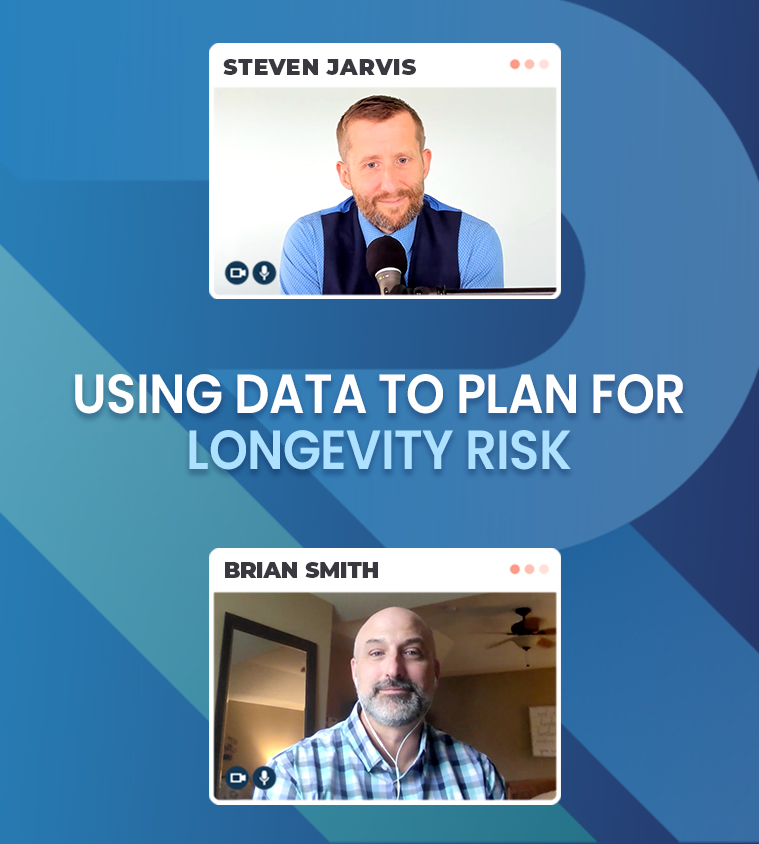
Steven Jarvis, CPA, welcomes Brian Smith of Foundational Income Associates back to discuss the difference between life expectancy and longevity and why that distinction matters in financial planning. They explore how advisors can use data and longevity calculators rather than arbitrary ages when building retirement plans. The discussion also highlights how longevity risk can compound other retirement risks, including market and healthcare risk. Brian shares a case study involving a 60-year-old teacher where incorporating guaranteed lifetime income helped improve the plan’s probability of success. They also discuss how advisors can use professional resources and specialists to navigate the growing complexity of retirement planning. Ultimately, the conversation is about making intentional, data-informed decisions instead of allowing longevity assumptions to happen by default.
Steven and his guests share more tax-planning insights in today’s Retirement Tax Services Podcast. Feedback, unusual tax-planning stories, and suggestions for future guests can be sent to advisors@rts.tax.
Are you interested in content that provides you with action steps that you can take to deliver massive tax value to your clients? Then you are going to love our powerful training sessions online. Click on the link below to get started on your journey:
Retirementtaxservices.com/webinars
Thank you for listening.
Steven Jarvis, CPA (00:52.046)
Hello everyone and welcome to the next episode of the Retirement Tax Services Podcast Financial Professionals Edition. I’m your host, Steven Jarvis, CPA, and I am thrilled to have joining me on the podcast again, my good friend Brian Smith. Brian, welcome back to the show.
Brian Smith (01:05.838)
Thank you, Steven. Always great to be with you.
Steven Jarvis, CPA (01:08.366)
For people driving who aren’t keeping meticulous notes of every guest that comes on, just just remind the audience your area of expertise that’s gonna kinda frame our our conversation here and the the great things you do with advisors.
Brian Smith (01:19.854)
Sounds good. Yes. I’m a wholesaler and owner at Foundational Income Associates. We help advisors make insurance simple, whether that’s life insurance, annuities, long-term care. We’re in it for the guarantees. We’re looking for the best way that we can solve your clients’ needs, doing it the right way.
Steven Jarvis, CPA (01:39.81)
We’ve been doing this kind of stuff together for a while now. This is one of the things I love about you. Like you just confidently and transparently start with, I’m a wholesaler. Like this this is an area where and and there might be some people who are listening who are like, never mind, I’m not listening to this episode. Like that’s that’s your loss, though. Because that’s what we’re gonna get into today is the very real parts of life that make these conversations super important. But we end up with these topics in our industry where people kind of want to like skate around the edges and like I’m for those of us who’ve been doing this a long time. We always know those people who who they they mean, hey, I do insurance, but they want to wait until the very end to say it. And I would always rather work with the person who says, Hey, this is what I do and here’s why it’s important and why I’m great at it. So I’m just one of the reasons I love working with you, Brian. But I appreciate that that’s your approach to this of hey, there there is a place for this. And I’m just gonna tell you exactly who I am and what I do.
Brian Smith (02:27.618)
Well, the only time that you need to dance around something is is when you’re not confident in what it is that you’re talking about, or there’s something to hide. And my conversations with Micah, even from the main stage at the summit last year, he was like, There’s some really awful product out there, you know? There are. There’s some really good products too. So that’s why at FIA we talk about how we use insurance for the guarantees. We’re not spinning product. We’re not talking about the latest uncapped strategy. Yeah. Right. We’re using insurance for the guarantees. And that’s what most of our clients want to hear, right? That’s what IARs and RIAs want to hear about. They want to hear about the guarantees because most of their efforts are going forward towards AUM. And and they should be.
Steven Jarvis, CPA (03:15.598)
I’m the tax guy. So of course I think there’s overlaps with tax and everything that we do. But as you describe it that way, it makes me think about a lot of the things I see in the in the tax world anymore of tax professionals, maybe we’ll use that a little bit loosely, but but people trying to sell aggressive tax tactics who they all they focus on is hey, don’t you hate taxes too? And they almost make you feel dumb for not using their crazy aggressive borderline fraudulent tax strategies because of course everyone’s scared of paying more taxes. And and you do see too much of that, I think, on the insurance side as well, that it’s just the scare tactics and then just the blanket, well, you need more insurance. But really, our conversation today was prompted because, and you were saying this before we started, I think sometimes people might dismiss what you have to say on some of these topics because they’re like, well, he is a wholesaler, so of course he just wants to make a sale. And so we’re gonna you we’re gonna use some third-party expertise here, some stranger in uniform, which has a lot of power when we work with clients as well. But… You had sent me this link. I I try to keep up on a lot of what Kitces.com does, but they put out so much great content. I don’t see it all right away. And so I appreciate that you sent me this link to a great recent podcast episode talking about longevity and lifespan. And you had sent this to me with some thoughts. And I thought it sounded great. So I wanted to get on and talk about it today. So give give the the listeners some framing for what we’re gonna talk about here.
Brian Smith (04:37.792)
You bet. Absolutely. Well, as you said, oftentimes if a wholesaler talks about longevity risk, they get dismissed oftentimes by advisors because you’re just trying to sell the fear. Fear-based selling so that you can get me to sell something that has guaranteed income. Well, of course, we all have a vested interest in selling something, right? We we’re not nonprofits. At the same time, when I saw this article and the podcast, I went, okay.
Brian Smith (05:06.146)
Now we’ve got Michael Kitces, who is is well regarded as one of the top thought leaders in the financial industry. Yeah. And he brought on a doctor that specializes in looking at longevity versus life expectancy. And by the way, before we jump into that, Steven, congratulations to you and RTS. Michael Kitces actually named you guys as one of the top thought leaders for tax. So congratulations.
Steven Jarvis, CPA (05:29.56)
Thank you. Yeah. It’s definitely quite an honor. It feels a little surreal sometimes. But appreciate you pointing that out. It certainly is an honor. When I look at things that that Kitces does and that he focuses on, I love his lens of hey, let let’s see what the data says. Because on this topic of of longevity and lifespan, unfortunately it is really easy to turn it into a scare tactic. Just like on the tax side, it’s really easy to try to calculate someone’s lifetime tax bill and just try to scare them into taking action. Just because there’s people on that far side of the spectrum who use it that way doesn’t mean the rest of us can ignore it because this is a very real thing. And part of the reason that I was excited to have this conversation with you is that while I’m the tax guy, at the end of the day, taxes are always like supplementary or complementary to other things in life. Taxes are never the primary goal. When I think about most clients’ real goals in life, it really is around. Supporting, maintaining their lifestyle, being able to do these things they care about for as long as humanly possible. And so you can type 90 or 100 or 80 into a financial planning tool. But at the end of the day, and I think this is some of what the article is talking about. Like we, you have to make a decision in the planning. And it comes down to are you doing this arbitrarily or are you actually putting some thought and research behind it?
Brian Smith (06:47.668)
Exactly. One of the things that they said in the podcast is if you arbitrarily choose an age for life expectancy, the client will almost always choose something that’s too early because they’ll oftentimes base it on what happened to their parents. And the advisor will probably choose something that’s too late because they certainly don’t want to create a financial plan that runs out of money too early. So what if we could use some of the resources out there to actually apply some knowledge and some technique to what age do we use to put into our financial planning software? What are we what are we talking about when we talk in terms of longevity versus life expectancy? So they listed in that article in that podcast three different tools that you could use. And I really liked the one that came out from the American Academy of Actuaries. I actually went to all three software. I think one of them was Northwestern Mutual. And I don’t remember the other one, but the the one that I really liked was American Academy of Actuaries because it’ll actually allow you to put in husband and wife because that actually does have an impact on longevity. If one spouse dies earlier, the second spouse tends to die earlier than they would if they had both been living. And that is something that the American Academy of Actuaries software puts in there. And it starts to allow you to see that living well into your 90s is not that uncommon. And it does actually ask some questions about living, lifestyle. How’s your diet? How’s your workout? It doesn’t get intrusive, but it does ask some questions like that to dial in. Do you smoke? To give you a little bit more accurate representation of longevity. And when we’re talking about longevity, I heard Tom Hegness say he’s he’s sort of a longevity expert. He said that longevity is the number one threat in retirement. Because it’s not just a standalone problem, it tends to multiply every other financial risk that you’re gonna face. The longer you live, the more you have market risk. The longer you live, the more you have healthcare risk. On and on and on. So I thought, interesting. So now we’ve got software that allows us to get to a little bit better of a number that we can put into our planning software to get more of a realistic answer.
Steven Jarvis, CPA (09:06.178)
Brian, talk about like how you the typical advisor should think about a calculator like this. Cause I I love I love tools, and we see the same thing on the on the tax side of there’s more and more robust ways to kind of pull the different levers. But at some point, the advisor has to apply their professional judgment and has to say, okay, the the tool is still just a projection. It it is not a promise of any kind that, hey, you answer all the questions, and so we’ve here’s the exact day you’re going to die. Like that’s not what we’re doing here. So what’s that balance? Like I guess where do you find the sweet spot of let’s use tools and then apply our professional judgment and and like how do we make those choices?
Brian Smith (09:43.31)
That’s great question. Well, I wanted to, you know, obviously I’m not gonna advertise something that I haven’t gone through myself. So I literally went in and put my information and my wife Angie’s information in there just to see all the different ways that it would, you know, the kind of the information that it would give us. And it operates in terms of age and percentage. So it doesn’t say, you know, Brian, yeah, you’re gonna die at 86.3. It says
Brian Smith (10:10.05)
There’s probably a 95% chance that you’re going to live past 65. Yeah. And it’s going to give you a 70% chance that you’re going to live to age 70, so on and so forth. And so I don’t think it necessarily should be used as a this is what the software said. I think it would be well used as a conversation with the client. Hey, one of the things my software requires is I have to choose when we think you’re going to pass on. And horrible conversation, but it it is sort of an important thing. What do you think we should use? And I have some tools that I can run. Maybe between what you think and what the software, we can sort of come to an agreement. So you’re not telling them and they’re not telling you it’s a little bit of both, if that makes sense.
Steven Jarvis, CPA (10:57.354)
Yeah. So you’re seeing this as more of a a way to frame the conversation with the client to help them understand what kind of the range of possibilities is, as opposed to that this this isn’t meant to be, and here is your estimated death date, like let’s let’s plan the party now, or services, probably party’s the wrong word, services. Yeah. but that this is more of like how do we frame the conversation? Cause it it it is a hard topic and one that a lot of people have more of a tendency to ignore than embrace.
Brian Smith (11:24.622)
For sure, for sure. And again, most clients will will refer to when their parents die. And or they’ll just focus on life expectancy. And life expectancy is just the 50-50. If your life expectancy is 83, that means, you know, if you put a hundred, whatever, 53-year-old in the room, half are gonna live to age 83 and half are gonna live beyond age 83. If you don’t understand the difference between life expectancy and longevity, you’re gonna use wrong numbers in your planning process, which is probably gonna put stress somewhere in the plan, you know?
Steven Jarvis, CPA (12:00.856)
So, Brian, how do you articulate that to clients? Like how do you how do you I’m all about taking complex topics and be able to simplify them so we can explain them to clients. How do you explain to a client here’s the difference between longevity and lifespan or expected lifespan?
Brian Smith (12:13.196)
I do it in terms of numbers. It may not be the best way. It’s just the way that I do it. So life expectancy, like I said, is just the fifty-fifty. If life expectancy, given the software that we’re using, says..
Steven Jarvis, CPA (12:24.759)
Life expectancy is just the average. So ha half people have to be above average, half people have to be below average.
Brian Smith (12:29.492)
Exactly. And if you think about it in terms of a bell curve, right, you got right down the middle, that’s life expectancy. But we’re more worried about longevity. Yeah. Which says there’s a very good chance, less than 50%, but higher than zero, you know, that you’re gonna live beyond age eighty-three. And and realistically and and recently when I’ve been running illustrations, it tends to be about age eighty-six for males. And that’s life expectancy. And then longevity is like 88 or maybe 90. With females, it tends to be more like you know, 87, 89, 91. If you put them together, now it’s more like 88, 100, 102. And then of course that depends completely on how old are they right now when I’m running the illustrations or using these software packages that we’re talking about. And if they see life expectancy is 83, they’re gonna say eighty three. What they don’t realize is that there’s fifty percent chance, given these software packages, that you’re still gonna live. If you build your plan on that, it might put the financial advisor in a pinch where now they run out of money too.
Steven Jarvis, CPA (13:42.606)
Soon. Like you said, the the calculator that you liked the most was coming from the Society of Actuaries, which I I love that actuaries exist because they’re the only people that are consistently deemed to be more nerdy than accountants. So that’s that’s that’s always the like day one of the accounting profession joke is how how can you tell the difference between an accountant and an actuary? Accountant looks at your shoes when they talk to you instead of making eye contact, an actuary looks at their own shoes. That’s good. So… Jokes aside, like this is coming from a place of what is the data telling us? This isn’t let’s you know flip over tarot cards or read the tea leaves. This is what is what is the data showing us as the range of hostile outcomes.
Brian Smith (14:21.55)
Exactly. And then what do you what do you do with that information?
Steven Jarvis, CPA (14:25.162)
Always the important question, whether we’re talking about insurance or taxes or or whatever part of our life, it’s okay, and what are we gonna do with that information? You know, based on that data, what decision are we are we gonna make? Because again, Brian, one of the reasons I love working with you is that you’re not a, hey, this is the magic answer to everything all the time. Like everyone has to have this one thing. Because even if we take that data and say, okay, great, here’s here’s this risk and we need to address it, then we need to get specific to the client and we need to look at their situation, look at their investments, their income, their risk tolerance, these different things and say, okay, what’s the right answer? And when we go through that, as I work with advisors, talk to advisors all the time, who as they go through that, there are going to be clients who say, Yeah. And having some kind of guarantee that I can, I can rest easy, I can sleep good at night, I know that I’m taken care of regardless of the outcome, there are, there are clients that is going to be very, very important to.
Brian Smith (15:14.73)
Exactly. This is where the part where, you know, advisors say, you’re a wholesaler, you’re just selling the fear. No, we’ve already discussed that there’s real numbers that we can use. And that doesn’t necessarily mean you need to sell annuities or life insurance. But what it does underscore is that we do want to do something that helps longevity risk. And how do we how do we deal with longevity risk? Well, pensions, if you’re lucky, they’ve been fewer and fewer as we know. Social Security Managed, and that’s another thing that Dr. Co., the the one that Michael Kitts has brought in, he actually has some software packages that you can use to integrate Social Security planning. And then of course, something with a guaranteed income stream. That’s where the annuities come in. And so now that you have consensus from a software and the client put together, put into your into your software package, whatever that with that’s right capital or e-money or or whatever it is that you’re using. If you want to abate some of that longevity risk, I would encourage you to take a look at the annuities lately with interest rates as high as they are. An 8% withdrawal rate at age 65 is phenomenal. And I’ve been doing this 20 years and I I haven’t seen it this high. I’ve heard that it was high this high before I was in the industry, but since I’ve been in the industry, I haven’t seen withdrawal rates this high, which theoretically should ease some of the tension off of your managed money. If you can take that need to abate the longevity risk and solve it now, that should allow you to be more aggressive with your AUM, which is a good thing, I think.
Steven Jarvis, CPA (16:54.734)
I think one of things you that you’re implying in there that I just want to like really specifically call out is you don’t have to have insurance or annuities, but like the reality is if your plan is to 83 and you get past 83, your lifestyle has to be afforded in some way. And so you do have to make this client specific and you have to go through the options. And like it’s very possible. I’ve got a family member that comes to mind that was fortunate enough to spend his working years in a career field. Where there’s very strong union, very strong pension. He’s already pulling from two different pensions, social security for him, his wife, regardless of his life expectancy, longevity, he’s gonna be in a great situation. But he’s he’s the exception, not the norm. And so for most people, they’ve got to be able to answer this question of okay, if I if I live longer than I expected, where’s that gonna come from? Then we can go down the options. How much is social security gonna cover? And is that gonna keep my lifestyle where I want it to be? How many kids do I have? And which one of them wants me to live with them? Like that, that might sound kind of silly, but that’s where where people end up if they don’t, they don’t plan ahead, which I I appreciate they keep reinforcing it because it it is this fine line. we don’t we don’t want to be fear-mongering, like we don’t want to get so aggressive with the doom and gloom that we’re scaring people into taking actions they don’t need to. The alternative to that is not ignoring it or pretending it’s not real, it’s taking a proactive and specific approach. It’s saying, okay, for this situation, when we evaluate the risk factors and we know what our range of outcomes is, are we comfortable with the current situation or do we need to put something else in place?
Brian Smith (18:27.712)
That’s a great way to put it, Steven. If you don’t mind, I have an example from an advisor here in Minnesota that we we went through. So local advisor runs his own RIA, you know, from a seminar, a client came in, a 60-year-old female that wanted to retire in two years. She’s a teacher. She got approximately a million of assets. She wanted about $60,000 a year in two years of income. The existing portfolio had 49% bonds. 37% equities and 14% cash. And running it through in this case, right capital, client had about an 81% probability that the money would last into her 90s. And in order to change that, there really wasn’t too many variables other than she would just have to work more. She didn’t work, she didn’t want to work more. Yeah. You know, so she’d have to work until 65 to get that 94, 95% probability of success. So… What this advisor did is took 25% of her assets and looked at a guaranteed lifetime annuity. And we’re not necessarily getting into any sort of product here, just something with a guaranteed lifetime income, which allowed her to be more aggressive with the remaining 75% of her assets. And that moved her up to a 96% probability that her money would last well into her 90s. Now you could always, without throwing stones at the previous advisor, you say, okay, well, is 37% equities sufficient? Maybe she was a little risk averse. In this case, we’ve taken 25% of the assets, put it in something that is lockstep guaranteed for the rest of her life for guaranteed income, which eases some of the tension of the withdrawals from the managed money and allows then the AUM to be more aggressive. In this case, you know, he made the sales, got a very happy client. Now that’s not going to happen every single time, but I thought it was an interesting experience and example to look at when we’re talking about the potential needs of guaranteed income or just the income strain that it can put on an overall portfolio.
Steven Jarvis, CPA (20:35.022)
It’s also a great reminder that it can get easy to get caught up on the mathematically optimal outcome of a plan as opposed to the reality of behavior and risk tolerance and things like that. I talked about it all. I was doing a webinar earlier this morning talking about taxes and we and we were talking about that very thing. And advisors were asking these questions that we were talking Roth conversion specifically, but they’re asking these questions, really trying to get at, but like, hey, wouldn’t it be more perfect if we did it this way? and it’s like, well, well, maybe, but… We’re not just doing math here. If we were just doing math, all of our jobs are gone tomorrow and AI’s taking over. AI does math way better than I’ll ever do. But we’re we’re not just doing math. We have to understand not just a client-specific situation, not just their variables, but some of these intangibles, their risk profile, their behavior, all of these different things. And so we can’t simplify it to and it totally where you’re coming from of like, hey, maybe maybe they should have had more equities. Maybe. I don’t know. I we neither of us worked with that client. Jeez, I’m not an investment guy, anyways. But at some point, like we we’ve got to accept the specific client’s risk profile. None of us get to age backwards. And so if you have a client that comes to you in their six their 60s, their late 50s, like we can’t go back and say, hey, how great would it have been if you would have had more equities in your 30s? Like that’s that’s that’s just not my not only is my crystal ball broken, but it sits on top of my broken time machine. So like you you can spend all day on those things, or we can say, okay, what’s gonna get this done for this client going forward?
Brian Smith (21:58.542)
Well said, perfectly said, perfectly said.
Steven Jarvis, CPA (22:01.442)
So, Brian, I know in the past you’ve been very generous with our audience. And if they go out to retirementtaxservices.com/ FIA, you’ve offered to review existing products that they have, that maybe it’s time for just a refresh of just understanding what’s in them. Like, is it time to kind of take a look at these things? The case you were just describing, though, that’s more of like a hey, have I identified a situation and I think there there’s there’s a product that may have a fit here. Like, how how should advisors be learning about like they’ve identified maybe anybody’s right answer. How should they be learning about what’s out there, whether that’s through you or anybody else? It’s
Brian Smith (22:35.566)
That’s great question. There’s so much information out there available. As you know, AI and Google can give you a heck of a lot of information. Yeah. Tends to be a little bit overload, in my opinion. Thank goodness there’s there’s great software out there to aggregate and consolidate the information. And I would never turn you away from doing your your own research, but since we’ve been doing these podcasts, I’ve been receiving a number of calls of people that just say, listen, I don’t know what I’m doing. And can you help me? And the answer is yes. It’s it’s financial planning is more difficult today, in my opinion, than it’s ever been. Not because we don’t have technology and resources, it’s because the expectations of financial advisors are so different than they used to be. Oftentimes you’re expected to be an expert in tax planning, financial planning, retirement planning, you know, all of that stuff. So if you can if you can tap into a resource that will do that kind of information and provide the training, why wouldn’t you? And that’s what I’m offering. Just give me a call and I’m happy to to go over the the the options. There’s fee-based options, there’s commissionable options. There’s so much available. The product is so good. I’m happy to walk you through it. And then if you do have a case, I’ll use all the tools at my disposal to shrink down all the options to the one, the very best ones that’ll make the best sense for your clients and then walk you through why I chose those options.
Steven Jarvis, CPA (24:01.582)
Yeah, and for those of you already signed up for the summit at the end of September, Brian’s going to be there with his team. Come with your questions. Like the if you want to get the most out of a conference, always come prepared with specific client examples, prospect examples. Come with your questions and ask those questions in person. If you haven’t gotten a ticket for the summit yet, we do have a few left. So you can go out to retirementtaxservices.com. Come spend two and a half days with us learning how to level up what you’re providing to your clients. We’re gonna help every attendee build a 12-month action plan. So it’s it’s gonna be incredible. And Brian, super excited that you’re gonna be there again this year.
Brian Smith (24:31.414)
Ought to be great. If you haven’t been to one of these, it’s juiced. It’s high energy; it’s packed with value. You leave with things that you can do. I actually had to go through, and Micah forced me, forced me to go through my own action plan and business planning of the things that I could do to be a better entrepreneur and to help advisors better. So yeah, if you haven’t been to a summit, you gotta get there. It’s it’s a heck of a time. Action-packed.
Steven Jarvis, CPA (24:58.648)
Well, Brian, appreciate your expertise and wisdom as always. Any other parting thoughts on this topic?
Brian Smith (25:04.18)
I would just say, yeah, the technology is out there. And I love that Michael Kitts has focused on the difference between life expectancy and longevity. And now that we’ve got software, whether or not you use any sort of insurance product is sort of irrelevant to the topic. Yeah. At least to use the right kinds of numbers for your financial planning. And I’m I’m happy to help you with that and show you where those software packages are as well. But yeah, thanks for having me on, Steven. I appreciate it.
Steven Jarvis, CPA (25:30.594)
course well that that’s such a great kind of theme to wrap up on is it like that this isn’t this isn’t about insurance or not insurance it’s about evaluating the risks and the data and your client situation and making intentional decision not letting these things happen by default so I love that. Brian thanks again for everyone listening. Thanks for being here and until next time good luck out there and remember to tip your server, not the IRS.