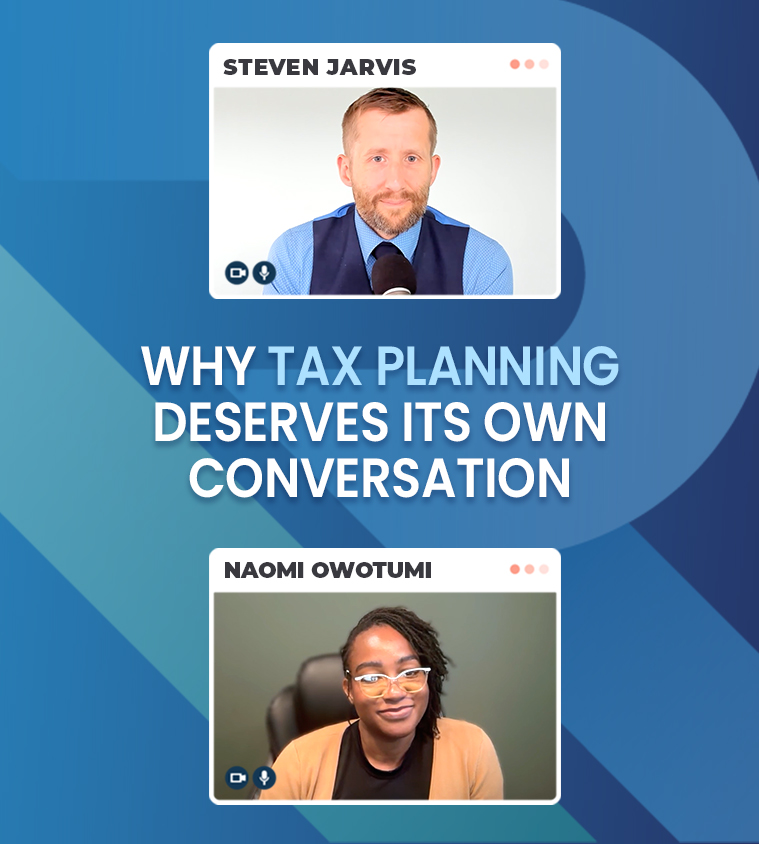
Steven Jarvis, CPA, welcomes Naomi Owotumi from Jump AI to discuss the growing intersection between wealth management, tax planning, and technology. Naomi explains how Jump goes beyond note-taking by analyzing client conversations to identify insights, sentiments, follow-up tasks, and business opportunities. They discuss how the timing of the tax conversation matters, with tax topics often being introduced halfway through or later in a meeting, which can lead to less follow-through. Naomi explains how creating a dedicated tax-planning conversation can improve client outcomes and cites a 16% improvement in client sentiments when tax planning is given its own conversation. The conversation also explores how technology can help wealth and tax professionals share information without requiring everyone to attend every client meeting. The episode emphasizes that advisors don’t need to have every answer themselves, but they do need to create space for the right conversations and follow through on the opportunities those conversations uncover.
Steven and his guests share more tax-planning insights in today’s Retirement Tax Services Podcast. Feedback, unusual tax-planning stories, and suggestions for future guests can be sent to advisors@rts.tax.
Are you interested in content that provides you with action steps that you can take to deliver massive tax value to your clients? Then you are going to love our powerful training sessions online. Click on the link below to get started on your journey:
Retirementtaxservices.com/webinars
Thank you for listening.
Steven Jarvis, CPA (00:55.298)
Hello, everyone, and welcome to the next episode of the Retirement Tax Services Podcast Financial Professionals Edition. I’m your host, Steven Jarvis, CPA, and I have a very special guest joining me this week to talk about the intersection of tax planning and technology, how financial advisors can really help with this convergence between the wealth planning that they’ve done all along and this growing demand from clients to also get involved in the tax aspects of their life. So joining me to have this conversation is Naomi Owotumi from Jump AI. Naomi, welcome to the show.
Naomi Owotumi (01:28.184)
Thank you, Steven. Thanks for having me.
Steven Jarvis, CPA (01:30.454)
Yeah, absolutely. I’m really excited for this conversation. And I want to make sure just like right out of the gate, I get this right because I I misunderstood when when we first got connected to have this podcast, you are not in the accounting department at Jump, as in you’re not doing the books and records of Jump. You came to Jump to specifically help build out the like functionality and expertise around like this convergence between wealth planning and tax planning, right? Is did I is that a better description than hey, Naomi’s doing accounting?
Naomi Owotumi (01:59.434)
Yeah, yeah, yeah. That’s one side of it. And the natural way that we went into the accounting world. So we have already a lot of CPAs and accountants using Jump and it is from like wealth firms. So these are CPAs sitting in wealth institutions or whose companies got acquired by wealth firms. So I’m here to then expand it to the entire profession. So even beyond tax. But a lot of our focus in today’s conversation is around, you know, tax and CPAs working with wealth advisors.
Steven Jarvis, CPA (02:28.002)
Naomi, I was super excited to have this conversation because I’ve been a big fan of Jump for a long time. I think a person could like overly simplify what Jump does and say, well, Jump’s a note taker for financial advisors. And that would be a gross simplification. Because the thing that stood out to me about Jump early on, and I think this is just accelerated, is that it’s really all about helping advisors do better by their clients, do more with their clients. Yes, like note-taking is one small aspect of that, but the things that really stood out to me immediately about Jump is the insights and the like, helping turn those conversations into action. Like that’s the part that’s super cool to me.
Naomi Owotumi (03:04.654)
Yes, I love that you say that because I’ve heard people say, this is a note taker on steroids. I can walk them through the whole platform end to end and they sort of latch into the note-taking part. So I do really want to emphasize the analytics. It goes even beyond being able to ask anything of the data and the conversations that you’re having with your clients. It’s figuring out like what’s top of mind for them. What are their sentiments around certain topics? And that’s part of what we’re going to talk about today. And even looking for new business opportunities. So on the wealth side, it’s helping folks uncover generational wealth, uncover held away assets. And on the tax and accounting side, it’s really opportunities for everything from, you know, Nexus to have a state filing, because they mentioned that they are opening a business in this new state to if it’s multiple lines of service, then it’s able to say, like, you also offer, you know, bookkeeping. You also you also offer CFO services. They mentioned, you know, this thing that points to that. So there’s a lot that you can do with the information that you capture from these conversations.
Steven Jarvis, CPA (04:02.102)
Yeah, which I love. I I tell people all the time that action is really the only thing that counts. Like that’s where value comes from. And so when note takers first became popular, I mean they they were everywhere. And I remember the first note taker I ever used. Like I was so excited about it and turned it on for a bunch of meetings and then didn’t do anything with it because it was literally it was just notes. And so it’s almost like sacrilegious to call Jump just a note taker because it it’s not, it’s not about the transcription of the meeting. It’s about the insight and the framework for then, like, how do we do more with this information? Naomi, before we hit record, one of the things that you said that I was super excited to learn more about that I had to I had to like be patient and wait so everyone else could hear it too. So you talked about coming with with insights with data that you guys have seen in in meetings from gee, I like all that you had give the numbers of just how how much volume you guys have, because you’re looking at a lot. So
Naomi Owotumi (04:35.256)
Yeah, absolutely.
Steven Jarvis, CPA (04:55.658)
On this topic of of tax planning, of wealth planning and tax planning converging, like what are some of the cool things that you guys are seeing and doing? Yeah.
Naomi Owotumi (05:02.024)
So our Insights team does research on data compliantly just to see, you know, where is the industry moving? How are conversations really appearing between financial advisors and their clients? And what we’re seeing is that tax planning and taxes overall come up 76% of the time in conversations. Yes. And that has surpassed retirement planning, which used to be the more popular thing. And for that one, you know, depending on where you’re pulling the figures from, that could be anywhere from 64%. It’s like seventy two percent of the time that retirement planning is coming up. But now everyone’s worried about taxes. You know, it’s also like top four of the sentiments that clients have fears about.
Steven Jarvis, CPA (05:42.528)
It’s so cool to see that directly because you you’re pulling that data out right out of the conversations, which I I love to see because there’s all sorts of industry surveys that go on. You can argue with me that that’s the general you, not the specific you. Surveys lack some credibility for me because when someone answers for the especially when an advisor, if you ask an advisor, well, how often do you talk to your clients about taxes? all the time. I do tax planning for every one of my clients. When you flip it and you ask the client how often they get tax planning, there’s this huge gap. So I love the the data that you’re sharing. This isn’t someone’s opinion about what they’re talking about. You’re you’re mining the actual conversations. And it is important to have that reminder of you guys are very, very particular about the data security and and the confidentiality and all of that. But you’re able to then mine these conver conversations and say, Okay, here’s what’s really happening, not someone’s opinion of what’s happening.
Naomi Owotumi (06:31.992)
Yeah, absolutely. I wanna stress the compliance piece. This data is only captured from folks who opt in for their data species for research, never ever trained the model on any of these conversations. But yes, so these are these are conversations that have happened in the past. So we have pulse and flash surveys as a product inside of Jump where you can essentially survey the conversations that you’ve had with your clients. And so we did a similar sort of concept across 12,000 conversations. so that’s a huge sample size, right? And at this point, it, you know, people aren’t thinking about answering these specific questions that we’re pulling out. You know, they’re not thinking about when am I bringing up tax in the conversation. They’re just having a conversation. So then there is, like you said, credibility to what we are reporting on, because you know, they’ve already happened in kind of a natural environment.
Steven Jarvis, CPA (07:22.932)
Naomi, let’s get a little bit tactical with this because I know that it’s super important to Jump to help people take action. It’s not just about the the record keeping. So I think you said 76% of these conversations, tax gets brought up. So for people who aren’t as familiar with what Jump does, like an advisor using jump who’s having these conversations about taxes, how is Jump enabling them to do more?
Naomi Owotumi (07:44.45)
Yeah. One thing I’ll say is it’s not only about how often it comes up, it’s when it comes up. So because of the an analytics that we can do around talk time and specifics on when things come up in conversations, what we found is even though those conversations are happening a lot, they’re being brought up halfway through or further in the meeting. interesting. What that ends up leading to is less action plans around it and less follow-through. So it’s it’s almost like having a psychological effect on clients. Well, someone’s bringing this up almost as a last minute thing, it’s not as important for me. Even just moving it to the beginning of the conversation can really change everything from clients’ sentiments to their actual follow-through on setting up plans around taxes. And we also saw the same thing with estate planning. I guess it’s not really a foreign concept, but if something is of importance, you want that to be the leading thing that you you discuss.
Steven Jarvis, CPA (08:40.14)
That concept in and of itself probably isn’t gonna shock anyone. But I think what’s so important is that there’s a difference between knowing things and doing things. And because even as you said that, like I started getting a little self conscious, like trying to think back through my last like kind conversations of hey, did I lead with the most important thing first? And and the challenge is that if we’re if we don’t have a tool or a resource to help us identify what’s really happening, it’s not very often that the stories we tell ourselves about ourselves are actually accurate. I think that’s just part of the human condition. Like we either give ourselves way too much credit or not enough credit, but it’s very seldom that somebody has like an accurate picture of the work they’re doing.
Naomi Owotumi (09:16.856)
Yeah, that’s true. And you talk too about how jump is able to help people with this follow through. So you know, after a meeting is done, what you’ll get is action items listed out in your notes and also as tasks in jump. So if you’re calling out, you know, you need to set a goal around you know, these tax planning advice that you’re giving to your clients, it will show up as a a task for you. And it’ll list it in your notes as well as tasks for your client. So when you’re sending your follow-up email, which Jump will also help you generate at the end of the meeting, you have a summary for here’s when you need to do this. And maybe not everyone does this, but even just setting deadlines too around the things that you need from your you need your clients to do, I think it’ll make it make them take it more seriously, right? And actually follow through on the steps that that you’ve given them.
Steven Jarvis, CPA (10:09.036)
Naomi, as you’ve been working on, you’ve been seeing this data on this kind of this convergence of wealth planning and tax planning, the tax planning is coming up more and more often. From the jump side of things, the do you see the kind of the value position as jumps able to help advisors identify what’s coming up, when it’s coming up, maybe how to adjust, or is jump actively working on adjusting the tool to also address this convergence that you’re seeing?
Naomi Owotumi (10:29.944)
We are adjusting it for the convergence in expanding the personas that we serve. I think I was mentioning this. A lot of our early accounting users are CPAs and tax professionals working in wealth management firms. And their workflows might look similar in some ways, but very different in a lot of ways. When you’re doing tax compliance, a very different thing from having multiple back-to-back meetings advising your clients. It might look a little bit like, yes, they’re using Jump for capturing all of their meetings. It might look like what tools were integrated into. So integrating with downstream tax and accounting CRMs and practice management tools in their workflows. And it also might look like, you know, I spend more time conversing with my client over email. So we also have an email assistant that our clients will use. And so our tax folks might tend to favor that as a tool that helps them to really capture and mind the information that they need. But ultimately, what we’re able to do, the story we’re able to tell for a lot of firms, is that everyone across the board using Jump creates this visibility across both tax and wealth. So, you know, wealth professional has a meeting and there’s information there that’s pertinent to the tax preparer. You can easily share that information in shared over email that also works. And vice versa. And admins who need or like you can you can also set up teams too so you can see these meetings and perform the same analysis on meetings across the board. Really have this client intelligence layer that helps to not just tell a beautiful story, but sometimes clients don’t like repeating themselves, right? If they’re working with a firm and they told one person this thing about their life situation, they don’t want to have to repeat it. So it’s just improving the client experience overall, regardless of which service they’re getting from you.
Steven Jarvis, CPA (12:19.138)
Yeah, that makes so much sense when you’re getting kind of multiple disciplines involved, even if it’s on the same team. I think people have that misconception sometimes that, hey, well, well, we’re under the same roof; we’re on the same team. So of course we share all the same information, unless you’re literally walking side by side and sitting in every meeting and all like which is never going to be a good use of anyone’s of everyone’s time. Like that’s just not the case because a financial advisor goes into a meeting and maybe taxes is on the list somewhere. Sounds like later in the meeting most often. That’s just one of the things that they’re thinking about. And even the best financial advisors I know, like when it comes to tax planning, they’ve probably prepared some taxes at some point in their life, but probably not many. Maybe they’ve reviewed a few hundred tax returns in their life, but certainly not thousands. And that’s that’s gonna be a different perspective than the tax professional. This is all they do is tax preparation and tax planning. They’ve reviewed thousands of tax returns. They’ve seen countless examples of how these things come up in practice. And hey, you mentioned stories, and I I love relating it back to that because at the end of the day, we’re trying to serve individual people and th their goals and all of that. And so a story that comes out of a meeting with a financial advisor might have a completely different implication to a tax professional hearing that story than it did to the wealth advisor.
Naomi Owotumi (13:30.498)
When you talk about good use of people’s time too, I’ve actually I actually know of some some teams where it is the case that every meeting that the financial advisor is having with the client, the tax professional is sitting in the call, regardless of what fraction of the conversation actually pertains to taxes. You know, that’s not a very effective way. I’m I’m sure they have their reasons, right? But it might not be very effective in the long run. What we actually advise just based on where we see positive outcomes is making tax planning its own conversation. So step one, you could move it earlier in the conversation, but just carve out a separate meeting to talk just about tax planning. What we see from conversations where that happens, that improves client outcomes by 16%. And by outcomes I mean sentiments, right? Less fear, more happiness, more gratitude, and so on. And that improves that by 16%. Which might not sound like a high number, but if you take a hundred meetings and sixteen more of your clients and your meetings are having good outcomes, I think that’s really good.
Steven Jarvis, CPA (14:36.654)
Yeah. And I think sometimes that client experience piece gets kind of lost in the mix because whether financial advisor or tax professional, we’re we’re numbers people, we’re focused on objective outcomes. And those, those are important. Like we I I want to help clients save money on taxes. I want to help them file quality tax returns, all of that kind of a thing. But that client experience piece is so vital because that’s that’s really the piece that clients are gonna remember. When they’re thinking about, hey, is my advisor delivering value? When their friends ask a question and say, Hey, do you know anybody who can help with this? They’re not thinking about the math in that moment. They’re thinking about how you made them feel. And so by being able to improve those experiences, we we we are changing the value we deliver to clients.
Naomi Owotumi (15:17.954)
Yeah, that’s absolutely true. When you mentioned a friend asking, I actually last month I was at my hairstylist retirement party and I ended up sitting next to this lady, and she owns a suite of beauty businesses. Uh-huh. And as soon as I said I was a CPA, I didn’t even get to say like I now work on the technology side. She was like her whole, you know, face just lit up. She was and she started telling me how rough it’s been with her. Current CPA and how they just talk to her twice a year, once for estimates and once for filing. And she really just needs someone to hold her hand throughout the year so she doesn’t keep getting shocked by tax bills. I think what was even more painful was there were some cases where she no longer had a tax obligation. You know, her CPU still filed and paid, and then she had to go through this whole painful refund process. And you know, I was very sad to tell her that I’m I’m not practicing right, I’m not taking on clients. But thankfully I’m part of a networking group of accountants and they’re also tax advisors in that group. So I referred her to someone. And it’s a distinction that people need to make. And I think you this is one that you make it on your podcast all the time. A tax preparer is not always the same as a tax planner. Some people might do both. And some firms might have, you know, that and all of the above, everything that you’ll need to serve holistically. But even the the customers don’t know that distinction. And I think… You know, it’s necessary too for the professional to realize what their clients are needing from them. And if it’s making a referral, then do that, right? So that people are walking away with a good memory of their experience with you.
Steven Jarvis, CPA (16:56.398)
Yeah, there’s a couple of really great things in there. and you kind of casually mentioned about I want to really highlight it because it it really has nothing to do with technology of any kind, but it it’s representative of what we see so often. You talked about that this person who is clearly a business owner probably has some complexity in their life from a tax perspective. But the starting point, the benchmark of where she is now is they file her tax return and they look at estimated payments once a year. Like for financial advisors who are hesitant to get into tax planning. Like the bar is so low. You don’t need a you don’t need you don’t need to become an enrolled agent or a CPA. You definitely don’t need a PhD in accounting to help clients navigate these issues better. Like you don’t have to have all the answers. You have to be willing to have the conversation. Cause as you as you told that story, I mean that that’s what I was hearing was she wasn’t and most taxpayer payers won’t even know what to ask, but they can tell that they don’t feel taken care of. They don’t feel like someone’s asking to hear their stories. So they can provide insight.
Naomi Owotumi (17:56.28)
And the worst part, I think, well maybe it’s not the worst part- but since we’re numbers people write. Yeah. I asked her about the fee and she said, that that’s not my concern at all. I’m willing to pay more. I just need someone who’ll, you know, hear what’s going on in my business throughout the year so they can tell me what I need to do.
Steven Jarvis, CPA (18:15.15)
Yeah, I mean, it’s true in every industry that cost is only an issue in the absence of value. For tax preparation, that can feel a little bit more challenging because so many people are anchored on DIY products or their local CPA that charges $200 a year. Sure, but we prepare several hundred tax returns every year. We do it at a premium price. And I mean, we definitely have clients who initially will say, Hey, why am I paying so much more? And then we explain to them why they pay so much more, and then we all move forward and no one asks about it again. Because it it’s about Illustrating here’s what it is that I’m doing for you. If you are concerned about what you’re going to charge for tax planning because H&R Block charges less, you’re taking the wrong approach to this.
Naomi Owotumi (18:53.742)
I see this too with technology tools, not to make a hard pivot towards Jump, but as we’re transitioning, you know, from wealth into accounting, you know, statistically, wealth professionals are willing to pay twice as much for the same piece of tech. And, you know, I also wonder sometimes if it’s a value thing, right? Not everyone will see the value immediately or they’re they maybe they’re just coming from a more prudent mindset, which is why I loved how you were describing jump in the beginning. It you know, really goes beyond the note-taking and all of the the value that you can draw from the insights, the the better outcomes that you can get from having these client conversations. So anyways, I was just thinking about how those two relate, but everything that you you just said is true. What people are looking for from, you know, their their advisors, even their CPAs is, you know, what is the value that you’re adding to my life? I mean, there’s some people who they’re looking for unrealistic value. You know, back in the day I definitely would have conversations with people who will say, like, well, why isn’t my tax bill lower? And they’re just simply a W two employee. Like that’s all they have. And like there’s there’s not that much to to work with here. You’re maxing out your four or one K, you’re doing all the things you’re supposed to do. That is your bill. So
Steven Jarvis, CPA (20:03.438)
Stereotypes exist for a reason. And I think my favorite alternative definition of CPA that I heard a few years ago is cheapest person alive. Unfortunately, I think our industry has earned that one pretty well. but I yeah, so I mean some of it’s business model and profit margins and that and that sort of a thing. But yeah, I I think at the end of the day, it comes down to how are you articulating your value proposition and how does that line up with your ideal client? This is why I kicked off the conversation describing jump the way I did, because I I wasn’t reading that off your website. You probably have something much more polished in way of a description, but that’s the part that stands out to me is is that taking action piece. Because when we we talk about this value proposition and this difference between cost and value, the actions, the things that are different, the things that a person can point to and say, here is a result of working together. That’s how the typical consumer is going to quantify the value they’re getting from you. And so any any tools that I can find that help me more consistently, more effectively take action, they help me involve my team more, they help me collaborate with other professionals. Those are all things that are going to pique my interest and say, okay, this is a way that we can better serve our clients.
Naomi Owotumi (21:12.686)
When we talk about the collaborating with more professionals too, something that Jump does very well is you know identification of opportunities. I think I had mentioned this in the context of more business lines or held away assets, but also referrals. So I know that the the CPA, the financial planner referral pipeline is, I don’t want to say touchy, but it’s imbalanced in a way, right? Yep. Financial professionals will refer to CPAs and you know, a good chunk of the time the client will actually follow through because there’s a compliance need there. But on the flip side, the hose doesn’t feel quite as powerful, if you will, because a lot of people consider financial planning to be an, you know, opt-in, opt-out choice for them and they’re not always sold on the value that’s gonna be added. Like I was saying, one thing that Jump does really well is for the CPA folks who are are not used to that motion of looking for opportunities for financial planning, for wealth management, when they’re leveraging Jump, and they have either affiliates that they refer wealth work to or they’re sitting in the same firm, it will flag those opportunities for them and make it easier for them to, you know, email that out. Like, you know, the client, I have this client that mentioned, you know, they just came into some money or or something. They want to know how to handle this really well. And it’ll flag the opportunity for them, make it a little bit easier. So it’s a bit more reciprocal.
Steven Jarvis, CPA (22:34.854)
It’s such a great example of how jump can help advisors take action because when you’re when you’re sitting there talking to a client, hear hearing their stories, trying to engage with them on what’s going on in their life, focusing on their goals, you’re probably not just sitting there with a piece of paper ready to write down every referral opportunity that comes up in that conversation. Seems a a little rude. If some theme after the fact is feeding you this list of, here were things that popped out that you need to consider, yeah, the the quality and frequency that you’re gonna be taking those great actions is gonna go way up.
Naomi Owotumi (23:05.922)
Yeah. Yeah. Absolutely. It’s actually been an avenue for me. Like I’ve been, you know, going around meeting our existing users, but then also reaching out to some of our top users to say, like, you know, we’re expanding into accounting. And some people have very enthusiastically said, you know, I work with a lot of CPAs. I know what Jub can do and.. You know, in terms of these referrals, like I would love my CPA people to use this so that they can find opportunities for me as well. I mean, that’s not the be all and end all of it of it, but you know, that’s kind of the what’s in it for them.
Steven Jarvis, CPA (23:36.462)
Sure. Naomi, before we wrap up here, tell listeners how they can get a demo of jump, how they can learn more about jump. What are next action steps specific to this conversation? Yeah.
Naomi Owotumi (23:45.188)
so there is an accounting subpage in Jump where you can request a demo from there. It’ll come to me, so I’m excited to meet you all. But we also have a general demo link on our website and we can also share that in the show notes as well. Yeah.
Steven Jarvis, CPA (24:00.046)
Absolutely. We’ll make sure the link gets in the show notes. jump.ai, I believe, is the is the URL to go out to, but we’ll make sure everything gets linked in the show notes. And then of course, the jump team will be at the RTS Summit at the end of September. So there’s a few seats left there. You can go to retirement tech services dot com, come to the summit, ask your questions in person, see some live demonstrations. it’s gonna be a great time in Scottsdale.
Naomi Owotumi (24:24.046)
Absolutely.
Steven Jarvis, CPA (24:25.614)
Tell me any other insights, thoughts or anything around this topic that that you guys have been seeing at jump or that you’ve been seeing personally that you want to share before we wrap up?
Naomi Owotumi (24:32.174)
I’ll just say, regardless of the method that you are integrating tax, like tax preparation, tax planning into your practice, whether you acquired, you hired someone or you’re a dual CPA CFP, move the conversation of tax planning to be its own thing or move it up in the meeting, it’ll it’ll lead to better outcomes and it’ll lead to actual follow-through.
Steven Jarvis, CPA (24:54.542)
And we talk about this all the time the podcast. Taxes are typically the single largest expense or one of the single largest expenses that a person will have in their lifetime and certainly throughout retirement. Like it it deserves dedicated time and attention. So I love that recommendation. Naomi, thank you so much for your time and insight. Really appreciate you being here. Yeah, absolutely. And for everyone listening until next time, good luck out there. And remember to tip your server, not the IRS.
Naomi Owotumi (25:11.15)
Thank you. Thanks for having me.