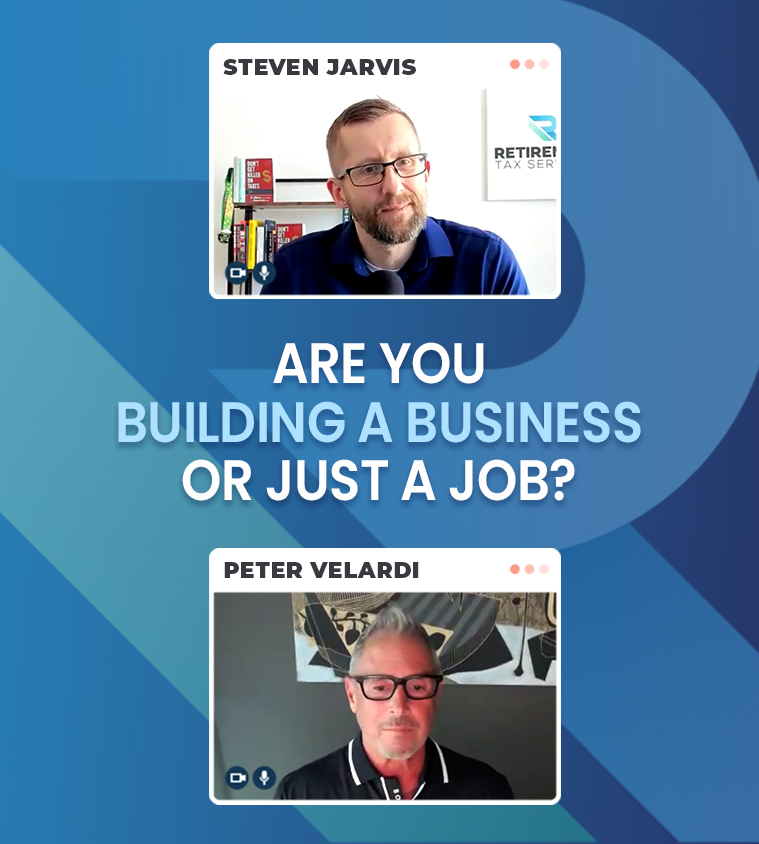
Steven Jarvis is joined in this episode by Peter Velardi of JPTD Partners to discuss how financial advisors can think more strategically about the future of their firms. They explore the shift from running a “practice” to building a true business, and why that distinction is critical for growth, scalability, and long-term value. The discussion encourages advisors to step back, plan intentionally, and position their business for both growth and optionality.
Steven and his guests share more tax-planning insights in today’s Retirement Tax Services Podcast. Feedback, unusual tax-planning stories, and suggestions for future guests can be sent to advisors@rts.tax.
Are you interested in content that provides you with action steps that you can take to deliver massive tax value to your clients? Then you are going to love our powerful training sessions online. Click on the link below to get started on your journey:
Retirementtaxservices.com/webinars
Thank you for listening.
Steven Jarvis, CPA (00:50)
Hello everyone and welcome to the next episode of the retirement tech services podcast financial professionals edition I’m your host Steven Jarvis, CPA and this week we could have a fun conversation about theory versus reality and there are some tax planning tie-ins.
But this is really a broader discussion about advisors and their own legacy planning, their own exit planning, what comes next, how they deal with risks and opportunities for their own firm. So joining me this week to have this conversation, Peter Velardi from JPTD Partners, friends of the show, and of course, great partners with so many of the advisors we work with on helping them understand not only the value of their firm, but options that are available to them. So Peter, welcome to the show.
Peter Velardi (01:31.31)
Hey great to be here with you Steve. Always fun to spend some time with you and your crew.
Steven Jarvis, CPA (01:38.092)
Yeah, absolutely. I love these conversations because you guys are doing this all the time. You’re working with so many different advisors. You get to see in the trenches how this stuff works. So we get to go kind of beyond speculation and say, OK, what are people actually doing? But Peter, this is your first time on the show. So I’ve had some of your partners on the show. But give us just a little bit of your background. Why should people care what you have to say on these topics as we talk about advisors and what they do with their firms?
Peter Velardi (02:01.25)
Well, thanks. Yeah. Not sure they should, but they’ll be the judge of that. Perfectly. Right. So yeah, I’ve been in the industry for 40 plus years, Steve. Half of my career was with some version of Ameriprise Financial, like them or most people on this podcast. was a CFP financial advisor, big producer. got turned on by leadership and went up the ranks of the company. Last 10 years, I was a senior VP in charge of five to 10,000 advisors. And that was a great run and 49, I could retire, I tried to retire, and I failed retirement, and really wanted to express my entrepreneurial roots, which is what I’ve always done. So in the last 15, 20 years, I’ve done some version of M&A consulting and SeaSquid Consulting. formed a company, I always had a passion for referrals. That completely automates the referral process at scale for firms in this industry and outside of it called ReferMeIQ and built that. I’ve got two sons that helped me grow that. So that’s a way to help companies grow at less cost scalable. And then along the way, hundreds of advisors began calling myself and my three partners at JPTD, saying, I know you’ve got M&A experience, because we’ve all done the advisor world, but we’ve all done many, many &A deals. I used to work for a private equity company, for example. So we understand their economics, we understand the advisor world intimately. And because we’re all doing these deals ourselves, we came together as a company called JPTD Partners. We’re not terribly creative from a brand perspective. Good at what we do, but not great at that. So we just…used our initials, I’m the P and JPTD. And we built this from scratch to having well over 200 practices hire us. We’ve come from the farm team to be the true lead in the industry. We’ve closed, gosh, over two to three billion in deal value. Closed over 30 deals last year, but we love doing this because we get to change lives in a different way. We change lives by hiring them into this fantastic industry, training them to build these practices, but now we get to help them build significant wealth and in some cases, generational wealth. Yeah. At the same time, designing their perfect and best job description of their highest and best use, and in almost every case, grow twice as fast as I did before. So it’s been a fun ride.
Steven Jarvis, CPA (04:43.022)
That’s awesome. Peter, thanks so much for sharing that background. As we’re kicking this off, mean, there’s gonna be some advisors who hear M&A, okay, I wanna know what my practice is worth. Like totally get it, that’s the point you’re out. You can actually just go out to retirementtaxservices.com/JPTD. If you’re in that bucket of, tell me what my firm’s worth, I’m ready to learn more. Just go out there, Peter and the team will get you kind of a high-level evaluation of what your firm looks like and get you some insight on that. That’s just a free resource they’ve offered to our audience. So that’s the point you’re out. Just go out there and get the valuation. Really, Peter, the reason we want to have this conversation today is because this goes so far beyond just, hey, what is my firm worth? There’s a bigger discussion that can be had here. And for advisors who are maybe newer to thinking about this, you should not think about this as, well, this is like if I wanted to sell my house, like Peter’s my real estate agent, put the sign in front of my house, let’s go. This is so much bigger than that because this isn’t just.
In fact, I think Peter, a lot of time it’s not hey I want to sell and walk away like you’re you talked about at the end there. You’re helping people identify what’s next? What do I want to do? Yes, there might be a liquidity event involved in that but more and more and part of reason I want to have this conversation this podcast about Taxes is because I hear more advisors both from the advisor and then from you guys Exploring this conversation because they see risks in the marketplace. They see limitations on their growth because of services they can’t currently offer. They’re not looking, they’re not necessarily looking for I want to walk away. They’re looking for how do I partner? How do I keep expanding what I’m doing? I’m meeting advisors now over the last couple of years who are going through major liquidity events to help them grow even more. I’d love some insight from your side Peter of what you’re seeing, maybe how this has changed over the last couple of years as far as what’s bringing advisors to you, what they say they’re looking for and then what they ultimately go with. Like help us understand the mentality of advisors you’re working with.
Peter Velardi (06:36.96)
Yeah, well, there’s a lot of important things of what you just said to unpack. I’ll start with what we’re seeing out there. And I think that’ll help your audience kind of say, that sounds like me, or this sounds like me. So generally people come to us through referrals and what kind of prompts them to come to us is a few things. One is they hear us on a podcast like this, or they’re flattered that they’re getting solicitations from some pretty credible companies, saying, buy your practice, your business, or invest in you. And they start going down kind of the rabbit hole of flirting with them and dating them. And then they get to the point where they’re being asked to make a decision and they get paralyzed because they have no idea if they should do it, who else is out there. Or an advisor somehow gets educated to realize they wake up one day and let’s say they’re worth two mil. of revenue, Steven, and let’s say that they’re worth on the market for a two mil rev. Let’s say it’s, you know, five to six times rev and they wake up one day and they say, gosh, I’m worth, you know, 12, 15 million. My net worth is 18 million. Gosh, I just woke up, and I’m one of my clients that I coached at RossaPy, and take some chips off the table because their business is worth 80, 90 % of the net worth. So, regardless of how people come to us, to your point, it’s all about fit. It’s all about what is the best fit? What is the best timing? And we have people come to us saying to us, because we always ask in the first interview with clients, you know, what prompted your interest to be talking to us? And what we hear are things like, I heard this M&A industry is red hot. And then I actually talking now about taking some chips off the table, which is true. We’re seeing the highest valuations we’ve seen in 20 years. It’s kind of like the peak of the real estate market. So it’s just kind of the acknowledgement that I’ve got some value here. It could be that. It could be we’re seeing things skew younger these days. When we first began this, was skewing towards people three to five years away from retirement. We’re seeing a lot of principals today in their forties coming to us saying, ” Hey, I spent off from the wire house to the IBD.
Peter Velardi (08:56.142)
Then I spun off from the IBD to my own RIA or hybrid and I’ve built this thing and we had a lot of growth in the beginning, but now I’m doing everything. It’s the last thing I wanted to do. And I’m hitting kind of that ceiling of complexity in my growth and growth is kind of stalling. So it could be that and the saying, I hear there’s these, gosh, these private equity backed, know, strategic acquirers, these big Baron RIAs, top 200 RIAs buying people like me, getting stuff off my plate, know, deploying and allowing firms like me to leverage their infrastructure. What does all that look like? And then the recurring theme is that just as you wouldn’t want to go to your own, you want to go to your doctor, you don’t want to be your own doctor. Advisors are becoming more self-aware that they don’t know anything about this world and what they know about it…Steve is kind of the old world. It’s, the old world was you waited until you were getting close to retirement. You went down the street to try to find an advisor to buy you. You went to a company to do what we call a BS business valuation because it’s accurate and it’s way lower than what the market would buy with a disciplined process and some expertise. But they do that. And then of course the past was they’d take back a 10 year note, five to 10 year note and pray that the person didn’t run up to the ground, but at least the clients were taking care of it. They know that world, but they don’t know this world and they perceive there’s a lot of sharks and that there’s a lot of mistakes being made. And they’re absolutely right there is. So, know, my first piece of advice, I guess on this podcast and all my experiences, whatever you do, don’t do this alone. Definitely explore finding an expert, to help guide you and coach you through it. So that’s what folks are seeing out there saying to us that kind of least encourages them to start with this.
Steven Jarvis, CPA (10:57.678)
Peter, I really appreciate that context. as I talk to advisors and I’m talking to more and more who have been through liquidity events of some kind, more of them than I would have expected that are partnering, not walking away and reinforcing the way you’ve talked about it, that this is skewing a little bit younger. These are people who probably a few years ago thought that they were still in the middle of their career and probably years away from considering this. So some of what I’m hearing from these advisors, and I think it’s similar for you, I’d like to get more specific with it, is that there is this element of as technology changes rapidly, as clients are making, expecting more internal services from their financial advisors, as that you talk about that complexity ceiling, as the expectation skews towards, I have to do more to keep providing this service, rather than try to figure that out on their own, rather than go get three new designations and go back to school or more realistically, just get the reps in of maybe risking doing it wrong at times. They’re saying, okay, who’s out there that I can partner with that I can, that can both have a liquidity event and get access to these additional resources. That’s what I’m hearing more from advisors. Are there particular areas where you’re seeing that as advisors come to you of specific risks or services or complexities that are bubbling up that conversation?
Peter Velardi (12:12.302)
Yeah, all the above, Steve. And I think you said it well. I guess the first headline I give about all of that is there’s this big myth that these &A deals are only for me when I get close to retirement and that I should wait till I do that. And there’s a lot of risk in doing that that we can get into. But for most people that come to us and say, okay, why should I engage? What are these global trends? What we’re seeing is more and more fear, more and more kind of the peak, the maximum point of the certainty of uncertainty. They acknowledge and recognize we’ve been in some version of a 14 year bull market of some type. So everything is up. They’re seeing some of these trends in terms of wealth transfer, know, 84 trillion transferring, and that’s a great opportunity to be an advisor. So they’re seeing the positive that they’re also seeing the positive that there’s a shortage of a hundred thousand plus advisors in the industry because over the last 10 years, few firms have hired and trained, you know, new people out of college the way we used to do back in the day. So the harder there’s been barriers of entry. So there’s a shortage. However, on the other end, the average age of an advisor today is 62 and 40 % of the practices are trying to turn over from generation one or G1 to G2. And as a result of that, they’re now beginning to understand that there’s a new game in town, there’s a new sheriff in town. And that’s these private equity, family office backed, private capital, sovereign wealth backed, super RIAs that are becoming, know, to use a hardware industry. Now they’re becoming the lows and home depots of the industry. And so what all that adds up, what’s that mean to an advisor? What it means to an advisor is that there is a massive amount of cash now chasing because these private equity backed firms, the way they’re deploying that capital is two ways. Rapidly building infrastructure to expand value to clients in light of this AI threat, because AI is a dual edged sword, right? On the one hand, if you use it, consume it, really good for your growth, right? But red is right now, AI can probably do five out of 10 tasks an advisor can do, and it’s probably gonna grow. So, unless you’re expanding your value to a client, it’s gonna become more difficult to charge your 1% fee. And that’s a big fear. A lot of advisors are coming to us just because of that fear. And just to wrap up, stir all that together. And advisors saying, wow, just from a supply and demand perspective, the 40 % of the industry is turning over and cash is being deployed. That means that valuations cannot hold up long-term. It’s like anything else. That’s like more inventory of homes to sell pricing is gonna come down.
as the demand and the cash gets deployed. So, between supply and demand, future imbalance, advisors are perceiving that there’s a window. So that’s the framework of why people are coming to us. And then lastly, when they come to us, here are the basic outcomes. We’re all about outcomes where we spend a lot of time, exhaustive time, making sure that we understand our client, what they want, their goals, their fears. We collect all their financials. We’ve got a disciplined process. End of the day, it’s how do we help them achieve the outcomes? The outcomes we’re seeing out of these deals, whether they’re, and they come in every shape and size, whether it’s a minority, majority or full deal, one, they de-risk. They can de-risk a little or de-risk at maximum value. And because it’s the tax business behind you, at very favorable capital gain rates upfront. And there’s an equity swap built in. You swap your equity for theirs and there’s no taxes on it, consults your CPA like you. So one is we’re creating such wealth for people over five or 10 years. And then second is this infrastructure these companies have, get a lot of things off advisors plate and they have all these growth engines you can plug into it. And then third, a lot of our clients are concerned about business continuity. They wanna get their one client served by their G2. They don’t have a G2, they want some G2s, to serve them, but there’s a massive problem in the industry where G2s can’t afford to buy out the G1s at these inflated values and they get crushed. And so they’re stuck and they’re coming to us saying, how do I de-risk? How do I grow faster? How do I get things off my plate? How do I build a succession plan? So that’s kind of where it ends up going.
Steven Jarvis, CPA (16:50.686)
Peter, that’s all super helpful context. As you’re going through that, one of the things I’d kind of like to drill into a little bit further, let’s take a step away specifically from the answer being &A, because I think you’d agree with me that anybody who says that what they offer is the answer to every single situation, probably not somebody I want to do business with. You’ve done a great job of identifying, okay, here are people that are a good fit for us that we work really well with, but maybe for the people who aren’t quite there yet of, this is the conversation I need to have. Let’s think about this just in terms of questions that every business owner should be asking themselves. Even if you don’t think the answer is M&A of any kind, and maybe the answer isn’t that, or maybe it won’t be anytime soon. What I’m hearing as you’re describing those things is that whether you think partnering with somebody else is the answer or not, you still need to have an answer to these things. You need to have an answer to what happens if I have a medical issue and have to take three months out of the office. Do I have a team in place? Do I have a gen two in place? Do I have a structure in place? There’d be that continuity. I’m thinking of, what are those questions that every business owner, every advisor who runs a book of business, what are those questions they need answers to? Even if JPTD isn’t the answer, they still need an answer. So what are, well, I’ve got some other ideas that are coming to mind. Peter, what are some of those questions that every business owner should be able to answer for themselves?
Peter Velardi (17:59.31)
Yeah, that is such an important question Steve, and you’re absolutely right that not everybody is ready for M&A and not everybody is ready to hire people like us. Just not. We turn away a lot of potential clients and say, ” We love referring them back to you because we want them to have a coach. We love well-coached practices and businesses. So the first headline I would give is that you need to change a bit about your mindset. So when you’re asking yourself these questions. You’ve got the right context to answer them with the right amount of thoughtfulness and accuracy. So the mindset shift is a lot of these advisors still are locked into building a practice, not a business. So as soon as you take that switch and you say, I’m actually building a business. Do I understand what a PNL is? Do I understand what EBITDA is? Do I have a clue? What is the ideal EBITDA margin against my gross? That I’ll be most attractive. So once you start to do that, it’s not just growth, it’s what’s the cost of your growth and how do you build a sustainable business that depends less or not at all on its principles. The more business depends on the principles. So the first mindset shift that we try to coach people on if they’re not ready is you’re still thinking like a financial advisor, like you have a practice. Like you are playing just for your survey clients. Well, all of our clients are just so committed to clients and they have to win post-deal for this to work. And we honor that and want that to happen. And these firms do as well. But first thing is that mindset shift to run a business. Then the questions they need to ask themselves once they can make that shift is, am I building a sustainable growth business? Because the shift is, I’m not just playing for my own personal income that I save, that I get paid as ordinary income. And then I save as much as I can, grow it as much as can. And that helps me accomplish my life goals. I’m actually building an underlying asset that right now is worth 80 % of my net worth. And so I can really grow my wealth and net worth faster and even more favorable tax treatment if I build it within this business. And then we’re going to coach them on at some point when they are ready is you’ll actually grow faster, post a deal and swapping some of your equity for theirs, really good thing. But the questions that they should be asked themselves, number one is, I doing everything to optimize my valuation? So what are those things? Number one, size matters. Getting larger is important. How do you get larger? You look at two channels. You look at the organic growth channel and the net organic growth channel. If you don’t know anything about making acquisitions in organically, then there’s lots of people that can help you with that and we can help you with that. But that’s, that’s just one channel. So do you have a predictable growth machine to acquire, you know, ideal ICP clients at a reasonable and lower cost each year to create margin in your business? Things like refer me IQ, for example, scaling a referral system. All those things can help contribute, but systems, systems, systems. We love your clients that come to us and with your grill mat because they’re well-cooked, they’re coached on systems. They have systems in place that produce predictable growth. That’s what you want to have. So am I growing above market more than the average bear on the street? Cause these firms will not buy you unless your CAGR is very, very strong. Not just from the market growth, but on top of the market group. Do I also have the infrastructure of a business? Do I have a tax practice? Do I have the right amount of staff? What’s my tech stack look like? All of those things matter. know, the ante in the game is you gotta be at least 80 % fee-based. Why? Because the buying recurring EBITDA, the more predictable that EBITDA is. So it’s all the things, do I have this? Do I have that? Am I playing like I’m a business owner?
Have I built some, some, you know, minimal infrastructure staff, then you’ve got to build organizational capacity. So the whole Covey concept of P and PC P being production, that’s the growth engine, but I’ve got to build PC production capacity, which is the infrastructure that allows me to scale, not just grow. So those are some of the things to ask above and beyond everything is can I do all that? Can I afford to do all that? And if I can’t, do I need a coach or do I need a capital partner? And if you’re like, I don’t think I can do that. You might need a coach. If you’re like, I can do it, but it’s gonna cost me millions to compete. Then you might wanna think about a strategic partner.
Steven Jarvis, CPA (23:03.074)
Peter, that’s such a great framework. It can be really easy in this industry to get relatively far along just by grinding things out. I’ve been there, there are things I’m still grinding. I think there’s that piece of all of us as entrepreneurs that just like the grind. We look for that thing we can grind on. Right, right. But the downside to that is it can give us this kind of false impression that grinding’s all it ever takes. And so I love that framework you’re describing of weight. It’s really important, whether we’re talking about &A or just running a successful business, it’s important to have that mindset shift of, Wait, am I running a business or am I just surrounding myself with a job? Have I set up those systems and processes? Am I building that infrastructure? Am I not just delivering value to clients, but I’m creating capacity to continue to grow. And at some point, we all only have the same 24 hours in the day. And the people who are making the most of those 24 hours across the board are the people who have systems. those systems can include people they’re delegating to, but there has to be…to your point, it has to be sustainable, repeatable. We have to able to point to this is the system, this is the thing that’s helping us do what it is that we do.
Peter Velardi (24:06.602)
Yeah, in fact, I went to future proof and went to every workshop that I could to just learn. it was great. went to Michael Kitces one on your tech stack and AI. And it was fascinating. One of the things that relates to this conversation is one of the statements he made, he said, it’s not the technology that drives ROI. It’s your infrastructure and staffing. They showed a chart of ROI, he showed the first chart was how overwhelming it must be for principles of an independent firm to design and update their tech staff, especially with all the, know, unproven, but super cool, shiny new AI tools out there. How do you decide what to do, what not to do? Right. What he was saying is it’s less about what you choose and your ROI is way more dependent on your execution with that tool through your infrastructure and your staffing. So we showed a chart of, know, if a firm this size has seven staff, you know, the ROI is X. If somebody has two staff, the ROI is a fraction of X. interesting. So, and you can have too much staff and you can have the wrong roles and staff doing the wrong things, or you can not have the right people on the bus, but assuming you’ve taken care of that. So it’s a pretty fascinating thing. What’s so important is to, again, It goes back to if you were to be the best business owner and playing for valuation, what would you do? And then when you decide that it’s the time to poke your head up, then it’s really about, you know, am I working with the right pros in this industry that can help guide me through that? So I do it right.
Steven Jarvis, CPA (25:52.514)
Peter, we could clearly keep going on this stuff for hours. If you’re enjoying the conversation and you haven’t signed up for the summit yet, you absolutely need to come out to the summit. Peter and the team will be there again this year, getting really hands on with this stuff. So yeah, go to retirementtackservice.com, get signed up for the summit. But Peter, let’s take just a minute as we wrap up here and make this really tangible and actionable for people who are listening. I think out of this conversation, there’s really a couple of key takeaways. One is that regardless of whether you think you’re one year, 10 years, or you’re never going to do any kind of &A event,
Just as a business owner, you have to take time away from the day to day, take time away from the whirlwind and spend it on business planning. So if you don’t currently have your next business planning date on your calendar, it needs to go on your calendar. Ideally, it’s going to be offsite. You’re gonna step away from everything. You’re gonna ask yourself some of these questions. You’re gonna make sure you have a plan for how these things are getting addressed. And who does it get assigned to? Do I need more people on my team? Is it a different tech stack? But you need to go through these things. You need a place for that. So that’s one that everyone should do regardless of you ever hear from Peter or I again, everybody who’s serious about their business needs to take time for that. From there, we of have some options depending on where we’re at. You might get through that exercise and say, you know what, thinking back on those things Peter shared, I do need to explore what’s out there. I need to explore what my options are. And so you can go out to retirementtaxservices.com slash/JPTD and get connected with Peter and the team. They’re gonna give you some great insight into what you’re doing and help you explore those options. that’s….Absolutely something that you can explore as you go through those questions to say, Hey, is it time that I understand what’s out there? Like anything else, the answer might be that you go through those questions. You say, Hey, there’s more I can do here myself or there’s somebody else I can hire. But if you don’t have a clear plan for what comes next or who you’re partnering with, you’re going to be in the same place a year from now, two years from now, five years from now, wondering why things haven’t changed.
Peter Velardi (27:41.01)
Yeah, all of that is true. I’d say tangible action steps is the headline would be learn fast. Do not sit and wait to see what happens. The cost of an action is severe because it’s going to be harder and harder to compete as it is. What’s going on with AI industry consolidation and all these firms building these just absolutely kick butt expanded value propositions. They’re all going towards some version of a family office where in-house has everything for high net worth and ultra high net worth. It’s going to be harder and harder and more expensive for somebody going solo to build that infrastructure. Most of us, Steve, we don’t regret the things that we did. mostly regret the things we didn’t do. So to your point, I would just poke your head up, contact us, have a half an hour or an hour conversation with myself or one of the partners, we will tell you it’s not in any of our best interests. If you’re not ready, we’ll tell you why you’re not. You may be too small. You may not have a real business. You may not have enough growth. You may not have enough, you know, G2s to handle your G1 capacity. You know, whatever it is, we’ll tell you and we’ll even give you some direction on where to go next. But often somebody has got all their ducks lined up, but they’ve just been kind of hesitant to talk to somebody. And in this window we have, it’s not gonna close, it’s gonna sustain for a while, but it’s gonna be harder and harder to command those valuations down the road. And there’s a lot of risks, not the least of which is market risk. The market cycles don’t wait for you. A 20 % drop in the market to your current accounts is one thing, but 20 % of what might be a $20 million valuation. You have to make up 4 million somewhere. And so it’s a big deal. don’t wait, just learn, explore, do it fast and become informed so you can make really good choices about what you do, which might be build it in a different way, bring in a partner or I’m doing great and I’m willing to accept the risks and continue to go solo. And that’s fine too. Yeah.
Steven Jarvis, CPA (29:53.4)
love that. Yeah, so one last time, retirementtaxservices.com/JPTD have that conversation that Peter’s describing to get that insight, that expertise. And even if at the end it’s we shake hands as part ways as friends, you’ve gained from that conversation. So Peter, as always, I really appreciate your willingness to do that for our audience. Thank you for your time jumping on the podcast with me. Of course, super excited to see you at the summit again this year and for everyone listening until next time, good luck out there and remember to tip your server, not the IRS.