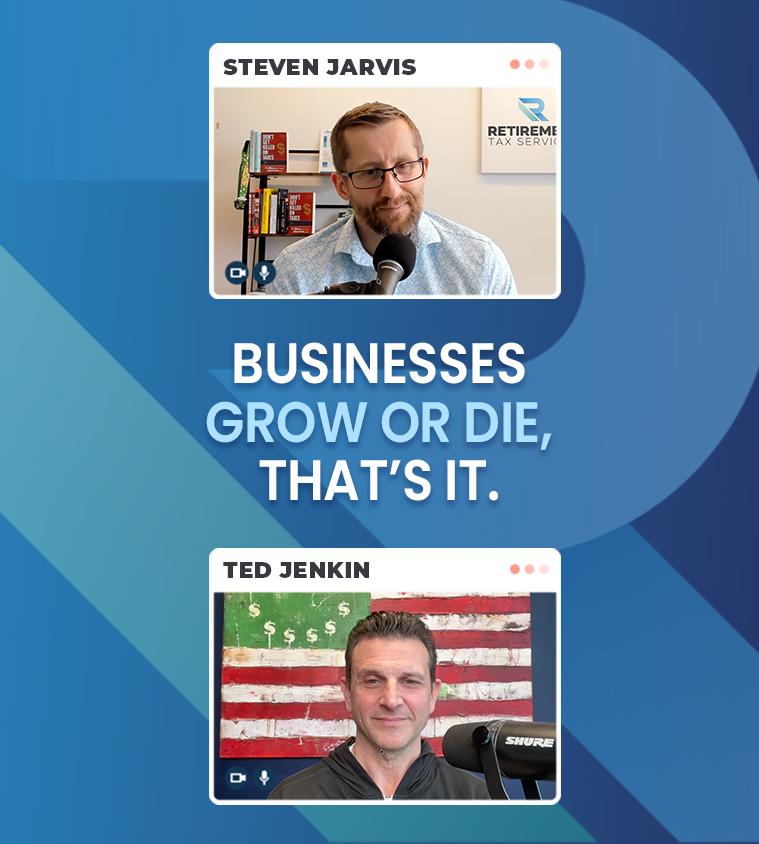
In this episode, Steven and Ted Jenkin from JPTD Partners explore the key factors that drive business valuation. They discuss why focusing on net new assets, maintaining clean and accurate financial records, and implementing effective tax planning strategies can significantly impact the value of a business. The conversation emphasizes the importance of running a business with intention and discipline, especially for owners who may want to sell in the future. Steven and Ted also highlight the role of consistent business development and how emerging tools like AI can improve efficiency, support growth, and help business owners scale more effectively.
Steven and his guests share more tax-planning insights in today’s Retirement Tax Services Podcast. Feedback, unusual tax-planning stories, and suggestions for future guests can be sent to advisors@rts.tax.
Are you interested in content that provides you with action steps that you can take to deliver massive tax value to your clients? Then you are going to love our powerful training sessions online. Click on the link below to get started on your journey:
Retirementtaxservices.com/webinars
Thank you for listening.
Steven Jarvis, CPA (00:52)
Hello everyone, and welcome to the next episode of the retirement tax services podcast, financial professionals edition. I’m your host Steven Jarvis CPA and joining me again this week on the show is my good friend Ted Jenkin from JPTD partners and we’re going to we’re going to start the conversation. I think with just kind of our recurring reminder that business owners need to grow up and take their business seriously. Is that good place to start Ted?
Ted Jenkin (01:14)
Yeah, you would think that you would, but often business owners don’t until they actually have to sell their business. So a couple of pieces of insight for advisors. Number one, the biggest trend I see now is the term NNA. Okay, it’s not M&A. We’re not talking about fighting here. We’re talking about NNA, which is net new assets.
Steven Jarvis, CPA (01:38)
Mm, yep, okay, yeah.
Ted Jenkin (01:40)
And people ask Ted, how do I get the highest multiple for this business? Sure, revenue matters. Sure, cash flow matters. And yes. I say this tongue in cheek, size matters. But NNA is the biggest thing right now because you become the antidote to a down market. If you can bring in lot of net new assets and the markets crash or they go down, you’re the antidote. Number two, I can’t tell you, Steven, how many advisors when I say, hey, we’re gonna need a clean set of your books from the last three years, you would think I would have asked them to basically write Atlas Shrugged because it is unreal. But you have to understand when someone’s buying your business, if you have to explain lots and lots of things because you’ve done either weird things or it’s not easy to show ad backs or you yourself don’t even know what a line item is because you created some marketing category that’s not really marketing. Go forward basis, people still have to run a P &L for your business and if they can’t explain your P &L, certainly we’re not going to be able to run a go-forward P&L and that can actually hurt you along the way.
Steven Jarvis, CPA (02:50)
Well, Ted, let’s talk about both of these things. Let’s start with net new assets. for anyone listening who in their mind is starting to write this off, like, I’m not going to sell anytime soon. Like, just hold on a second, because the reason we talk about this in terms of the reason I love having you on the podcast, Ted, because you help people sell their businesses, is we’ve talked before that most valuations are complete BS unless money is exchanging hands, unless a transaction is happening. And the reason we have this conversation even for advisors who aren’t thinking about selling is because what someone will eventually pay for your business is a great indication of the health of your business, even if you want to keep running it. And so when you look at your business and you say, like, how am I doing? is my growth? All these kinds of things. the reason I correct me if I’m wrong, the reason we come back to net new assets is because it’s a way for us to strip out market growth, clouding organic growth. And at the end of the day, that’s that’s how we’re measuring the health of a business.
Ted Jenkin (03:24)
Yeah. Here’s a real life story, okay? In the last three months, I had one practice where I had a guy that was 51 years old, averaging net new assets of more than 20 million a year, which for most advisors is really, really good. And his revenue was about 3 million. Conversely, I had a 67 year old advisor, their revenue was four and a quarter million, much higher, but they had a leaky tire. The average age of the client were in their 70s, net new assets were slightly negative over three years and the three million guy got a higher valuation than the four and a quarter million dollar guy.
Steven Jarvis, CPA (04:20)
Yeah, yeah, which again speaks to like whether we’re looking specifically at hey, I want to sell sometime in the future and I’m looking at the actual valuation my company or I’m just looking at the health of my company that I want to continue to run like these are important things to understand because if we just kind of let time go by not actually assessing the health of our business, we’re not doing right by our clients. We’re not doing right by our families and our team like you’ve got to understand where you’re at and where you’re headed.
Ted Jenkin (04:44)
Let me give you the other crazy number in here. This is gonna sound like an insane number and I know some advisors that are listening to this are gonna say, you gotta be out of your you know what mind Ted. But I’m going to tell you whether they reduce your payout post transaction or your salary or it’s a higher payout. Most of these companies believe that you should be able to run your non-advisor staff, your non-advisor staff at a 7% of revenue clip. What does that mean? It means that if your revenue is 3 million, your op staff shouldn’t be more than about $210,000 of salary. Yeah, so a lot of advisors are like, man, I have a great staff, I have a team of eight and blah, blah, blah, blah, blah. But what’s gonna happen is if you have a team of eight and it costs you a million dollars on the same model for all that staff, a buyer’s not gonna care. They’re just gonna say, you’re gonna make less money. No, no, wait a minute, I don’t wanna make less money. Well, we can’t do it both ways. If you’re running your own comp and advisor staff at 50 % of revenue, it’s never gonna fly.
Steven Jarvis, CPA (05:54
Well, and Ted, this is probably why we all get along so well, because I love to tie this back to examples I’m familiar with, the way when my brother Matt talks about running and scaling to practice, that million dollar threshold in revenue is, from his perspective, the first time you should even think about hiring somebody beyond like an executive assistant or, and so that fits with your 7%, that like below a million, what are you doing hiring this huge staff? Like you need to be able to run an efficient practice or you’re not as healthy as you think you are.
Ted Jenkin (06:22)
No, Matt and Micah are exactly right. I mean, there were some weird rule or just that got thrown around that like three, $400,000 of revenue, you should start hiring your first staff. And you can, while you run the business as a lifestyle business, you can probably still make money. But as you get closer and closer to a transaction, you have to think about what your comp and running the staff is gonna be post transaction.
Steven Jarvis, CPA (06:48)
Yeah. Well, it’s interesting you bring that up because there’s plenty of people in the industry who will give you their opinion on what a healthy firm looks like, but they’re not the ones signing checks to buy those firms. And so again, for me, I don’t care what asset we’re talking about, whether it’s a business, it’s a house, it’s a car, the best, the best way to know the value of something is what someone will write a check for. And so again, for me, that’s why I love having these conversations with M and A people like you Ted, because you’re seeing what checks are getting written. So whatever other opinions people have about what a healthy firm looks like, let’s just let the numbers do the talking.
Ted Jenkin (07:18)
Yeah, and I don’t want to play captain obvious here, but the thing is, is that if you make a million dollars today, y’all realize you’re not going to get paid a million dollars after you sell because you got paid cash. Like it seems like an obvious thing, but there are so many advisors that go, wait, if I sell, I’m used to making a million a year. I got, I got to still make a million. And it’s like, well, then don’t sell. mean, no one, no one’s going to pay you a check for 20 million and then let you make the same money you made before.
Steven Jarvis, CPA (07:43)
No, Ted, I don’t think that’s kept it obvious at all because I’ve talked to lots of advisors post-transaction and that seems to be one of those things that’s really hard for them to swallow. Even the ones who like knew on paper, okay, I’m going to get this big check now and then my annual salary, my annual income is going to go way down because I just sold the cash flow to someone else. But then having that reality of wait before I was getting a half million a quarter and now I’m getting $250 a year, like, eh.
Ted Jenkin (08:12)
You know, it’s so funny, you know, I obviously was in financial planning for a lot of years and I know that you know a lot of advisors and for those people on here like myself that have taken the SEPA course, you know, just think about two things being your own planner, right? One is what’s the wealth gap? Meaning that if you want to quote unquote make work optional yourself and you’ve got a certain amount of money saved, what does the business need to sell for on an after-tax basis to get you to that lump sum ofmoney to make work optional. That would be the wealth gap. The profit gap then would be what EBITDA does your business need to get to at the multiples to get to that wealth gap. And it just gives you a better operating view on what you should be thinking about goal wise. Like this is the way you would plan for your clients. It’s like almost like the Cobbler’s kids had no shoes. I don’t know why advisors don’t plan this way for themselves.
Steven Jarvis, CPA (09:06)
Yeah, yeah. on the first point you made, like for advisors listening, you need to understand what your net new assets are each year so that you can check the health of your company. Let’s go back to the second point you made about asking for clean books and that being this like Herculean effort. Because there’s a couple of things that come to mind on this, Ted, and I’m not going to disagree with you at all because I’ve seen it plenty of times too. And since I’m the CPA and this is a tax podcast, I’m going to bring tax planning back into it because one of the things I see and that I’ve started trying to point out to advisors more often is that when you, like, tax planning shouldn’t happen in a bubble. And there are times where advisors get so hung up on, wait, but I could save a buck now. It’s like, yeah, let me put my kids on payroll and not document it correctly and not really have a job for them because I’m saving on taxes. But then you go to do a transaction and you’ve got this, you’ve just got this mess in your P&L. Not to say you can’t hire your kids, but do it right and do it clean or don’t do it at all. You’re gonna shoot yourself in the foot later.
Ted Jenkin (10:01)
Totally agree. And if you are burying expenses that you believe are in the gray zone, at least get a second set of books. Pay your bookkeeper an extra few hundred bucks to basically, no, I’m just saying you’re going to need to show ad backs every way. There’s no business that doesn’t have ad backs. But if you simplify your general ledger and you know what’s what, so you can go back and explain the ad backs, no buyer has a problem with them if you can explain them. What’s hard is a lot of times advisors can’t explain them.
Steven Jarvis, CPA (10:28)
can’t explain them and can’t quantify them, right? Cause if you do, if you’re doing really poor bookkeeping and everything just kind of comes in and out of the credit card, like cause you’re right. Every buyer knows that that stuff is going to be in there. But if I’m coming in and I have super messy books and I’ve got this miscellaneous expense, it’s got 400 grand going through it. And I start saying, no, no, no, but only a quarter of that is personal stuff. Great. Show me, did, did, did you actually categorize any of this or am I just taking your word for it? Cause if, if I’m going to pay you a huge multiple, like I don’t want to just take your word for it.
Ted Jenkin (10:57)
The funniest thing on the book, Steven, is that I’d say 50 % of the books that I see from advisors have only one general ledger entry for revenue. It’s called income. It says income. At least bifurcate or trifurcate him where it says like fee based advisory revenue. You y’all realize you can change the words in QuickBooks and you can say fee based advisory revenue, know, financial planning revenue, insurance commission, whatever it is, that way it’s much easier to tell people to break down of the revenue..
Steven Jarvis, CPA (11:30)
Well, and pro tip real quick to people listening, if your bookkeeper, hopefully you are not your bookkeeper, like if you are your bookkeeper, like please go back and listen to the episode with Belay, they can help you out, like you need somebody else doing your bookkeeping. But if you’re listening to this and saying, well, geez, I only have one income account, I’ve only got like three expense accounts, it’s probably because you didn’t give good instructions to your bookkeeper. Like they’re trying to process transactions for you, and like you need to be a leader in this case, you need to own your business and say, okay, here’s how these things are gonna work. Otherwise, the bookkeeper is just playing guess and check with your credit card statement. And that’s not a winning game for anyone. So take some responsibility. Like if you set this up right, like the bookkeeper will still do all the work. You just gotta give him the guidelines. Yeah, yeah, again, CPA here, I don’t do my own bookkeeping, because that’d be a terrible idea. I’ve got other things that I need to be doing, and I want somebody who’s an expert in that. So thankfully, I have a really good bookkeeper. And probably about once a quarter I still get an email that says, hey, Steven, I don’t know what these transactions are, which is totally fine. Because it happens quarterly. doesn’t happen for like, it’s not like, hey, could we go back through the last three years and tell me about these random transactions? Like we keep it clean as we go. Yeah. Yeah. Yeah. So just like when we’re working with clients, like we’ll stay on the tax plan thing for just a second here and then kind of move on. But like we’ve got to make good life decisions and good business decisions and then figure out the tax efficient way to go about them.
Ted Jenkin (12:52)
Well, it’s funny you bring this up because as of late, and by the way, you’re the tax advisor, not me, but you’d be surprised how many advisors ask me for tax advice. And when you think about a transaction, you know, I mean, there are a lot of considerations and I’ll just throw out a few of these, you know…you’ve got to think about the family decisions that you make pre-loi. Because if you decide to put shares of your company and it’s allowable into some sort of charitable trust … Or some sort of family foundation. It generally needs to be done Pre-loi and a lot of advisors don’t understand that they get into the process they sign an loi and then they’re like they’re just like your client, you’re like, what can I do now? I sold the company. Well, like not much. Two, dependent upon the sale transaction, some of you may be able to set up a deferred sales trust or some way that you defer out income and these are considerations. And then I’m surprised, Steven, about how many advisors who are in our business don’t understand the qualified rural opportunity zone and the QOZ in general, even with their own proceeds.
Steven Jarvis, CPA (14:04)
Yeah, there’s definitely a big knowledge gap there. There’s one thing I want to touch on just because you made me think of it. I’m also kind of constantly shocked at how often people don’t understand the importance of getting things in writing and understanding what’s in writing. know that, again, we already mentioned Matt once. He had a post recently on LinkedIn, an advisor that he knows who’s having to sell his ownership for like 10 cents on the dollar because, because he got a Parkinson’s diagnosis and didn’t realize that that could be a triggering event. I’m working, this is not a financial advisor, but business owner still, I’m working with a client who, thankfully, I mean, he’s got good intention to follow through, but there had been some kind of verbal agreements about payouts when transactions happen and he’s going to honor them. But that was my immediate thought when like, when he’s telling me about this is like, Hey, if it’s not writing, if you were on the other side of this, you’d probably get screwed every time. So like this isn’t about like,…We can live in fairyland and assume positive intent and, well, verbal is just as good as writing. It’s not. We need to make sure we understand the terms. We get them in writing. So I’m a huge fan of people for big transactions like this, working with someone outside the transaction, like you and your team, Ted, to be able to say objectively, OK, what’s actually going on here? Let’s not get lost in the boilerplate language.
Ted Jenkin (15:13)
Yeah, a lot of times when I take on new clients now and I sell their business, financial advisors or not, before I agree to do it, I read the operating agreement. And I turned down a financial advisor practice the other day because it was a great practice. I would have loved to sell it. But the operating agreement specifically said, and some of yours are written like this, it was an 80-10-10 split, two junior partners, one senior partner. So assumptively, most of you thinking 80%, you’ve got all the voting rights. But the way the voting rights work in some operating agreements is that some things require unanimous consent and some things require majority consent. And the agreement said it requires unanimous consent. And I said, hey, man, I don’t want to have this conversation unless all three partners are on. And he was like, I don’t really want to get the other partners involved yet. And I said, well, they are already. You can’t even if you get the best deal in the world unless they sign off and he’s like well Let’s just do this and I’ll get them to sign off later. No No, but I like you but I don’t need a paycheck and I certainly don’t need a headache. So
Steven Jarvis, CPA (16:20)
Yeah, great reminder that whether you think you’re six months, six years, or you’re never going to sell, these are things that you really should take the time to understand and know upfront. I’m pulling it back to tax, because that’s what I always do. When people ask me about entity selection, and they always ask me as if it’s only a tax question. It’s like, this is a tax question after everything else. We want to think about how we’re going to operate the entity. We want to think about how we might eventually exit the entity. There’s all these other things. And then we’ll think about taxes.
Ted Jenkin (16:50)
Have you seen it all? You know, the way I read this thing, because I have a bunch of other businesses and I’m trying to get into a 1202 wherever I can. And y’all need to call Steven if you don’t really know what a 1202 is. But anybody in the financial services field, is there any way to structure a C Corp today to get that that qualified small business because it specifically says like financial advisors don’t qualify. But you know, I just wondering, does tax qualify? I just wonder if there’s a way to deal with it.
Steven Jarvis, CPA (17:19)
That’s a good question, Ted. And that’s one that I’m always the first to tell people when I’m outside of my area of expertise. And I’ve had a couple of clients go through those. And jeez, I high-five them. And they’re getting giant checks tax-free. But I’m not the one setting them up. And so that’s one that I refer out. But you’re right. There’s a couple of industries that are specifically excluded. For people not familiar with section 1202, this is the qualified small business stock sales where they’ve got expanded a little bit under 03BA. But I mean, you’re potentially getting $10 million plus gains completely tax free. Has to be a C Corp. There’s some other things that have to go into it. And yes, there are specific industries that are exempt from that. But yeah,advisors who go from all the cash flow of the companies come into them. They sell a portion or all of it. And now their income’s gone way down. And so they’re looking for other opportunities. And as they set up businesses outside of financial planning, that’s something to be very aware of. Yeah.
Ted Jenkin (18:10)
But if you’re going into a sale and even while you have your business, mean, this pre tax planning to me is very, very important because even if your capital gains, like it’s funny, I was, I just throw around terms sometimes that I learned over the years, you know, and, one advisor were talking and it’s just like, just not only the state that you may get the revenue in can affect it. Right. And, you know, I don’t know about moving to Puerto Rico, but, but, know, because that’s, that’s… Yeah,I think it’s much more difficult, but there are things that you can do potentially, but a lot of advisors, it’s kind of like I said, they don’t give themselves their own tax advice.
Steven Jarvis, CPA (18:48)
Yeah, Ted, was talking to an advisor recently, actually had him on the podcast, and he is currently looking at moving his business in anticipation of eventually selling it so that he gets out of the state he’s currently in that’s got an incredibly high state income tax. And that definitely gets super complicated. That’s not an easy decision you can make while my business is now a different state. But especially as you grow a large practice and you’re looking at a healthy eight figure exit, yeah.
Ted Jenkin (19:12)
Are we sure California is going to let him go? I mean, you never know.
Steven Jarvis, CPA (19:15)
Well, this, you know, he was not trying to come out of California. California does not let anything go. They’re trying to drive people out, but.
Ted Jenkin (19:21)
It’s like another country. got like an exit tax when you want to leave or something. It’s, it’s real.
Steven Jarvis, CPA (19:26)
Well, and I’m in Washington state where we like to brag about being income tax free, but the local politicians have made it very publicly known that they’re trying to change that as fast as possible. So it is fascinating how all those dynamics work. Yeah. Still one of the good ones. Apparently my new parlor trick, a bunch of non-financial advisors, non-CPAs, I was hanging out with the other day, were all really impressed that I could just name the income tax-free states off the top of my head. It’s not as impressive as you guys think. Yeah, yeah. So apparently in non-financial realms, if you want some easy kudos points, just list out the income tax-free states.
Ted Jenkin (19:53)
There’s a reason they’re going to Nevada, man. There’s a reason they’re going over the border.
Steven Jarvis, CPA (20:10)
Yeah. All right, Ted, you talk to so many advisors, so many business owners, like what else? Maybe it’s tax related, maybe it’s valuation related, maybe it’s completely unrelated to anything we’ve been talking about. What else are you seeing as common themes or common opportunities as you have these conversations?
Ted Jenkin (20:22)
Listen, thematically, it’s not just true in our business. And I know that Matt and Micah talk about a lot of this as well. But there’s nothing from an activity perspective that is more valuable in your business in this country than being in business development. And y’all just got to, for a second, listen, I took seven designations in this business. I don’t want to say that I can wipe my, you know, what with them because there was a lot that I, it helped. In the end, the end, the highest paying job in America is always business development. It’s always business development. And so as much as you might like watching Bitcoin crashing or watching the markets or whatever it is you’re doing with your time, I see advisors that chart all this stuff and they can tell me the gold to Bitcoin something ratio. I have a portfolio that beats the S &P 500. I mean, I created a super duper financial plan. You, you, like everybody that owns a roofing company, like everybody that owns a car dealership, like everybody that owns a hair salon. Everything about growing top line revenue is about business development. So if you’re in business because you just love being a planner, be happy making a little bit of money and having it as a nice little lifestyle business. You can take 10 weeks of vacation. But if you’re really thinking about having a business, you need to alter your thinking, whether you like it or not, into creating most of your time around business development. And that’s true of all the businesses. On the operational side, I’m just going to use two letters, which is AI. There isn’t any business that I see, including ours, where the topic of discussion around many, parts of the business is how can I leverage AI to increase XYZ in the business, efficiencies, marketing, or whatever. And I think we’re just at the forefront of that. And I think, advisor Steven, who don’t really take stock that AI is going to impact you, I think you’re going to miss the boat.
Steven Jarvis, CPA (22:26)
Yeah, Ted, let’s let’s try to dive into both of those before we wrap up here on the business development side. Like this is a question I’ve asked a few people recently on the podcast and so I’m going to phrase it frame it to you as well, just so we can keep getting more people to agree with me is really what I’m after. But I to point out business development, the thing that is amazing about business development is that it really does drive all this value that you’re talking about. But the reason it drives all that value is because that’s where you have the highest risk of rejection. And as humans, we’re just adverse to rejection. And so if you can lean into that and do it regardless of the channel. And so this is the part I want to put to you. As you work with all these different advisors, I’ve met advisors who are crushing it doing in-person seminars, who are doing webinars, who are doing podcasts, are doing you. Like, you can name any channel you want. And if they’re doing the hard work, if they’re putting themselves out there risking rejection and putting in the hard work of business development, they’re growing. Do you see?
Are there channels where you say, nah, you can’t possibly win at that? Or is it really just come down to the hard work and getting the reps in?
Ted Jenkin (23:19)
I think what it comes down to is what you said, which is the consistency of marketing. Since the dawn of time, the two things that make marketing work is frequency and repetition. And that’s been true for 100 plus years and more. So if you do what you do and you do it often and you don’t veer from the path, you’re going to be successful, whether it’s referral marketing to doing plate liquor dinner seminars, right? You can do all of them. But my point is, the reason advisors fail so much is that if they don’t get immediacy of ROI in 90 days, it’s like, dude, I was on a thing and I could get leads here and it’ll change my business. And I went to a conference and it’ll change my business. But that’s what doesn’t work. And it hasn’t worked for McDonald’s or American Express or Nike or any of these companies. You’ll see campaigns that work the same way for years and years and years.
Steven Jarvis, CPA (24:13)
Yeah, Ted, I’m totally with you. Even though I’m the tax guy and I’m a huge advocate and have seen tons of success from advisors incorporating tax planning into their marketing, the tax plan on itself is not the important part. It’s you consistently doing the reps of whatever marketing channel you’re going to use. Now, if you’re consistently getting the reps and you want to start leveling up, sure, incorporate tax planning, incorporate these other topics that are timely and relevant to your clients. But you can be the smartest tax person. And if you’re not consistently getting the reps in, you’re not going to see the growth. That part, yeah, I think we’re on the. I think we’re completely agreeance here. You got to do the hard work. Let’s go back to the two letters you mentioned. Because I mean, the ends of the spectrum for me are like early adopters who don’t even know how to pronounce the word but want every new technology. And then you’ve got Luddites on the other far end. I think of myself as somewhere in the middle. I’m never the first one. But when you see something like this where it’s like, whatever you think about the prognosticators where AI is going, it’s not going away. And it is a powerful tool. I’m not worried about it taking my job, but I am worried about the people to your point who are ignoring it or who think they don’t have to lean into it. You’ve got to find a way, whether you’re using somebody else’s tool, you’re building your own tool, whatever that looks like. Like this is the new, this is the next internet, whatever you want to call it. You’ve got to lean into this.
Ted Jenkin (25:23)
Yeah, listen, I kind of laugh when I talk to people and saying, you realize like Facebook wasn’t even around when the internet was born. And if I had told you in 1999, this is, you know, 25 years ago that you could just click a button and you could get a review from 8,000 people on every Chinese restaurant in your city. You’d say no way can that happen. But the truth is that this is a revolution, right? It’s not a it’s not a bump in the road here right it’s a revolution and it’s the next technology revolution and we don’t know where it will end up just like we did the internet but you’re gonna all have to lean into it because you’re either gonna figure it out and figure out how to use it so you stay relevant and you can grow or some of you that are listening to this will become irrelevant and I can tell you this having developed an AI financial coach. There are things today that my AI financial coaching system can do that will dwarf the advisor that’s sitting in their basement still doing yellow legal pad financial plans. I just crush them, and people are gonna have access and some advice is gonna become democratized and some won’t. But those of you that are using softwares like Jump, do you really need to pay an assistant to sit on every meeting for 50 grand when you could spend two grand and get it all done?
Steven Jarvis, CPA (26:50)
Yeah, there’s definitely huge opportunities in this space. And I love to see the creative ways that people are using it. And I don’t know what the end result will be, but I’m totally with you that people got to get on board. got to figure it out. Just like we went from, they’re still financial advisors. They’re trying to put out 100-page financial plans, but…
Ted Jenkin (27:05)
Let me, let me. I’m gonna give you one great example this just so I don’t forget it, Steven, that I had a very good friend of mine who used to be the like number two or number two guy in command and technology at Toyota. He wrote a Harvard Business Review article about this and then I called him to show me what I did. And he created his own board of directors on AI. And his board of directors were like, you know, the Dalai Lama, it was Bill Gates and he went through an exercise and he does a monthly board meeting on AI with those people giving him advice and he said it’s unreal. And I called bullshit and he showed it to me and now I’m working on my own board of advisors through AI.
Steven Jarvis, CPA (7:51)
Interesting. Well, Ted, I’ll be fascinated to see that. And of course, we’ll be seeing each other live in person at the summit later this year. We’re super excited you guys are coming back. That’s September 27 through 30. For those of you who don’t have tickets yet, which is a lot, I mean, there’s a lot of you who are already signed up. It’s super exciting. Go to retirementtaxservices.com. Come enjoy the summit again. We’re on year four, which means you can keep getting your check marks towards our five-timer club, because there will definitely be five-timer club jackets when we hit five years. Ted, as always, really appreciate you taking the time to come on and the insight that you’re sharing. Where can people learn more about what you’re doing?
Ted Jenkin (28:24)
Hey, easiest thing to do is go to red, white, and green dot com. Red, white, and green dot com. Check out all the AI stuff that we’re doing on there. And we have a podcast where we talk about capitalism and what it means. And you might enjoy it.
Steven Jarvis, CPA (28:39)
Yeah. Awesome. Red, white and green.com. love it. Ted, thanks for being here and to everyone listening until next time. Good luck out there and remember to tip your server, not the IRS.