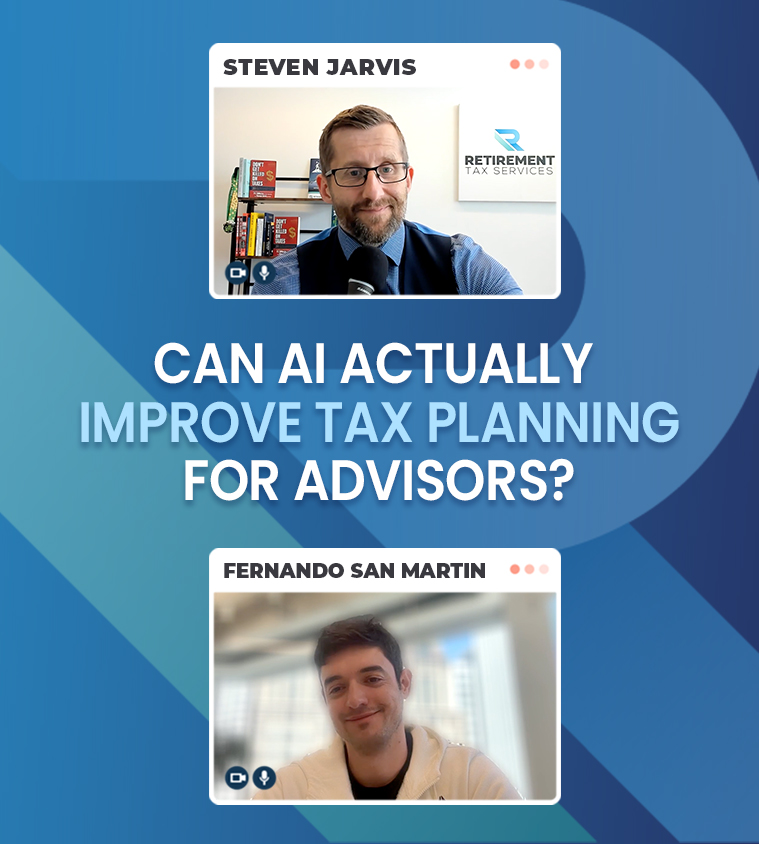
Can AI Actually Improve Tax Planning for Advisors? with Fernando San Martin




This episode explores how AI is changing the way financial advisors approach tax planning and client service. Steven Jarvis speaks with Fernando San Martin from Altruist about Hazel, an AI-powered tax planning tool designed to help advisors uncover opportunities in tax returns. Fernando explains that the focus is not on replacing advisors or CPAs, but on enhancing their ability to deliver consistent, high-quality insights at scale. The conversation highlights how tools like Hazel can surface tax-saving opportunities, save advisors time, and improve client conversations around tax strategy. They also discuss the importance of starting with client outcomes before selecting tools and how AI can help bridge the gap between personalization and scale.
Steven and his guests share more tax-planning insights in today’s Retirement Tax Services Podcast. Feedback, unusual tax-planning stories, and suggestions for future guests can be sent to advisors@rts.tax.
Are you interested in content that provides you with action steps that you can take to deliver massive tax value to your clients? Then you are going to love our powerful training sessions online. Click on the link below to get started on your journey:
Retirementtaxservices.com/webinars
Thank you for listening.
Steven Jarvis, CPA
Hello everyone and welcome to the next episode of the retirement tax services podcast financial professionals edition. I’m your host Steven Jarvis and this week I am once again trying to help all of you navigate this question I hear so often which is what tools should I be using to do better work around tax planning for my clients and joining me this week to help have this conversation senior product manager from Altruist Fernando San Martin Fernando welcome to the show.
Fernando San Martin (01:17.644)
Hey, Steven, thank you for having me. Excited to chat more about Hazell, Altruist, and AI for financial advisors.
Steven Jarvis, CPA (01:23.554)
Yeah, absolutely. I’m excited as well. I very much sit on the side of, you know, I’m trying to train great operators. If we want to do great work, I mean, at some point in human evolution, thousands, tens of thousands of years ago now, like the first tool was picked up and we’ve gone a long way since then, but at least at this point, the robots haven’t completely taken over. Like we need operators and I’m focused on training great operators, but to do that, we got to understand what tools are available and…The piece that you and I were talking about before we hit record that I really want to start with is really before we even talk about whether it’s the advisor deciding what tool to use or a product engineer like you trying to decide what tool to build, you mentioned like, really what we got to start with is what’s the outcome we’re trying to create. So if you could speak to that a little bit for Altruist or Hazel overall, and then I really want to get into why was tech such an early and important feature for you guys to get into.
Fernando San Martin (02:20.48)
Absolutely. think you touched on an excellent point. And interestingly enough, think just like you mentioned 10,000 years ago, humans have started using some tools, probably like a stick or a rock, maybe for their needs. It’s interesting AI models do the same thing these days, right? They’re only as powerful as the tooling they have access to. I think the way we started this journey was by taking a look at really our own situation in many cases and quickly realizing how taxes are for most households, for most folks out there, is the main expense on a given year It makes sense therefore for everyone, we think, not just the high income earners, to know how much they’re paying in taxes and are there any strategies that they can utilize to minimize that liability. What we wanted to empower advisors therefore is can you have a meaningful conversation with a prospect or a client to, again, in simple terms, explain them what’s going on in their tax return. For in most cases, there are strategies that can be utilized to minimize that liability.
What is the risk of applying them? What is the difficulty in applying them? What is the trade off? How can we enable that conversation? In our own research, we see only a subset, a small subset of advisors doing tax analysis consistently. Consistently, I mean like you do it for everyone. You do it on a calendar with the same level of depth for everybody. So we see not that many advisors approaching it that way. And we think it’s a great tool for deepening existing relationship with your client base. And it’s also a great tool for winning over prospects. It’s a quick way of showing value. It’s a quick way of engaging with someone and bring them up to the table to implement maybe some of those strategies that you’ve uncovered. So that’s a bit, I mean, we focus on the outcomes. And now that we’ve had Hazel tax planning running for a few weeks, a few months, we’ve been able to collect some user feedback as to which outcomes that our users are able to unlock. On average, when you submit a tax return to Hazel, we offer $6,000 worth of savings in that tax return and that we’re saving the average advisor and it went between one to five hours per week.
Steven Jarvis, CPA (04:15.32)
So when you pull that data, do you have context for, that average $6,000, is it coming from particular strategies or that’s just across the board? When you talk about advisors saving one to five hours, is this advisors who are previously doing tax planning, so Hazel’s helping them go faster, or advisors who wouldn’t have even touched tax planning because they didn’t feel like they could go fast enough? Like, well, what are you seeing in there?
Fernando San Martin (04:36.238)
Yeah, a lot of this data is self-reported, right? We value the privacy of the data of our users. That’s one of our core value propositions. So we ask our users how they feel about the software. Not everybody feels equally. And when we mention things like average savings, we understand that there is a wide distribution of ranges. Some cases, there are no strategies, no reasonable strategies to be implemented for a given household. In some cases, there are many, and the average is skewed maybe by some outliers as well. it’s a bit of a genetic number. We have to get into the details. The way we, I mean, some of the strategies that we uncover. They go in tremendous depth and were able to bring this strategy to the table, some of which are very human in the way they’re thought out. I’ll give you examples, but I just want to say that our proprietary engine that looks at the tax return, and we can also get into why we think that tax planning was the right bet. The market seems to think that it is, but we also did so, and that’s why we brought it up this particular time. Our proprietary engine is able to parse the documents, research the sources, including topics like IRS letters, for example, the deal, you’re a CPA, you certainly know this. They go into extraordinary details where maybe the tax code is not as clear. And it’s able to bring all of that and surface things that, again, it almost feels, I don’t want to attribute human-like attributes to a machine, but it does feel, in a way, almost human, right? A couple of examples that I bring up, and this happened to me actually personally, first thing I did when we were tinkering with this product was to upload my tax return. And I asked, hey, so what do you see here? I work with a tax professional.
I deeply respect this person. goes extraordinary lengths to make sure that, you know, we’re tuned. Yet Hazel was able to point out a few facts, some of which were basic. I was not maxing a 401k. I thought I was, but I wasn’t. I also wasn’t matching my HSA account, not by much, but Hazel quickly picked that up. And I had some money saved in a savings account with some yield, I think something like 3.5%, which me being a resident of California was being taxed at the marginal tax rate. So given my federal income brackets in California, I mean, we’re looking at probably a 40 % bite plus. Hazel pointed out that, well, for a similar level of risk and liquidity, you could move these two municipal bonds in California and effectively almost doubling your return in an after-tax manner. I said, wow, that’s very human take on, again, it’s a bit like a non-obvious take on how you allocate your assets.
Steven Jarvis, CPA (07:00.138)
So Fernando, let’s jump into that for a second. So you said you work with a CPA that you highly respect, which is great to hear. love it when people are working with tax professionals. So just share your own personal experience here because I get these questions from people of how are we going to navigate this. So you run your return through Hazel. It gives you these things that your tax preparer had not told you before. So then what was your next conversation with your tax preparer like?
Fernando San Martin (07:19.246)
Like I did tell my tax preparer, like, we, by the way, my tax preparer has prepared, again, all their strategies, particularly to my circumstances that have been very effective. This was a bit more on the margin. I did bring it up to him. I was still on time to make an HSA contribution to fill that gap. This was, this was really a few weeks ago. I was not on time anymore because it’s 2026 for the 2025 401k contributions. But he did say that, you know, he thought that I was maximizing. I think it’s a, it’s a function of. And again, this is maybe where tools like Hazel can help. It’s not that he doesn’t have good intentions, obviously, or that he’s not a great professional. It’s more that with the tooling available, see tooling and operator are in the same room here trying to make the most out of our relationship and trying to unlock them as well. I think the traditional tooling we have to solve this problem is very effective. It works in a very, in a prescriptive way, which constraints can be good, but I don’t think that it solves for these use cases of where in the margin I want to analyze every tax return across every one of my clients this year. And I want to make sure that I cover these little paper cuts that would add extra value to the relationship. I attribute it more to tax return. think my tax return has anywhere between 50 and 100 pages. You multiply that by 100 households. I don’t think any human can read through all that context and make sure that everyone is checking all these boxes. Mine were too. I’m sure there are two other hundreds in the tax code.I don’t place a particular blame on the person. I place more of a blame on the tools that are available today and precisely the gap that we’re trying to fill.
Steven Jarvis, CPA (08:51.724)
That’s really interesting as you describe that. And think it highlights where advisors will continue to have a really critical role. Because what I didn’t hear in there, and maybe you’re just not willing to say it, so you tell me if I’m interpreting this wrong. But what I didn’t hear in there is, hey, we’re trying to put advisors out of business. Or hey, we’re trying to put CPAs out of business. This is about tools that leverage the realities that we’re dealing with to have better outcomes. But we still need an operator in there. Especially as we get high powered tools at a rapid rate, which seems to be the environment we’re in as the operators, whether that’s financial advisor or CPA, whoever that might be, like we do have to be mindful of how we navigate those to create those great client outcomes. Because I will get that hesitation from advisors at first. Not that they’re not willing to use a tool, but they’re just not sure, OK, great. When Hazel tells me that the CPA did X, and Z wrong, how do I bring this up without burning that relationship? And say, well, it’s going at a faster rate, but it’s no different than it was before. Like there’s always been a risk that when you’re doing a high volume of complicated actions that there’s going to be errors. And so it really isn’t different than when you found out that your client’s tax preparer didn’t report a QCD correctly. Now it’s just a higher volume. And so how we navigate those dynamics is going to accelerate the value of the advisor, not diminish.
Fernando San Martin (10:04.014)
Absolutely. I mean, that’s exactly the view we have internally at Altruist and Hazel. We think advisors are not going anywhere in the next century. Any more than a robot is going to replace a painter or a carpenter. None of that is true. I think, at least in our view, what we think is going to happen is that tools like Hazel, large language models, they’re going to empower something that has been a bit of a conundrum before, which is personalization and scale. It used to be that you would have to pick between the two. Do I want to deliver very specialized advice to a small set of individuals, very personalized, or do I want to create a flywheel of clients where I put them through this pattern and through this sort of like, for lack of a better word, conveyor belt of an operation with an outcome in mind at the end? And I think now you can do a bit of both. And that’s exactly what the power of AI is. I mean, just to go back on the topic, we’re not in the business of replacing advisors. think that’s not realistic. think…There is a lot of value in human relationships. think humans have unique attributes that I think machines, if you ask me, will definitely never have. But on the other extreme, it would be almost foolish to not use the best tooling available for you to deliver the best service. that’s where tools like Hazel could pick up on maybe these paper cuts, maybe these things that you forgot. Maybe I check. often, the way I work with a lot of AI models is I do some work and I ask it to be reviewed. I have a meeting with my manager and I ask it for feedback on how can I do better. And the comments are incredible.
Does it get it right 100 % of the time? Maybe not, but 95 % is still really good. And I can make that discernment as to this is what I’m going to retain and this is what I’m going to discard. And I think if you see more of advisors and clients are in the same team, they’re trying to achieve greater outcomes. If you see it like that, then the relationship between, say, a CPA, an advisor, and a client, even when you add AI into the mix, does not need to be adversarial. My conversation with my CPU is very friendly. think again, he’s doing extraordinary value for me for which I’m very happy to pay top dollars for AI is able to elevate that. And hopefully maybe this was an anecdote, but hopefully it’s able to allow him to elevate his service going forward. That’s it.
Steven Jarvis, CPA (12:08.654)
Fernando, me with an analogy I’ve been working on. I’m not entirely sure it’s spot on, but it feels relevant to this discussion. just for a little bit of background for you, I have a 13 year old son and about a year and a half ago, he got his first RC car. And his first RC car was, was pretty small. It wouldn’t go very fast, but he would play with that thing relentlessly. And for me, it didn’t go fast enough, so I wasn’t really particularly interested in it, but he played with this thing for a really long time. He got really good at the controls. And then recently he had saved up his money. He went and got…a significantly more powerful RC car. This thing will go like zero to 60 instantly. And he starts playing with it and does a really good job with it because he’s been practicing with this other RC car. He’s having so much fun. He’s racing all over the yard. He hands the controller to me. I immediately smash it right into a cement wall because I have no idea how this really works. And it’s super powerful. So to me, it’s not a reason to not use AI tools, but it’s something that I think that people do need to be aware of that when you’re suddenly handed the keys to a really powerful car, like you need to know what you’re getting into. And so especially on complex topics like taxes, what should an advisor be thinking about coming in who I think the early adopters of tax powered tools are people who are already doing tax work who want this to supplement what they’re doing. Where my questions come in is for the people who have never touched a tax return, but now see, wait, Hazel will do it for me. How do we make sure they’re not slamming into cement walls?
Fernando San Martin (13:29.55)
Absolutely. Yeah. So we’ve put a lot of emphasis behind the scenes on what we call evals, what any company would call evals. In which we have our own proprietary data set that’s analyzed hundreds of tax returns. We’ve scored aspects like are we getting the optical character recognition right? Are we getting the math right? mean, that’s table stakes today. We can get the math wrong. We can bring the wrong number to the conversation. We’ve invested a lot there. Again, maybe going back to the topic of a CPA, I could see how a CPA already has an established software. They’re very familiar with the tax code. Something like Hazel does not do tax prep for you, tax preparation in the sense that submitting your taxes to the IRS, for example, that is not something that Hazel does. That is more on the margin than for you to use Hazel to do a pass on a tax return to identify those opportunities before you hand it over to a client. Where we think we bring a lot of value is maybe precisely what you said. Let’s say that advisor that is not a CPA feels like knows a little bit about taxes, but is not a certified tax professional. And maybe feels like the existing software solutions are a bit too hard to use, require expertise. His will be a great starting point for them. So maybe that analogy, this would be like your 13 year old son with their first RC car where I’ve haven’t done this before, dipping in my toes a little bit into the water. I can start by with a couple of clients that I feel comfortable.bring in their tax returns, I’ll pull them to Hazel tax planning mode and see what comes out of it. Do a bit of my own research, verify and have that conversation with them. And from there, really, sky’s the limit. Maybe this is something that you want to operationalize, that you want to bring to everybody. Maybe this is something that you want to focus on particularly for prospects. And that will allow you to graduate. mean, tax planning is the first of many that we foresee. Going back to the conversation we’re having before about Excel, you go to these genetic LLM models and they’re very open. You’re presented with a blank canvas. It’s incredibly powerful. And I’m sure that someone like Picasso seeing a blank canvas, their imagination goes wild and they can paint whatever. You know, they can paint a beautiful piece. And if you’re that person, then great. For us, we think that we need to ground the use cases a little bit and make sure that they work right off the bat well. And to that end, and that’s how we separate from these LLM model providers is we’re defining the use cases that you can use Hazel for. We’re constraining the output. Like the output, for example, of our tax planning mode is not entirely constrained. There is room for. You’re a California residence versus Oregon, or you’re a business owner and the other person is not. But at the same time, it’s not as open-ended, which lacks the consistency that you would get from an LLM. So we think it’s that sweet spot of merging both worlds. And again, I think it’s a great tool for those that are not doing any tax planning to get their toes in. It’s a great tool for those that are already doing tax planning that want a, can you do a pass for me on this? Can you highlight opportunities and can I get ahead of those questions that I might get?
I think that’s where we see the value. Yeah, that’s really interesting.
Steven Jarvis, CPA (16:23.8)
Fernando, what are areas that Hazel is not the right fit for? Anytime I’m exploring new options, I always like to know, here’s when I know this is the right thing for me, what are the areas that maybe it’s not there, it just isn’t intended to be there?
Fernando San Martin (16:37.646)
I mean, there is no shortage of challenges, I would say. We love a good challenge on our table. I think one area that Heiso is not great at yet is integrating with some solutions out there. To be clear, we integrate with your CRM, with most CRMs in this industry, Wealthbox, Retail, Salesforce, HubSpot. We integrate with definitely candidate email providers. There is some maybe more niche tooling here that we don’t yet integrate. It’s a bit of both, if you ask me. When I say both, I mean there’s maybe a bit of a lack of interest from this niche solution in integrable, something like Hazel. Maybe there is a perceived competitiveness on the side. We don’t necessarily see it that way, but it’s not really, it’s not just up to us. And I think there is another angle, which is to an extent, they’re right. I think some of these traditional software providers are again, in the light of LLMs, in the light of this very powerful coding models. They’re looking back at their mode, and they’re maybe realizing that code is getting somewhat commoditized. That maybe the tens of millions of dollars that they spend in developing their solution throughout the 2010s are no, you know, now that investment is at risk. And again, I think if you look at Hazel, which is very thoughtfully placed at the heart in San Francisco, at the heart of the AI boom with world-class talent in every aspect, particularly in engineering. Then I could see how you look at our track record backed by a company like Outrest and you’re maybe uncertain. Maybe you come, for lack of a better word, from a place of fear to the table. I’m not saying that I support the feeling and I don’t want anybody to be fearful, but I could also understand maybe where some of this rationale is happening. So those are the two ideas I would mention. Some of the integrations, I guess we wish we had. We have quite a few of them and the list is always getting larger. We just launched Hayviews. That’s one place we’re not great at I wish we could be even better. And the other one is we don’t do things like tax filings. We not replace the advisor or the CPA.
Steven Jarvis, CPA (18:41.07)
I certainly appreciate the candor. I’m always skeptical of somebody who tells me that their solution is perfect and needs no improvement and is the answer to all things in all cases. So I appreciate the transparency there. Fernando, the other question I always have when AI tools get introduced and so I mean, my audience I’m sure already knows this, but I’m not a tech guy. So I might ask the question slightly wrong. I might just need some education here, but I’m sure I’m not the only one. When like ChatGPT and Claude first started like showing up on everyone’s desktop, I was very much in the camp of please don’t put your tax return into a public chat engine. As AI gets used in more diverse ways, but I think for the general consumer, they still kind of all get lumped in together of if someone comes along and says, Hazel AI, that’s like chat GPT. is the same. My CPA told me not to put my tax return into chat GPT. Talk a little bit about the data security side of asking advisors to start dropping all of their clients’ data into an AI-driven tool.
Fernando San Martin (19:38.124)
Absolutely. Again, this is one area where we’ve maybe spent a pathological amount of time thinking about this way, maybe to an unhealthy degree. I’ll by saying, you retain one sentence from what I’m going to say, is that Hazel has a constraint called Serial Data Retention, CDR for short. This constraint means that the vendors with whom we work, and you mentioned some of them, the leading LLM providers, we don’t just use one, we use many, depending on the model, depending on the vendor for the right use case It ensures that with all these AI providers, they do not retain any of the data that we send them, including documents. For documents, use actually another, there is a specialized tool that we use for document parsing, given their, sometimes their length and complexity, but they do not retain any of this data. Meaning even if an engineer within these organizations wanted to take a look at what our users are using Hazel for, they wouldn’t be able to. So very strong commitment to privacy is one that took us a long time to get at these are. You don’t obtain this by default, even on the enterprise agreements. Yeah, you got to request it. You got to go through a risk assessment because it deprives these companies that operate these models from the ability of, know, if you want to use this maliciously, then they wouldn’t know because they can. This is not locked in their systems. But in a nutshell, we operate under this constraint. We also have a trust center. have a CISO, Chief Information Security Officer at Altruist, which also oversees Hazel. So we use the same framework, the same infrastructure that oversees tens of billions of dollars on the outreach side. We have the same standards as they do. So I’m sure this is, again, a bit of a contentional stopping. If you want more details on our security policy, I would invite you to go to trust.hazel.ai and they’ll be able to see a detailed review of how we handle your data. But yeah, definitely something very critical that’s top of mind for us. We hope that CDR constrain appeases most folks. And if it doesn’t, please come to us to have a conversation.
Steven Jarvis, CPA (21:29.358)
I appreciate you sharing that. Fernando, what’s on the roadmap ahead for Hazel that you’re excited about? Not asking for industry secrets here, but what are some things that people can look forward to that you’re excited to be able to get out there?
Fernando San Martin (21:39.768)
There is so much to be excited for. I truly mean it when I say that even when we scope out of HESO, we just look at the landscape of software and tech as a whole. I am aware working on this field that there is maybe at times it can feel like hype or it’s being oversold. But I think there are some very real fundamentals of the value that AI can bring to the table on many industries, not just the wealth management one. For us in particular, I mean, these models are getting better. Tooling, like document parsing, transcription, email reading, all of this is getting better and it’s getting better at a rate that doesn’t seem to diminish. My bet maybe 18 months ago was that, we sort of not plateaued, the maximum change rate has already happened. No, mean, these models keep getting increasingly better. They surpass, in my opinion, in benchmarks that I’ve seen, surpass human reasoning on many aspects in particular verticals. What’s coming? Well, our next big bet is financial planning. This is something that we’ve talked about before. Tax planning is one aspect of financial planning. Financial planning is interesting for many aspects. think it’s one of the core value propositions of an advisor. It’s one that has been traditionally very manual, where you collect a lot of data and then you put together a plan and you keep chipping away at different fronts. Like, okay, what are your goals and what is your income? And can you tell me more about your state plan and send me some documents and your insurance? We think that the technology is converging towards not automating, but unlocking a lot of the value in putting together all these facts, collecting them, and really presenting compelling narrative that transmits value, that shows a plan, right? That communicates with the end user. We see this problem really in three layers. There is the collection piece, the data collection piece. There is the actual planning where… You run the numbers and you assigned the expected return for their asset classes and volatility and so on. And maybe you want to run Monte Carlo if that’s appropriate for the user. And then at the end of it, and maybe more importantly of all, there is a deliverable. Whether that’s a meeting, whether that’s a video recording that I’ve seen some advisors do, or maybe it’s a document that you want to share. We’re actually tackling the three of them and we think AI can play a role in all of them. And again, that paradigm of personalization at a scale in that to the table. So that’s a big next bag. We’ve set for ourselves the goal of launching a new agent every quarter for the remainder of the year. So we have all the topics in mind. I think it’s maybe a bit too far away, even though it’s only really a few months to adventure to say. Maybe we can have another conversation when the day is bit closer. But yeah, continue to polish the product as well, make it even better, deepening those integrations that I mentioned before. Telephony systems, for example, those are things that are going to… We have an Android app that has been requested by many folks that…We don’t have just yet, but it’s coming.
Steven Jarvis, CPA (24:30.542)
I appreciate you sharing all of that. For everyone listening, I want to make sure that we circle back to kind of what we started with, which is whether you’re diving deeper into Hazel and what Altruist is offering or you’re using other tools, we have to start with what is the client outcome that we’re trying to solve for? What’s the outcome for our team that we’re trying to solve for? At the end of the day, like these tools have to be part of a bigger system with a clear goal for what is our value proposition and how we’re trying to move that forward. So Fernando, I really appreciate all the insight and expertise that you’re sharing here. How do people try out Hazel? How do people learn more? Like where do people go after listening to this conversation?
Fernando San Martin (25:05.518)
Yeah, no, great questions. Visit at hazel.ai. We’ve showcased our value proposition there. If you want to start an account, it’s fairly easy from there. You can use Google, Microsoft accounts, or even your Altruist crystal account if you have one. To get started, is a free trial. You can see the value of all the features of Hazel for 14 days at the moment. You can invite your team members and have them see the value as well. And from them onwards, hopefully you convert to a paid client and the best is yet to come, I love to say. You’re going to be up for some quite nice things coming down the road. If you want to stay in touch, you know, we have a inbox that we continuously monitor. Hello at hazel.ai. If you want to drop out, have some comments. And lastly, if you have feedback, if you’re already a user maybe and you’re like, yeah, this, you know, I want to, I want to request this feature or like, this is not quite working the way I expected. Once you open a Hazel account on the bottom left next to the settings, there’ll be an ideas linked. That will take you to Kani which is the product we use to collect user feedback. It’s a bit of forum style. You can search previous posts, add both, comment. We actively look at that. I can tell you to decide what’s going to happen next. So please contribute to the discussion there.
Steven Jarvis, CPA (26:16.366)
Fernando, thank you so much for your time, really appreciate all the insight. And to everyone listening, thanks for being here. And until next time, good luck out there. And remember to tip your server, not the IRS.