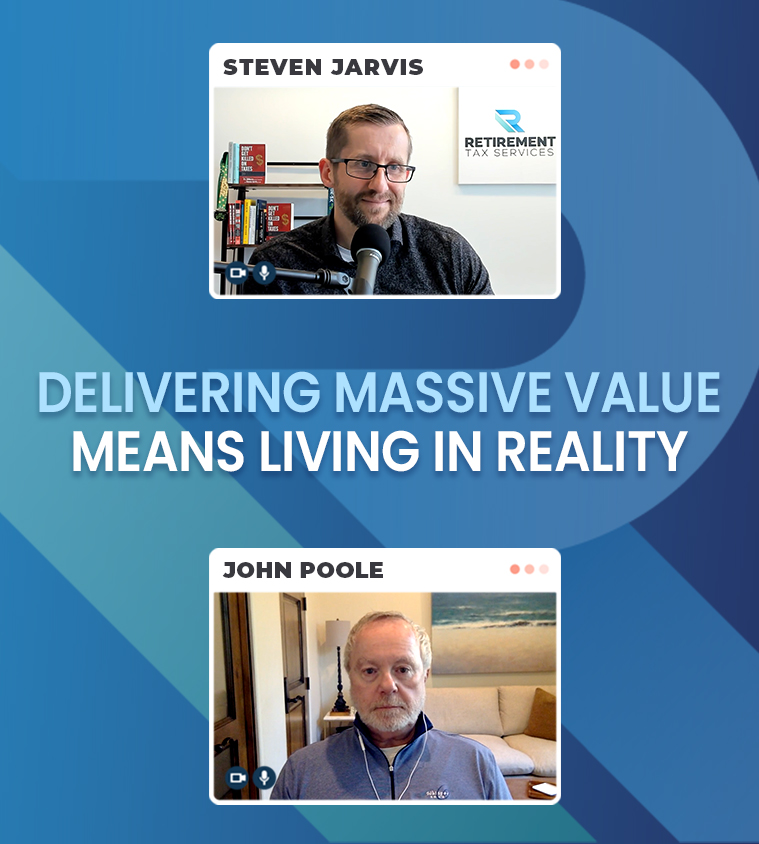
In this episode, Steven is joined by John Poole, a partner at JPTD and a seasoned veteran when it comes to helping financial advisors get their practices ready and navigate through equity events. John and Steven talk about common misconceptions advisors have about their own numbers and what really drives value in a business. John shares from his extensive experience with real practice transactions to help listeners understand the steps they can take and the areas they need to focus on to maximize their value, whether they are 2 months or 20 years from any kind of equity event. Every business will eventually transition in some way; the key is being intentional along the way.
“To get the reality to get the highest multiples, you're going to have to show what's real, what does my business really look like, and have the reporting necessary.” - John Poole Share on X
“And tax planning can be an incredible additional service for financial advisors because consumers are looking for it. But we've got to make sure that we understand its place, that it's one piece of the puzzle, it's a pass or… Share on X
Steven and his guests share more tax-planning insights in today’s Retirement Tax Services Podcast. Feedback, unusual tax-planning stories, and suggestions for future guests can be sent to advisors@rts.tax.
Are you interested in content that provides you with action steps that you can take to deliver massive tax value to your clients? Then you are going to love our powerful training sessions online. Click on the link below to get started on your journey:
Retirementtaxservices.com/webinars
Thank you for listening.
Steven Jarvis, CPA (00:51)
Hello everyone, and welcome to the next episode of the Retirement Tax Services Podcast, Financial Professionals Edition. I’m your host, Steven Jarvis, CPA, and this week is a special episode. We’re gonna dive deep on helping all of us recognize those areas where we need to make sure that we’re dealing with the right data before we make decisions, before we really get into the planning. That’s certainly true in tax planning. It’s also true in how we run our businesses. And joining me this week to have this conversation is John Poole, a partner with JPTD Partners, good friends of ours that we have seen guide advisors through business transitions and just so much expertise in this area. And John, welcome to the show. I’m so excited to have this conversation. Give our audience a little bit of background on who you are and what you do before we get into the really fun stuff.
John Poole (01:39)
Sure, Steven, great to be here with you today. Yeah, I am one of the founding partners at JPTD Partners and we’re a boutique firm that helps advisors that are interested in having some form of an equity event in their business, whether it be a partial sale or a complete sale of their business, whatever that happens to be, and consulting with them and guiding them through that process. We’ve had our firm together now for five years. But I’ve known my partners for quite some time. Longer than that, we were all together as executives within American Express and ultimately at Ameriprise for a period of time. But yeah, it’s something that we all get to do now as part of sitting on the side of the desk of the advisor versus sitting on the side of corporate America.
Steven Jarvis, CPA (02:27)
John, before we get kind of into the heart of this conversation that we want to have, just, for our audience, it can be easy to think, well, John and JPTD partners, they help with business transactions, with events. Like, I’m years away from that. I’m going to tune out for this one. And I just really encourage you to wait for just a second before you make that decision. Because one of the things that really blew me away when you guys were at the summit this last year and got on stage in front of this group of advisors, many of whom came into the room thinking, yeah, this isn’t relevant to me. I’m not about to sell. But as you guys walked through and really helped people understand not just what their business could potentially be worth, but things that they should be thinking about long before a business transaction ever happens. And then just helping people understand how they should understand their own businesses, the advisors walking back out of that room without exception, jeez, this opened my eyes. I learned a lot from this. I wasn’t even expecting. This conversation isn’t just for someone who thinks they’re six months, 12 months away from some kind of transaction. Is that fair to say, John?
John Poole (03:27)
Definitely fair to say and there’s a couple of things to reinforce that one is that our average client now is just under 50 years old, and when we started, myself and my partners being the age individuals that we are we thought we would be dealing with people 60, 70 years old and all of sudden we started finding out no this is the reality. There’s significantly more people interested in either taking chips off the table or more. How do I apply capital and have a capital infusion in my business that actually helps me multiply the growth of my business, and finding those capital partners? Who are the partners that I need to be investing that need to be investing in my business to help me grow it and expand my operation? So that I can get that second buy of the apple 10 years from now, 15 years from now. And then the other part is that we have hundreds of people in our system right now that we’re just providing them with what amounts to be free advice. And it is our way of giving back, but more importantly, it’s helping them to get prepared where they should be. So there’s certain things that they need to be doing today that can actually have an impact on them and change that trajectory of their business and the valuation of it in the future.
Steven Jarvis, CPA (04:42)
Yeah, and just real quick for our listeners, JPTD has been generous enough to offer to do a free valuation for any of our audience members who want to go out to retirementtaxservices.com/JPTD. You’re going to provide some information about your firm, and John and his team will provide you with some insights that you probably haven’t ever seen before. And I throw that out now because it really is a place that you’re going to be able to go for a resource, kind of a reference that you might not be able to get anywhere else, because as John and I have this conversation, you’re going to realize there’s probably some things you need someone else to help you understand. Because John, as we get ready for this interview, one of the things we want to focus on is helping people realize where they might not be interpreting their data correctly. So I’ll let you get us started on this of, as you work with advisors across different channels, across different firms, you’ve seen this trend where advisors think they know what their revenue is, but they’re really missing a step.
John Poole (05:36)
Yeah, that’s very true, Stephen. One of the areas that we see, it comes from various different firms, but there are a number of firms out there that the way in which they report revenue to their advisor, the way that they report revenue coming in to the advisor is actually a little bit shaded. And what I mean by that is the clients…Let’s just say that the client has paid a fee of a thousand dollars. Typically, you would say, okay, well it’s a thousand dollars, then I get my payout against my thousand dollars. I’m at a 90 % payout, therefore I get $900. That’s true, but there are some firms, however, that actually mask that through haircuts. And what I mean by that is there’s a thousand dollars and I take a…hundred dollar haircut well it’s actually only nine hundred dollars that I’m going to get my payout against now and so my revenue actually reflects the 900 it doesn’t reflect the thousand and that gap in there that that that administration fee that a person’s paying to whomever whatever broker dealer or record keeper they have out there that they’re working with can actually mask what the true revenue of the business is. So that when someone’s making an acquisition and they’re looking at the true revenue of the business, I may not show them because what I’m being reported is the $900. I’m not being reported the $1,000. And next thing you know, at the end of the year, I’ve got two, three, four. We had a client recently had as much as $700,000 in an admin fee.
John Poole (07:09)
And they didn’t recognize that their business actually had an additional $700,000 in revenue and they their offer put it to understand the importance of it the offer that they received was in a seven times multiple. Well if you take a seven times multiple on what amounts to be hundreds of thousands of dollars we’re now into millions of dollars and it doesn’t take long to get there that I’m missing, so that if I’m not being able to record what my real revenue is, I have the potential of selling something on the cheap.
Steven Jarvis, CPA (07:45)
Well, and John, what’s so interesting to me and this is this reinforces the importance of working with experts in different areas of my life because of our lives. I mean, we’re talking about financial advisors here who are money savvy people. When they work with their clients, most of the financial advisors I work with, they insist on seeing all of the clients assets, all of the clients data before they make planning recommendations as they should. We have to have the complete picture before we make a recommendation on how a client should invest or the tax plan strategies they should implement. And so I see these advisors who are great working with their clients and insisting, hey, we’ve got to have the right data. But then when they look at their own situation, they don’t take that extra step. Or they’re just not aware of what step they should be taking, because it’s not what they do every day. And so then working with somebody like you and your team to be able to say, hey, we do this all the time. And we know the pieces that you might not even be aware of. John, would imagine there’s a compounding effect here because there’s the piece that you’re talking about, which is if you don’t know what your total revenue is, you’re not even coming to the table with the right kind of offer or providing the right information to get the right kind of offer. But my understanding is I work with financial advisors who have been through transactions recently from talking to you and your partners. A big driver of what that ultimate multiple you’re going to get is, is based on your organic growth. And if you don’t even know your true revenue, how are you possibly communicating your actual growth? I mean, we’ve got to be dealing with real numbers or you are not going to maximize the value out of this incredible asset you’ve spent your life building.
John Poole (09:08)
Yeah, that’s very, very true, Steven. When they don’t recognize that true revenue piece and they’re making that transaction and they’re trying to garner the highest return that they possibly can, one, it doesn’t show the true growth of their business. What’s the year of the year? What’s my CAGR really look like? Two, I’m not getting the multiple against that revenue because I don’t even know it’s there. And three is I’m not showing myself at the true volume because keep in mind, as that volume takes up Market cap will your market multiple Will grow as well So it’s kind of like the inverse of Costco a big jar mayonnaise, is it’s gonna get a better market cap than a smaller jar of mayonnaise so not having that revenue in there kind of limits and restricts what’s the real true value of the business.
Steven Jarvis, CPA (10:00)
Yeah, yeah, I just want to reinforce this point to our audience one more time because I think it’s just so important. I spend all my time talking to advisors about tax planning. I’m constantly on this podcast, hey, get tax returns every single year like tax returns or didn’t happen, like you have to have the real data. But my focus is on taxes. And so that’s why I use that particular example. But this applies in all areas of your life. And so, whether you see yourself having some kind of equity event in the next couple of years, or this is 10 or 20 years out for you. You’ve got to be working off of real data to make good decisions as a business owner, as a leader, whatever that looks like. And so if you don’t have that opportunity to say, OK, here’s what my business is really worth. Here’s what the numbers really look like. That’s why we partner with you and with JPTD partners so that our audience can go out and get out to retirementtaxservices.com.JPTD. You can get some of that information. I’ve now talked to dozens of advisors who have been through that process with you guys. And some of them have ultimately done transactions. Some of them are still in that process. But all of them have shared how eye-opening that experience is, how much it informs just even how they run their businesses and understanding how their businesses really operate.
John Poole (11:07)
Yeah, it’s kind of like this. As a financial advisor and granted, Steven, just to be clear, I was never a financial advisor. There’s those that do and there’s those that go into management. I went to management, let’s just be clear. If I’d have been a financial advisor, I’d be in a corner calling for my mother. That’s too hard of a job for me. But it’s like that of a financial advisor that the client comes in and says, I’m making, I make $100,000 a year, but the reality is that they make $120,000 a year. That doesn’t sound like that. It’s giving you the advice that you’re giving back to that client is based on them making $100,000 a year. That’s all they’re reporting to you. That’s what they’re showing you. But the reality is, there actually is another 20 grand in there. I would be doing things differently as a financial advisor, I’m assuming. Again, I was never one. But I would be positioning my client in a much different light with true understanding. And the same thing is true with advisors and evaluations of their business. What’s it really worth? And no, it’s not formulaic. Everything’s your recurring revenue is two and a half times, and you get one on your broker dealing, whatever. That’s just garbage. The reality is that it depends upon multiple different things. It depends upon how fast you’re growing, are you growing and can you show evidence of that to the market that you’re in. There are some firms that just want to pay more because it’s a market they’re trying to a flag in. And three, to get the reality to get the highest multiples, you’re to have to show what’s real, what does my business really look like and have the reporting necessary.
Steven Jarvis, CPA (12:39)
Yeah, yeah, it’s so valuable to work with people who do this all the time. There’s just insights you’re not gonna have. I would imagine that most people listening to this podcast have never been through an equity event before. know, mean, John, you talked about being able to get a second bite of the apple later on down the road, which we’re seeing more often, but still, the vast majority of financial advisors themselves might go through one equity event, maybe two in their entire career. And so if you haven’t been through it before, why wouldn’t you take the chance to talk to someone who has, who can open your eyes to kind of what’s possible, what’s out there. I know that on the tax firm side of things, it’s interesting, and John, I’d love to hear your thoughts. I know you focus on financial advisors, so I’ll tie this back in in just a second, but for years now on the tax prep side of things, firm owners who go to market, they’re getting, I mean, a good deal would be like one to 1.5x revenue, maybe. Because of how the business model works, because of just how that market’s going. And so I think why this ties into our bigger conversation, John, is I have all of these advisors who want to bring tax prep in-house. They want to acquire tax prep firms. They want to do all these things. In part, they see it as enterprise value for their firm. And so, where I’d love your insight is, when you’re doing these transactions, is there really any enterprise value to the financial advisor because they do or don’t offer tax prep directly? Or is it what it does for their growth and the service they’re actually providing to the client? Does what I’m asking make sense? know I’m pulling together a lot of things there.
John Poole (14:01)
Yeah, yeah, it does. And it’s actually the latter. It’s viewed by firms as being a tool. I have this tool and this tool can be, I’ve got a marketing machine, and I’ve got this marketing machine, and here’s the way I bring in new revenue and new clients, and here’s what I do over and over and over again. And it’s driving that bus, and that’s why year after year I’ve got this particular growth rate. Same things viewed as far as tax is concerned. If they have their own tax division within their organization, it’s not viewed as, okay, well that’s a value in its own. It’s viewed as, okay, well you have that tool, but it’s ultimately adding to the growth and the capturing of additional assets from existing clients and new clients that you garner from within.
Steven Jarvis, CPA (14:47)
Yeah, I appreciate that perspective, John, because even though I’m the tax guy and I’m a huge advocate of financial advisors incorporating tax planning and what they’re doing, I think it’s so important that we keep perspective on how these different things kind of mesh together. And tax planning can be an incredible additional service for financial advisors because consumers are looking for it. But we’ve got to make sure that we understand its place, that it’s one piece of the puzzle, it’s a pass or another bus, whatever analogy you want to use. But we can’t get so laser-focused on any one tool that we assume that just adding that one tool transforms everything. We’ve got to look at how are we building this business over time and what does that mean for someone who’s potentially interested in partnering or acquiring my firm.
John Poole (15:23)
Yeah, we had a firm, it was not long ago, and they came to us and they were asking some advice on, because they were, at that particular time, were pondering, do I add a tax, they were looking at acquiring a tax firm and adding that to their business. And what was interesting was, in sitting down with them and sharing, and what I shared with them, I said, okay, well, let’s look at this from what’s it gonna cost you? And they said well, there’s a certain amount of cost from time. There’s a certain amount of cost from dollar amounts. And we went through, and we uncovered what is the real expense. And then we turned it around and said okay, so what do you expect to get from that? Given the fact, and this person was in a position where they wanted to actually have a full equity event within seven years. And when we went back to him and shared with him the numbers and said, okay, now if we took that same capital, both time as well as cost, and we invested that in other marketing endeavors, what would that do? And then it was an easy layup between the two as to what’s more prudent for them. And they decided not to acquire a tax firm. But they had, in fairness, to this gentleman he goes I just been to a conference and this advisor was saying everybody should buy tax firm tax firm tax firm and he goes it’s and I’ll never forget he goes it’s just so stupid of me just to fall in line with the rest of the sheet he goes I really didn’t think it through I just did what I heard a guy say
Steven Jarvis, CPA (16:46)
Yeah, that’s a really interesting dynamic because here we are in a podcast and we’ve been at conferences together telling people they should go out and do things. But there’s this interesting dynamic of how you follow advice you get from people that you don’t yet know. And this is why I like to focus on, let’s start with this education and discovery process. And let’s start with helping you understand better what the options are, what the opportunity costs are. When people get really carried away with, have the answer for everyone. It’s like, OK, but really? There aren’t any universal answers. And so again, being the tax guy, I hear from advisors all the time who they know this one friend, it’s this one uncle, whatever it is, they acquired a tax firm, and it was great. And it’s like, wow, I question how great it really was. And to be clear, I have seen advisors be very successful with tax prep in-house. But I’m also more recently seeing more and more of those advisors come to a service like retirement tax services and say, actually, we don’t really want this in-house anymore. Can you do this for us? To your point, John, we would rather focus on what’s our highest and best use. And even at the summit this year, mean, from stage, we talked multiple times about, hey, there’s really only three things that a financial advisor should be doing. They should be spending their time on, as opposed to delegating to their team. It’s meeting with clients, it’s prospecting, and it’s vision casting or strategic planning, whatever you want to call that. And so if as a financial advisor, you’re not focused on one of those three things, like there’s a huge opportunity cost to learning how to do tax prep as opposed to delegating that or outsourcing it. Like we’ve got to make sure that we recognize we’ve got some limited resources in our time and attention. We’ve got to make the most of them.
John Poole (18:17)
Definitely do and in this guy’s case it really was a very, it was pretty much a slam dunk between the two as we went through and we looked at the cost to compare to the benefit and we looked at the cost from a marketing perspective and the benefit on the other side. And it kind of goes back to what one of my professors in graduate school said to me that was, you know, never make a sandwich for five dollars that you sell for three. And I’ve always stuck with that as a theme.
Steven Jarvis, CPA (18:41)
Yeah, yeah, the other thing I always try to look out for is I want to work with people. I want to take advice from people who have seen something work over and over and over again. I’m always cautious when I’m listening to a podcast, when I’m going to an event, and someone is giving blanket advice based on one success, right? So you can absolutely go to a conference and have somebody say, hey, here’s this one thing I did this one time and worked for me. So now everyone needs to do it this exact same way. That’s where I would really prefer. John, that’s why I like working with you and your team. Like you guys do this over and over and over again every single year. And so you’re seeing the range of outcomes that happen and what makes sense time and time again. The other thing that comes to mind is we’re having this conversation, John. Clearly I’m the tax guy here. I want to make sure that we don’t leave with the impression that I’m undervaluing the importance of tax planning for financial advisors. And really, for a couple of reasons, this is still really critical to what you do as a financial advisor. But because of how it feeds into these other things that we’re talking about. Because one, your clients pay taxes every year and they need help on it, which means they’re gonna be asking you those questions, which means if you can’t help in some way on tax planning, they’re gonna look other places for that. And where this is gonna play out is in your growth rates, in your marketing, in your client acquisition, because it’s easy when the markets are going up for advisors to get distracted and think they have this amazing growth when really what they have is market growth, not… Organic growth and John you can obviously comment on this a lot better than I can but when we when it’s when it’s equity event time, those things get stripped out and they really look at what’s that organic growth and one of the most common ways I’ve seen advisors set themselves apart and compete with the broader market of financial advisors is when they have that combination of tools including tax planning that sets them apart and makes them a clear difference from just going to Vanguard or Fisher or Fidelity or someone else out there to be able to say to a client: Here’s these things that we do for you that as the firm owner, they know, hey, this is going to drive my organic growth.
John Poole (20:33)
Without a doubt and I never want to discount the fact that anything I can save on taxes is adding back to into my pocket whether person whether it’s an advisor on their own practice or an advisor with their clients whomever what I can say is benefiting me and I never want to discount that and I never want to discount either the importance of that relationship where I can depend on someone to provide the tax advice that they need. Someone like yourself, Steven, that’s going to show them this is the benefit and here’s why you do that. It’s not just do it because I said so. It’s here’s let me help you understand it so that it really does come to light and it’s something that they can internalize.
Steven Jarvis, CPA (21:12)
Yeah. Yeah. So it’s such an important perspective to keep in mind. And really, as this podcast airs, our good friends over at the Perfect RIA will have just finished up their annual business planning conference, which JPTD and the team will be at, helping advisors understand not just how they can keep building their practices, but what their businesses are really worth. As you’re listening to this podcast and you’re getting ready for your business plan this next year. If you don’t have that opportunity, that resource to say, okay, what am I missing? What story am I telling myself that maybe just isn’t quite right? That’s why we take the time to offer this opportunity to go out to retirementtaxservices.com/ jptd. can get that insight so that you’re making informed decisions, so that you have real data to work off of. But John, what else, as advisors listening to this and thinking about planning, whether it’s for this next year or for potential equity event…Like what are those top couple of things that come to mind that you think everybody should have in their plan?
John Poole (22:04)
There’s a couple of things. One is to make sure that you’re able to drive growth organically, and you can demonstrate that. Having the definitive plans in place for marketing, having definitive plans in place for adding or capturing, continuing to capture additional assets from your clients. The service models, that entire piece of I’m trying to bring in and show that I can grow organically year after year after year. That’s one of the biggest drivers of a multiple that anyone’s going to see on the valuation of their business, is I can show that I can do that year after year. I’ve got a client now that’s out of Dallas. And they’ve been able to show that they can grow at 15 % clip and they’ve been able to show that for the last seven years, it’s not just something new but it’s something that they can show that this is what we’ve been doing, and that’s irrespective to market growth. This place is just exploding and everybody and their brother wants to get in front of them because It’s exploding growth and they can show how. Here’s our systems. Here’s here’s how it’s actually occurring and and I can show you evidence of where I was and where I am today. So it’s there’s not a one-hit wonder It’s year after year after year irrespective to that market growth in and what I would tell you too Is that from a planning perspective most advisors have seen significant asset growth over the last 10 years, and that’s just because of Wall Street. Wall Street has helped to grow that pool of capital, and look, I could be myself the worst advisor in the world and just plug money in, and it’s grown just simply because of what the market’s done. I’m talking about can I capture additional assets. Am I able to show that I can capture additional assets each and every year and if I’m able to show that, that’s really where my multiple starts to happen and I always tell people it really boils down to am I seeking out and if I can’t do it, am I looking for and garnering the advice I need to get me to that level and… I like the way you you phrase it Stepvn, we sit down and we think we can do it all. It’s like when my kids were little and my wife would come home with a gift and I have to put the thing together. I hated, by the way, I hated doing that. That was the worst chore in my life. But it’s putting that stuff together.
John Poole (24:29)
And me thinking that I had all the tools I needed, I didn’t. Me thinking I had everything that was necessary, I didn’t. Now I had a neighbor a couple of doors up that owned a restaurant supply company and a restaurant repairing company. They’d go in and repair ovens and fryers, and he had tools out the wazoo. So anytime I had a package that came in that I had to put together, I just took it two doors up, and I went to his little backyard. Uh, his, his little, uh, workshop back there. And I would always go, Tommy, you and I are going to put this together, buddy. And I would sit down, have a beer, and watch him do it. And I’d bring it home and say, look what I did. I didn’t touch that fricking thing. And the worst was some big wheel item that my son had that had sliders and whatever. So actually looking for and finding the professionals to plug the holes that I need support…That’s not showing any kind of vulnerability. It’s just showing you’re being prudent, for goodness’ sake.
Steven Jarvis, CPA (25:29)
Yeah. Yeah, sometimes the oldest edges are the best, and who you know can be a lot more important than what you know. But whether it’s the who you know or the what you know, as we approach a new year, it’s a really great time to take that step back and say, Can I tell you what my organic growth number is? If I was to off the top of my head try to guess where my last 10 clients came from, would I get it right, and was it intentional or was it just kind of happenstance? And as we work with advisors, we see a lot of, to your point, John, the markets in a lot over the last several years to help advisors keep growing. And so we see a lot of advisors who just really aren’t as familiar with the inner workings of their own companies as they probably should be. And so, reall,y the starting point is as we kind of bring this conversation to a close, for anyone listening, you need to go through this exercise. You need to think about and then prove to yourself, hey, do I know where my clients are coming from? Do I have organic growth that exceeds what the market is doing for me? Are those intentional systems that I can keep amplifying to ramp up the growth of my company? And that all speaks to what you need to know. And then even as you go through that exercise, there’s going to be pieces where it’s going to make a ton of sense to have that outside perspective. Have someone who does this all the time take a look and say, OK, here’s the piece you didn’t think about, or here’s what we’ve seen work dozens of times in other places. And so one last time, it’s retirementtaxservices.com/jptd. And they’ve generously offered to do that initial valuation for free for our audience. So take the time to do that. Learn more about your own business and how you can make the decisions they’re going to help you as you continue to grow. So John, I really appreciate your time. Any other thoughts as we wrap up before we send everybody off into the new year?
John Poole (27:11)
No, it’s a pleasure to get to speak with you, Steven, and get a chance to speak with your audience. We really do enjoy what we do. And it’s a joy when we get to see something come to fruition. And that something can be either A, they decide this is the right path, or this is the right path. Whatever the path is, it’s a joy on ours to see someone have that happen.
Steven Jarvis, CPA (27:33)
John, thanks so much for being here and for everyone listening. Until next time, good luck out there and remember to tip your server, not the IRS.