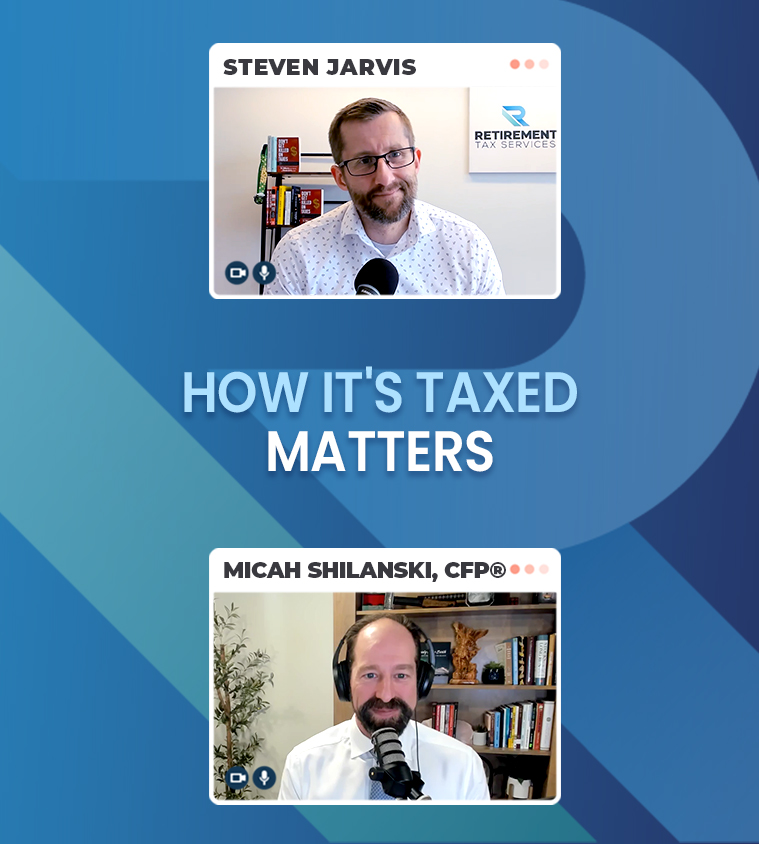
Steven is once again joined by none other than Micah Shilanski, CFP®, to share real-world examples of tax planning that matters. Steven and Micah share recent client experiences highlighting how the “simple” things on a tax return can make all the difference to a client, and the reality that most taxpayers aren’t getting tax planning help unless a financial advisor is providing it. They share best practices for learning and leveling up when it comes to understanding what’s on a tax return and what an advisor can do to partner with a tax preparer for the best possible outcomes.
Steven and his guests share more tax-planning insights in today’s Retirement Tax Services Podcast. Feedback, unusual tax-planning stories, and suggestions for future guests can be sent to advisors@rts.tax.
Are you interested in content that provides you with action steps that you can take to deliver massive tax value to your clients? Then you are going to love our powerful training sessions online. Click on the link below to get started on your journey:
Retirementtaxservices.com/webinars
Thank you for listening.
Steven Jarvis, CPA (00:51)
Hello everyone, and welcome to the next episode of the Retirement Tax Services Podcast Financial Professionals Edition. I’m your host, Steven Jarvis, CPA, and my favorite person who wishes he was a CPA joining me this week, Micah Shilanski. Micah, welcome back to the show. That’s your favorite introduction, right?
Micah Shilanski (01:06)
Steven, that is my favorite introduction, especially of this year. It’s my favorite introduction this year by far. Thank you so much for having me.
Steven Jarvis, CPA (01:12)
Well, well, Micah, in your defense, I feel like I should clarify that I genuinely believe that there is part of you that wishes you are a CPA, but not because of our knowledge or expertise or any of those kinds of things. Just for the number of times that clients who have worked with you for who knows how many years still will turn to me the first time they meet me and say, yeah, but Steven, what’s your opinion?
Micah Shilanski (01:34)
You know those little things I think are great stranger uniform is a wonderful thing to have and recognize but yes And that’s why it’s one of things before it really irritate our CFP audience not for the knowledge, but just from the immediate credibility There’s virtually nothing better than a CPA to get immediate credibility for having no knowledge of how taxes work whatsoever because most CPAs actually don’t do a lot of tax work Is that fair Steven?
Steven Jarvis, CPA (01:55)
Yeah, if we look at CPAs broadly, mean, a huge percentage of them don’t do tax work at all. And then of the ones who do tax work, it’s even a smaller percentage that do tax planning, which is what you and I care the most about. And so, yes, while the general consumer puts a lot of credibility in the CPA designation, there’s a lot of room for any of us, whether financial advisor or tax professional, who want to take tax planning seriously, there’s a lot of room to add some massive value.
Micah Shilanski (02:18)
There is, and that’s, I’m excited what we’re gonna talk about more today, right? Regardless of your designation, or hopefully like stop everything you’re doing and don’t get your next designation until you know and master these several things. Like designations are neat in one hand, but what really matters is moving the needle with your clients, understanding what their goals are and helping your clients get to the goals the most efficient way possible.
Steven Jarvis, CPA (02:38)
Yeah, I mean, as we’re kicking off a new year here, whether you want to talk about taxes or really any other area of your life, but we’ll talk about taxes. That’s why people show up to this podcast. One of the things I’m really trying to focus on for myself and reinforce to other people is that action matters. Attention does not. And the internet really gives us a skewed view of that because what gets clicks and likes and reactions is not the same as what actually makes a difference. And so you’ve got to decide like, Hey, am I trying to be, am I trying to be famous? Am I trying to get the biggest LinkedIn following, or do I care about delivering value for my clients, for my family, for myself, whatever that looks like, and I’m gonna go ahead and land on the side of action is what I care about.
Micah Shilanski (03:14)
You know, Stephen, it always goes back to kind of the same things. Fundamentals, no matter what we’re talking about, it could be like about competitive shooting. We could talk about strength training. We talk about nutrition, right? We talk about taxes. Fundamentals are the key thing that move the needle at the end of the day. Everybody wants the shiny, fancy toys, excitement thing, quick draw, immediate supplements to get your, you know, whatever the best tax planning option where I pay no taxes ever again. But the reality is those really don’t exist. It’s the fundamentals that move the needle. And the advisors that I see that really master the fundamentals with clients are the ones that are crushing it across the board.
Steven Jarvis, CPA (03:47)
Yeah, yeah, absolutely. Micah, I have a new litmus test that I’m exploring. Want to get your take on this because we get a lot of, I get a ton of questions about where the line between tax advice and tax planning is. And like, we’re not even gonna get into that because every money decision has a tax impact. So I’m gonna go ahead, this is my new litmus test. Regardless of your designation or lack thereof, regardless if you think you’re a financial advisor or financial planner or financial counselor, whatever the list is. The new litmus test is gonna be that you should not make any money recommendations to anyone ever again unless you can pick up their tax return and explain to me how the next $1,000 of income is taxed. What do you think, Micah?
Micah Shilanski (04:23)
Dude, I like that. I like that. yes, if you do not, and I would even add to that, if you do not understand how to read a basic tax return, right? Not a whole list of plan report, but if you don’t know how to read a basic tax return, boy, you need to pause. You need to quit giving advice to clients, go spend 20 minutes, maybe 60, or if you need a lot of time, that’s it, and really understand what 90 % of your clients…see and do. Sure, there’s always weird things on a tax return that could come up, especially in some of the business planning that I have to reach out to other resources. I don’t understand it all. Absolutely. But 99 % of my clients, like I can pick up all of their tax return and I know exactly what’s going on with them. More importantly, I can explain it to them in a way they get to take action. And I think estimated tax payments or tax withholdings is a great thing because that’s something clients can actually look at and do if you explain it correctly.
Steven Jarvis, CPA (05:12)
Yeah, well, and Micah, I mean, you said it quickly in there, but I want to make sure that it doesn’t get lost. You said, hey, take 20 minutes and go figure this out. Like part of the reason I started so narrow of how does that next thousand dollars get taxed is because this you don’t need another degree. You don’t need a master’s or doctorate or even a bachelor’s. Like you just go pick up your own tax return. If, as you’re listening to this, even if you think you are confident of how your next thousand dollars would be taxed, go pick up your tax return and start there. Spend 20 or 30 minutes, figure out how those pieces line up, what you would need to look at, because it’s just a couple of lines. And yes, if we want to get super nuanced and technical, there’s a whole list of questions we’ve got to ask, but we need to start basic and go from there. Which, Mcah, it always makes me laugh when people want to put all these caveats in of, but you need this assumption and this piece of information. Say, yeah, yeah, but currently you’re ignoring all of it, so I feel like my recommendation of understand how the next $1,000 is taxed is better than ignoring the whole thing. Don’t let perfection get in the way of progress.
Micah Shilanski (06:06)
Boy, it’s even you just nailed that one because you don’t want to work with clients. It’s one of those things that we’re talking about numbers and I’m going to be really clear with clients, especially when I’m not getting exact details from them. I’m not going to give them their exact tax bill, exact tax withholding, etc. But I’m like, hey, we’re to get 98 % of the way there if we follow a, b, and c, and we might have to catch up a little bit at the end of the year. And that’s really no big deal. And I’ve never had any client ever push back on me with that. But if I waited to get it like 100, I was actually working with an advisor at the end of the year and he was really like, Mike, I get it. This tax bill a hundred percent. I’m like, why? Like what’s like, you’re not doing the tax return. Like I understand if you have all the documents and you’re preparing the tax return, you need to get it 100% accurate. But if you’re doing a tax projection, we need to get pretty close and then everything else we’re going to be fine with. Cause we don’t have all of the information and we’re not going to get all of the information and getting 98 % answer to your client and just letting them know, Hey, this is our wiggle room. They love it. They’re so grateful for that.
Steven Jarvis, CPA (07:01)
And in this case, close isn’t even an abstract idea. I grew up with the saying of close only counts in horseshoes and hand grenades. I don’t know if that still resonates with anyone. But the IRS has already defined for us what close means. We just got to get to the safe harbor levels. We can sort out the rest come tax time. So that means in a year where income is going up, we got to get to 110 % or 100 % of the prior year, depending on our income. And if income’s not going up this year, then great, 90%. We got to get within a 10 % margin of error. And so you don’t need perfect, you need close. Please.
Micah Shilanski (07:30)
Now, Steve, I’m going to add to that or maybe push back on that one just a little bit. So that makes sense to you and I, right? And you already know this, so forgive me. That makes sense to you and I because we know the second part of this. Hey, that’s the safe harbor. What does the safe harbor mean? We’re just not going to be penalized. That doesn’t mean I don’t owe later on, right? So yeah, so if we’re going to communicate this with clients, we got to make sure we’re getting the other part of that saying great news, here’s the amount we’re gonna pay right now to make sure you’re not penalized. And in April, we’re gonna have to pay an additional amount between X and Y. We can give them a range, that’s okay. But if all you tell them is, and Steven, I know you know this, so forgive me for preaching the choir here, but if all you tell clients is, this is the safe harbor, what a client thinks is this is all that I have to pay, and then they get pissed when they have to owe more at the end of the year, then you’re like, dude, I told you it was a safe harbor. Like, what, WTF?
Steven Jarvis, CPA (08:21)
Well, and Mike, I mean, again, mean, action is more important than attention. So I appreciate you clarifying that because we’ve got thousands of people listening. We all want to level up on this stuff. And so we’re getting off on a little bit of a tangent here of what I originally intended, but I think it’s all good stuff. So I want your opinion on this because I’ve had a couple of clients kind of call me out on it recently in a really positive way. When I’m doing estimates for people, not only are we being really clear of what’s the total amount going to be due or that range and how much needs to be paid by January 15th versus how much can be paid when the tax return is filed. I also always communicate in ranges and really when I’m talking to clients about tax bills, I start on the high end of the range. Now, I’m not making up numbers because I had a client ask something to that effect. Said, Well, hold on a second. When I calculated, I came up with this and you just told me this number that’s $300,000 higher. And so again, it was all real positive, but they were so, they misunderstood how their tax bill is going to work. And they kind of thought I was sandbagging a little bit like, Hey, Steven gave me this huge number so he can tell me a lower number later. And so I walked him through it because I do this stuff all the time and I wasn’t making it up a number. Said, hey, Mrs. Client, here’s the possible range of how this could be tacked. So here’s how I came up with my number. And to be honest, yes, I do start on the high end of that range because I’ve learned that if I start on the low end of the range and it gets higher, you’re going to be mad. If I start on the high end of the range, even if we end up close to that high end of the range, like we knew what to expect and we can all come away from this feeling like we did the right thing.
Micah Shilanski (09:41)
So Steven, let’s get some action items around that one. So here’s what I would do with that client. So if we’re working on this client together and you come up with this range of 300,000, let’s say they sold a property, just make it easy. The very first thing, as soon as a client tells me they’re gonna sell a property, the first thing I talk about is their favorite family member that’s gonna come to the dinner table, and IRSs. IRS is coming to this table. That’s the very first thing I start talking about, because I’m planting the seed right away, they don’t get all of the money.
And then I want to come up with that swag of what it is. And every single time I talk to him, he says, great news, Steven, when you sell this and you get a million dollars of profit, we’re going to take that 300,000 immediately from closing. It’s going to be wired to the separate account and we’re going to earmark that for your tax payments. Like immediately we are taking that money away from the client. It’s in the client’s accounts, right? But we’re putting that Schwab and we’re earmarking that for a tax payment. So maybe I’ll throw out a money market or something or we’ll make estimated tax payments with it or something of that nature. But I’m immediately doing that with the top dollar amount. And Steve and I say the same thing. Great news is we’re going to estimate a little bit high. At the end of the year, we’re going to find all these deductions. Steve is going to do a great job working the tax turn. If he gets that money lower, awesome. Your money’s been growing at like three and a half percent and you got to keep the balance. But we have the money earmarked for taxes. Never have I had a client irritated about that strategy.
Steven Jarvis, CPA (10:52)
Well, Micah, I’m give you a little more specifics about this client situation I was dealing with so we can get another perspective on how this might come up. And I think also shows another common client tendency. So this taxpayer is gonna have a huge capital gain from some, I think it’s a business transaction that they’re small equity owner in. They’re gonna get this huge capital gain. They’ve never been through something at this scale before in their life. And so, really sharp client, and so they said, oh, well, what are capital gains taxed at? 15%, great. And so they did some quick math on…Well, it can only possibly be 15%. And so they said, Steven, how did you come up with your number? And I said, well, okay, we gotta go through a couple of things here. Said one, that 15 % bracket doesn’t go forever. So you actually have quite a bit of that gain that’s gonna be taxed at 20%. Not only that, the IRS thinks you make too much money. And so we need to talk about the net investment income tax and the next year 3.8% that’s gonna apply to actually that entire capital gain. Not only that, you’re in this state that also has
another four to 5 % income tax. So while I get why you started on 15% and you’re not 100% wrong, you’re just only about 10 % right. And so when we went through it, then they were able to see, oh, here’s how Steven came up with his number. And I even told him, I said, took the total gain and applied the highest rate to it. So I knew I was a little bit high, but it’s not 15%. And having that conversation in December is so much different than having that conversation in March or April. You can see it in the client’s eyes. Doing something in anticipation completely changes the experience.
Micah Shilanski (12:207)
And Stephen, I’m holding up right now my RTS tax guide. That’s right, laminated on my desk. Now I have the 25 version, so apparently I’m behind the curve on this one. So I got to update this. But what I love about having this, and this is every single conference room, this is on every single advisor’s desk, et cetera. When these things come up, laminated pieces of paper are flipping amazing. Like if you get a piece of paper and you laminate it, all of a sudden it’s like gospel. Like when you come in, it is just crazy, the authority that this has. So I just have this in the conference room and when that comes up, like, you know, Steven, let’s just walk through this together. And I’m going to grab this laminated piece of paper and I’m going to walk them through these different things so they can see the numbers, right? So this isn’t Micah making it up. This is out, this is on a laminated piece of paper, has to be correct. But I have this RTS guide that’s going to walk me through step by step with this because I want to make sure when I’m explaining to the client, I’m with the clients. I’m not on the other side of the table as a client. I am with the client walking through this experience. And so some of the ways that I’ll explain the tax is Steven, I know you do this as well. I say, Hey, let’s walk through this together. And I’ll actually just grab this guide, maybe a little sheet of paper and I’ll just walk through and do the math. It’s not complex math. And I’ll just walk through and do the basic math side by side. And I’ll come up with what that number is going to be. And it could say, this is going to be a range and Stephen’s gonna do a great job and figure out what the exact dollar amount is. But now I brought the client with me on the experience. was a guide with them on this journey. And now when they’re going back and Googling it later and saying no taxes should only be 15%, how in the heck did Stephen come up with this 28 %? It’s like, oh, that’s because Steven went through all of the math line by line. And they’re not gonna remember it all. And they don’t have to, that’s our job. What they need to know is that we’re with them line by line, making sure they’re taken care of.
Steven Jarvis, CPA (13:56)
Well, Micah, that goes back to our earlier recommendation that people pull out their own tax return and figure out how the next thousand dollars is taxed. If you go out to retirementtaxservices.com, you can download the 2026 edition. Micah, you can go out to retirement tax service or have somebody on your team go out to retirementtaxservice.com download the 2026 edition because it, it is so important. Mean, yes, Google has all this information. Part of the reason we give it away for free is because there’s no proprietary information on there, but it was intentionally designed. for financial advisors with the help of financial advisors to say, here’s what’s most relevant to your clients so that when you get that tax return out, you can walk through this and say, okay, here’s that range, here’s what this might look like.
Micah Shilanski (14:32)
Yeah, I love it. So Steven, on that kind of the next thousand dollars of taxes, let’s kind of up this, just a little bit, right? So I love you being able to see there. I would also say, where’s the next thousand dollar deduction? Where’s the next thousand dollars in tax savings? Those are two different things I know. Where is that going to come from on a client’s tax return, right? So it’s not just enough to know where they’re at. We got to know what can we do to lower their tax bill.
Steven Jarvis, CPA (14:53)
Yeah, well, just to make that distinction really clear, Micah, you’re not even saying, hey, how much, how much tax will that next thousand dollars save? Because that’s obviously important, but we’re just talking about from the planning perspective of how do we even identify where that next thousand dollars could come off their bill? And having worked with you on so many clients, I know that it’s the same for you as it is for me. That’s not necessarily the next thousand dollars off of this year’s tax bill. We’re looking multiple years at a time because when we look…when we take the IRS multiple years at a time is how we really can get ahead. And sometimes tax savings long-term can mean paying more on purpose right now.
Micah Shilanski (15:29)
Especially with that IRMAA, right? This is gonna come at a CPA, working with a new CPA with a client down south and their, CPA just retired so she found a new one and he was kind of against Roth conversions. So we had to go through this whole guided discovery process and it was paying the bucks, he wouldn’t take phone calls. But anyways, it walked him through, he was against the Roth conversion because he was gonna kick her two IRMAA brackets higher, which it was. And I was like, however, When the client is 73 and we do nothing, she will be permanently to IRMAA brackets higher. So we’re going to take this next five years and just take it on the chin intentionally. Right. But then after five years has gone by, now we’re permanently going to be in a lower Irma bracket. So how long is she going to live longer after 73? More than five years, then that’s going to be our break even with this. And it’s going to make sense to do it. So it was able to finally get him on the same page. The client was with that. But it’s one of those things, Stephen, you said sometimes you just got to take taxes on the chin because it’s a long-term game.
Steven Jarvis, CPA (16:23)
Micah, the other one that’s been really interesting to me with IRMAA is how seldom anyone, financial advisors or CPAs, anyone involved in the client’s life actually articulates to a client what the cost of moving an IRMAA bracket is. Because what I find is when advisors and clients come to me and they’re scared of IRMAA, I just take a second and say, have we taken the time to understand how much that’s gonna change your premiums buying? And it’s always just like kind of deer in the headlights. What do you mean? IRMAA is this terrible thing. It doesn’t matter what the number is. And hey, that might be fine. I especially like doing this, Michael, when I’m talking to an advisor without the client present, because I can push a little bit harder, because I don’t make anybody look bad in front of a client. But when it’s just the advisor, like, oh, Bob’s really worried about Irma. Great. Does Bob know how much it’s going to cost him? Well, no. OK, let’s do the math really quick. So based on this client situation, I had this come up just a couple of weeks ago. Based on the client situation, it looks like they’re going to go up one Irma bracket, maybe. And here’s what the cost would be, it’s like 17, 1800 bucks. And so, okay, now we can make an informed decision. And I happen to know enough about Bob, engineering background, super meticulous and detail oriented. And so give, and even the advisor, like as I was explaining, there’s like, oh yeah, Bob’s gonna totally understand that and wanna go forward, cause now it’s a real number. It’s not a vague, scary monster. Yeah. Yeah.
Micah Shilanski (17:35)
So scary monster under the bed. Yeah, so quantifying these things and then also setting the time expectations for them, right, with IRMAA, because it’s not immediate. You know, it’s going to be a year, two years before you get notified about this thing, right? So whenever we trigger an IRMAA bracket with a client, we’re all, every meeting, it’s on our notes to remind the client about this. Or if they had a once in a lifetime event, like they sold a property, they lost income in the property. Okay, now it’s a qualifying life event. And then now we can apply to have that Irma appealed. Every meeting I’m going to remind the client about this, right? Just to make sure that we’re being proactive with it.
Steven Jarvis, CPA (18:05)
Micah, I’m not taking Medicare myself yet. I’ve got a few years left. But anecdotally, I get the impression that people who aren’t reminded consistently like you do to your clients, it’s not even that they get some kind of notification that they’re like, that’s right, my IRMAA’s about to go up. They get a social security check that’s less than it was the month before and they are livid. That seems to be, or maybe those are just the situations I hear about, but that seems to be the more common, what’s your experience been?
Micah Shilanski (18:29)
Those are definitely the ones you hear about. They do send out a letter. The letter is not consistent. Whether it doesn’t get delivered, it doesn’t get issued that I cannot talk about, but they do send out a letter that says, Hey, your IRMAA is going to change, right based on this. And you have an appeal process that you can go through. but it’s pretty short. I mean, they implement it pretty quick. Now, if people aren’t paying attention to that, or they miss the letter and anything, then yeah, their check goes down. They’re like, WTF, how come my check went down?
Steven Jarvis, CPA (18:52)
Michael, let’s change gears here just a little bit and I’ll probably regret this just a little bit because I’m going to give you a chance to share some stories here because we do need reminders that like all sides of the profession need to improve at times. But to kind of lead into this, one of the things I’ve been trying to reinforce to financial advisors is that if you end tax planning conversations with, you should go double check with your tax professional, you need to give them something to go double check. Like if you think back to middle school math class, when you had your like review sheet and then you double checked with your desk mate, it wasn’t, here’s my blank page, you fill it in. It was, tried, now you double check what I already did. So as an advisor, if you want great outcomes for your clients and you should absolutely collaborate, but you need to give them something to go double check because, and here’s where your stories are gonna come in Micah. A lot of tax professionals are not inherently doing tax planning. And so if you send a blank slate, you’re not gonna get much back. we need to, this actually needs to be collaboration and not just throwing a ball over a cement fence.
Micah Shilanski (19:48)
So Stephen, the way I’ve started to explain this to clients, right, is no longer saying a tax professional, no one’s saying a CPA, is saying, hey, do you have a tax historian or do you have a tax planner? And they’re like, what is this? Hey, tax historians are great. We’re required actually by law to have them. And what a tax historian is, is generally it’s a CPA, EA, something like that. And what they’re going to do is they accurately tell you what happened last year and they were historically report that information to the IRS. That’s a tax historian. And it looks like as you’re working with Bob, it kind of looks like that’s what Bob’s doing. Now a tax planner is completely different. They may have the capabilities of historian, but they sit down with you outside of tax season and explain exactly how you need to beat the IRS out of tens of thousands of dollars in the next several years. So do you have a tax historian or do you have a tax planner you’re working with? Cause it’s no longer a CPA. I’m, I’m screw that. I’m making a different distinction here. And they’re like, I have a tax historian. I was like, okay, great. Well, we still need a historian. Like those are fantastic. Great news is we’re not historians. We’re planners. And so we’re the ones that are looking to the future and help you reduce your taxes. So we still need that historian. But the problem is like I unboarded couple of clients at the end of this last year. And if you’re not familiar with business returns, this might go over your head just a little bit. So it’s definitely something to watch out for. But while I talking to a client, one, whenever you’re talking to like a self-employed client or a small business, they really don’t know how they’re taxed. I taxes in LLC. Pro tip, LLCs are not taxed, right? They’re a liability entity. They’re not a tax election, right? And so whenever I hear that, I was like, this is why I have to have the documents. I have to have the tax returns. I am not going to rely on what the taxpayer is telling me. I need to see how they’re actually set up. So I got their tax return. They’re basically taxes as corporation, which is a hundred percent pass or entity. And they’re kind of zeroing out their income for the last several years. The business hasn’t made any money, but the owner’s compensation has been changing for the last several years. So I’m meeting with the client like December 20th. Wasn’t it? It was like the 15th was the end of the year. And I was like, Hey, tell me a little bit about this. And basically she’s like, well, I don’t want my business to be taxed. So at the end of the year, we figure out in November how much we’re to make. We bonus myself and my husband out all of this income. So then that way the business isn’t taxed at all. And I’m checking in my poker face going on, Steven, but I’m like, holy crap, this is a horrible idea. And why is this a horrible idea? Because when they bonus, that’s earned wages that they’re paying out. So they weren’t above the social security threshold, each of them. They’re actually just maxing it out pretty much. He was going a little bit above, she’s a little bit below it. So they’re paying 15 % extra taxes on this bonus that they don’t have to. They’re not an SSTP, so they’re not getting the QBI deduction. That’s there. So like all of these things are kind of compounding. And so I look at it and sure enough, a CPA signing on on this every single year. So still haven’t been able to talk with that CPA as of this podcast trying to work with him and trying to figure out like what the heck happened for the last several years, but they overpaid the IRS by tens of thousands of dollars for the last several years by not understanding how income was taxed from businesses.
Steven Jarvis, CPA (22:30)
Yeah, Micah, it’s unfortunate how often that sort of thing goes on. And really, it fits really well into your context of, you have a tax historian or a tax planner? Because especially as we start a new year and all of my intentions are really high, like I really do try to not just ascribe to malice everything that everyone else does. That’s one of those like, you’re an idiot, but I’m wrong, like that kind of thing. I’m trying to work on those. And so even if we take this CPA and we give them the benefit of the doubt and maybe the client misunderstood something, was really insistent at some point of here’s how I want it to be done. Maybe the CPA explained it to him four or five years ago and it just, it didn’t land. And so as he does a thousand business tax returns each year, he doesn’t have time to go back and try to convince them to do it otherwise. This might not in any way be maliciousness or incompetence. It might just be a simple function of economics of time. Like financial advisors tend to work with a smaller number of clients than tax historians do.
But whatever the reason, there’s clearly an issue there. And Micah, even though, like as we get on a podcast, we can sit here and be like, geez, like what the heck, like this has to get fixed. Like I’ve seen you and I’ve worked with clients that you’ve worked with go through this and you have a really intentional process for how to address what you see as issues to make sure it can be collaborative and productive. So let’s assume for a second that this is 100 % wrong, that this could have been done differently and the client would have saved money if they had done it differently. How are you kicking off that con, when you finally get on a call with this CPA, how are you kicking that off?
Micah Shilanski (23:51)
Well, Steven, say it one of two ways. Number one, like saying, Hey, Bob, I realize you’ve been just like screwing this client’s texture for the last several years. Like, you don’t tell me about that. Like that was one approach that I thought about quickly. but to your point though, I, there’s a lot, I don’t know that this, the CPA has history with this client that I don’t know about. Right. So could there be, and there’s one of things I tell myself all the time, I love to learn new things. So I’m going to approach this with that same conversation the same way. Like I have my bias. Like, I think this was just done wrong, just frankly, just done wrong, but I love to learn new things. And he may have a piece of knowledge that I was unaware of that this makes a massive difference. Like maybe in your head you’re thinking, well, Mike, they wanted to max fund retirement accounts, but they weren’t, right? So like maybe there was something else out there that we needed this higher income for that I’m unaware of. So the first thing I’m gonna approach it, Steven, with genuine curiosity, right? The second way I’m gonna approach this is him and I are on the same page. We want to follow the law and we want to pay as little in taxes as we legally have to. Right? I’m sure while I haven’t worked with him before, I’m sure that’s going to be his mindset as well. So we’re on the same page. We want to take care of the client. So genuine curiosity. I want to talk about it. And then when we come to this thing about the income and the thing I’m probably going to say, cause Steven, you and I talked about this now. it was like, Hey, I was working with another CPA. And as we were kind of talking about a different client in a similar situation, their thought with S-corps was to reduce their income in order to get a higher QBI deduction. I’d love to get your thoughts on that. So, I’m not going to pigeonhole it as something that says, why did you screw this up for the last several years? I’m going to say, Hey, I was talking to other CPAs. These are other tax clients I work with. They’re doing similar things. Is this something that you think would be appropriate? And I really do want his opinion.
Steven Jarvis, CPA (25:25)
Well, Micah, that last piece there, it’s such a game changer in how we work with other professionals of being able to have other peers or resources you can go to so you can bring in that stranger in uniform. And so obviously, I mean, you can get on a podcast with me. Not everybody has that opportunity. It’s one of the things I love about doing office hours with our premier members. Like we get, I get to do that twice a month where I get together with a group of advisors and say, okay, what are those issues you’re coming across? The questions that are coming up so they can do that same thing and they can go and say, Hey, I was talking with a CPA that works, that I work alongside of, could you help me understand how this piece of it works? And so for listeners, you wanna make sure you have access to a resource of some kind like that. You might already have that in your network, you might need that in your network, but that should absolutely be on your list of resources to make sure you have in 2026. It’ll make a huge difference on how you navigate these relationships.
Micah Shilanski (26:08)
Well, and Steven, I would say a huge way that I help navigate these relationships, quite frankly, a little biased in this one, but is the RTS Summit. The fact that we get to go to the RTS Summit every single year and meet with couple hundred advisors that are focused in tax planning, and I get to hear the way they present this information. There’s several great nuggets I got from last year at the summit with different advisors on how they approach these problems and how they present it to clients. be hey, that’s a great way to think about it. I haven’t thought about it that way. Now I’m going to take it back that and incorporate that in my practice with my clients.
Steven Jarvis, CPA (26:38)
Yeah, so absolutely shameless plug for the summit. It’s incredible. Yes, you and I are biased. go every year. We present there every year, but so do hundreds of other advisors. It actually took the place of the AICPA Engage Conference on Michael Kitces’s list of top tax conferences for the year. That was not something I expected, but something I’m certainly very proud of because it speaks to the impact we’re having on everybody who attends. So you can go to retirementtaxservices.com to claim your spot for the summit. While you’re out there, you can go ahead and download for free the desktop tax guide that Micah mentioned earlier. It’s a great resource as well. And then as we work through this year, every year, but let’s take it one calendar year at a time, really look for those areas where it’s, okay, is what I’m doing going to lead to action? Like that really should be the barometer for success in just about everything we do is what did I do as a result? It’s how we tell people, Micah, you and I were on stage together talking to people about how to measure success at the summit. And that’s what it all came back to is that action you take and the impact you have.
Micah Shilanski (27:34)
100%. Well, Steven, thank you so much for having me on this podcast. I always love jamming with taxes with you and talking to people about how to improve clients lives and this matters.
Steven Jarvis, CPA (27:43)
Absolutely, Micah, thanks for being here and to everyone listening until next time, good luck out there and remember to tip your server, not the IRS.