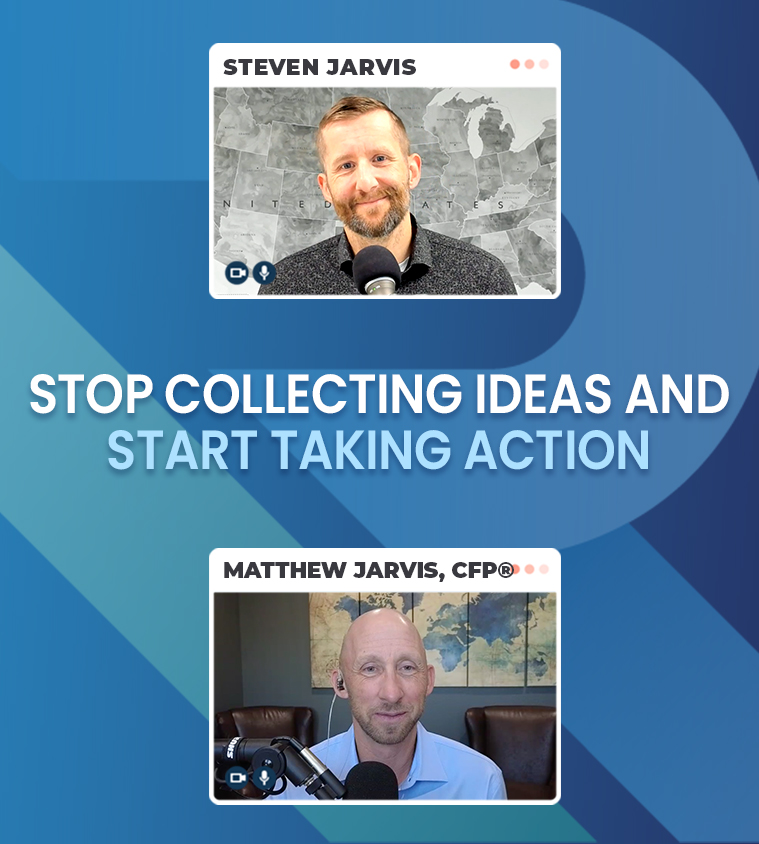
Stop collecting ideas and start taking action with Matthew Jarvis, CFP®




Steven Jarvis,CPA is joined by Matthew Jarvis to discuss one of the biggest takeaways from the 2026 Summit: turning ideas into action. They explain why attending a conference or learning something new is only valuable if advisors actually implement what they learn. Steven and Matthew walk through the importance of measuring how much time and money advisors are investing in professional development. They discuss how to identify the gap between where an advisor is today and where they want to be, and the value of learning from advisors who are already achieving the results you want instead of trying to reinvent everything yourself. Finally, they encourage advisors to decide what results they want and what price they are willing to pay to achieve them.
Steven and his guests share more tax-planning insights in today’s Retirement Tax Services Podcast. Feedback, unusual tax-planning stories, and suggestions for future guests can be sent to advisors@rts.tax.
Are you interested in content that provides you with action steps that you can take to deliver massive tax value to your clients? Then you are going to love our powerful training sessions online. Click on the link below to get started on your journey:
Retirementtaxservices.com/webinars
Thank you for listening.
Steven Jarvis, CPA (00:52.014)
Hello, everyone, and welcome to the next episode of the Retirement Tax Services Podcast Financial Professionals Edition. I’m your host, Steven Jarvis, CPA, and joining me once again on the show is my brother, none other than Matthew Jarvis. Matthew, welcome back to the show.
Matthew Jarvis (01:05.944)
Dude, thanks for having me back. I just noticed though, that we both have similar map background, different maps, but we both have map backgrounds. So I guess since our hairstyles don’t match, at least our backgrounds can be in harmony together. But Steven, it great fun seeing you and what, some three hundred advisors at the RTS tax summit recently. Excited to be kind of chatting through that action item specifically today. It’ll be a lot of fun.
Steven Jarvis, CPA (01:25.388)
Yeah, I wanted to make sure that you and I had a chance to do this close after the summit because we got so much feedback from everyone who was there, which of course we take as a huge compliment. Like we try to measure success of everything that we do and not just like kind of tell ourselves that things are helpful. And one of the most common themes, you already mentioned it, was people saying how the summit, compared to any other conference they’ve been to, is all about taking action. And that is that’s very intentional on our part. Anybody listening to the podcast will not be surprised by that. We always end with action items. But we we really intentionally went out of our way to level up this year how we help people take action.
Matthew Jarvis (02:01.432)
Yeah, we did. It was fun. Brad Wooten, CPA, who was one of our guest speakers, he mentioned that as well. He says, Well, I’ve been to lot of conferences. I think you guys ruined conferences for me. So, Brad, what do you mean? He said, This is the first conference where every session ended with action items. I said, Yeah, Brad, you’re right. Cause now once you get used to there being action items, like every other presentation feels like the movie got turned off before it ended. Like the hero’s about to save the girl and then the movie just ends. Which is, I guess, just a word for any of you that are doing speaking, whether that’s publicly at conferences. Client events, seminars, just even client meetings, it’s always gotta have action items and they’ve got to be specific. you know, Steven, this is kind of off topic. But let’s use Roth conversions as an example, which was a common topic discussed. we’ll talk about why some people thought that was basic. But as an advisor, we need to come to the client with a recommendation for the Roth conversion amount. Yeah. Now I can lead with ranges, right? I can talk about here’s what’s left in your tax brackets, here’s what’s in the next tax bracket, here’s your 10-year tax projection. But at the end of the day, I have to give a number. Now we’re still gonna run the number by the CPA. The client’s gotta approve it. The client can go up and down on it. But you might be like, well, Matt, there’s there’s not a big difference between ten thousand and fifteen thousand. We could flip a coin. Great, flip a coin before they get there so that you’re giving them specific advice.
Steven Jarvis, CPA (03:11.342)
No, I love that. Flip a coin before they get there because as humans, we all have only a certain capacity for how many decisions we can make in a day. And certainly how many big decisions we can make. And paying the tax man voluntarily is a big decision. And so as a professional in a client’s life, like you just helping them make decisions is a huge value add. Now, now you mentioned there’s over 300 advisors there. And so in a room of 300 people, it we didn’t come like at least Matt. When I got on stage, I didn’t have like here are the three actions I want everyone to take. Because everyone’s in the exact same situation and serves the exact same clients and has the exact same issues. Like we so we had to come at this from a how do we set everyone up for success? In we’re in two and a half days, we’re gonna give them more action items than anyone could possibly take, but we need a framework. And I think that was something that we realized was missing just a little bit from previous editions of the summit is like, how do we make this even clearer that when you leave? You’re going to be able to take action. And so, Matt, you and I and the and the rest of the team, if they’re listening, huge thank you to our whole team for the work that went into this workbook, this physical workbook we put together for the summit, because it was definitely a labor of love to get this almost 90-page document together and to be excited to print these documents and come to a room full of attendees and say, Hey, we got you this giant workbook. Here’s how we’re going to work on this.
Matthew Jarvis (04:29.292)
Yeah, that it was. Well, we’ve all left conferences with a list of ideas, right? Page sometimes pages and pages of ideas that never come to fruition, right? Because we get back, and just like our clients, we have a lot of other things to do. Like we have an office to run, we have a team, we have a family, we have we need to get to the gym, we need to get our car washed, the the laundry done, like all of these things come back in, like real life comes back in. And so if we don’t have it, this goes to your point, Stephen, to the workbook as a specific action plan. In fact, the the workbook even had month by month. So here we are. And where are we gonna do the next twelve months and what are we gonna do each month to move this thing forward versus sort of like a vague like a opposite of that would be like, Hey, I wanna do the 1099 letter. Awesome. That’s a great value on every advisor needs to do the ten ninety nine letter. But if it just sits there like, Hey, I’m gonna do it, January’s gonna come and go and you’re not gonna have got it done. Instead, we gotta map it back out. Like I I wanna deliver it on the fifteenth of January, which means by this date and this date and this date, everything’s gotta be done.
Steven Jarvis, CPA (05:22.476)
Why I was so glad that you would join me on the podcast so quickly after the summit, because for our podcast listeners, I want to walk through a brief version of kind of how this framework for taking action worked. Of course, it’s never gonna be the same as if you had been there in person and had the physical workbook and spent the time with us. And so if you need that in your life next year, you do need that in your life. Go to retirementtaxservices.com/summit. You can already get signed up for Summit 2027. It’s at the end of September back in Scottsdale.
But to make sure that you have action you can take between now and then, I’ve got my workbook in front of me, Matt. I think you’ve got your workbook as well. The first thing I want to highlight, because it can be really easy to feel like, let me just jump to the end. Let me just jump to the part where I’m taking action. But just like when we work with our clients, we we need to have a bit of a guided discovery. We need to have a framework for why this matters and how we identify what comes next. And so when we kicked off the summit, one of the first things we did, and this is a page right of the workbook. We said, let’s talk about what you’re already doing. And so we walked everybody through hours you’re committing to things like conferences and CE and professional development. And then Matt, I think the one that maybe was more insightful and probably made a few people a little uncomfortable was we had people walk through what they’re investing, dollars they’re investing in professional development. And then we did this comparison of what the average advisor spends on PD versus top advisors.
Matthew Jarvis (06:42.774)
Yeah, so PD is short for professional development. and this is a distinguisher between the advisors that struggle. Remember, the median financial advisor earns $105,000 a year, which means that half of financial advisors earn less than that, according to the Bureau of Labor Statistics. So to get over that, you’ve got to do dramatically more work, or at least more hard things. And professional development is one of those hard things. Like it’s hard to take money out of your budget, out of your income, and put it towards professional development. Now, our target range is usually five to 10% of your income. Right. So if you’re an advisor and let’s say your income was 200K this year, then you need to do between $10,000 and $20,000 of professional development. Now at $200,000 of income, once the IRS takes their piece, $20,000, that’s a big hit of your personal income. Yeah. But you just got to decide like what kind of advisor do I want to wanna be next year or in 10 years? Do I wanna be like three percent better to stick up with inflation? Or do I wanna be twice as good in three years as I am today?
Steven Jarvis, CPA (07:36.546)
Matt, that’s one of the reasons I love getting together in person. Cause there there’s an advisor who joined our panel of success. And at least I won’t share his exact numbers on the podcast. Like some of that’s just being in the room again to hear those details. But and this is an advisor I know and I’d heard a little bit about his story, but as he he was sharing where he was at a couple of years ago from an income standpoint. I wanna say he invested more like thirty plus percent of his income. And he’s like, you know what? Like, I’m gonna go all in on becoming successful. So I’m gonna get the resources, I’m gonna get the coaching, I’m gonna get the help need. But I was just kind of blown away that like, I mean, we talk about the top advisors spending five to ten percent, the elite, the the ones who are like really all in, they’re saying, No, no, no, like I’m making the investment right now.
Matthew Jarvis (08:16.652)
Yeah, especially if you’re sub a hundred thousand of income, not not top line but bottom line. And again, if you’re sub two hundred, yeah, ten percent’s probably not gonna be enough. we can do a whole podcast on that. Really, what I would recommend is say find, find an advisor that has your end goal, right? So I’ll do a shameless plug here for the Perfect RIA freedom coaching program. Yeah. That thing’s like twenty five or thirty thousand dollars a year. So if you’re an advisor doing a hundred or two hundred thousand dollars a year, that’s a huge investment. But how many years is it going to take you to learn on your own what Mcah and I learned over the last 20 years? Like, Micah and I have literally each invested over a million dollars in our careers in professional development. Like I can give you receipts, a million dollars plus. That’s a huge investment. So you could spend 20 years and a million dollars learning that yourself, or you could say, who has what I want? Not who talks about what I want. It’s really important. Sorry, I’m on a soapbox here. Not who talks about what I want, who actually has what I want and can I learn from them? Like, can I just learn their scripts and their systems and their processes?
Steven Jarvis, CPA (09:12.162)
Yeah, so for people listening, here’s why this is important. And after I say this, you might even pause the podcast and do this little exercise for yourself. It’s really easy for us to tell ourselves stories about why we can’t do more. I I’m already spending too much on PD. I already, I already have too much time committed to this. Great. What does that mean? So take the time for 2025 and 2026. Write this out. Like how much time are you actually spending on meaningful professional development versus plain office? How like receipts, Matt talked about having the receipts. Do you have the research? How much are you spending on professional development? Because if you’re like the average advisor, it’s probably less than 1%. And so we’ve got a level set on what the reality is today so that we know what that investment gap in time or money is. So that as we talk about the rest of these actions that we walked people through at the summit, like you know you have the capacity for, yes, I can do more.
Matthew Jarvis (10:01.518)
Quick side note on the time investments. We talked about the money, the time investment. When I was in my growth years for my practice, I would block out all day Monday for professional development. Cause I didn’t have a lot of money to spend on professional development. So it was time. But I also needed it to have a container. So professional development can also be an avoidance behavior. So that meant on Tuesday, Wednesday, Thursday, and Friday, when I saw something, I thought, I need to study this. It went into a folder. Or back then that was magazines. I would put the magazine in a pile. And then on Monday, I would get around and would look at… Otherwise, what would happen on Wednesday when I need to be prospecting? I think, you know what I need to do today? I need to read another Kitces article, which is a great thing to do on Mondays. On Mondays. On Mondays is when I study. That’s when I listen to podcasts, all of that. The other days I gotta re-prospect. Steven, I want to pivot just a tiny bit on page 71 of the workbook. So if you were at the summit, you still have your workbook. The advisor growth plan, I would recommend, and I know we’re talking about a summit, but I would recommend this for every event you’re attending or considering attending, and really just any investment of time or money into professional development. I get invited, you and I both get invited to conferences all the time. There’s a lot of fun conferences out there. There’s a lot of great educational conferences. But my goal when I go to an event, when I take time away from my practice and my family is to improve my practice. And so if I’ve been to an event and it didn’t improve my practice or my life, it’s not an event I’m ever gonna go to again. So right out of the gate, the first thing we ask people was, Hey, why did you come? Like what vision did you have when you signed up for this? Let’s be sure to honor that and really lock that in. Yeah.
Steven Jarvis, CPA (11:26.168)
And Matt, it was interesting to he kind of hearing people’s responses to that question because we did have a couple of people kind of throughout the summit who were more or less like, hey, where’s where’s like the deep technical tax things? And and I know you’re great at your response to this, but I think we all kind of take the same approach, like as far as you and Micah and I, that the hosts of the conference, of that stuff is interesting, but are you sending out a 1099 letter to every client? Are you getting a tax return from every client? Have you talked to every client about a Roth conversion? Like it’s so easy to get distracted by the shiny objects… That we skip over or ignore the fact that we aren’t doing the simple things consistently already.
Matthew Jarvis (11:59.704)
Yeah, for sure. That’s a good one to be self aware of. So, like if hey, if I’m signing up for this event because I want to just tickle my brain, okay, that’s fine. I guess you need to be understand, like, all right, I’m just going to have my brain tickled, not because I want to improve my client’s life, not because I want to be a better advisor or a better father, a better husband, wife, whatever your thing is. Like, why why am I here? If it’s because I hey, I just want to hang out with my friends, cool. Like, whatever answer I put there, I need to make sure is this the best way to get that? Right. So if you say I just want to tickle my fancy on knowing obscure tax product tax topics, okay, is this really the place to go for that? Or if I’m saying, hey, I’m coming here because I want to definitely improve my clients, that changes my whole approach. So like if the first was like, I just want to tickle my fancy, then every advisor I meet like, dude, what’s the coolest tax strategy you know but you’ve never used? That’d be a lot of fun. If I want to improve my client’s life, I’d ask every advisor I know, hey, what’s something you’ve done with almost every client this year that made a big difference? Totally different experiences. Yeah.
Steven Jarvis, CPA (12:50.646)
So let’s let’s talk about how that actually worked at the summit because normally we go to a conference, we hear an interesting idea, we write it down, we tell ourselves we’re gonna figure that out on our own when we get home and we never do it. So, one of the ideas that kept coming up at the summit was reviewing every single client tax return. And if this was a normal conference, again, people would have left and tried to figure that out on their own and probably never have gotten anywhere. But since we’re so intentional about this, like we really like push people to go deeper. This the things you’re talking about, like, hey, ask everybody else what they’re doing. But this is why the workbook was so important, because we said, okay, here on page 72 is where you’re going to summarize your biggest ideas. And then here’s how you’re gonna fill in the blanks. And so if your big idea was I need to review all the tax returns, okay, great. I need to understand how other people are getting tax returns. I need to know what language they’re using. If this is going through email, if people are dropping them by the office, if they’re uploading to a secure portal, then I need to. I need to have resource. I either need to create my own resources or get ones that work. maybe it’s the 37-point checklist. Maybe maybe I need to take a class on how to review tax returns, like depending on where my expertise is. But instead of having the idea of reviewing tax returns, now it’s this bullet pointed list that can go on your calendar on X date. I’m gonna ask all my clients for their tax returns. I’m gonna having talked to my fellow attendees, I’m gonna know that maybe I get half the first year and seventy five percent the second year, so that I’m not if I don’t get to a hundred percent, I’m not a total failure the first year. But this is this is how we go from an idea to a reality.
Matthew Jarvis (14:16.044)
Yeah, it’s also how we get structure around it. We got a lot of compliments about the presentations at the summit. And and again, we had a lot of great presenters. But I always remind people that a good conference, a good event, at least half of the value comes from the other people that are in the room. And Steven, one of the things I get the most benefit from, if I’m trying to implement something new. So let’s say review tax returns, I’m gonna find other advisors that are doing that and find out what system they’re following. What came up again and again on that topic of reviewing tax returns was the 37 point checklist that you created, right? Yeah. So you say, well, the 37 point checklist, if you haven’t seen it, I think Stephen, you tell us where to download it. If you have it, though, it’s something you can just have in your hand. It’s 37 questions. It’s really close to like 43, but it’s 37 questions to ask yourself while reviewing a tax return. Otherwise, why is this important? Because if you’re just gonna look at a tax return and try to just dig around in your mind and find things. That’s going to use up a lot of brain power. And there’s no way you’re going to get through a hundred of them. You’re going to get through like three of them. You’re going to be totally fried. You’re going to have still missed a lot of things. But if I’m going through a checklist, heck, I can even have my team, and we you had a newsletter on this. I remember reading because we had the team use it. Go through the 37-point checklist, depending on the skill set of your team, mark the items that they can check. We say, Well, what can my team check? Well, they could check to make sure the address is correct. They could make sure the filing status makes sense. They could make sure that we have the tax repair’s information that we’ve met with them. There’s a lot of things you can have your team do. Or a belay virtual assistant can do that doesn’t require deep technical knowledge.
Steven Jarvis, CPA (15:36.674)
Well, since you’ve been to the 37-point checklist, the summit this year I had another great reminder of why this in-person time can be so valuable for all of us. Yeah. There was an advisor there. He’s a fairly recent premiere member. And so he’s really leaning into tax planning. And you know, props to him for taking seriously his PD investment, signing up for something where he’s like, I’m gonna go get the resources that work. But as I was talking to him at the summit, he asked a question about how long it takes to go through the 37-point checklist with a client during a meeting. I was like, that’s interesting. Cause that’s those never our intention. But it was also like good for me of, there’s something else we need to make clear. Because his takeaway was, these are 37 questions I should ask a client. Which, like, when when he brought it up that way, like, totally see where you’re coming from. But now he gets to come to the summit, he gets to hear how other people are doing it, and he gets to adjust his process to keep leveling up to say, actually, the 37-point checklist is something we use behind the scenes, like you’re mentioning Matt, with we use it with the team, the advisors are gonna step in on the places they need to. And then we’re using the dishwasher rule to share the relevant points with the client. But we’re still gonna let the client know, hey, we went through all 37 things. Here’s three that we need discuss together. But what a great opportunity for this advisor to then learn what’s actually working in practice.
Matthew Jarvis (16:50.414)
Yeah, that’s really important. Speaking of learning from other advisors, Steven, here was my biggest takeaway, my personal biggest takeaway as an advisor from the conference. On one of the panels of success was a longtime advisor, Alexandra Lundgren, who’s in Boise, Idaho. You can look her up; she goes by Alex, incredible advisor, great practice, Boise, Idaho. Alex is up on stage during a panel of success, and she says, and I’m actually gonna go back and watch the recording because I want to get her script exactly. But the way I wrote it down, Steven, was she tells all of her clients, because she’s a premier member. Which means she has access to the monthly office hours with you. And she says, she tells all her clients, Hey, every month I can get on the phone with one of the top CPAs in the country. So if you ever have a tax question that I can’t answer, I’ve got a guy who can answer that. And I thought, wow, what a brilliant example of the dishwasher rule. Like, all of as Premier members have access to that, but she’s using it as a value-add as an advisor with that client. And so if she’s ever against another advisor, which is rare for her because she’s very talented. The client’s gonna be like, Well, hey, do you have access to one of the top CPAs in the country that you can ask my questions to? Well, no, I don’t. Right. So what a value differentiator. It’s a very quick line that can be dropped in. She mentions it in client meetings. It’s her fallback. Anytime a client has a tax question that she doesn’t know the answer to, or is just even at all unsure of it wants to buy some time. You know, that’s a great question. Later this month, I’ll be on a call with one of the top CPAs in our industry and I will ask him that question and I’ll get back to you at the answer by the end of the month. Is that okay with you? Like, That was one it’s a simple thing, but I wrote it down again. I’m gonna watch the recording again because those little things make all the difference.
Steven Jarvis, CPA (18:20.586)
Matt, I wrote that one down as well. I mean, since I host those office hours, I love hearing that people are getting the value out of it. But again, a great example of seeing how other advisors are doing this because I get a little bit carried away sometimes, maybe on the marketing side of here’s all the benefits of Premiere. but for her, like that one thing, and she does, she comes every single month. I talk to Alex on a regular basis, love having her there. But for her, that one thing makes her whole membership worth it because of how she’s articulating this to clients. It’s incredible to see.
Matthew Jarvis (18:47.074)
Yeah, it really is. Now, not to dime out Alex too much, but she had a workbook full of notes. She had specific action items, she had a month by month thing. It’s amazingly consistent that way. The other advisors that were on that panel of success, they said the same thing. Like I come to these, I make an action plan and I implement them. And I find somebody that has the success I want, and I just do what they did. And once I get close to their level of success or exceed it in some cases, then I can modify it to hit my own way. But my friends, if you’re spending time reinventing this. Dad, that’s silliness. That’s like saying, hey, instead of flying to the tax summit in Scottsdale, what I’m gonna do is build my own airplane from scratch with no plans. That would be absurd. The same is true in your practice. There’s no reason to figure this stuff out on your own.
Steven Jarvis, CPA (19:27.64)
Another example from that panel of success: Digger was up there, another great advisor who’s a member of both the Freedom and Premiere programs that we run. And the one that he talked about that stuck out to me, he was talking about getting or working on the center of influence strategy that you talk about in your book, delivering massive value. And and again, this this is where things have levels because you have an incredible chapter in your book about that. And I mean, realistically, you describe that well enough that an advisor wanted to on their own, they could do the rest. It’s just gonna be a ton of work because it was a ton of work for you, and you’re sharing, here’s what I did, you can go do it yourself. And so as Digger’s up on stage saying that one of his takeaways from the conference is that he wants to double down on his COI strategy, he just outlined right there. He’s like, I’m gonna take the calendar that Steven created and I’m gonna use RTS newsletters and reference guides and handouts as the things that I send them. And I’m sure surprising no one, that calendar I created was based on conversations with you and what you’ve done in the past. So this wasn’t my theory on what might work. It was that collaboration of here’s what I know the timing on the CPA side looks like and here’s what you learned from 20 years of working with CPAs. And so for Digger, rather than here’s the idea and like kidding himself that he’ll DIY it, he’s like, nope, I’m just gonna use all the resources available to me and make this as easy as possible.
Matthew Jarvis (20:40.118)
Yeah, and Digger, by the way, is absolutely crushing it. And again, this is a theme we see again and again where the top advisors say, in fact, our good friend Michael Henley, he always says, I would rather copy genius than reinvent mediocrity. And Michael Henley is a phenomenal advisor. Brandy Wine Oak Wealth Management in the East Coast. Like, you look at advisors like that: Brian Skinner, who’s a longtime member who’s crushing it, Finn Prince, like all these people. They are saying, Hey, I want to know what works, and I’m just gonna do it again and again and again. And then I’ll adjust it for my own style. And what’s what’s great about that is it’s totally fine. Like this isn’t stand-up comedy where you’re like, hey, that was a really funny joke. I’m gonna start using that joke and you get borrowed from the industry because you’re stealing content. That’s not what this is. You’re saying this is a strategy that works. It’s like a surgeon saying, Hey, we figured out this way to do heart surgery more effectively. Use this strategy.
Steven Jarvis, CPA (21:29.272)
Well, and for anyone who’s a longtime listener of this podcast and hasn’t yet started listening to the TPR podcast, if you haven’t heard Matt talk about this before, Matt, this is also how you got to where you’re at, is you went and found people who had the level of success you wanted. I mean, Tom Gau, may he rest in peace. I know that that was a pivotal moment for you of going and finding this advisor who was doing things you wanted to do and just saying, I’m gonna do whatever Tom does.
Matthew Jarvis (21:51.65)
This goes back to the importance of going to the right events. It was definitely at least one half what Tom did. And then it was one half the community that he and Ken Unger had built with Million Dollar Producer, right? Yeah. And so I could hear what Tom was doing in his practice. And then I could talk to 300 other advisors who were doing similar things. And I would always watch for who’s a levels ahead of me that I can emulate what they’re doing, but also who’s stuck at my level or levels below me and what stories are they telling themselves. Right. So you you see this in a conference, not so much ours. We have a pretty good crew that shows up. There’s always a group that’s just making excuses. Well, I’m at capacity and the compliance and the tax law and all these things. And there’s another group that like everything that everyone else views as bad news, they’re like, this is great news. Yeah. The tax laws are complex. Great. Nobody else understands them. Clients don’t want to give me their tax return. Great. That means they’re giving no one their tax return. So when I get it, I’m gonna deliver value that no one else can do. Learning taxes is hard. Great. Well, that’s why Vanguard and Fisher and most other places don’t do taxes. It is hard. But it when I learn it, it puts me in a league of my own.
Steven Jarvis, CPA (22:49.738)
And while I’m sure to some people we can sound a little bit dismissive of at times of these objections, like we this is hard and it does take work. We we do listen to the objections, but we just don’t use them as excuses. We either show you how other people have already done this. Actually, it’s it’s always an and we show you how other people have done this, and we go back to the drawing board of working on what what resource can we create next that will help people overcome that capacity issue, which… For the first time at the summit this year, Surge TK was there. It’s relatively new to the industry as well. I mean, you have to give the exact dates, but like the this idea of like, hey, software is the magic answer, like, I think distracts people sometimes. Like, right, there’s there’s always a new shiny thing that’s supposed to just replace advisors or whatever the nonsense is. When you and Micah started telling me about what you were doing with Surge TK, I was like, this is this is software, but it’s totally different because this is all it this just builds on the principles we’ve been talking about: how do we take these great ideas and then leverage resources to make them a reality. So maybe let’s specifically talk about the 1099 letter because if I could wave a magic wand, I would make every single advisor do a 1099 letter every single year. But we do get this pushback of like, well, but Steven, it takes a lot of work.
Matthew Jarvis (23:59.35)
Yeah, that’s a great one. So you guys can go back and watch the recording if you attended and you can go to search TK dot com to learn more. But the ten-ninety-nine letters, something I created many years ago. Holisti Plan does a great knockoff version of it as well. But I created it several years ago because clients were calling in January, February, March, asking for ten ninety nines and often asking for ten ninety-nines that don’t exist. What what does what does that mean? Well, it means like the year before we had done a Roth conversion, and so they got a ten ninety-nine, but last year we didn’t do anything, so they wouldn’t get a ten ninety-nine. But the information sheet they got from their tax preparer said you had one two years ago, you’ll definitely have one this year, or vice versa. We started an IRA distribution last year. It was on a prior year, so it got missed. Or we did a Roth conversion that got missed, or we closed an account that got missed, or we did QCDs that don’t get reported at all. So we thought, how can we be proactive on this one to make the client’s life easier? And Steven, I know there’s actually an entire newsletter on the 1099 letter in the RTS portal, and you have templates on that as well. But we said, great, let’s proactively by January 15th each year, send a client a list of all of the tax documents they will receive or not receive for each of their accounts through our office, opened or closed, along with any relevant notes for their tax repair. Clients absolutely love this. tax repairs love it. We always send two copies, one for them, one for their tax repair. Steven, you mentioned earlier the COI strategy that Digger’s using. One part of that, which actually works right now as you’re listening to this, is to bring all your tax repairs to 1099 letter and say, hey… What could we do to improve this to make your job easier? By the way, don’t do that in February, March, April. That’s gonna be a bad plan. It’s too late then. I mean, you can just see how like this one tool, this one pager can parlay into so many things.
Steven Jarvis, CPA (25:34.508)
Yeah, absolutely. And so then taking this a step further, I mean, you guys created Surge TK to take some of the legwork out of it. It doesn’t mean it’s no work, it’s just kind of accelerating what you’re able to do by putting this into a a a software package so that you can so that advisors can leverage what you and Micah have been learning for years.
Matthew Jarvis (25:53.358)
Yeah, so we’ve been Mike and I have been doing value ads every single calendar quarter for like the last 15 years, maybe. And it was predominantly done in Excel, which is we know Excel is temperamental, it doesn’t scale, you know, babysit it. I literally knew an advisor. I went to jail for an Excel error. that’s another not their 1099 letter, a different thing. He was doing his billing in Excel. Yeah. And everybody asked, even from kitces.com/7, my first episode, 2017. People said, Hey, can we get these value ads? No, I can’t give you these Excel documents. It’s too temperamental. You’ll break it and you’ll screw yourself, so we finally built it into software. It’s a software we use in our office and it’s available for all advisors to use. Again you go to surgetk.com. In our in our last couple of minutes, can I share my my biggest complaint from the summit?
Steven Jarvis, CPA (26:29.972)
Thank you so much for sharing that.
Steven Jarvis, CPA (26:34.358)
Yes, please. As long as it’s not about me. Well, even if it’s about me, yes, you can share it. I always want to
Matthew Jarvis (26:39.146)
It’s mildly about you. So here’s my biggest complaint about really good presentations, which is that it gives the impression to everyone in the room that you’re a natural speaker. Right. So we’ve all been to presentations that are lame and we’re like, well, whatever, that that guy or that gal just sucks. But when you go to a really good presentation and we do a pretty good job at the summit of bringing in good presenters, right? It creates this illusion that there’s this group of good speakers in the world. Like there’s this group of natural athletes or that that this concert pianist, they were they were born with that ability to play. And and you dismiss in your mind that this was hundreds and thousands of hours of of practice. our MC every year is is Corey. How does Corey say his last name? McKillis. Corey McKaelis. You can look him up. Great comic. So our our MC is a comic. How did this guy become a comic or become a MC? Well, you and I both took stand up comedy classes from him, not because we’re looking for a side hustle in stand-up comedy, but because stand-up comedy is the hardest form of public speaking and we wanted to be better at public speakers. So I guess my,,,
Matthew Jarvis (27:38.06)
Summarizing all of that, my complaint is never think that somebody else had the easy road. Because even if they did, like so what? So what to hurt Alex Hormozi’s point, if you want to emulate any success that someone else has, public speaking, ability to do taxes, advisory practice, anything, you’ve got to look at the road they went down and go down that road.
Steven Jarvis, CPA (27:57.08)
Well and Matt, I’ll tag on to that because that reminds me of one of my favorite moments of Summit as well. And the end of that is maybe not the end of it, like a tag on to that is there is no end to the hard work. The hard work will change, like you don’t like with public speaking is a great example. You will get better at it and it will get more comfortable, but you will still have moments. And you mentioned this from stage. Like you got up on stage. And kind of talk about this a little bit. And you said something to the effect of, but I still have times where I’m backstage looking at where the exits are, trying to convince myself, like I could run out that door and no one could stop me. And and everyone kind of laughed. And someone pointed that out to me afterwards and was like, ha ha ha, that’s a funny joke that Matt made. I was like, that’s not a joke at all. I know exactly what that feeling is. Like I have had that feeling during this conference. I’m backstage. They’re my they’re saying my name. And there’s part of me that’s like, I could go out that door. I run faster than all of these people.
Matthew Jarvis (28:47.458)
Yeah. Yeah. You’re kinda like doing the math. Like which would be less bad? Like me not showing up or me going on stage and bombing. Like which would be my friends, that that’s just the case. Like the head trash, it doesn’t go away, it migrates. You learn you learn how to tame it. It’s sort of like the suck of physical training. Like it still hurts every time you work out, right? You just say like this is just the price I gotta pay. And so back to action items, back to the summit, like decide like what result do I wanna have and more importantly, what price am I willing to pay? And sometimes you just need a big enough why, like, hey, I just… For me, I don’t want any of my clients overpaying the IRS. I feel like we all pay plenty in taxes, probably too much. I don’t want my clients overpaying the IRS. And I know that if I don’t help them with this, no one’s gonna help them with this. So that burden is mine, right? And so I need to be the best advisor I possibly can, which means I’m gonna invest in professional development. I’m gonna surround myself with advisors that are doing the same thing. And no matter how hard it is or whatever head trash I have, I’m still gonna do it.
Steven Jarvis, CPA (29:40.344)
Specific action items coming out of this podcast. One, go to retirementtaxservices.com/summit, get signed up for summit 2027. The Kitces team has already let us know that it’s once again going to be their top tax conference for 2027. That’s based on the feedback they get, not from us from the attendees. So get signed up for the summit. Come do this in person with us next year. Action item number two is whether you use the framework that Matt and I just discussed, or I pick something else. Like again, we let’s copy genius, not create mediocrity. Take time. Put it on your calendar the next week or two weeks at most. Take time to sit down and go through those notes you have from the podcast from recent conferences. What are those ideas that have only ever been ideas? Take time to turn them into an action plan. That’s that’s the biggest compliment you can ever give us about the podcast or our speaking or our summit is let us know the action you’ve taken and then show up at the next one.
Matthew Jarvis (30:29.998)
I love it. Steven, thanks again for all the work that you and the team put into these summits until some until you’ve run one. By the way, call our good friend Adam Schmila. Like, he put on a conference for the FPA. He can tell you how much work it is to put on a conference. Like they’re impossibly difficult and they only just barely come together. So when you go to a conference, you go to future proof, you come to the summit, you go to the FBA events, like these are Herculean events that cost a ton of money and are very difficult to put together. So thank you for making this happen.
Steven Jarvis, CPA (30:56.43)
Absolutely. Matt, thanks for being here, and to everyone listening. Until next time, good luck out there. And remember to tip your server, not the IRS.