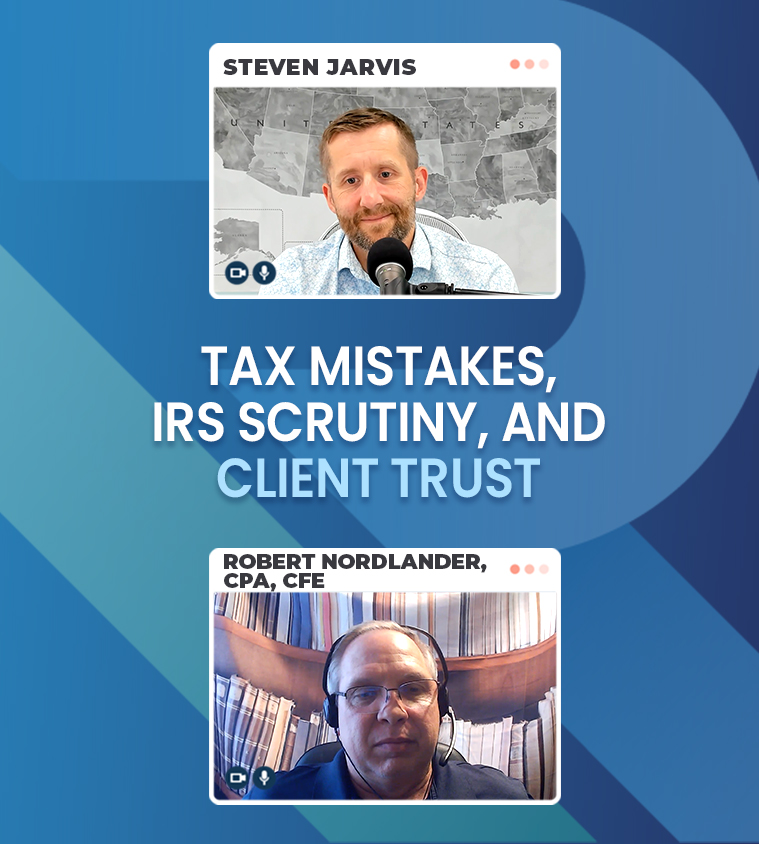
Tax mistakes, IRS scrutiny, and client trust with Robert Nordlander, CPA, CFE




Steven Jarvis,CPA is joined by Robert Nordlander, CPA, CFE, a former IRS Criminal Investigation special agent, to discuss tax mistakes, IRS scrutiny, and the importance of honest client conversations. Robert explains how accidental errors differ from intentional tax evasion and shares his approach to evaluating mistakes and potential amendments. They discuss why tax decisions should focus on accuracy and supportable positions rather than assumptions about audit risk. Steven and Robert also explore how taking responsibility for mistakes, explaining consequences, and acknowledging the limits of your expertise can build client trust. Finally, they discuss IRS notices, the IRS Data Book, and when a client with a significant tax debt needs a specialist.
Steven and his guests share more tax-planning insights in today’s Retirement Tax Services Podcast. Feedback, unusual tax-planning stories, and suggestions for future guests can be sent to advisors@rts.tax.
Are you interested in content that provides you with action steps that you can take to deliver massive tax value to your clients? Then you are going to love our powerful training sessions online. Click on the link below to get started on your journey:
Retirementtaxservices.com/webinars
Thank you for listening.
Steven Jarvis, CPA (00:52.541)
Hello everyone and welcome to the next episode of the Retirement Tax Services Podcast, Financial Professionals Edition. I’m your host, Steven Jarvis, CPA and continuing our theme here of welcoming guests who have recently joined us at the RTS Summit. Joining me this week is Robert Nordlander, a fellow CPA, former IRS auditor, employee,
Robert Nordlander, CPA (01:10.916)
special agent. That is even more prestigious than the auditor, by the way.
Steven Jarvis, CPA (01:15.208)
Special agent. I love it. I want to give you the credit you deserve. But Robert, thanks for taking time to join the show today. We’re going to talk a little bit about your summit session. But honestly, I had a question that came up just today that I’m hoping you’re going to give me some insight on. But just real quick before I just start bombarding you with the questions, give our listeners who haven’t heard you on the show before, just a little bit of background about who you are and what this special agent thing is.
Robert Nordlander, CPA (01:36.916)
I grew up wanting to be a police officer. I watched too much “CHiPs” and too much “Miami Vice” growing up. That tells you my age. And my father said, “You can go anywhere around the world with an accounting degree. Go become a CPA.” And I knew the FBI hired a lot of accountants. So I went and got an accounting degree. And my dad was a CPA by trade anyways, self-employed. So I got that and then got out of college and got my CPA license and then ultimately joined IRS Criminal Investigation about a decade later. And IRS has a law enforcement arm that’s on par with Secret Service, DEA, FBI, Homeland Security. When you think of those guys, you think of people who are carrying guns and handcuffs and blue lights and all that great stuff. And that’s what I did for 20 years for the IRS. A law enforcement arm of really accounting nerds with badges is what they are. A handful of them do have CPA licenses.
Robert Nordlander, CPA (02:28.625)
A handful of them do have certified fraud examiner credentials. But it’s what we do is we just do white collar crime the whole time. Just nothing but following the money. This is like “Mathletes with Guns.” There’s a movie called “The Accountant” I think out there with… I think it’s something that’s on par with that. And so…
Steven Jarvis, CPA (02:44.125)
Perfect. Okay. So you’re basically Ben Affleck. Okay. Got it.
Robert Nordlander, CPA (02:47.833)
No, no, no, no, no, no, no, no, no. I get all that. It was a great career. Great career. I thoroughly enjoyed it. But at the time I turned 50, you can retire with full benefits. It didn’t pay to stay. It really didn’t. I decided, “What do I want to do when I grow up?” So I decided to run a CPA firm that really focuses on forensic accounting, which is accounting in court, and damages and where the money came from and where the money went. It goes from bankruptcy to divorce to recreating books and records, criminal actions, embezzlements, blah, blah, blah, blah, blah. But that’s what I do now is I just focus on that. And because I worked for the IRS, I also solve large tax problems. So clients come to me when they owe a lot of money or “The IRS is stepping on their neck. How do you fix all that?” I don’t prepare returns, Steven. And I do that on purpose. I just want to do the big stuff.
Robert Nordlander, CPA (03:41.916)
And I kind of enjoy it.
Steven Jarvis, CPA (03:43.333)
Well, Robert, let’s start with a big question then. At least for some people, it’s going to feel like a big question because whether they’ll admit it or not, they definitely meet a lot of people who have this undefined fear somewhere in their brain that if they get something even minor wrong on their tax return, that some IRS special agent is going to bang down their door and steal their cat and take all their money. So just for people listening out there, just go ahead and tell me how many times did you have to bang down somebody’s door because their Roth conversion wasn’t done correctly?
Robert Nordlander, CPA (04:12.291)
Zero.
Steven Jarvis, CPA (04:12.916)
Oh, zero. Okay. Okay.
Robert Nordlander, CPA (04:14.458)
Zero. And the reason why is this is because there’s a lot more tax evaders out there than there are agents. That’s number one. Okay. Number two is most of these things are a civil issue, not a criminal issue. Civil issue, and we talked about this at your summit, actually, a civil issue is when things are just mistakes. It happens. Everybody makes mistakes. Every CPA that I interviewed has made a mistake on the tax return, believe it or not, but they didn’t go to prison for it. Their client went to prison for not telling the CPA everything. But there’s always a mistake that the CPA made somehow, some way. I’ve always seen it. It’s okay. It’s typical. It’s fine. What really goes from the civil issue to the criminal issue is whether or not you really wanted to do this. You are trying to get something over the IRS. Not a mistake, not a transposition error, but you’re hiding money in your girlfriend’s name.
Robert Nordlander, CPA (05:03.583)
You make the same mistake 10 times in a row. And the mistake is not a few bucks, but it’s maybe a $100,000 mistake. I mean, how many mistakes can you make before it starts obviously looking like you did it on purpose? And Steven, you got kids, right?
Steven Jarvis, CPA (05:18.166)
I do, yeah.
Robert Nordlander, CPA (05:18.791)
Yeah. You got kids. You understand when kids do things intentionally and when they’re just being goofballs, right? Well, same concept. You know when something was intentional versus something just being a minor mistake. And agents and federal prosecutors, we know the difference and we can tell the difference. And that’s kind of the reason why some people go to prison and some people don’t. But those types of mistakes, never.
Steven Jarvis, CPA (05:40.500)
Yeah. I appreciate you making that distinction because the clients I work with and the type of tax plan I make that joke to clients of, hey, none of us look good in orange. And so we’re going to stay away from the stuff that could get us in trouble. Not to say that mistakes never happen. And honestly, Robert, there are times where there are areas that aren’t completely clear.
Robert Nordlander, CPA (05:58.833)
Shocking.
Steven Jarvis, CPA (05:59.750)
Yeah. Yeah. Go figure with 80,000 pages of tax code. To your point, I haven’t been on your side of that or that side of the desk that you used to be on. But my impression from everyone I’ve ever talked to in those shoes is like, hey, clearly there are reasonable people on the other side of this that if you make a mistake, maybe you’ll have to pay taxes. Maybe there’ll even be interest and penalties if it’s a big enough amount or it’s been outstanding long enough. But this doesn’t become a criminal issue just because you made a mistake.
Robert Nordlander, CPA (06:24.666)
No. And in addition, let me add a little extra complexity to that. The other thing too as well is whenever there is a criminal tax investigation on the individual, we don’t go into technical issues. You’re not going to say, ladies and gentlemen of the jury, please put this guy in prison because he depreciated something over five years versus seven. I mean, we’re not going to do that, right? And in addition, it’s not also going to be… Yeah. You have to know your audience. Your audience typically are individuals who may have a high school diploma, may have a college education, that are plumbers, doctors, nurses. They’re sitting in a jury box. They don’t reconcile their own checking accounts, and for sure they don’t do their own returns, right? So how are you going to explain technical issues to this audience if it really is an issue? So you have to simplify it as an agent, a federal prosecutor.
Robert Nordlander, CPA (07:13.583)
And it’s very simple. Ladies and gentlemen of the jury, this guy over here claimed to make $10,000 a year on his tax return. He lives in a million dollar house and spends a half a million dollars on three girlfriends, his kids, private school tuitions, and he takes his family to Disney World four times a year. Could you do this? Is it intentional? You make the determination, but he did it for five straight years.
Steven Jarvis, CPA (07:35.916)
Yeah, interesting.
Robert Nordlander, CPA (07:36.125)
That jury will understand that, and that’s what we’re going after.
Steven Jarvis, CPA (07:41.166)
Robert, I could spend the next few hours just hearing these stories. I love hearing them. They’re fascinating. I’d love to pivot just a little bit because, I guess probably fortunately, the people who listen to this podcast, the clients that I work with, they’re not toeing the line of are they doing criminal activity or not. But we’ll still come across, because you also talked about helping people just resolve large tax bills at the IRS. We definitely come across issues where, unintentionally, somebody’s created a situation where a mistake has happened, there’s errors that need to be corrected, or there’s just a little bit of uncertainty about what should have happened. I’ll give an example that came up this morning as I was doing office hours with our premier members. A question came up from an advisor of, essentially, you have the 2025 tax return where a credit was misapplied. I hesitate just a little bit because there’s a little bit of a gray area.
Steven Jarvis, CPA (08:28.041)
There’s this credit that you could make an argument it should or should not have been applied. They didn’t take credit for it. They didn’t apply it on the tax return. But the two years previous to that, they did claim the credit. Now you have a situation where we have inconsistency over the three years, and the advisor is trying to decide if I recommend they go amend the most recent return to potentially draw more scrutiny to it, even though they get an additional refund, that might then open up questions about other years, which, for me, you don’t have all the context of that situation. So I’m not asking you to give an authoritative opinion on that situation specifically. But how do you help taxpayers navigate the reality of an amendment takes time, it’s unclear, it’s uncertain, it could be 18 months before it gets processed. How do we decide what we go and try to fix with the IRS versus what we let go of and move on from?
Robert Nordlander, CPA (09:15.708)
Good question. The first question I would ask is, “In whose favor is it? Is it for the taxpayer or for the IRS?” That would be number one. Number two is, “How material is this?” We’re talking about a few dollars, we’re talking about a few million dollars. I mean, so there’s that. Number three is, “The ethics regarding return preparers is to prepare an accurate return. And if you find out there’s a mistake, you’re required to tell the client there’s a mistake here, and here are the consequences.” Sometimes there’s no consequences because they’re owed more money, right? Sometimes, and so really, I always say this, Steven, I told this to your audience at the Summit, “Don’t worry about, well, this may draw extra scrutiny or not. That’s not your decision. You don’t make tax decisions based upon if it’s going to be audited or not. And if it’s a gray area, there are ways to figure that out too, to acknowledge as a gray area.
Robert Nordlander, CPA (10:08.583)
Not a problem. But the job of the taxpayer is to file an accurate return. And the job of a return preparer is to file an accurate return. And if there is a mistake, they have a duty, an ethical duty as well as by law, to tell the client what the problem is and how to rectify it, what the consequences are if we don’t. That’s really all it is. Now, the client gets to dictate whether or not they want to amend it, okay? But you’ve done your due diligence and told them what to do. Now, what you can’t do is if there’s an error is somehow participate in propagating the error, you know, the next four years when you’re a purtant . You can’t turn a blind eye to that, of course, right? But it’s not a problem. Now, when it comes to amending in that situation like that, I was asking, “Well, IRS’s favor or the taxpayer’s favor?” I said, “Well, it’s a taxpayer’s favor, and but we don’t want extra scrutiny.”
Robert Nordlander, CPA (11:00.125)
That’s not really the issue, okay? Just do the job. If the IRS picks up on it, okay, it is what it is. Just do your job. Don’t worry about what the IRS does. You’re trying to read the tea leaves to determine whether or not this is going to cause my client more headaches or not. The client is the one that voted for Congress. I mean, come on. They are the ones that voted for these rules. They are the ones that decided this is the IRS A-O-K as an agency. They are the ones that do all this stuff. So just file an accurate tax return.
Steven Jarvis, CPA (11:31.416)
That’s what I would tell them. Such great insight in there, Robert. I really appreciate your perspective on that. And I want to make sure, a highlight for people listening, that piece in there of make sure you’re informing the client, like that is a really critical piece that I will hear professionals try to dance around sometimes. And that’s when I’m always really clear with advisors I talk to, with my team, with my clients, of like, “Hey, regardless of what the final decision is, we have to be making informed decisions here.” Where it becomes particularly interesting for me is when I’ve got a new client who’s got issues in prior years that I didn’t prepare. Because if I make a mistake and somebody brings a mistake to my attention, that’s a professional responsibility I’m going to take seriously. I’m going to make sure that I’m correcting. And thankfully, that’s the exception, not the norm.
Steven Jarvis, CPA (12:12.458)
But I definitely had to have those conversations with clients before of like, “Hey, it looks like this was done wrong in the past.” And to your point, Robert, if a client’s going to work with me going forward, we are definitely going to do it correctly going forward. And sometimes doing it correctly going forward means we do need to correct some of what happened before just to make sure it is correct going forward. But those can be interesting conversations to have of, “Hey, Mr. and Mrs. Client, here’s what went on and what it’s going to take to fix it.”
Robert Nordlander, CPA (12:36.083)
I was telling someone who I’m mentoring right now, we are professionals. Yeah. Our job is to do it right. And if it costs a little extra money for the client, we let the client know, but we’re doing it right. That’s what we’re here for. So we don’t believe in surprises. My clients should never, ever be surprised. I want to let them know what’s happening, what the potential lay of the land is, and what the odds are probably. But that’s what they pay me to do. And if you have clients that want to be on the cheap side, you probably don’t want them as a client, honestly. In this line of work, it’s one thing to have a hamburger and you don’t like the hamburger where you don’t put too much ketchup on. I can get you a new hamburger. No big deal. These types of things can be fixed, right? And it’s not that big of a deal. But when it comes to thousands of dollars and doing the things right, and your clients and my clients, they hire us for a reason.
Robert Nordlander, CPA (13:26.250)
And typically it’s not because you’re the cheapest guy on the block. It’s because you’re the most competent guy on the block, right? And they trust you and they like you. Well, keep the trust like no type of thing going on. And I’d rather have hard conversations with my client now than six months down the road because I hid the ball. Because I had that uncomfortable conversation. And if you have to have these conversations with your clients, this is a little, you didn’t ask this question. There’s nothing wrong with sitting down with a client going, this is a hard conversation for me to have. We’re going to lay out the land. This is hard for me to have. Here’s my dilemma. We’re friends, we’re going to be business, whatever we’re doing at the end of the day, whatever the consequences already are. But this is hard, but we need to go forward and have these conversations. And I think most people appreciate, almost everybody that I’ve talked to appreciates it.
Robert Nordlander, CPA (14:13.958)
Even if I had to lay down on my own sword. I’ve had to do it once or twice, Steven. I messed up. I had to tell the client, I screwed up. I need to fix it. I’m going to fix it, but I’m at least going to admit that I screwed it up and we’ll get it done. And the client was disappointed. But you know what? I think I got more business from later on because at least I was honest about it. No one will surprise us.
Steven Jarvis, CPA (14:37.833)
No, and I think we all just kind of human nature, we don’t actually expect perfection from people. We expect responsibility. And so it’s not that I’m going to fire somebody the first time they make a mistake, depending on how they handle it. So I really like how you’re describing that same approach I take. If something comes up, especially if it’s my responsibility, but regardless of the issue comes up with the taxpayer’s tax return, we’re going to have that hard conversation. And I like something else you said in there, Robert, I want to make sure I reinforce this because it’s something I talked to clients about, talked to other advisors about. Like we should not be making tax decisions based on our perception of the audit risk. Absolutely. I like to call it the straight face test. Like regardless if I think an auditor is ever going to show up and ask me about it, I want to only prepare, I’m only willing to prepare returns and sign off on returns, put my name on returns where everything in that return, I can with a straight face explain to an IRS auditor and show them support for why I made the decision that I made.
Steven Jarvis, CPA (15:32.708)
Not to say that I’m 100% confident that every decision I’ve ever made, they would agree to, because every now and then we got to make some interpretations. But I’m not going to prepare a return that makes me have the possibility of ending up in a situation where I’m squirming in my seat.
Robert Nordlander, CPA (15:45.583)
I think a lot of return preparers, people who give tax advice, frankly, are not very comfortable with making some of these decisions because they’re not comfortable with what the rules are. What the Congress has delegated to the IRS, well, here’s the rules, here’s how you want to enforce it. And it’s something called Circular 230. And why it’s 230, I have no idea, but it’s called Circular 230. It lays out the rules. I mean, and it lays out the objectivity and competency and what you can disclose and can’t disclose. Is it a pain in the rear end to read? Yes. But I always advise return preparers that they should be taking at least two hours of ethics on this thing, at least keep up to date objectivity and what’s questionable and how do you handle it and these types of things. It’s not really that complicated. I think people in those shoes, what you’re talking about, just are not comfortable with the ethics of how they’re supposed to handle things.
Robert Nordlander, CPA (16:39.875)
That’s just my opinion on the matter, that they need to be more comfortable going, “I know what my lane looks like. I know what gets me in trouble and we’re going to stay out of trouble.” But the lane that we’re in, frankly, is pretty broad. As long as you just do the best you can, do due diligence, everything’s going to be fine.
Steven Jarvis, CPA (16:56.833)
Yeah, Robert, if we go back to this idea of being willing to have hard conversations, when you admit to someone upfront, “Hey, this is an area I’m not an expert in,” they’re going to be okay with that. To your comment about not having surprises, for whatever reason, CPAs get a ton of credit from the general consumer. If you don’t make it clear to a client what you are and aren’t an expert in, they probably are going to assume that as a CPA, you know all that can be known.
Robert Nordlander, CPA (17:23.958)
Don’t tell the secret that just because you’re a CPA, you’re not an expert in all things. I make a lot of money because people assume when they see me on the witness stand that the CPA license means something.
Steven Jarvis, CPA (17:34.541)
I won’t say it in a court of law, but on the podcast and to my clients, I make sure it’s very clear to them, here are the things I am very, very good at, and here are the things that are not my area of expertise, and I’d be happy to help you find someone who is an expert in those areas. Because that’s such a better outcome for everyone involved, including me. There’s a little bit of selfishness in there. I want the best outcome for the client, but I also don’t want to put myself or my team in a situation where we’re dabbling in something we don’t really understand.
Robert Nordlander, CPA (18:02.083)
That’s true. I also want this client to trust me that I know where the boundary is at, and I want them to give me business within my lane.
Steven Jarvis, CPA (18:10.625)
When I’m on the buying side of any sales discussion, the fastest way somebody can do it with me is when I ask a question about, “Hey, when is this not a good fit?” or “How does this go wrong?” For everybody all the time, it never goes wrong. Okay, cool. There’s no way I’m ever doing business with you, because that’s just not how life works.
Robert Nordlander, CPA (18:27.000)
You’ve always had that sales hat on. I want an honest salesman. I don’t want a hungry salesman. Listen, I’m right now looking for an RV. We talked about this off camera. You got RV salesman out there. Oh, this is the best thing. It’s like, really? Okay. I mean, come on. It’s one of those things where I’d rather have someone say, “This is not a good fit for you. Let me find something better.” I’m telling you, I had a plumber who did that to me one time about four years ago, Steven, and he said, “Listen, I can upsell you on this but I think you’d do better with a cheaper version right here.” I’m like, “You will have my business forever. Just because you’re honest with me,” I called him two or three times after that, and I recommend him. Yeah, I want somebody who’s just honest with me.
Steven Jarvis, CPA (19:06.666)
Even though he could have sold you something else or done more, I mean, that’s such an important takeaway for anybody who’s in a service role. Even if you don’t think of yourself as a salesperson, if you are trying to get people to follow through on your advice, that is sales. And there are good ways to do it, and there are ways that create trust, and they create follow through, and then there are some pretty bad ways to do it.
Robert Nordlander, CPA (19:26.375)
Well, yeah, I want to find out what my client’s pain points are and solve those pain points. I don’t need to add on and do this. If they’re having trouble sleeping at night regarding this, we’ll fix it. But I’m not into, “Do you want that undersealant underneath your car? Do you want this other stuff that’s, frankly, the extended warranty?” And I’m not doing all that stuff to people.
Steven Jarvis, CPA (19:48.541)
Robert, we’ve mentioned a couple of times that you spoke at the summit recently. So much great feedback from the people who attended. Any other highlights from your session that you want to make sure that you’re sharing as broadly as possible?
Robert Nordlander, CPA (19:59.166)
The biggest takeaways for your audience were, number one is, if it’s too good to be true, it probably is. Number two is, if you’re going to go down that road where it’s too good to be true and you still want to believe it, be prepared to suffer the consequences. I mean, just the way it works. Number three, don’t try to read the tea leaves on the IRS. We talked about that. Just do an accurate return. Do the best you can. And if the IRS doesn’t like it, we can always come back. We can deal with all that type of stuff. But don’t try to worry about, “Well, this will cause an audit.” No one really knows what causes an audit. People think they do. I always ask for the source documents and they can’t give you one. It’s because they don’t know. They just like to pair it to something. So just do an accurate tax return is all you got to do. And last but not least, find competent professionals. The next door neighbor who does it on the kitchen table may be smart, but I think I’d rather have someone who’s helped out somebody else a good referral.
Steven Jarvis, CPA (20:51.833)
I’m with you. Even if it feels like this year, it’s a relatively simple situation. Over your lifetime, there are going to be times your taxes get really complicated.
Robert Nordlander, CPA (20:58.208)
Absolutely.
Steven Jarvis, CPA (20:58.875)
And having competent support is going to make all the difference. Robert, you mentioned these statistics that people quote without any receipts to back them up. So I’m going to ask if you have some receipts to back up some impressions that I’ve gotten over the last couple of years. Not the audit rate specifically, but for myself and talking to a lot of my peers, it does seem like the rate of IRS letters in general, which most of these are not audits at all. This is 1099 mismatch letters. Sometimes it’s the IRS made a mistake and doesn’t realize they made a mistake. Do you have any insight or do you know where people could like, where do we find out if those kinds of things are really going up or if it just feels painful every time it happens?
Robert Nordlander, CPA (21:32.708)
Well, there is an IRS Data Book that comes out every year. If you type in IRS Data Book, you can see it. It’s like a gazillion pages long. It has so much stuff in there, but it’s always two years behind. So does it really make a difference what’s two years behind? The answer is no, but there are data books out there about at least a trend of where things are going. I will dare say anecdotally that I am seeing more and more notices, not only from the state, but from the federal government. The problem is that the IRS and all its wisdom will send out more letters, but don’t have enough people to answer the phone to answer the letters, which is kind of ridiculous. But you know what? It is what it is. I can’t solve the IRS. President Trump has not asked me to solve the IRS, so therefore I don’t have any authority over this stuff.
Steven Jarvis, CPA (22:16.833)
Not yet.
Robert Nordlander, CPA (22:17.500)
And put my name in the hat. The first thing I do is make all the commissioners and bigwigs have to call a 1-800 number in order to find your employee. Guarantee you it’ll stop.
Steven Jarvis, CPA (22:32.916)
Oh, that’s my new favorite. Yeah. The whole IRS leadership team has to like, maybe like on a monthly or quarterly basis just to keep it fresh. They have to just spend the whole day on that 1-800 number.
Robert Nordlander, CPA (22:45.625)
I don’t care how simple it is. What’s the name of your dog? I don’t care what it is. Call the 1-800 number and get your answer. Even if you get hung up on, get an answer. Guarantee this. Stop.
Steven Jarvis, CPA (22:56.458)
If you’re listening, you’ve never had the privilege of calling the IRS. If you even get someone to answer, which could take hours or just not happen at all for an entire day, you get hung up on. And then if you do talk to somebody, here’s what’s going to happen. You’re going to ask your question that seems really simple. What’s the name of your dog? And then they’re going to say, I’m going to put you on a brief seven to nine minute hold, and then they’ll come back on and they’ll give you an answer that doesn’t actually answer it. And you’ll ask the question again. They’ll say, I’m going to put you on a brief 11 minute hold. It’ll be a different number every time. It’ll seem super specific. And you’ll just chase your tail all day and not feel like you accomplished anything.
Robert Nordlander, CPA (23:30.125)
I, it’s unbelievable, but I had the same problem. I had a problem. This is a little short thing. I was on the phone today with the IRS and the lady sounded like she was in a different county. I was like, can you at least speak into the phone, please? And she would, and she’d go back. I mean, it’s like, okay. So she was too far away from the phone, whatever’s going on. The one prior to that I was like, can you at least put your lips away from the phone? I think I’m hearing your lips on the phone. This is ridiculous. I mean, it’s like the, this is normal etiquette of just talking to people on the phone. It’s just bizarre. I don’t know what to say about this stuff. You just, you just have to laugh about it.
Steven Jarvis, CPA (24:06.458)
You really do. You do. Cause yeah, it’s laugh or cry sometimes. Well, Robert, for people listening who come, come across issues where it’s like, Hey, I do have a client with a big outstanding balance to the IRS. How would somebody learn more about what you do and how they can get in touch with you?
Robert Nordlander, CPA (24:19.458)
They can go to my website, NordlanderCPA.com, or you can just Google Robert Nordlander. I’m all over the place and they can get in touch with me, but I’m happy to help them. The squeeze has to be worth the juice, of course, but typically the clients that I get probably owe 50, 100, 500, a couple million dollars and we can at least get the IRS off their back. And this ten-cents-on-the-dollar stuff is extremely rare. Let you know. We can’t promise that stuff. Not going to promise it. It is an option, but it’s rarely a viable option, but we can fix these large tax problems. Everything, everything Steven is fixable. The good news is no one’s going to die. It’s fixable. It’s a pain, but it is absolutely. It’s a pain.
Steven Jarvis, CPA (24:57.250)
Yeah.
Robert Nordlander, CPA (24:57.666)
Living in anxiety is their own doing.
Steven Jarvis, CPA (24:59.083)
Yeah. And it does not get better if you ignore it. That is for sure. And so if you have, if you’re a client who finds themselves in that situation, owing significant dollars, 50,000, six figures, seven figures, it’s time to find professional help. And I’m not your guy. That is not an area of expertise for me. You want someone who does that all the time. So Robert, thank you so much for joining the podcast. Thank you for coming to the summit this year. If you missed Robert this year, you missed out on the summit, you can go out to retirementtaxservices.com/summit. You can already get signed up for next year already working on the agenda. Super excited to once again, be in Scottsdale next fall. So Robert, thanks so much for being here. Really appreciate it.
Robert Nordlander, CPA (25:34.083)
Thank you for all that you do and congratulations on another successful summit.
Steven Jarvis, CPA (25:37.541)
Thank you to everyone listening. Thanks for being here. And until next time, good luck out there and remember to tip your server, not the IRS.