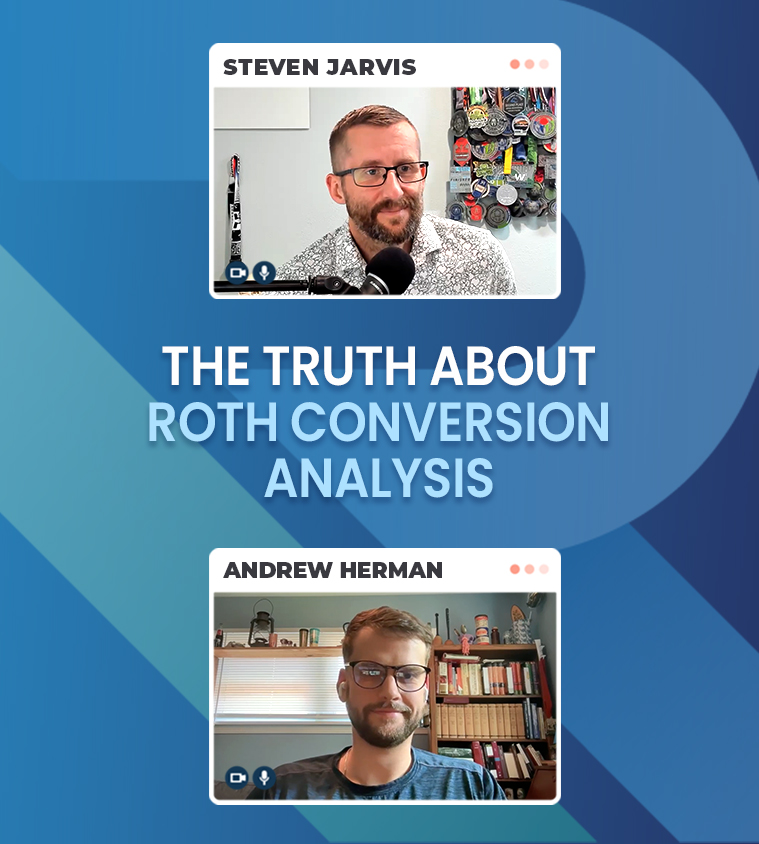
Steven Jarvis is joined by Andrew Herman, software engineer at Holistiplan and former CFP®, to discuss what advisors often get wrong about Roth conversion planning. They explore why successful Roth conversion strategies are built around tax bracket arbitrage, not eye-catching lifetime tax savings projections, and why estimating future tax brackets is often more valuable than trying to predict exact future income. Steven and Andrew also talk about the challenge of helping clients see the value of paying taxes today for benefits they may not realize for many years. Along the way, they discuss how technology can strengthen an advisor’s recommendations without replacing professional judgment, and Andrew shares his thoughts on the next generation of planning tools that could optimize Roth conversion strategies based on each client’s unique goals.
Steven and his guests share more tax-planning insights in today’s Retirement Tax Services Podcast. Feedback, unusual tax-planning stories, and suggestions for future guests can be sent to advisors@rts.tax.
Are you interested in content that provides you with action steps that you can take to deliver massive tax value to your clients? Then you are going to love our powerful training sessions online. Click on the link below to get started on your journey:
Retirementtaxservices.com/webinars
Thank you for listening.
Steven Jarvis, CPA (00:51.416)
Hello, everyone, and welcome to the next episode of the Retirement Tax Services Podcast Financial Professionals Edition. I’m your host, Steven Jarvis, CPA, and I’m very excited for this week’s episode because we get to nerd out on a favorite topic of mine, which is Roth conversions. And to make sure that we can have a really robust conversation about this, my guest this week is Andrew Herman, who is a software engineer who has had a huge hand in making a Roth conversion analysis tool that you all are probably familiar with. So, Andrew, welcome to the show.
Andrew Herman (01:20.834)
Thank you, Steven. I’m excited to be here today.
Steven Jarvis, CPA (01:23.084)
Yeah, absolutely. I think this is gonna be a fun conversation. I’m definitely a nerd when it comes to to Roth. I always feel just because of how much nonsense is on the internet, like I when I’m talking about Roth, I do try to just start with like, hey, just real quick, like we don’t talk about Roth because we think it’s the answer to everything. There’s some real opportunity here if we go about it the right way. So if you’re worried that like this is gonna be the next half hour of this is the only solution, okay, like lean in. Like we’re gonna have some fun here, but this is gonna be some really good stuff about how we actually talk about is this the right choice for someone. So Andrew, before I get too carried away, get too excited about this topic, give just a little bit of background for the audience of who you are, what you do, how you ended up having this conversation with me about Roth Conversions.
Andrew Herman (02:04.696)
Yeah, awesome. So I’ve always been a personal finance nerd, super into it from a young age. And then I pursued finance and financial planning in in college and ended up earning my CFP and working in the like the fee only heavy financial planning space for about four years. And at that point I got super interested in all the modeling software and was asking a lot of questions of what’s going on beside behind the scenes? How’s this working? And Keith would say, get out of the weeds. And I was like, but I love the weeds. So yeah, I left my CFP job, went to a coding boot camp and then been a software engineer at Halistiplan for the past two and a half years now.
Steven Jarvis, CPA (02:45.302)
Yeah, it it’s this fascinating intersection, especially when it comes to Roth conversions, but tax planning in general, financial planning more broadly, of kind of like where’s the balance of the the expertise of the financial advisor, the communicating with clients, help helping them be accountable, helping them execute on things, but like the math still has to get done somewhere. We can’t we can’t just wave a magic wand and just kind of make this all up on the back of a napkin. At least most of us can’t. And so I love seeing the proliferation of tools that help advisors do this. But just because it’s on a computer screen doesn’t make it magically right. And so, like one of the things that stood out to me early on as I was seeing how advisors were approaching Roth conversions is I would see these scenario analyses that would project out a lifetime tax savings. And so I’d be sent these reports. It’s like, well, of course I’m gonna do a Roth conversion with a client because the the software told me they’re gonna save four and a half million dollars in taxes over their lifetime. And I’ve always just been a little bit hesitant, and by and by a little bit, I mean quite a bit hesitant. To do Roth conversions based on a promised lifetime tax savings because there’s so many assumptions built in there. And Andrew, maybe you can speak to a different experience, but I’ve yet to see the advisor who then retrospectively says, you know, 20 years later, Hey, look, that four and a half million dollar number we promised you, here’s how it came to fruition. So, like this number gets used as almost like a carrot to get people to take action, but then never like gets like revisited. So that was kind of my introduction. Two scenario analysis when it came to Roth conversion and we still see a lot of that in the industry. And if you totally disagree and that’s your favorite thing, like this is the chance to say it, but where do you kind of come from when when we just think about scenario analysis more broadly and when it comes to Roth conversions and like where where it fits in helping an advisor get things done?
Andrew Herman (04:26.924)
Yeah, that’s a great question. It’s super interesting because when you project over a lifetime of a client or two clients and you model Rob conversions versus doing none, the tax savings can usually turn out to be a pretty huge number. And like you said, a lot of questions that that people have are is this even possible? Is this accurate? And I think there’s one thing that a lot of advisors miss that’s really super important. And that is the concept that a hundred dollars of tax savings 30 years from now, is not worth the same as a hundred dollars of tax savings today. Right. So we all know that. Like time value of money exists, and you have to do that full analysis. So I think a lot of times what happens is you could model doing a lot of conversions this year or in the next few years and even creeping up into really high brackets, you could save millions of dollars from not having to do RMDs in 30 or 40 or 50 years. And if you net those together, I’m saving three million dollars.But that’s not really the case. And I think that can be a little bit misleading and cause advisors to make poor decisions.
Steven Jarvis, CPA (05:29.292)
Always been fascinated to see how different people approach this topic because at its core, and I was I was I was looking back at a LinkedIn post you had actually probably several months ago now, where you’re just kind of outlining kind of big takeaways as far as like why people do Roth conversions. And one that stood out to me that I fully agree with, and there’s a lot of good things in there, but you talked about tax bracket arbitrage. And we’re gonna come back to to kind of where we started with this as far as that scenario analysis, but I just want to make sure that like the early we really reinforce this for everyone listening. That at the end of the day, like before we layer on this other complexity, Roth conversions are the really the Roth versus pre-tax deferrals. The only reason there would be a difference if we ignore time value of money for a second, which I agree with you, it’s a very real concept. But we just take it at its face, pre-tax versus Roth. There’s only a difference if the tax rates change. Right. So if tax rates stay the same, then the the outcome is the same. The numbers are different because it’s because time has passed and investments hopefully have grown, but I I was surprised when I first got into all of this of how often that that core piece gets missed. And so, like as a starting point, like but even before we get into all the layers of complexity, like we have to we have to keep in mind that that really when we’re making a decision of even whether to evaluate whether Roth makes sense, we’re looking at situations where do do we expect tax rates to be higher in the future, whether because Congress is gonna change the rates or because this person is going to have higher income. More importantly, the person who’s gonna use this money, because maybe it’s not even client that’s going to use the money. Maybe it’s, maybe it’s heirs. but we we got to look at hey, do do we expect there to be a difference in these tax rates? And then if the answer is is yes, we expect there could be a difference. Then we want to layer in these other pieces to say, okay, now how much makes sense? Does it make sense? Where are we paying the taxes from? Those kinds of things.
Andrew Herman (07:12.31)
Yeah, definitely. I think, like, as you said, tax bracket arbitrage is the biggest area to create value with Roth conversions. Some people will argue that there are a few other positive externalities, like if you pay for the conversion from a taxable account, you’re removing the tax drag on that that tax cost, which is which is true. Yep. You’re locking in rates now and removing the uncertainty of what future rates will be, which is true. Yeah. But yeah, the bulk of the value, like you said, is coming from tax bracket arbitrage. And in order to properly do that evaluation, you need to know, hey, what is my client’s true marginal tax rate today on a conversion? What are they actually going to pay? It’s often not just a marginal bracket. And then also what do I anticipate their true marginal rate to be down the road? And doing that requires a longer-term analysis.
Steven Jarvis, CPA (08:03.986)
Andrew when you’re doing these this analysis, you’re helping advisors do this analysis, where do you draw the line at just how many assumptions you’re gonna put in here? Because the the inherent problem with any kind of future planning, not just not just tax planning or financial planning, is that it it happens in the future and none of us know exactly what’s going to happen. My crystal ball is just as broken as everyone else’s. And so at some point we have to make a judgment call where we’re gonna say, okay, I’m gonna include this level of assumptions and I’m gonna ignore the rest because it just… Like we don’t have time for it. It’s too complicated. There’s too much uncertainty, whatever that is. Because even as we talk about Roth conversions, quite often we’re projecting out into the future to say, okay, 10 or 15 years from now, we want to start using this money. And here’s what we expect to be going on in life then versus now. Here’s about how much we think we’re gonna need every month, and here’s the sources it’s gonna come from. But we could also then, if we really wanted to try to get specific with this, we’d I mean, we’d have to run dozens of different situations where. What if in year twelve we need to replace our roof and we need an extra chunk of cash? What if in year seventeen we decide to take all of our grandkids to Europe and we need an extra chunk of cash? What if instead of year seventeen it was in year thirteen? And so at some point we just have to we just have to stop and say, this level of assumptions gets us directionally accurate and we’re gonna make a decision. So how how do you think about where we draw that line?
Andrew Herman (09:17.09)
Yeah, that’s a good question. Cause yeah, like you said, there’s always more inputs you can could add. There’s always more details you can add. But for me, it’s like a two-part process. You want a big picture idea of what the lifetime income and expenses look like and what brackets they’ll be in. And then you can hone in each year on how much should I convert this year. But to answer your question over the long term, in the tool that I build and when doing these sort of analyses, we try to get a good idea of income, expenses, and distributions. And what that will do is it will help us make relatively accurate estimates of what brackets they’ll be in. So it’s less about what’s their AGI gonna be in twenty sixty and it’s more of what bracket do we think they’ll be in. And the reason that we do it that way is like what you mentioned is we’re looking for opportunities to do tax bracket arbitrage, convert at a lower rate than we would distribute down the road. And I think it varies client to client. Some clients are are into the technology and are into getting as much detail as they can in there, while others are more hands off and they don’t wanna do the the budget document or provide all those low level details. So I think that yeah, long term you want to have an idea of what the the brackets are going to be. One example is a lot of people don’t realize that their IRAs are going to pile up to be massive and then distribute, cause them to have big RMDs, which will push them into higher rates. So modeling income and expenses can help you kind of see that general trend. But then on top of that… Each year you can do a more detailed analysis, right? Like when you are mocking tax return and scenario analysis or whatever tool, you can see the the effects of hey, is this social security taxation going to change? Is my capital gains taxation gonna change? Are there gonna be other phase ins and phase outs, whether that’s like salt deduction stuff, enhanced senior deduction? But all of those are like the more tactical level of how much should I convert this year?
Steven Jarvis, CPA (11:10.082)
Yeah, Andrew, there’s a couple of things that you said in there that I think are are really important for people to kind of keep in mind. Well, one, you said at the end there that, like, hey, we can keep refining this every year. Then the nice thing about having these ongoing relationships with clients is definitely is more work. The first the first year you talk to a client about Roth conversion, the first year you go to execute one, there’s definitely gonna be more work that year of understanding what should we expect in the future. What what do you expect for when you’re gonna retire right now? And hey, geez, that that not that year could change as we go forward. But if we have this baseline that we can come back to each year and then make adjustments to the amount of work goes down and the quality of the outcome actually goes up as we continue to refine that. the other thing that I think is related to that, that you also mentioned in there is that this does need to be client-specific. You talked about clients’ preferences and kind of level of detail they’re going to. It’s a good reminder for just what Roth conversions or any other tax planning. Like we’ve we’ve got to make sure that at the end of the day, what we’re recommending is client-specific. And while though those recommendations might look similar if we’re working with similar types of clients, we still need to take that time to say, okay, for the family that I’m working with right now, what what assumptions are applicable? What goals of theirs are we trying to accomplish with this Roth conversion? I think that gets missed sometimes too. That huge fan of Roth conversions. But at the end of the day, if we don’t tie that activity to here’s the goal you had with that money, they’re they’re less likely to feel valuable and to be consistently executed because whatever jokes we want to make about how much people hate paying taxes. At the end of the day, for the vast majority of clients, the ultimate goal is not just sticking it to the man. Like it, this is this is about preserving their spending power from their hard-earned money to do the things that are really important to them. And so we’ve got to understand what their goals are. Sometimes a big limiting factor for a client isn’t all of the math and the background on what the perfect amount is, it’s their tax tolerance. It’s it’s how much of a tax hit are they willing to take in any particular year? Every now and then, I mean, I’ll talk with very sophisticated taxpayers who understand all the math, but still at the end of the day, we’ll say, Stephen, like I get all of that. There’s no way I’m writing more than a ten thousand dollar check to the IRS. It’s like, okay, great. I would I would rather you do the fifty thousand dollar Roth conversion and you write a ten thousand dollar check, even if that wasn’t the mathematically optimal outcome. If that’s what you’re willing to do, I would much rather you do that as opposed to do nothing. Yeah.
Andrew Herman (13:25.816)
There’s some general rules of thumb out there of like this tax bracket, maybe convert versus don’t. What levels are good to convert at, what levels are bad to convert at. But like you said, it’s very individual. For some clients, converting in the 24% might never make sense, right? If they’re low if they are not gonna creep up into those brackets ever. Whereas for other clients, it might be a steal to convert a twenty-four percent.
Steven Jarvis, CPA (13:48.512)
Yeah, it is interesting with the tax brackets because I think 22% and 24% are the ones that get talked about the most often. And I’m sure that somebody could could do the research for us to back up why those get talked about so frequently. But per personally, I’ve seen t Roth conversions in every single bracket. I would say the least common brackets for me to see conversions in are the 32 and 35% brackets, just because there’s there’s big jumps from 24 to 32%. And just it and some of it’s just the clients that I work with that, If we’re bouncing in and out of those brackets, we’re probably doing a little bit more to look at okay, are there gonna be years where we’re not that high? Like, does this really make sense to convert in these brackets? Because when I get into 37% bracket with clients, as long as it’s not a like a one time thing, they sold a business this year and have this huge one time gain. I definitely see Roth conversions consistently in the 37% bracket because the clients in the top bracket always expect to be the top bracket and they want they want tax free funds to leave to their heirs. They want a tax free account to create flexibility in the future. And so if if I’m in the highest bracket and I know I’m or I plan to always be in the highest bracket, great. Let’s create that flexibility. So that’s that’s a little bit anecdotal. I and I’d have to go back and see if I can prove that out. But I would say the 32% and 35% are probably the least common brackets I see or I make recommendations for Roth conversions. I see them in all the other brackets.
Andrew Herman (15:04.812)
Yeah, that’s interesting. Yeah, I I think some people might say, the third and the thirty percent, there’s no there’s no point in doing it. But like you said, it’s really about aligning with the the client’s goals, whether that’s reducing the tax burden on their heirs, estate taxes, or yeah, reducing RMDs.
Steven Jarvis, CPA (15:20.194)
Well, and and you you mentioned it earlier, but the other piece that goes into that sometimes, especially when we’re doing multi-year Roth conversions, is that not just the understanding of the discounted cash flows, but the cash flow management. Like the this money’s got to come from somewhere. Like these taxes don’t just magically get paid. And so sometimes we’re we’re also just managing availability of funds.
Andrew Herman (15:38.466)
Yeah, I think the the discounted catch flows piece is interesting as well. Because like I I feel like we didn’t close the loop on this, but a lot of times advisors will see big numbers and it looks really appealing. But if you start to to discount those future tax savings to what they’re actually worth in the present, and you do an apples to apple comparison, I’ve seen somewhere it actually goes negative. So like the net impact on net worth goes down from doing a raw conversion.
Steven Jarvis, CPA (16:07.072)
So Andrew’s talk a bit more about that. Can you give a more specific example?
Andrew Herman (16:10.358)
Yeah. So I like to think of Roth conversions as investments because there are a series of cash flows, cash outflows by paying the conversion, cash inflows when you are receiving tax savings. And in the corporate finance world, whenever you’re evaluating a potential investment or project, it’s all about discounted cash flow analysis, right? Like if I discount these cash flows, what is this investment doing to my business or my net worth today. And a really important consideration in those discount cash flows is what discount rate should I use? And I find a lot of advisors not discounting future tax flows, future tax savings. And that makes the Roth conversions look a lot more appealing than they would look if they were to discount those. So an example would be maybe you’re not discounting future savings or you’re using inflation, but in reality the way that you would fund these Roth conversions is from your taxable account and say maybe your taxable account is earning 5% a year in returns. So in order to have the analysis be accurate, it’s important that you capture the opportunity cost of the money that you’re taking out of the taxable account to pay for those conversions. So in most modeling softwares, you could toggle between either the nominal values or the discounted values, and it’ll allow you to put in a discount rate. And if you discount future savings based on what you think an appropriate discount rate is, then a lot of times the tax savings can sometimes drop negative.
Steven Jarvis, CPA (17:48.594)
Because the opportunity cost of how the taxes are getting paid.Several questions are coming to mind because what what I what I always try to go back to is okay, what is what does this look like in practice when I’m sitting down with across from a client? And so th these are questions that I I don’t necessarily have the answer to. I’d be curious if there’s a way that that you can pull data on how people are using your Roth conversion tool. People are coming to mind that I want to reach out to who can see if they can help me do this research. But I’d be fascinated to know how many advisors when they’re talking about Roth conversions are communicating specific tax savings versus are communicating like here’s the value proposition of why we’re doing this. Because I definitely know advisors who do both. I know advisors who will put the analysis right in front of the client and say, hey, we’re gonna convert X amount to Roth because it’ll generate Y amount of savings and here’s what the software says. And so they are putting those numbers in front of clients. And so then the that begs a lot of questions about how the what assumptions went into that. I also know a lot of advisors who the conversation on Roth conversions isn’t tied to a specific amount of tax savings as, hey, as we look at your situation, here’s the tax brackets you’re in now, and here’s why we think you’re gonna be in higher tax brackets in the future, would it make sense for us to work together to fill up this tax free bracket so that we’re not taking money out in this higher, this higher bracket? So I’d be fascinated to know how often advisors are using projected tax savings as part of that conversation versus just having the value proposition conversation.
Andrew Herman (19:12.15)
Yeah, that’s a good question. I’m a numbers guy, right? So I would always if I if I was making a recommendation, I would always want to have the the full picture of cash flows and what I project the future tax savings to be. But using tax brackets as a rule of thumb, I think is the best generalized approach rather than using other other rules of thumb. Cause yeah, you’re right. I some clients might not want that level of detail, but I I would be curious as well to see how many advisors are are doing like the full lifetime taxes analysis versus current tax bracket compared to future projected ones.
Steven Jarvis, CPA (19:47.864)
Yeah. I won’t say their name on on the podcast because I don’t want to volunteer them for something, not knowing whether they can do it or not. But somebody’s immediately coming to mind in the industry who might be able to pull some interesting data for us. So stay tuned for a future episode. I’m gonna have to come back to that topic because I I think we can pull some client meeting data to to kind of start putting some numbers around this. Cause now that we’re having conversation, I am curious to know okay, how often is the the quantified tax savings part of the conversation to get people to take action? Because that’s a whole other piece of this this conversation. I mean, you and I can nerd out about the math all day long. I mean, as you talk about different assumptions and different levels of details, like there’s there’s that nerdy part of my brain that wants to go right there with you. Like, let’s go as let’s go as deep as we can. Let’s keep layering down the assumptions. I I I love that stuff. But then there’s also that practical side of me that says, okay, but when we bring this back to okay, which pieces of the of this get communicated in the client conversation, which pieces of this are what helps the client say, yes, Steven, that’s the thing I want to do and I want to keep executing on every year. Because there are definitely tax planning strategies out there that have a more upfront, like good feeling to them. Like we talk about like strategic charitable giving. Like sure, we might do this in a way that’s gonna give us the tax savings today, but we also got to give money to a charity that we cared about. And so there’s a little bit more of like an upfront feel good of we’re doing this together. Roth conversions are nothing but upfront pain. This is purely a long-term strategy. This might even be a strategy that benefits our kids and not us. And so a Roth conversion is nothing but upfront pain. And so the conversation can look a little bit different as far as how we say, okay, here’s this strategy where I’m gonna ask you to pay money to the IRS right now that you otherwise wouldn’t have to. And so we whatever balance of quantified support versus qualified support, like there’s some balance in that conversation of Mr. and Mrs. Client. Like here’s the reasons I think you should go ahead and write this check to the IRS.
Andrew Herman (21:41.198)
Yeah, that is interesting. Well, like you said, it’s it’s painful up front and you’re never actually getting like you don’t get a tangible check from the IRS and tax savings, right? It’s always like here’s what we project them to be. But it’s it’s really difficult to quantify the value that you created from past fraud conversions. And I’ve been thinking about that a bit, and I think that’s an interesting space because it’s certain, right? Like you there you can do the calculations and derive what the the value created was. It’s not forward looking. Yeah.
Steven Jarvis, CPA (22:10.168)
Once you start taking money out of the Roth, right? Like just just so we’re on the same page for for listeners, like what once you start distributing money from the Roth, we could go back and do the math on, Hey, did we come out ahead? Is that or or are you thinking about it some other way?
Andrew Herman (22:22.254)
Well, I think you could also if you kept track of all your conversions, you could have a s projection built where you didn’t do any conversions. Yeah. And you could have one where you did do the conversions and you could see how different between the two.
Steven Jarvis, CPA (22:37.25)
Yep. If there’s any listeners out there who are doing that in some way, like I would love to hear from you because I think it’s really fascinating. I don’t know anybody who’s I have yet to come across anybody who’s doing it, either practitioner or software provider that’s saying, hey, here’s how we would like look back and grade ourselves on how well we do with this Rothkin version. and so if there’s anybody out there doing that, I would love to hear from you. That’d be a fantastic conversation to have on the podcast. So go out to retirement taxservices.com or or find me on LinkedIn, send me a message. I would definitely be fascinated to have that conversation.
Andrew Herman (23:06.414)
Yeah, I’ll to think more about that.
Steven Jarvis, CPA (23:07.894)
Yeah, let me let me know what you come up with. Andrew, I mean kind of on that topic of of like other things related to to Roth conversions that would be interesting to talk about. Like before we wrap up here, ’cause we could talk about this for hours. I mean, what are other things kind of in this space that you’re excited that are coming down the pike? ‘Cause whether it’s software or tax planning in general, things don’t tend to stay stagnant. So are there there are things you’re looking ahead to that either you’re working on or would like to be working on that you’re excited about? Yeah.
Andrew Herman (23:30.444)
Yeah. The thing that gets me most excited would be different forms of optimization, right? Cause as software gets more and more evolved, this is something that more and more people are requesting. But like right now we have the feature where you just like press a button and it fills the twenty two percent bracket for however many years. Or you fill permature bracket three, four however many years. But what’s really what I’ve been thinking about is what’s the next level of optimization that you can do? And what are you optimizing for? Right. So one advisor might want to optimize for the highest after tax portfolio value at the end of the life. Or someone else might want to optimize for lowest present value of taxes paid over their lifetime. Or maybe someone wants to optimize for spending. And to be able to build a solution where you could optimize conversions over the lifetime of a plan, given some of those different objectives, that’s really interesting too.
Steven Jarvis, CPA (24:27.342)
That is super interesting. That really goes back to making sure this is specific to the client’s goals. That we’re not just using our Roth brush to paint over the top of everybody the same way, but that we’re really, really saying, okay, for this client, what’s most important to them and then how do we optimize for that?
Andrew Herman (24:42.798)
Yeah, and I think that brings up conversations of if you’re deciding on what you’re optimizing for, interesting conversations come up with the client of like what do they what do they want this big pile of money to do for them? And I think that can lead to some more interesting, like value based conversations.
Steven Jarvis, CPA (24:58.892)
Yeah. Just kind of touched on it briefly because we we both i enjoy the numbers so much, but that subjective side of of what really is my goal with this money, that will change the conversation around Roth conversions for most clients more than any of the numbers because that’s what that’s the part they care about more. Like there’s a reason they come to math nerds like us. They want somebody who understands how this all works, but at the end of the day, they’ve got some other goal they’re trying to accomplish, whether that’s leaving a legacy for their kids, whether that’s enjoying their own retirement. Maybe it’s a beach house in South Carolina, who knows what it is. But being able to tie the conversation to what is it that’s most important to you? It’s easy for us to talk about Roth accounts and investments, but at the end of the day, the the client has a goal in mind for what those dollars are actually gonna get spent on. Well, and Andrew, as we wrap up here, how how do people learn more about what you’re doing or get connected with you if they have questions?
Andrew Herman (25:41.868)
Yeah, couldn’t agree more.
Andrew Herman (25:48.226)
Yeah, so just as a disclaimer, like all my opinions here are my own, not those of my employer, but I like to write about Roth conversions so people can find me on LinkedIn. I’m always happy to chat anything Roth related with people that are curious. So
Steven Jarvis, CPA (26:02.158)
Well, and if you haven’t already tried out the tool that Andrew’s been instrumental in helping build, you can go to Halistaplan.com, test that out, including the Roth Conversion analysis. It’s always fun to be able to see what people are producing. So Andrew, really appreciate you being willing to take the time to come on and share your expertise. It’s been great having you. Yeah, and like Andrew said, LinkedIn’s a great place to continue this conversation, learn more. Go give Andrew a follow. If you want to have an in-person conversation about the ins and outs of Roth Conversions, be sure and get signed up for the summit at the end of September. We’d love to see you all in Scottsdale.
Andrew Herman (26:16.76)
Yeah, thank you so much, Steve.
Steven Jarvis, CPA (26:30.818)
So until next time, thank you for being here, and remember to tip your server, not the IRS.