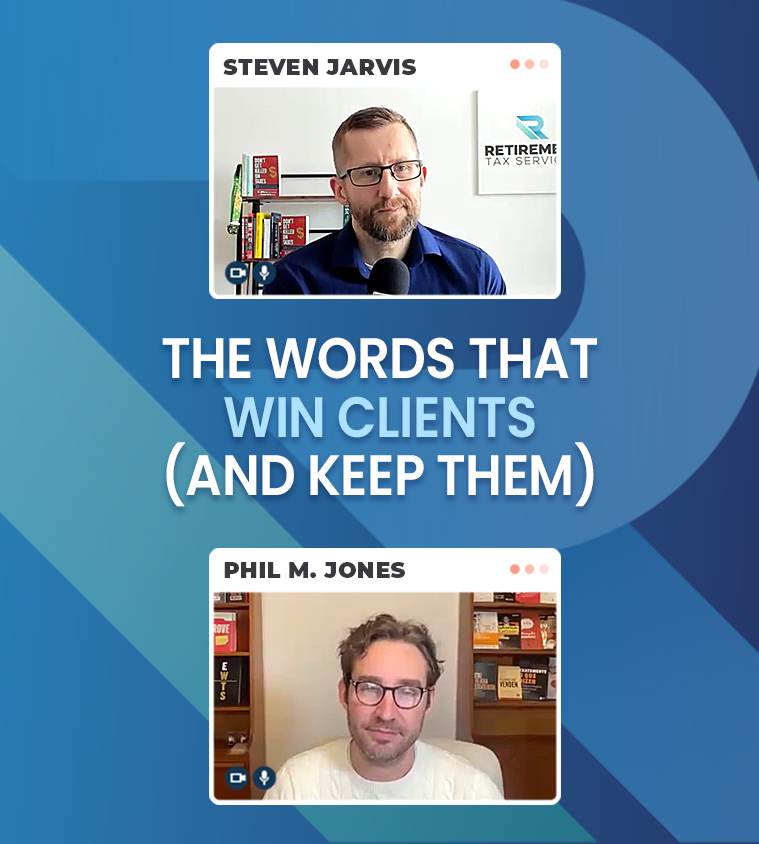
Steven Jarvis is joined by Phil M. Jones to explore how the right words can drive better client outcomes. Phil shares why success isn’t just about expertise, but about knowing what to say at the right time. They discuss the shift from being a problem solver to a problem seeker, helping clients uncover issues they didn’t realize they had. and practical ways advisors can structure conversations to build trust and inspire action. Discover practical strategies for effective communication, persuasion with integrity, and mastering conversational techniques to grow your financial advisory practice.
Steven and his guests share more tax-planning insights in today’s Retirement Tax Services Podcast. Feedback, unusual tax-planning stories, and suggestions for future guests can be sent to advisors@rts.tax.
Are you interested in content that provides you with action steps that you can take to deliver massive tax value to your clients? Then you are going to love our powerful training sessions online. Click on the link below to get started on your journey:
Retirementtaxservices.com/webinars
Thank you for listening.
Steven Jarvis, CPA (00:51)
Hello, everyone, and welcome to the next episode of the retirement tax services podcast, financial professionals edition. I’m your host, Steven Jarvis, CPA. And in this episode, we aren’t really going to talk about anything technically tax-related, but it’s going to be super important for anyone who cares about getting their clients to take action, which should be all of you, because as we talk about all the time, action is the only thing that really counts. So joining me this week to have this discussion, Phil M. Jones is an author, a speaker, an expert in this area of knowing what to say that will actually help people take action. So Phil, welcome to the show.
Phil M. Jones (01:27)
Pleasure to be here, Steven. Thanks for having me as part of this.
Steven Jarvis, CPA (01:29)
Absolutely. We’re super excited to have you on the podcast. You’re also joining us later this year in person at the summit in September. So many of you listening are already signed up for those of you who aren’t, can go out to retirementtaxservices.com to get signed up. We’re at the summit. We’re going to not only cover a lot of great tax topics, we’re going to make sure you really have the tools to get this stuff done. And Phil, right before we hit record, you really kind of summarize your whole goal of how you work with people, of what you’re trying to get them to do. So just because you put it so much more eloquently than I will, like just give us that kind of high level view of what it is you help people do and then give us some of your background so listeners know where you’re coming from and why you talk about this stuff all the time.
Phil M. Jones (02:07)
You bet. I’ve learned the outside of hard work and endeavor, hustle and product knowledge and all those basic fundamentals to get a job well done. The difference between doing good and great beyond those other factors is finding the right words at the right time. is knowing exactly what to say, what to say and how to make it count. So I’ve been obsessed by this idea of how word choices impact decision-making for now, well, yeah, approaching 25 years. It started with me being involved in a senior leadership role at a very young age and I couldn’t get any respect. I was leading teams of a couple of hundred people, but I was in my late teens time, big time over retail operations. And I got a lot of prejudice because of my age. So what I would start to do is instead of advising anybody to do anything or delivering any direct orders, I’d just be looking at what top performers were doing. And then anybody who I was looking to be able to make a change in their behavior is I’d model what I saw at a top performer. And I’d be able to say to you, Steven, look, I don’t know if it’s for you, like Sharon over here, who you know is crushing it, does three things when she interacts with customers different to what you do. And I thought you might want to know what they are to help you amplify your results. So I built a leadership style that came from model peak performance. And from doing that for years and years and years, I started to there were patterns, significant number of patterns in language. that then built out to me writing methodology, that then built out to me studying it further from an academic point of view, that then built out to us running more of our own studies. I’ve written 11 books on the subject of sales for non-salespeople and how people could influence sway with integrity. But my one book, like a lot of music artists have one album or one song that goes gangbusters is exactly what to say. And that little book now is, has reached around 3 million people around the world, been translated into 29 languages, and very much distills down some success language in commercial environments. There’s 23 sequences of words and we call them our magic words, but what they really aren’t is magic words. They are actually principles around influence and persuasion disguised as magic words. And I’ve learned that if you try to teach people principles, they struggle. They certainly struggle to find examples. Whereas if you can teach people examples, they’ll trip up principles in the process. So my work really now is in conversational engineering. It is looking at conversion points, it’s looking at points of friction, it’s looking at moments that could be amplified in speed or precision with finding the right words.
Steven Jarvis, CPA (04:37)
Phil, I always look for guests and we look for speakers at the summit who like I’m personally excited to interact with. But as you describe that, like I almost want to kick everybody else out of the session, just have a one-on-one with you for an hour in September because there’s so much great, just great wisdom in what you’re saying. And I love that this is what you spend all your time doing. Cause as you talk about, hey, know, Sharon over here is doing these things that are getting success and maybe you’d be interested too. There’s so many things that resonate with things that I have painfully learned over time through trial and error, that I would love it if I could just spend more time with someone like you saying, okay, help me skip over some of these things. Like help me get to the good part because when your team sent me a copy of your book, I always have kind of this like double-edged feeling when somebody sends me a new book because there’s this worry in the back of my mind that someone’s gonna send me this like 500 page tome that I’m not actually gonna get through and that it’s…It’s like, okay, the idea was in the first sentence and then you spent 17 pages telling me what you already told me in the first two sentences. So there’s always that part of my brain. So I’m personal to you. I was expecting this giant. And then the book came to you. You kind of casually mentioned in there that, hey, this little book, but it is a little book because it’s to the point and it gets right. just, okay, here’s what you need to know because to your point, what people really need is not another dissertation on these endless principles of here’s how this all connects. It’s tell me exactly what to say so that I can go start saying it and see the results.
Phil M. Jones (06:03)
Well, the other reason that I made it such a short and easy read and made it something that you can get covered a cover in in an hour is that repetition is required for skill to exist. And, you know, most big books, they don’t get read once, let alone repeatedly. geez. Yeah. And I ask a lot of people like, have you read blank? And they’ll say, yes. And I say, like…Like I took the Blink List, or I watched a YouTube video on the topic, or I skim read it, or I listened to it on a board, 3XL. I’ve learned when it even comes to the commercialisation of books is the only thing that sells a book is I’ve read this book and you should read it too. Nothing else sells books other than that. Now are hundreds of ways you can get somebody to read a book and then say, I read this, you should read it too. But if you can’t…in today’s attention-deficit society, get somebody to actually sit down and read the thing in the first place. It’s not going to have any virality. It’s not going to have any word of mouth spread. So the book was very much intentionally crafted with that full following function. And what’s interesting is, Audible have, I know we’ve got some numbers people that listen into us today, that Audible have an average of like 0.4, 0.5 of a listen of a book. Exactly what to say has a 7.5. Wow. I love that stat because it tells me people are re-listening, re-reading and they go back to it. And I think that’s where skill is built, is coming back to the same thing again and again, not necessarily looking for what’s new.
Steven Jarvis, CPA (07:25)
Yeah. Well, and Phil, clearly your background is not in tax planning. It’s not in financial planning, but it’s fun to see kind how the universe comes together sometimes because so many of things you’re talking about are themes that we talk about so often as it relates to tax planning, as far as getting the repetitions in that we’re not, I’m not interested in helping somebody learn the whole tax code. I want you to understand the few things that you need to do over and over and over and over again. for, for, people listening, for people who are going to attend the summit, like this, this is so great and so powerful in two ways. It’s both how you learn from other advisors when it comes to growing your practice or running your practice, that idea of, this has worked for someone else. That’s why we fill the room with people who are crushing it. So you can say, this has worked for someone else. Maybe it can work for me too. And here’s exactly what I need to do. But then also the other side of that is, okay, this is how I need to talk to my clients or my prospect. Whether I’m literally trying to sell someone on using my services, or I’m trying to sell someone on taking that action that I know is going to help them accomplish their goals. Anytime you’re trying to persuade someone to take action, like call it whatever you want, but it’s sales. We want someone to take an action that we know is going to benefit them. You talked about doing it with integrity, which is clearly so important, but at end of the day, we’ve got to know what to say. And then we’ve got to get the reps and we’ve got to do the work so that we’re not, we’re not like holding that book in front of us and reciting what Phil told us to say, but we’ve, we’ve rehearsed it. We, we know the right words to use and then we can do it in our own style, in our own voice, in our own cadence, whatever that looks like so it feels authentic.
Phil M. Jones (08:52)
100%. And we can look at some examples later in today’s conversation about how we could utilize them in the world of the advisors that you support. Yeah. But I think there’s something here too, that is a big shift in how decision-making is happening. this time, particularly as we sit here, you know, at the end of Q1 of 2026 and start thinking about influence persuasion and decision-making, is I’m seeing in any professional services role, I see this for CPAs, I see this for independent financial advisors, I see it for real estate professionals, I see it for the legal profession, I see it across the board. Is gone are the days that you can win by being a problem solver. Like for the last decade, many people have had a good time. Somebody has a problem. If your expertise is available to solve it, you had a good time for a good time. If you look at today and backwards. But today, if you’re looking to win more than your fair share, which I believe everybody listening to this is of that mindset, I would argue that more people should be looking to be a problem seeker want to be actively hunting out problems that live inside the world of the people that we’re looking to try and serve. Because if you can help discover a problem before they’d realized they had that problem themselves, not a fake problem, a real problem, then position a solution towards the problem that they only just realized they had, it’s strong possibility that they are going to trust you with the solution that then comes behind that. in the financial planning world, this is so prevalent because I’ve operated on the fringe of this industry for a chunk of time. And more often than not, almost every advisor is leaving opportunity on the table inside every client they work with. Not like some of, or most of, or many of, like all of them, because they’re not having the conversations that they could, should, and really need to be having about not the next 12 months, but the next 10, 15, 20, 30 years, and have the ability to blow up a bigger conversation.
Steven Jarvis, CPA (10:44)
Yeah, I like that phrasing of being a problem seeker because you’re absolutely right, especially in this context that we’re working in. So many consumers, so many taxpayers, it’s not that they don’t think taxes are painful, but there’s a distinction between I don’t like something and I recognize there’s something I can do about it. And that’s the piece where an advisor, if they take this problem seeker mentality of, yes, everyone agrees that taxes are painful, but…So many people have never had someone tell them, there’s some, if we work together over the next five, 10, 15, 20 years, there’s something we can do about it. And that that’s where we’re not just telling them we’re taking, we’re going beyond, there was a pain we’re identifying. Hey, it’s a problem in terms of there’s something we can do about it. And then to your point, we’re then offering the solution to it because this, this isn’t like if you have a broken bone where like everyone knows, Hey, that, that bone is broken. You need to go to the doctor. The doctor is going to fix the broken bone. This is more like I have no idea why my arm hurts, but it seems like everybody has arm hurts, so I’m not really gonna talk about it. But then when somebody comes along and says, I can do some about that for you, if they provide a solution in a way that inspires action, because that’s the other piece of it. Between the internet and social media and AI, there’s plenty of flash in people’s faces of the illusion of solutions to everything. But if we don’t communicate it in a way that inspires people to take action, there really isn’t a solution.
Phil M. Jones (11:58)
And most people don’t want the answer. Because they don’t even know the question first. Yeah. And people talk about AI, it’s like only as good as the way that you prompt it. I’m like, same as humans.
Steven Jarvis, CPA (12:09)
Same as humans, sounds familiar.
Phil M. Jones (12:11)
Much of complex decision-making inside of industries like financial services means that you have to have the ability to slow things down with the conversation. You have to have the ability to create a wider field of play if you want to be able to score more. Most people have no idea what they want because they don’t even know what their options are. And the systems are built to create confusion.
Steven Jarvis, CPA (12:32)
Yes, yes, unfortunately that resonates a little too much.
Phil M. Jones (12:37)
The risk I would say for every advisor right now is if any one of your clients at any point in time in the future has a and I should have moment. If they find that themselves six years on from now and say I should have done X in 2026 and you were part of that and it was from a conversation you didn’t have in 2026, you should be pretty disappointed.
Steven Jarvis, CPA (12:56)
Yeah, fully agreed. You mentioned that we could get into some examples of how this works. Let’s get real with this. Give me some examples. let’s do this.
Phil M. Jones (13:04)
Well, give me some context first. So give me a scenario of a frequently occurring conversation between your people and someone else, and let’s talk about what we’re trying to achieve. And we’ll put the words to work.
Steven Jarvis, CPA (13:16)
Yeah, love it. So my area of focus with financial advisors is in this whole tax planning conversation. And I think where a lot of advisors get hung up is that they don’t have to tell people that taxes exist. Everybody knows that. They don’t have to tell people that taxes are painful. Everybody also knows that. Where we get lost is in the conversation around how do we identify, like we were just talking about, how do we identify this as a problem that not only has a solution, but I, as the advisor, can provide that solution too. And we’re not talking, you know, the elevator pitch that I’m trying to get as much as I can out in 30 seconds and hope that they listen to the whole thing and remember it. We don’t want that. We want what’s the impactful way to help, especially for prospecting, maybe it’s the way that we help them realize that they should have done something and the person in their life isn’t helping them take action. But so where we have something that has awareness, it has some emotion tied to it already, but we need to get to the prospect client is willing to take action and they see us as being part of the solution.
Phil M. Jones (14:06)
So where are we? Is this a prospecting phone call? Is this a face-to-face appointment where somebody’s come into your office? Is this an existing client that you’re in conversation with for a review?
Steven Jarvis, CPA (114:18)
Let’s stick with the, this is a prospect meeting. This is someone who has expressed some kind of interest of having a financial planning solution in their life. It might not be necessarily that they said, I need help on taxes. We just see that as one of the value propositions we can add. And then honestly, Phil, I’ve got a mix of advisors who are doing this in person or on a Zoom call, but this is a live interaction where we can see each other’s faces.
Phil M. Jones (14:40)
So I’ll explain the most frequently occurring problem that I see in these scenarios mostly, is what many people were doing, the cause of this nature is they will have a friendly bit of banter and they’ll go back and forth and break some ice and create some rapport. And then they’ll jump straight forward to a current situation and what they’re looking to try and achieve and miss the biggest step that is helpful, which is to go backwards first. So what would this look like is in the early stages of the conversation is like, help me understand how long you’ve been thinking that you might need an alternative solution. You see how that first question helps create a timeline for how long they’ve been thinking about potentially an alternative solution. And the assets under management that you have right now, the 401k, the IRA, the brokerage account that you have, where did each of those start? And how did you go about picking those funds? How well have they performed by your own expectation?And how did you go about choosing them again? You see what I’ve done first is by going all back in time, I’ve created a little bit of chaos here and I’ve created now. I can also probably put a summary on this that says, so, so everything you’ve really chosen up until right now is just being out of convenience or necessity. Wasn’t necessarily a strategic choice.
Steven Jarvis, CPA (15:55)
Yeah, I really like how you’re staging that for the person we’re talking to because it can be really, especially for people who feel passionate about the service they offer, which is most people, understandably so. They think they have a solution for people. It’s really easy to just jump right to like, I’m the answer to everything. One of the phrases that I really like when it comes to taxes, and you’ve added this additional layer of let’s go backwards first before we get into this conversation of, what’s the strategy around fill in the blank? And so I like that layer you’re adding of, well, let’s go backwards and talk about how we got to this point. Because if part of the solution we’re answering is that we have a different strategy, a better strategy, some way that we’re going to help you implement better, if we start from today and just go forward, this is almost more of like an emotional competition of, you like me better? If we can illustrate how we got to this point and create that little bit of chaos and have them, because there’s a reason they’re having the conversation with you. Everything was going perfectly.
Phil M. Jones (16:50)
This wouldn’t even be. be there. And what they do by that early part of the conversation is they hold their hands up hypothetically and say, well, I guess I have no idea what I’m doing. Which is a great place to then be able to move forward from there. What I’d probably then do is ask a, what do you understand question? Like, what do you understand about all of your options when it comes to choosing a professional answer right now? Because it’s helpful to understand is they might say, I don’t know. I don’t know what my options are. They might say, I could use the, you know, the tide investment solution at my bank. I could use the same person that my mom and dad use, or I could look at being at a, find an independent provider. There’s other similar rates to me. okay. And what is your experience of hiring professionals in any area of your life that would be similar to this?
Steven Jarvis, CPA (17:34)
Well, it’s a great, yeah, it’s such a great list of questions. I love how you’re clearly you do this all the time because I think the tendency so often is to want to jump immediately into comparison or asking what are clearly leading questions to just to just say, well, this is this is my designation and this is my background. This is my fee structure and whatever that is. But the way you’re. Right. The professional asking those questions obviously is going to feel confident that they have a solution in the end, but you’re asking open ended questions in the beginning to create this frame of mind for the prospective client of, I’m in a situation that I need help out of.
Phil M. Jones (18:19)
And look how you can do other things. You can say, would it help if I walk you through the different types of advisors you could work with in this type of scenario? Say, yeah. And I’d say, well, the way I see it is you have three options and present three options. And the first option I’d give is somewhat of a viable-ish option, but there’s some friction attached to it. The middle option would be one that I’m a hundred percent certain they don’t want to do. And the third option is the one that I think might work best for them. And what could that look like in this scenario? Is the way I see it is you have three options. Is you could look to again, find a brokerage of convenience via your bank or a family friend, et cetera, and plug into somebody else’s system and have yourself running along with a limited number of options and a limited number of relationships. Alternatively, you could learn more of this yourself. You could very actively get hands-on and be managing every part of your portfolio. And you could piece together all of the different product options and solutions with all the different vendors. And you could drive this ship yourself. Or by alternative, you could work with an independent full service retirement and tax planning organization that not only help you manage your investments, but also make sure that those investments grow in a tax-efficient way, and also provide some advice to you that means that where there are discretionary moments where the money could go to the IRS or it could go into your retirement planning, we get more of that into your retirement planning rather than give it to the IRS. So now those three options, which one do you think your future self will be most thankful for?
Steven Jarvis, CPA (19:43)
Yeah, you’re setting yourself up for the greatest chance of success possible. I love it.
Phil M. Jones (19:48
100%. And then it’s all language and it only works if you’re good enough. Like if you suck, then you can’t get somebody somewhere if you’re not good enough.
Steven Jarvis, CPA (19:59)
Well, Phil, let’s talk about that because the list of questions I have for you is way longer than the podcast will allow, which is why I’m so glad that you’re coming out to the summit later this year. But let’s talk specifically about this piece because I think what you’re talking about is that, you have to be able to deliver a quality service to back up what you’re communicating. But there’s these two pieces to it. And I think more often the advisors I run into are struggling more with the communication piece than they are with the delivering the service piece, which, but I don’t, don’t, I don’t want to skip over that. If you’re not delivering quality service, like skip all of this, like you need go back and make sure you’re doing right by your clients. Let’s talk about how you help people get from where they are to where they want to be when it comes to how they communicate. I think part of the reason people aren’t already better at this is that it can be uncomfortable. You’re to make mistakes along the way. You’re going to, you’re going to listen to this podcast. You’re going to get really excited. You’re going to go to your next meeting and you’re going to walk out saying, well, I said it exactly like Phil did and it didn’t work. it clearly doesn’t work. Like what, how do people get the right reps in and stick out some of that discomfort early on to get to a place where they’re doing this well?
Phil M. Jones (21:00)
I mean, practice is required. And we’ll talk some more about practice, but just to put it into an analogy that people might understand, that’ll be helpful is that there’s systemization and method and order and sequencing that is attached towards how somebody would run an effective tax plan. Correct? It isn’t you watch one YouTube video and you get a quick tip on how to do something to be able to save taxes on blank. And, and before you know it, that you think that Section 179 is the greatest gift since sliced bread, people grab breadcrumbs of ideas, think they know more than they know, and then wonder why they don’t get the big picture result is because all they have is one tiny little piece of information they didn’t really understand its full consequences. The same is true with this body of work. The only way you get good at anything is through practice. And like, I’ll grab the book here for a second and…One of the ways you practice is, you can just say any of the sequence of words and let’s just say where did I land? I landed on the words most people. So I could decide it’s most people Monday and I’m going to use the words most people as much as I possibly can on Monday and look to increase my reps. I’m going to find contextual application of that sequence of words in as many different ways as I can from the moment that I wake up and I say good morning to my family right the way through to bedtime and every moment in between is I’m going to look to get 100 plus bat with that sequence of words in context of my everyday life. You can’t go back from that. The other part that is perhaps where it starts to get more interesting is where you think about sequencing and stacking some of these words together. Like the reason this book runs far and wide is because people think the individual words imagine. They kind of are ish. They work better though when you can sequence. Like keys on a keyboard to how to make music is, you have to learn to play a note, then you have to learn to play scales. Then you learn to write a sheet, read sheet music, and then you can play socks. It goes in that order. So I would even take the book and say, well, can I take any scenario? And let’s just say I’m independent financial advisor and I’m meeting a long-term client that I’ve worked with for number of years and they’re coming into the office today. Cause I say, look, I’m not sure if it’s for you. But how open-minded would you be to understanding some of the ways that other clients in your situation are expanding their benefits longer term by deferring more of their income into an increased tax plan outside of their 401k? What do you know about a defined benefits plan? And how would you feel if you could take some of the increased profits that you’ve collected over the last year and the next few years and wrap it up in an accelerated pot that would allow you to be fully funded for your retirement? Just imagine how much freedom that will have for you and your family if you don’t feel worried about having your retirement pot taken care of. And when would be a good time for us to map this properly so that we can make sure that we’ve got the right amounts and we’re not overcommitting to a budget.
Phil M. Jones (23:57)
And I’m guessing you haven’t gone around to speaking to your family about what this would need to look like. Look, you have three options. You could continually have great year after great year after great year and pay the good fortune of ensuring the IRS are well-funded out of your well-funded life. You could keep doing that. Alternatively, you can look to find some creative risk-a solutions, et cetera, to band-aid or minimize your taxes year in, year out. Or alternatively, you can make a smart decision and take some of your increased profits in this busy season of life where you know you’re prepared to be able to make more in this window than maybe you’re to want to do later in life. And you can defer that and then invest it in a way that is going to grow in a tax-efficient way for the remainder of your life. Out of those three options, which one do you think your future self will be most thankful for? Because there are two types of people in this world. There are those that think year to year and there are people that try to actually prepare for their whole life. And I bet you’re a bit like me that when given the option, you’d rather take a long-term view when you’re planning to live a long time. But if you’re serious about maximizing your relationship of us working together, then I wanna make sure that you could take advantage of every part of the advice that we can provide. Like, don’t worry. I know what I’m doing. We’ve done this with dozens of business owners like you before. And most people find that all I’m doing is I’m flicking the examples in the book, but I’m applying them for a conversation I’m having today.
Steven Jarvis, CPA (25:22)
Yeah, no, I feel I’m loving this because I mean you’ve you’ve clearly gotten thousands and thousands of not hundreds of thousands of reps and saying these kinds of things because we didn’t skip over the part in the intro where you’re secretly a CPA like this. The tax piece is not your area of expertise. The way to say these things because of the reps you’ve gotten in and for anybody who works with with business owners and talks about defined benefit plans, you can just listen to that the last two minutes of the podcast on repeat so you can hear how how eloquently he went through that in a way that just because for listeners, what I want you to hear in there is how the whole time, even though I knew where he was going, I’ve read the book, like I even know what the framework is and I still, there’s part of me that’s like, yeah, keep going, Phil, please, like tell me the next part because you’re being so intentional with how you say it. I also, we’ve got to wrap up here in just a second. I want to call out, because you mentioned it a little bit casually of when you’re getting those hundred reps a day in, you mentioned from the time you wake up with your family, with your friends, like this isn’t. If you’re serious about improving really any skill, especially these communication skills, this you have to be getting the reps in throughout your life. The worst time to practice is during a performance. Your client meetings, your prospect meetings, those are the performance. Not that you’ll get them exactly right the first time, but if you want to do well when it comes time to performance, you’re to be practicing all the other times. Whether you go on Amazon and get a copy of Phil’s book, exactly what to say, or you come onto the summit and hear Phil in person and get a copy of his book, the getting the reps in, Phil, tell me if I’m wrong, but I think you and I would both heartily agree that at end of the day, getting the reps in is the thing that sets people apart more than anything else. Millions and millions of people have heard these concepts, will hear these concepts, and so many of them won’t do anything about it. Maybe try it once and be mad it doesn’t work. The people who will have an impact on themselves, on their families, on their businesses, on their clients are the ones who take it seriously and get the reps in no matter how uncomfortable they are.
Phil M. Jones (27:12)
A hundred percent. And professionals practice. Does practice look like? Practice looks like practice. Practice doesn’t look like game day. Practice looks like practice. So as I worked through those examples, one after the other in what practice, which means if anyone’s like, yeah, but that’s not right. It’s cause I was practicing. Running a practice. Yeah. And it will never go the way it does in practice on game day. Yeah. But on game day, if you run the practice. You can then make the adjustments on game day to how you differ from the way that this showed up in practice. But what amateurs do is they practice on their prospects and then wonder why they get amateur results.
Steven Jarvis, CPA (27:44)
It’s such a, such a good thing to wrap up on. amateurs practice on their clients and wonder why they don’t get great results. So Phil, people can go out to retirementtaxservices.com, sign up for the summit, come see you in person, come learn these things in a hands on way. then go out to Amazon, get a copy of exactly what to say or any of your other 11 books. How else can people follow along with the great things you’re doing?
Phil M. Jones (28:05)
If you’re on Instagram, come find me at philmjonesuk. That’s probably the platform I’m most active personally. I’d love to hear that you joined this conversation with Steven and I today. And if you’ve got questions that follow up, that’s probably the safest place to be able to catch me. If you haven’t yet caught on to being on Instagram, like maybe fix that. Maybe just get that done today. Or LinkedIn’s another place you can come and find me. So philmjones on LinkedIn.
Steven Jarvis, CPA (28:30)
Phil, thank you so much for your time. We’re looking forward to seeing you in Phoenix for the summit this fall. To everyone listening, really, the takeaway here is you have to get the practice in. If nothing else, action is what counts. Get the practice in. Until next time, good luck out there, and remember to tip your server, not the IRS.