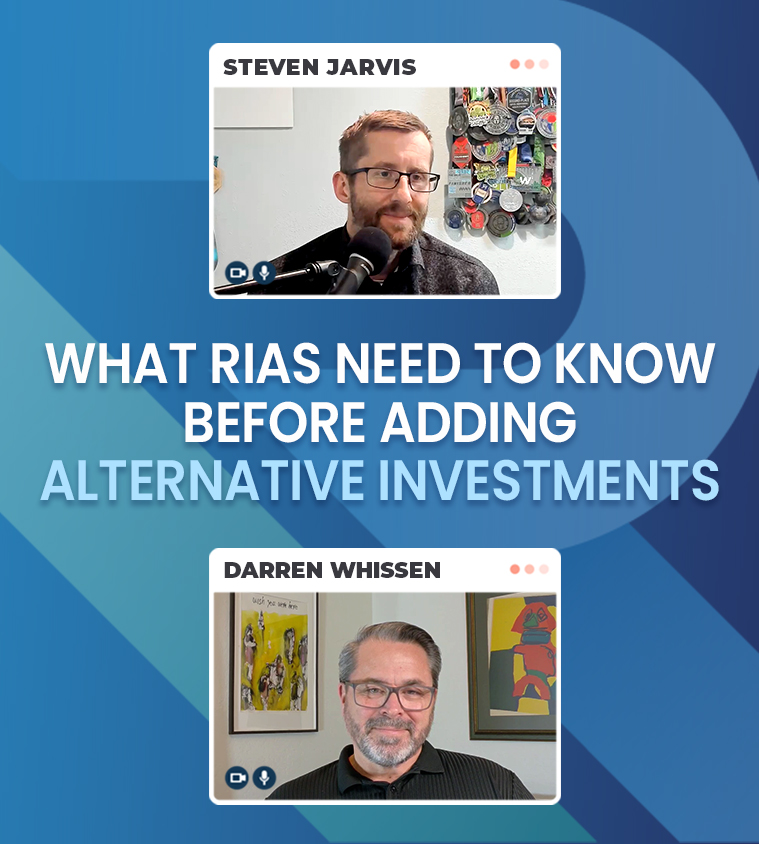
What RIAs Need to Know Before Adding Alternative Investments with Darren Whissen




Today, Steven Jarvis, CPA, is joined by Darren Whissen from Invito to explore what it actually looks like for RIAs to implement alternative investments in practice. Darren shares his background running an RIA where nearly half of the client assets were allocated to illiquid alternative investments. Darren also walks through the compliance infrastructure required to support an alternatives program, including WSP updates, due diligence processes, and supervision requirements. The discussion highlights common pitfalls advisors should avoid, including poor manager selection, overly optimistic projections, and overconcentration in client portfolios.
Steven and his guests share more tax-planning insights in today’s Retirement Tax Services Podcast. Feedback, unusual tax-planning stories, and suggestions for future guests can be sent to advisors@rts.tax.
Are you interested in content that provides you with action steps that you can take to deliver massive tax value to your clients? Then you are going to love our powerful training sessions online. Click on the link below to get started on your journey:
Retirementtaxservices.com/webinars
Thank you for listening.
Steven Jarvis CPA (00:53)
Hello, everyone, and welcome to the next episode of the Retirement Tax Services Podcast Financial Professionals Edition. I’m your host, Steven Jarvis, CPA. And this week we’re gonna get a little extra nerdy, which I know is a bold claim for a tax podcast. But sometimes there’s this gap between things we talk about and then putting them into practice. And I’ve gotten to learn a lot over the last year and a half or so of working with our partners at Invito Energy, more about some of the alternate investments that
Your clients ask about all the time and more specifically, what that means for advisors who are looking to really get this done in practice. And joining me this week on the podcast is Darren Wisson from our friends at Invito to talk about what it actually looks like for RIAs in particular to get involved in the alternative investment space. So, Darren, welcome to the show.
Darren Whissen (01:42)
Stephen, thank you for having me. I appreciate it.
Steven Jarvis CPA (01:43)
Yeah, I always love having these conversations because we want to make things as real world as possible. And of course, our mutual friend Steve Blackwell has been on the podcast before. He spoke at the Summit last year, gave a lot of really great information about how oil and gas investing in particular work, especially the tax strategies around it. I love that you guys really focus on, like, hey, at the end of the day, these are investments that have a tax component to them and while we’ve navigated some of the tax pieces,
What we haven’t had a chance to go deep on, at least for my audience, is yeah, but if I’m getting into this alternative investment space, I’m getting into something other than kind of the normal stuff I do, what do I need to be thinking about from a compliance standpoint? So before we try to answer that question in a little bit of a condensed format here on the podcast, Darren, why don’t you give some of your background just so people know where you’re coming from, what your experience is to talk about this stuff.
Darren Whissen (02:33)
The short story is I’m a 20-year wealth management veteran. I owned and operated my own RIA for a better part of 13 years. And my RIA specialized in the utilization of alternative investments. So on average, about 50% of my clients’ investable assets would be invested in illiquid direct investments. And the use of investments with associated tax benefits such as oil and gas and other variations of that was a heady proponent of how we did our business. And because of that,
We had a tremendous amount of regulatory scrutiny over us. And so we got really good at the operational and compliance protocols around alternative investments, so much so that about five years ago we started our own FINRA and SCC compliance consulting firm specifically to help other RIAs onboard alts. I’m still a partner in that practice, but I did sell my RIA in twenty twenty-two and after a little bit of downtime joined in veto to help them
sort of access the RIA channel because there’s a as you just said, a big gap of knowledge between the product and the implementation.
Steven Jarvis CPA (03:41)
Let me take us in just a little bit of a tangent here, real quick, before we get into some of the compliance things, because that’s some incredible experience to be able to talk about this topic. I think most advisors don’t find themselves in a firm that’s specializing in alts. Where I hear questions from advisors is more because either they’re hearing things about this or they’re having clients ask about these types of things. But so before we get into the compliance piece of it, i any thoughts or
like experience with when should an advisor even look at adding alts to what they offer? Because this isn’t like, hey, I set up my RAA last week. I’ve been doing your pretty plain vanilla financial advising, plain vanilla investing. Like getting set up on alts is not going to be your priority on day one of starting your RA. So like what are signs this is something that you should be looking into more seriously?
Darren Whissen (04:27)
I’ll start with what you don’t do, which is what I did in the very beginning. ⁓ I I thought I thought alts in the very beginning was gonna be another asset allocation sleep. So I thought I would have to have allocations to real estate and within real estate, commercial and residential and you know down the line. And that was my starting point. And that really wasn’t the right way of looking at alternative investments. Over time, what we figured out was that we had to contextualize the role or the purpose of the alternative investment.
in the portfolio as it relates to the client’s overall objective. So simply put, right, we would say is what is the role of this alt? And if it’s say a private credit fund as an example, its role is to provide stabilized distributions that do not have the volatility that bond portfolio would typically have, nor does it have maybe a higher, maybe it has a higher ⁓ cash on cash distribution. So that’s an appropriate contextualization of that alt.
On the other side, you might look at a real estate that looks for growth that’s non-correlated to the volatility of the S & P five hundred. So you could add growth to the portfolio without adding risk or risk relative to volatility. Yeah. And once we contextualize all of our alts, now we looked at the client situation and said, what are we trying to achieve in their financial goals? And where is our traditional portfolio falling short? Right. And so if a client was retired and they needed a higher drawdown than what we could provide.
with our standard portfolio, then that would be the opportunity to start to introduce those types of alternate investments, the high cash distributions. And that was an appropriate allocation given the things they would give up, namely liquidity, because we would be able to ship it. And so now you could start to have more scenario based allocation towards alts. That was sort of the appropriate way of doing it overtime. I love
Steven Jarvis CPA (06:13)
How do you describe that because really there’s a core theme in there that should apply to whatever topic we’re talking about when it comes to the client, which is well, let’s go back to the client’s goals or the desired outcomes. Like whether we’re talking about investments or alt investments or tax plans or whatever it is, at the end of the day, if we want to provide real value to a client, it has to align with what they’re trying to accomplish. So I love that you describe it that way. So thank you for that context. Let’s talk more specifically about this compliance piece of it. Okay?
I’ve decided, working with my clients that there’s outcomes here, there’s goals here, that within that context, there’s gonna be different types of alts that make sense. What does an RIA even do to start exploring this?
Darren Whissen (06:51)
Where to start with respect to just onboarding alternate investments.
Steven Jarvis CPA (06:53)
How do you think about that compliance? ‘Cause that is this is totally different than I’m gonna allocate it inside of a Fidelity brokerage account.
Darren Whissen (07:01)
So the first thing they’re gonna have to do is they’re gonna have to update their WSPs and create or at least describe in brief like what is their alternative investment program gonna look like. So they’re gonna have to identify what is the minimum suitability that they need for their clients, what is gonna be their due diligence protocol, their process for evaluating programs, what’s gonna be their advice advisor training program.
What’s going to be their supervision on these types of alternate investments? And then is there anything unique about how they’re going to bill on these assets that’s unique to alternate investments that may not be part of their standard billing cycle? And a classic example of that would be is if they’re billing on an asset that’s held away, it’s not on their custodial platform, they need to make sure that they have the protocol to bill on an alternative asset. So on a cash asset for an investment that lives abroad.
Steven Jarvis CPA (07:52)
as someone’s getting started in this direction. I mean, you talked about like philosophically how you thought about this the wrong way, but let’s talk a little bit more mechanically. what are things to avoid from the outset to make sure that you’re setting yourself up as your success?
Darren Whissen (08:07)
Gosh, there’s a lot. It ultimately determines what kind of program the advisor wants. But I can say some of the catch things that I will do is at the end of the day, what mattered most in any alternative investment, regardless of the asset class, was the quality of the management team. And so what I had found is that too often it was more of a syndication than it was a true asset manager that was the one that was overlaying the funds. And generally speaking, those didn’t have positive outcomes.
Or at part of the due diligence process, the layer of management that you ultimately needed to evaluate was so far removed from where you would have access to that you really couldn’t tell. So avoiding scenarios in which you don’t have a good handle on the quality of managing was a clear one. I think also other ones that had very optimistic expectations about outcomes was always an easy one to avoid. You know, or returns were going to be 10x or some silly like that. That was a clear one. And then but internally,
The other ones was to avoid, and this was the key one was really to avoid over concentration. you know, that things will go bad, right? There’s always something that will go wrong. And if it represents one to two percent of a client’s portfolio, it’s a conversation. If it represents ten percent of their portfolio, it’s a very awkward conversation. And if it represents twenty plus percent of their portfolio, that’s a litigation, right? There’s just there’s no way around it. So, you know, you have to think about those kind of protocols.
Steven Jarvis CPA (09:30)
too.
Darren, you mentioned due diligence in there. I know from a tax standpoint, like there’s multiple times a year I’m doing due diligence on ⁓ new strategies or new versions of strategies that are getting sent to me. A lot of them have similar kinds of underlying themes. And so I have my kind of standard checklist if I’m doing due diligence on any kind of tax-related strategy. And so there’s gonna be things that I’m looking at. Like I, I’m obviously getting any real documentation that I can get if there’s some kind of pitch deck or or sometimes these will come with private letter rulings.
But there there’s a couple other things that are definitely specific to tax planning, where I will say, Hey, can you share any times that this strategy has been through audit and what the result has been? Like, and so like there’s a couple of really specific tax things that I ask about from the investment side of things, specifically the alternate investment side of things. What are some things that stand out to you that should be on someone’s due diligence checklist when they’re evaluating? I mean, you talked about, you know, the management’s really important, but like how do we have we’ve vet some of those things?
Darren Whissen (10:28)
Sure. So again that’s the funny thing about measuring the quality of a management team. It’s very qualitative in nature. It’s not a checklist. It’s something you have to look at them in the eye, talk to them, ask them some MAV questions and see how they respond, right? Ask them some ones that aren’t maybe so comfortable, but the other points that you’re asking for are beyond management team, and particularly when you’re talking about investments with tax associated benefits, you gotta understand the entire fee stack. And this is where unfortunately.
A lot of the programs in this space, the space that provides tax deductions and economic returns, that the fees are not A, transparent and B, they may be so stacked up that that sponsor is going to make all of their money prior to the investor getting a minimum of return of capital, such that they never see their economic benefit. And the challenge with that is that let’s say most of the life cycle of these types of programs is on the minimum five plus you know years, maybe closer to seven, eight, maybe even 10 years.
That’s a long window to figure out you didn’t get your return on capital. And I think sometimes they’re just expecting some amnesia to happen where you it, you know, after eight years, did you really get your 100K back? Well, then that’s a long time to figure that out. So that so understanding the fee stack is gonna be essential towards due diligence. And that is a checklist because that is getting down to the gritty gritty every fee, both inside the fund and outside the fund, because some of these programs will have things like an asset markup.
Where they introduce an asset that they’ve acquired into the fund and they mark that up. That’s not necessarily a PPM disclosure.
Steven Jarvis CPA (11:58)
Darren, I like that you talked about the fees because that’s another question I’ll ask anybody who’s bringing a tax strategy to me is hey, how do you make money on this? And I’m not opposed to people making money. People should make money. I just want to understand how they’re gonna make money. So similar question we should be asking on the alt alt side, like is how deep do we or how do we validate that? If if I say okay, great, Darren, how do you how do you make money on this deal? Like, is there something in particular I should be asking for? Or I’m just having a conversation with you.
Darren Whissen (12:24)
look at it is all fees kind of come in three sections, right? There’s front end fees, which are typically loads that come right off the top. So you should those are pretty easy to understand because they might have let’s say as low as, you know, a couple percent, maybe as high as 25, 30 percent. But you can understand a load. In the middle, that’s typically asset management fees and any kind of markups on the assets and so forth. And so those ones are a little bit harder to find. ⁓ so that’s why you need to ask very specific questions about what happens in the middle.
What are all the costs that happen before payout? And then at the very end, the back end is typically profit participation. Right now, in the industry term, we call it carried interest. But essentially it’s the share of the net distributions after all of the middle expenses have been stripped out. So is that fair? Because that’ll generally be split between a couple of different ways. Either one is before payout and after payout, call that option A. And another one will be just underneath a preferred return and over a preferred return. That’s option B.
But that’s where you’ll understand the alignment of that sponsor relative to the investor. So if the goal or the primary goal, I should say, is a return of capital, where does the primary or the bulk of that sponsor’s compensation come from? Is it before that payout or is it after payout? And then that’ll tell you a lot about alignment.
Steven Jarvis CPA (13:42)
Darren, for an RA looking to get into this space, what’s that time commitment, that regulatory commitment, that compliance commitment, like up front versus on an ongoing basis? Is there significantly more legwork to get your program set up or is or are we talking about the kind of the same annual recurring requirements to to make sure we’re staying up to date and in compliance? ⁓
Darren Whissen (14:03)
gosh, that’s a good question. The startup phase of getting into alts is, I don’t want to undersell it. It is significant, right? Because you’ve got to fix your ADV, you’ve got to fix your WSPs, you’ve got to get an alt investment blotter, you’ve got to upset your update your fee agreements, you’ve got to update a lot of stuff, right? So that takes time. That could take you maybe, you know, 30 to 60 days of a couple hours ⁓ a week kind of stuff. ⁓ and then you do your due diligence and you’ve got to provide kind of least annualized maintenance on the on the due diligence side.
So that’s all become part of it. The challenge that’s really ongoing for alternative investments, and especially ones that come with tax deductions, is billing. And that is where an advisor is going to have to create sometimes an entirely new protocol on how they bill on those assets. So I can get into details in a minute if you want, but that’s where you’re going to spend some time. And that’s where your operational staff is going to take an additional load. So
Because of all that, because of the additional regulatory and arbitration risk you take, because of the additional time, right? It’s always fair to charge an appropriate fee for the use of an alternate investment, even though it isn’t illiquid, because it is illiquid, I should say. Right. Because you’re taking on risk, you’re taking on the question is what’s that fair amount? There’s this always this argument if it’s an illiquid investment, you can’t charge an asset management fee on it because you can’t trade on it. Okay. That’s one argument. But if I’ve got to take twice the risk and I get to take twice the work.
I should be compensated fairly for that. And now it’s just a matter of working that out.
Steven Jarvis CPA (15:35)
That’s interesting. So, Darren, I mean you said that the firm that you were part of, I mean, highly specialized in this alternate investment space. Talked about using alternative investments to accomplish specific client outcomes. So for people interested in this area, like should advisors be thinking about this as, hey, I need to get into alternative investments to deliver value to clients, to expand what I’m offering current clients.
Is it an opportunity for growth and prospecting? Were you using this specifically as a marketing tool when you’re in the firm? Is it a combination of those things? Like how do we think about how this fits in with the growth and development of a firm?
Darren Whissen (16:10)
If I use our firm as an example, when we accepted our firm and we made that conscious decision to be an alt specialist, we knew that there was a segment of the investor population out there that didn’t have faith in the traditional stock market, right? Whether they got burned on the, you know, some kind of down market cycle or whether they earned their wealth privately. And so they don’t really believe in the stocks. They want to have something they can understand. Or whatever the reason was, they didn’t want to have just a traditional portfolio. And that was our segment.
In Orange County, California, which as you imagine is a highly saturated market with respect to wealth advisors, we stood out as being the one of the few options that would give them an alternative to a traditional portfolio. That’s how we grew. But I look at it slightly differently nowadays. I think of it as what at the end of the day can an RIA provide that’s truly differentiated from the next guy or the next girl, right? Everyone does financial planning, right? Everybody’s got asset management.
And really it comes down to kind of two things, right? One is access to investments that the broader population doesn’t have access to. So that’s going to be the more specialized alternative investments. And then as we see now, advanced tax planning and implementation, helping their investors save significant amount of taxes is a core differentiator, full stop. And that’s how you can go and beat out certainly the warehouses who will never get into this space.
But even the larger, more established, you know, multi billion dollar aggregator RIAs that have a very restrictive compliance protocol because they’re not really allowed to get in there. So you beat these guys out, right? It’s the core differentiator. It’s the last frontier, if you will.
Steven Jarvis CPA (17:50)
Well, I’m certainly in agreement that the tax planning. We see that over and over again as a huge differentiator, a way for firms to grow to add value. At the end of the day, I mean that’s that’s why you use professional service of any kind, right? Is access to information, opportunity, products, whatever it is, like you don’t always just go to Amazon. Yes, they have the most stuff, but if you’re looking at specialized stuff, you need to go to the people who specialize in that thing that you’re after. Darren, you mentioned before that billing gets a little bit more complicated
when there’s ongoing tax strategies as part of this investment. I’m circling back a little bit here, but I meant to ask about when you brought it up. What makes the billing more complicated? Not being on the advisor side myself, well why what is that level of complexity?
Darren Whissen (18:28)
Sure. So again, simply put, most advisors out there are charging ⁓ an asset management fee, an AUM fee. And that’s the concept they understand. And most of what I’ll call traditional alternate investments like private real estate and private credit and so forth will typically carry a net asset value in NAV that can be utilized for that. Okay. But most of the alternate investments that are specific to the tax place, and as a terminology we used called tax alpha, right? Tax alpha was a term we used to represent investments that came with tax benefits.
And economic benefits. So in the tax alpha space, most of those investments do not carry net asset values. They don’t carry defensible net asset values. And that’s the key thing for an RAA. So if you don’t have a defensible net asset value for your product, how can you charge an asset management fee? Well, if you take the non-defensible NAV, you’re going to get in regulatory trouble. If you take basis, right, you’re going to take basis minus distribution. So that basis will lose value every payment.
until it goes to zero and then you can’t charge anything. So those two really don’t work. Now it’s about looking for other options outside there. And we can get into those if you want, but that’s the challenge part of that equation. The solution part is there’s multiple options out there.
Steven Jarvis CPA (19:43)
Yeah. That’s helpful. I appreciate you making that distinction. Cause you’re absolutely right. Some of some of these ⁓ tax heavy investments, like when you look at them on paper, especially in the early years, you can have very very low value if you’re looking at it strictly from like an accounting standpoint. That doesn’t mean that there isn’t value the advisor’s providing and should be billing for. So thank you for that.
Darren Whissen (20:02)
clarification.
And the key to re thing remember is i in the SEC land, it’s the RIA’s responsibility for the valuation, not the sponsor’s. Yeah. So if the sponsor gives you a non defensible valuation, that’s not the sponsor’s problem, that’s the RIA’s problem.
Steven Jarvis CPA (20:17)
Well, that’s a good approach to taking life in general. It’s like taking responsibility for the things we’re doing and not just hope somebody else is going to cover us. But important distinction there. So Darren, for people who listen to the podcast a long time, they’ve heard Steve come on here before. A lot of the people listening probably were at the summit last year or coming to the summit this year. If you haven’t signed up for the summit yet, there are still spots available. Go to retirement tech services dot com slash summit. We’d love to see you there. But share just a little bit with our audience specifically about what Invito does and how they can learn more.
Darren Whissen (20:46)
Sure. So quick blurb on Invito, right? We’re a sponsor of non-operated working interest opportunities. So our fund is a portfolio of non-operated working interest in US onshore tier one wells. So in that tax alpha paradigm, right, clients that invest in there will get anywhere between an 85 to a 95% deduction to offset against ordinary income. That’s the tax component of it. That’s the headline or the lead, if you will.
Then on the economic side, depending on the underlying value of oil over the long term, and investors can generally expect somewhere between a 1.75 to 2x total return exclusive of the tax benefit under some various pricing assumptions of oil. So we like to price our assumption at around 65 a barrel, just to give you a number. If it’s up north of that, it’s accretive. If it’s less than that, obviously it’s a little under our base case. So for our investors, that’s what they’re generally getting. I’ll highlight one key attribute of oil and gas is that unlike most of the other tax strategies that allow them to offset against ordinary income, oil and gas is the only one that does not require material participation. So unlike short-term rentals, and I’m not trying to disparage short-term rentals, but unlike short-term rentals, which require, you know, hours in that space, oil and gas has an IRS exclusion from that.
Steven Jarvis CPA (22:07)
Yeah, that’s always been one of the interesting things to me about oil and gas is that even though making an investment in this type of fund by traditional definition is passive. They’re not going to ask you to show up and help manage this company or dig it well or be part of the fund. But from the IRS’s perspective, because they wanted to incentivize investment in domestic oil production, they said, Great, we’re not going to call it a passive activity. And so you have that opportunity to deduct it against other earned income. The joys of the lack of logic in the tax code. This is certainly
Another example. Darren, it really is a good reminder though that for us when we look at the tax code in general, we think about tax planning for our clients. This isn’t I remind clients all the time that we’re not looking for logic in the tax code. We want to do our best to understand the rules that are available and the choices we can make so that we can pay only what we absolutely have to and not leave the IRS a tip. So I always love being able to hear how other people are doing that and the opportunities that are available out there.
Of course. For everyone listening, if you haven’t had a chance at you, you can go to retirementtaxservices.com/Invito, that’s I N V I T O, and download a free ebook that describes more about how oil and gas investing works, gets into some of the details of what Darren’s describing and the tax advantages there. So that’s retirement tax services dot com slash Invito. Darren, as you as you think about whether it’s RA’s
getting into alts or just how they serve clients in general. We’re always focused on how do we help people take action. So anything that comes to mind for you that you would love to just be able to share with RIAs on how they continue to deliver value to their clients.
Darren Whissen (23:36)
Gosh. You know, I’d say if they’re just getting into it, pick one strategy for the year to learn and and and learn it well. Right. Just take the time to do not just the due diligence on the sponsor, but learn the asset class. And one of the advantages, of course, of everyone’s AI tool now is that it can be kind of almost like a little bit of a mentor and teacher and to help them through some of the more technical terminology that comes up. I
seeing it use more and more art. And it’s been really interesting to see RIAs get through that. My estimate is it’s about six to eight weeks start to finish to truly onboard alternative investment. So they just got to have that kind of time. So that means you got to start now. You can’t wait till December to figure out how to onboard an alternative investment because you just don’t have enough time. You’ll miss the deadline. But now’s a good time to kind of down season if you
Steven Jarvis CPA (24:26)
Well. Darren, I certainly appreciate your time. I really appreciate that you led with hey, learn how this works. Even though you obviously Invito is a sponsor of these oil and gas funds, this this isn’t the kind of thing that you just want to rush into, that you want to get, you know, timeshare sold into. Like understanding what you’re getting into so you can understand where it fits for those outcomes you’re looking to accomplish for your clients. That’s where we’re gonna do the best work. So I really appreciate that recommendation.
Darren Whissen (24:52)
Absolutely.
Steven Jarvis CPA (24:53)
Darren, ⁓ as always it’s great to talk to you. I’ll look forward to seeing you at the summit again this year, along with so many people listening to the podcast. for everyone listening, until next time, good luck out there and remember to tip your server, not the IRS.